
In the field of metallurgy and casting, spheroidal graphite cast iron stands out due to its exceptional combination of strength, ductility, and cost-effectiveness compared to steel. Particularly for heavy-section components, such as those used in industrial machinery, wind turbine hubs, or large automotive parts, achieving uniform mechanical properties throughout the cross-section is critical. However, the thermal gradients inherent in heat treating thick-walled spheroidal graphite cast iron can lead to variations in microstructure and hardness from the surface to the core. This study investigates the effects of normalizing treatment on the microstructure and hardness at different depths within a heavy-section spheroidal graphite cast iron component. By employing detailed experimental methods, we analyze how normalizing influences graphite morphology, pearlite formation, and hardness distribution, aiming to provide insights for optimizing heat treatment processes for large-scale spheroidal graphite cast iron castings.
The significance of spheroidal graphite cast iron lies in its unique microstructure, where graphite exists as spheroids embedded in a metallic matrix, typically ferrite or pearlite. This structure imparts high tensile strength, good wear resistance, and improved toughness. For heavy sections, defined as wall thicknesses exceeding 100 mm, challenges arise during solidification and heat treatment due to slower cooling rates, which can promote graphite degeneration, carbide formation, and inhomogeneous matrix structures. Normalizing, a heat treatment involving austenitizing followed by air cooling, is commonly used to refine the microstructure, enhance strength, and improve hardness uniformity. Yet, the efficacy of normalizing in thick spheroidal graphite cast iron sections remains a topic of interest, as thermal inertia may cause differential transformation behaviors across the wall thickness.
In this work, we focus on a heavy-section spheroidal graphite cast iron casting with wall thicknesses ranging from 147 mm to 253 mm. The casting was subjected to a normalizing and tempering cycle, and samples were extracted from various locations to assess hardness and microstructure at incremental depths. We employ hardness testing, metallographic examination, and quantitative analysis to evaluate the depth-dependent variations. The goal is to determine whether normalizing can achieve consistent properties in such thick sections and to elucidate the underlying microstructural changes. This research contributes to the broader understanding of heat treatment dynamics in spheroidal graphite cast iron, with practical implications for manufacturing high-performance components.
The experimental methodology began with the production of the spheroidal graphite cast iron casting using standard melting and pouring practices. The chemical composition was controlled to ensure adequate nodulization and matrix formation, with typical elements such as carbon, silicon, manganese, and magnesium. The casting geometry, as illustrated in the schematic, features varying wall thicknesses to simulate real-world components. After casting, the component underwent normalizing heat treatment: it was austenitized at a temperature of 900°C for a duration sufficient to achieve full austenitization, followed by air cooling to room temperature. A subsequent tempering treatment was applied to relieve residual stresses. To evaluate the effects, attached test blocks were cast alongside the main component, representing the material’s properties under similar conditions.
For hardness assessment, cylindrical samples were drilled from both the inner ring and outer vertical faces of the casting using a hollow drill. These samples were then machined on a milling machine to create flat surfaces 10 mm in width. Hardness measurements were taken at depths of 0 mm (surface), 10 mm, 30 mm, 70 mm, 100 mm, and the core using a Brinell hardness tester. The sampling locations were strategically chosen to account for geometric variations: positions #1 to #3 on the inner ring (with #1 near a thick rib, #2 at the mid-point) and positions #4 to #6 on the outer face (with #4 behind a thick rib, #5 at the mid-point). This approach allows for a comprehensive analysis of hardness gradients influenced by local cooling rates and wall thickness.
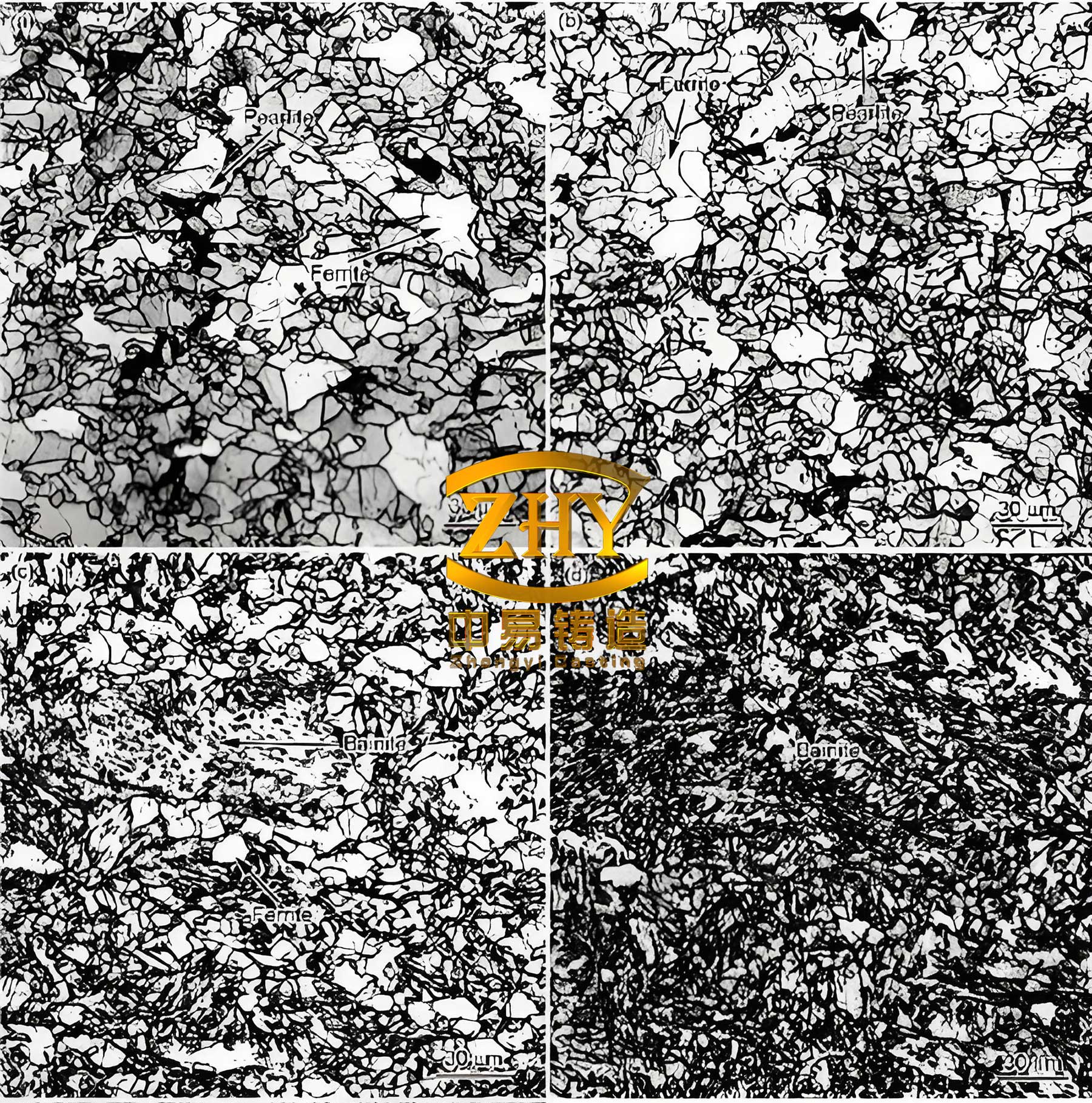
Metallographic examination was conducted on sections from sample #4, which was cut into segments corresponding to different depths: 0 mm, 30 mm, 70 mm, 100 mm, and 130 mm. The samples were polished and etched to reveal graphite morphology and matrix structure. Quantitative analysis included measuring graphite nodule count, nodularity, pearlite volume fraction, and pearlite interlamellar spacing. These parameters are critical for understanding the mechanical behavior of spheroidal graphite cast iron. The data were correlated with hardness values to establish structure-property relationships.
The attached test block, with dimensions of 70 mm in height and 52.5 mm in diameter, served as a reference for the base material properties. Its microstructure and mechanical performance were evaluated after normalizing, providing a benchmark for the casting analysis. The results from this test block indicated excellent nodularity and a fully pearlitic matrix, with tensile strength exceeding 960 MPa and hardness around 345 HB. This confirms the efficacy of the normalizing treatment in achieving high-strength spheroidal graphite cast iron.
To quantify the microstructural evolution, we consider theoretical models. For instance, the kinetics of pearlite transformation during cooling can be described by the Avrami equation: $$ X = 1 – \exp(-k t^n) $$ where \( X \) is the transformed fraction, \( k \) is a rate constant, \( t \) is time, and \( n \) is the Avrami exponent. In spheroidal graphite cast iron, the presence of graphite nodules influences nucleation sites, altering transformation dynamics. Additionally, the relationship between hardness and pearlite interlamellar spacing \( S \) is often expressed as: $$ H = H_0 + \frac{K}{\sqrt{S}} $$ where \( H \) is hardness, \( H_0 \) is a base hardness, and \( K \) is a material constant. This formula highlights how finer pearlite, with smaller \( S \), leads to higher hardness, which is relevant for assessing depth-dependent variations.
| Depth (mm) | Graphite Morphology | Nodularity (%) | Graphite Nodule Count (per mm²) | Matrix Structure | Hardness (HB) |
|---|---|---|---|---|---|
| 0 | 85% VI + 15% V | 100 | 144 | Fine Pearlite | 337 |
| 30 | 84% VI + 12% V | 96 | 64 | Fine Pearlite | 325 |
| 70 | 60% VI + 34% V | 94 | 31 | Fine Pearlite | 315 |
| 100 | 55% VI + 37% V | 92 | 29 | Coarse Pearlite | 300 |
| 130 | 50% VI + 36% V | 86 | 16 | Coarse Pearlite | 290 |
The hardness results from the inner ring, with a wall thickness of 175 mm, revealed minimal variation across depths. As shown in the data, the hardness ranged from 347 HB at the surface to 326 HB at 100 mm depth, with deviations within 10 HB for individual positions. This uniformity suggests that the cooling rate during normalizing was well-controlled, leading to consistent transformation throughout the section. Position #1, adjacent to a thick rib, exhibited slightly lower hardness due to slower cooling, but the effect was marginal. This indicates that for moderate wall thicknesses, normalizing can effectively homogenize properties in spheroidal graphite cast iron.
In contrast, the outer face, with a wall thickness of 253 mm, showed more pronounced hardness gradients. At the surface, hardness values varied from 307 HB to 337 HB, a spread of 30 HB, attributed to local cooling differences. At 30 mm depth, the range narrowed to 25 HB, and at 70 mm depth, it remained at 25 HB, indicating good uniformity within each depth layer. However, for individual samples, hardness decreased with depth: sample #4, behind a thick rib (effective wall thickness 410 mm), showed a drop of 56 HB from surface to core, while samples #5 and #6 had smaller decreases of 12 HB and 22 HB, respectively. This underscores the influence of wall thickness on cooling dynamics; thicker sections experience slower cooling, leading to coarser microstructures and lower hardness. Nonetheless, the overall variation is not excessive, demonstrating that normalizing can manage gradients even in heavy-section spheroidal graphite cast iron.
The microstructural analysis provides deeper insights. Graphite morphology, a key factor in spheroidal graphite cast iron performance, evolved with depth. At the surface, graphite nodules were spherical and numerous, with high nodularity. As depth increased, the nodule count decreased significantly, from 144 per mm² at the surface to 16 per mm² at 130 mm depth. Graphite showed a tendency to become irregular or “exploded,” but remained within acceptable grades (II to III per standards). This degradation is due to slower solidification and cooling rates in the core, which reduce nucleation sites and promote graphite growth in unfavorable directions. Despite this, the spheroidal graphite cast iron maintained adequate nodularity, ensuring good mechanical integrity.
Pearlite volume fraction remained consistently high (>98%) across all depths, indicating complete austenitization and transformation. However, pearlite interlamellar spacing increased with depth. At the surface, fine pearlite with spacing below 1 μm was observed, whereas at 100 mm depth, spacing exceeded 2 μm, classifying it as coarse pearlite. This coarsening directly correlates with hardness reduction, as per the formula \( H = H_0 + K/\sqrt{S} \). Using experimental data, we can estimate constants: for surface hardness of 337 HB and spacing \( S \approx 0.8 \mu m \), and core hardness of 290 HB with \( S \approx 2.5 \mu m \), the relationship holds, confirming that hardness in spheroidal graphite cast iron is inversely proportional to the square root of interlamellar spacing.
To further analyze the thermal profiles during normalizing, we model heat transfer using Fourier’s law. For a one-dimensional slab of thickness \( L \), the temperature distribution \( T(x,t) \) can be approximated by: $$ \frac{\partial T}{\partial t} = \alpha \frac{\partial^2 T}{\partial x^2} $$ where \( \alpha \) is thermal diffusivity. For spheroidal graphite cast iron, \( \alpha \) depends on composition and microstructure. Solving this with boundary conditions of convective cooling at surfaces yields cooling rate variations with depth. The cooling rate \( \dot{T} \) affects pearlite transformation kinetics; slower rates at deeper depths lead to coarser pearlite. This theoretical framework supports our experimental observations.
| Position | Wall Thickness (mm) | Hardness at Surface (HB) | Hardness at Core (HB) | Hardness Deviation (HB) |
|---|---|---|---|---|
| Inner Ring #1 | 175 | 340 | 330 | 10 |
| Inner Ring #2 | 175 | 347 | 338 | 9 |
| Outer Face #4 | 253 (effective 410) | 337 | 281 | 56 |
| Outer Face #5 | 253 | 307 | 295 | 12 |
| Outer Face #6 | 253 | 332 | 310 | 22 |
The uniformity of hardness within same-depth layers across different positions is noteworthy. For example, at 30 mm depth, hardness values clustered around 320 HB, with a standard deviation of less than 10 HB. This suggests that normalizing effectively mitigates local geometric effects, promoting consistent transformation behavior. In spheroidal graphite cast iron, this is crucial for components subject to multi-axial loading, where property gradients could lead to stress concentrations and premature failure.
Another aspect is the role of alloying elements in spheroidal graphite cast iron. While this study used a standard composition, elements like molybdenum, nickel, or copper can enhance hardenability, reducing depth-dependent variations. The normalizing response can be optimized by adjusting austenitizing temperature and cooling rate. For instance, a higher austenitizing temperature might increase solutionizing but risk graphite dissolution, while controlled air cooling with fans can accelerate surface cooling. Future work could explore these parameters for heavy-section spheroidal graphite cast iron.
The economic implications are significant. Spheroidal graphite cast iron offers cost savings over steel, especially for large castings, but requires precise heat treatment to achieve performance targets. Our findings show that normalizing, a relatively simple process, can yield uniform properties in sections up to 250 mm thick, minimizing the need for additional treatments like quenching or alloying. This makes spheroidal graphite cast iron even more attractive for industrial applications.
In summary, this investigation into heavy-section spheroidal graphite cast iron after normalizing reveals that hardness variations across depths are manageable, with deviations typically within 25 HB for most locations. Graphite morphology degrades slightly toward the core, but remains within specification, while pearlite coarsening is the primary driver of hardness reduction. The mathematical models presented help quantify these relationships, providing tools for process optimization. We conclude that normalizing is an effective heat treatment for spheroidal graphite cast iron components with wall thicknesses around 250 mm, ensuring satisfactory microstructure and hardness uniformity. This reinforces the viability of spheroidal graphite cast iron for demanding heavy-section applications, leveraging its inherent advantages of strength, durability, and cost-efficiency.
Further research could extend to even thicker sections or alternative heat treatment cycles, such as austempering for austempered spheroidal graphite cast iron (ADI), which might offer improved toughness. Additionally, in-situ monitoring during normalizing, using thermocouples or simulation software, could refine cooling strategies. The principles elucidated here for spheroidal graphite cast iron contribute to the broader knowledge base in materials science, supporting advancements in casting technology. As industries push for larger and more robust components, understanding and controlling microstructure-property gradients in spheroidal graphite cast iron will remain a key endeavor.