
In my extensive experience within the manganese steel casting foundry industry, I have consistently observed that the quality of high manganese steel castings is profoundly influenced by the smelting process, particularly in terms of non-metallic inclusion formation. Inclusions act as stress concentrators and crack initiation sites, severely compromising mechanical properties, wear resistance, and overall service life of components like crusher liners, mill hammers, and railway crossings. This article, based on practical investigations and metallurgical principles, details a comprehensive smelting methodology for high manganese steel aimed at controlling inclusion morphology and size, thereby enhancing metallurgical quality, reducing rejection rates, and lowering production costs. The focus is on techniques applicable to medium-frequency induction furnace operations, which are prevalent in many manganese steel casting foundries.
The core challenge in a manganese steel casting foundry is to balance efficient melting with precise control over deoxidation and alloying to minimize oxide and silicate inclusions. The standard ZGMn13 or Hadfield steel, typically containing 1.0–1.4% C and 11–14% Mn, is notoriously prone to oxidation during melting. Traditional practices often overlook the sequence of operations, leading to excessive inclusion generation. The following sections elaborate on a refined process flow that has yielded significant improvements in our manganese steel casting foundry operations.
Fundamentals of Inclusion Formation in High Manganese Steel
Inclusions in steel primarily originate from deoxidation products, slag entrapment, and re-oxidation during pouring. For high manganese steel, the high affinity of manganese for oxygen is a critical factor. The reaction can be represented as:
$$ [Mn] + [O] \rightleftharpoons (MnO) $$
where [Mn] and [O] denote dissolved manganese and oxygen in the steel melt, and (MnO) represents manganese oxide in the slag or as an inclusion. The equilibrium constant \( K_{Mn-O} \) is temperature-dependent:
$$ K_{Mn-O} = \frac{a_{MnO}}{a_{[Mn]} \cdot a_{[O]}} $$
where \( a \) represents activity. At lower melt temperatures common during the early stages of melting, the equilibrium favors the formation of (MnO), leading to a high concentration of MnO-rich inclusions if the melt is insufficiently protected or deoxidized. This thermodynamic principle guides our process modifications in the manganese steel casting foundry.
Medium-Frequency Induction Furnace Melting Process
Our manganese steel casting foundry employs a GW-1-500J medium-frequency coreless induction furnace. This equipment is chosen for its rapid melting, excellent electromagnetic stirring action promoting homogeneity, and relative ease of operation suitable for batch production of castings. The process is based on the precipitation deoxidation method, chosen over diffusion or comprehensive deoxidation for its simplicity, lower cost, and shorter process time, aligning with the operational needs of many manganese steel casting foundries.
The process sequence is meticulously designed. The table below summarizes the key stages and their objectives in our manganese steel casting foundry practice:
| Process Stage | Key Operations | Primary Objective | Impact on Inclusions |
|---|---|---|---|
| Charging & Initial Melting | Layering lime at furnace bottom; charging scrap steel & returns. | Early slag formation for protection. | Prevents atmospheric oxidation; initial slag captures early oxides. |
| Melting & Slag Control | Maintaining a lime-fluorite slag cover; adjusting viscosity. | Continuous melt protection and thermal insulation. | Minimizes oxygen pickup; slag acts as a sink for floating inclusions. |
| Pre-deoxidation | Addition of high-carbon ferromanganese at ~1620°C. | Bulk oxygen removal before final alloying. | Lowers FeO content, reducing Mn oxidation later; generates CO for flotation. |
| Manganese Alloying | Addition of primary FeMn alloy in batches after pre-deoxidation. | Introducing 11-14% Mn with minimal loss. | Avoids massive MnO formation; higher Mn yield reduces exogenous inclusions. |
| Final (Killing) Deoxidation | Addition of aluminum wire or shot before tapping. | Deep deoxidation to very low oxygen activity. | Forms fine Al2O3 clusters that can float out; prevents re-oxidation. |
| Tapping & Teeming | Tapping at 1480-1500°C; ladle holding for 3-5 min; pouring at 1430-1450°C. | Allowing inclusions to float; controlled pouring. | Promotes separation of deoxidation products; minimizes slag entrainment. |
Detailed Process Rationale and Control
1. Slag Covering and Protection
A persistent issue in many manganese steel casting foundries is the neglect of effective slag cover, with excessive focus merely on chemical composition. From the moment charging begins, we ensure a protective slag layer. Approximately 1% of the metallic charge weight of high-quality lime (CaO) is placed at the furnace bottom. As melting proceeds, this forms a basic slag that covers the molten metal surface, acting as a barrier against oxygen and nitrogen from the atmosphere. The slag also provides thermal insulation, improving energy efficiency. To adjust the slag’s melting point and fluidity, fluorspar (CaF2) is added intermittently in a CaO:CaF2 ratio between 4:1 and 5:1. A fluid, basic slag is essential for effective inclusion absorption. The reaction capacity of the slag for inclusions like Al2O3 can be related to its basicity index \( B \):
$$ B = \frac{\%CaO}{\%SiO_2} $$
We maintain \( B > 2.5 \) to ensure good sulfide capacity and oxide dissolution. The importance of this continuous protection cannot be overstated for any manganese steel casting foundry aiming for consistent quality.
2. The Critical Sequence: Pre-deoxidation Before Manganese Alloying
Conventional “remelting” practice often involves charging ferromanganese with the scrap. We have found this detrimental. As per the thermodynamic principle shown earlier, adding manganese when the bath oxygen activity is high (during initial melting) leads to substantial oxidation loss and generates copious MnO-SiO2-type inclusions. Our data, collected over numerous heats in our manganese steel casting foundry, clearly demonstrates the advantage of delayed manganese addition:
| Ferromanganese Addition Timing | Approximate Mn Recovery (%) | Typical Inclusion Index (ASTM E45 Method A) | Remarks |
|---|---|---|---|
| Charged with scrap (early addition) | 88 – 91 | Thin Series: 4-5 Heavy Series: 3-4 |
High MnO content; larger, more numerous globular oxides. |
| Added after pre-deoxidation (late addition) | 94 – 96 | Thin Series: 2-3 Heavy Series: 1-2 |
Inclusions smaller, fewer; primarily fine aluminates. |
Therefore, the alloying ferromanganese (FeMn75C7.5) is added only after a pre-deoxidation step has significantly lowered the oxygen potential of the melt. The alloy is preheated to above 750°C to avoid excessive temperature drop and added in batches of 50-100 mm size. Each batch is stirred into the melt and allowed to dissolve fully before the next addition, preventing localized “freezing” and sedimentation.
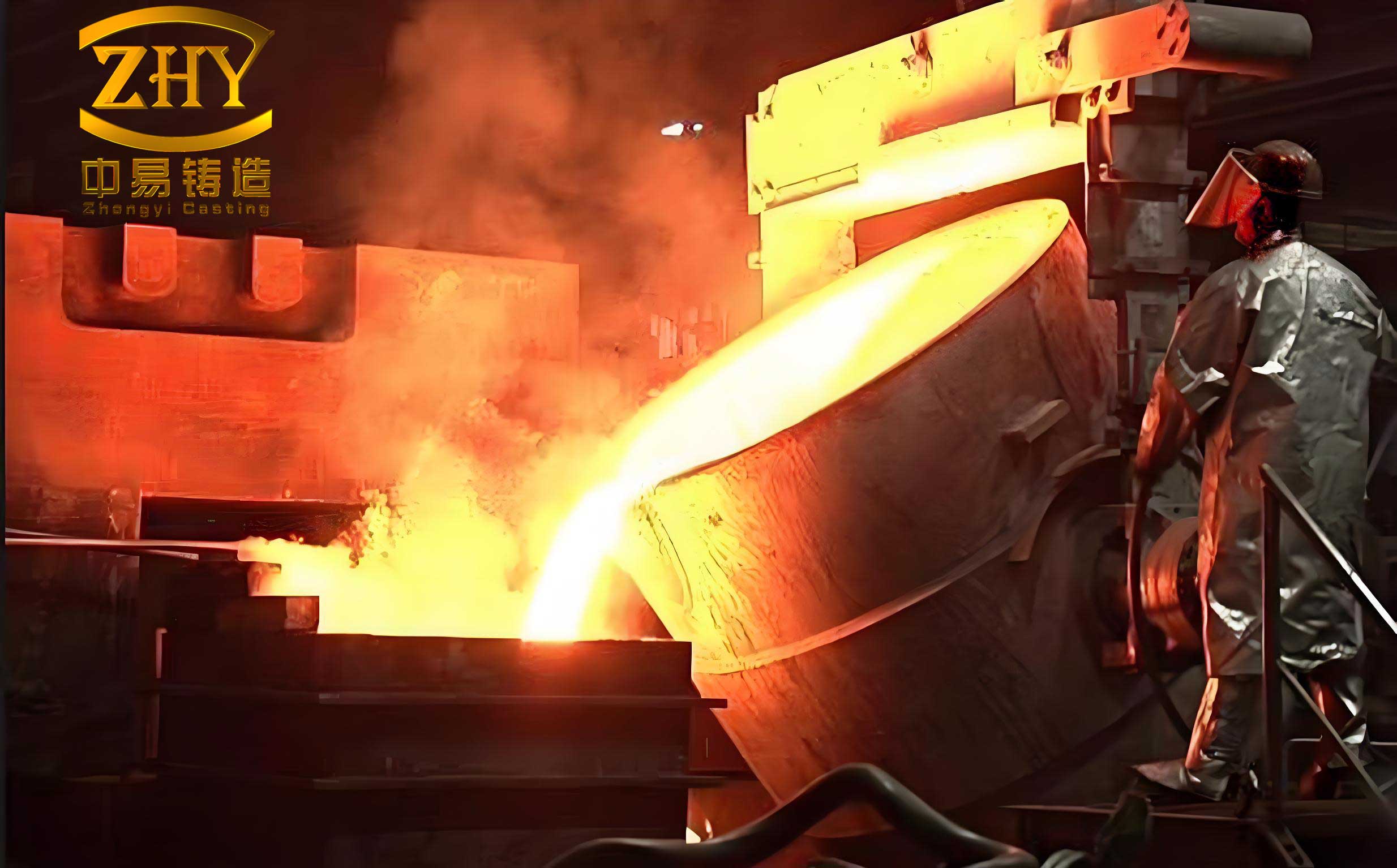
3. Optimized Deoxidation Practice
Deoxidation is the heart of inclusion control in a manganese steel casting foundry. We employ a two-stage approach: pre-deoxidation and final deoxidation.
Pre-deoxidation: This is performed immediately after the charge is fully molten and the temperature reaches approximately 1610-1640°C. We use high-carbon ferromanganese (FeMn75C7.5) at an addition rate of about 1.0% of the melt weight. Carbon, a strong deoxidizer, complements manganese’s weaker deoxidizing power. The combined reaction is more effective:
$$ [C] + [O] \rightleftharpoons {CO}_{(g)} $$
$$ [Mn] + [O] \rightleftharpoons (MnO) $$
The gaseous CO product aids inclusion flotation. This step rapidly lowers the dissolved oxygen content, creating a favorable environment for the subsequent addition of the bulk manganese alloy without excessive oxidation.
Final Deoxidation (Killing): After temperature and composition adjustments, a strong deoxidizer is added just before tapping to achieve very low residual oxygen. Aluminum is the preferred choice due to its high affinity for oxygen:
$$ 2[Al] + 3[O] \rightleftharpoons (Al_2O_3) $$
The equilibrium constant \( K_{Al} \) is very high, ensuring deep deoxidation. The amount used is critical; excess aluminum can lead to coarse alumina clusters or promote carbide formation. We use 0.15-0.20% of the tap weight, slightly higher than typical practice for killed steels, to compensate for the less “perfect” nature of precipitation deoxidation compared to diffusion methods. The formed Al2O3 particles are initially finely dispersed but coalesce and float into the slag during the subsequent holding period.
The effectiveness of a deoxidizer can be compared using the solubility product. For element M forming oxide MxOy:
$$ [M]^x[O]^y = K_{M}(T) $$
At 1600°C, the approximate values of \( K \) are: \( K_{C} \approx 0.002 \), \( K_{Mn} \approx 0.05 \), \( K_{Al} \approx 4 \times 10^{-14} \). This clearly shows why aluminum is necessary for final deep deoxidation in the manganese steel casting foundry process.
4. The Role of Melt Holding and Pouring
After final deoxidation and tapping into the ladle, we enforce a mandatory holding time of 3 to 5 minutes. This quiet period is crucial for inclusion flotation, governed by Stokes’ law. The terminal rising velocity \( v \) of a spherical inclusion is given by:
$$ v = \frac{2 g (\rho_{steel} – \rho_{inclusion}) r^2}{9 \eta} $$
where \( g \) is gravity, \( \rho \) denotes density, \( r \) is the inclusion radius, and \( \eta \) is the melt viscosity. For typical Al2O3 inclusions (\( \rho \approx 3.97 \, g/cm^3 \)) in steel (\( \rho \approx 7.0 \, g/cm^3 \), \( \eta \approx 0.005 \, Pa \cdot s \) at 1500°C), an inclusion of radius 10 µm will rise approximately 15 cm in 3 minutes. This demonstrates the importance of both time and inclusion size. Holding allows smaller clusters to agglomerate into larger ones that rise faster. Pouring is conducted calmly to avoid turbulence and re-entrainment of slag or inclusions from the ladle lining.
Quality Assessment and Operational Results in the Manganese Steel Casting Foundry
Implementation of this integrated process has led to measurable improvements. Test coupons are cast along with production pieces and evaluated according to standard specifications for high manganese steel castings. Macro-inclusion rating and micro-cleanliness are assessed.
The most significant evidence comes from inclusion rating. Following the aforementioned process, independent evaluation by a national metallurgical laboratory consistently shows inclusion levels not exceeding the following thresholds, a marked improvement over previous practices:
| Inclusion Type | ASTM Rating (Worst Field Observed) | Typical Rating Achieved |
|---|---|---|
| Sulfide (Type A) | 4 | 2 – 3 |
| Alumina (Type B) | 4 | 1 – 2 |
| Silicates (Type C) | 3 | 1 – 2 |
| Globular Oxides (Type D) | 3 | 1 – 2 |
The reduction in inclusions, particularly the hard, brittle alumina and globular oxides, has a direct impact on mechanical integrity. Rejection rates due to cracking during heat treatment (water toughening) or in service have dropped significantly. The improved metallurgical quality translates directly to performance in demanding applications.
A compelling case study involved the production of liner plates for MQG3600×4000 wet grate ball mills in a major mineral processing plant. Our manganese steel casting foundry supplied components for six such mills. Operational data over an extended period showed that the specific consumption (wear loss) of our high manganese steel castings was 76 grams per ton of processed ore. Competing suppliers for similar equipment in the same plant recorded specific consumptions of 83, 88, and 93 g/t, respectively. This 8-18% reduction in wear rate is a direct testament to the superior integrity and work-hardening capability of steel produced with lower inclusion content. For any manganese steel casting foundry, such performance metrics are the ultimate validation of process efficacy.
Economic and Practical Implications for Manganese Steel Casting Foundries
Adopting these process refinements involves minimal capital investment but requires disciplined operational control. The economic benefits are multifold:
- Higher Alloy Yield: The 5% increase in manganese recovery directly reduces ferroalloy costs.
- Reduced Rejection and Rework: Lower inclusion levels mean fewer castings scrapped due to cracks detected by non-destructive testing or failures in service, saving on melting, cleaning, and inspection costs.
- Enhanced Product Reputation: Consistent delivery of high-integrity castings strengthens market position for the manganese steel casting foundry.
- Energy Efficiency: The protective slag cover reduces radiant heat loss, and the faster, more predictable process reduces overall furnace on-time.
The practices are entirely feasible for small to medium-sized foundries. They align with the inherent characteristics of medium-frequency induction melting—good controllability, batch processing, and the absence of external refining gases—making them ideal for the manganese steel casting foundry sector.
Conclusion
In conclusion, the metallurgical quality of high manganese steel, as produced in a typical manganese steel casting foundry, is not solely determined by its final chemical composition. It is a direct function of the smelting process dynamics, especially the control of oxidation and deoxidation sequences. By instituting a rigorous protocol involving continuous slag protection, strategic sequencing of pre-deoxidation with high-carbon ferromanganese prior to manganese alloying, forceful final deoxidation with aluminum, and adequate melt holding, the population and size of detrimental non-metallic inclusions can be significantly reduced. This integrated approach, grounded in fundamental metallurgical thermodynamics and kinetics, has proven effective in elevating inclusion ratings, eliminating crack-related defects, and enhancing the in-service wear performance of cast components. For any manganese steel casting foundry seeking to improve product consistency, reliability, and cost-effectiveness, mastery and meticulous application of these smelting techniques are indispensable. The process underscores that in modern foundry practice, attention to the journey of the melt—from charge to pour—is as critical as the specification of its destination.