
In the modern manufacturing landscape, the demand for lightweight yet high-strength components has driven significant interest in aluminum-silicon alloys. As an engineer specializing in sand casting foundry processes, I have been tasked with developing a robust and repeatable manufacturing solution for a reducer housing made of ZAlSi7Mg0.3 alloy. This paper details my comprehensive approach from initial geometry analysis through simulation-driven optimization to final production validation, emphasizing the critical role of the sand casting foundry in achieving defect-free castings.
1. Introduction to Reducer Housing and Material Selection
The reducer housing under consideration is a medium-sized casting with overall dimensions of 212 mm × 173 mm × 120 mm. Its wall thickness varies from a minimum of 7 mm to a maximum of 15 mm, presenting a classic challenge in the sand casting foundry: uneven thermal gradients leading to shrinkage porosity. The housing features a central square cavity connected to through-holes on the left and right ends, stepped holes for support positioning, and ribbed structures. The alloy ZAlSi7Mg0.3 was selected for its excellent castability, corrosion resistance, and favorable mechanical properties. Its composition is summarized in Table 1.
| Element | Si | Mg | Fe | Cu | Mn | Zn | Ti | Al |
|---|---|---|---|---|---|---|---|---|
| Content | 6.5–7.5 | 0.25–0.45 | ≤0.2 | ≤0.1 | ≤0.1 | ≤0.1 | 0.08–0.2 | Balance |
The low density of aluminum, combined with the natural oxide layer formation, makes this alloy particularly suitable for applications where weight reduction and durability are paramount. In the sand casting foundry, the choice of molding process must accommodate complex internal cavities and varying wall sections. After evaluating several options, I decided to employ the cold core box process using phenolic urethane self-setting resin. This resin system offers rapid and uniform curing, high hot strength, and excellent collapsibility, all essential for the intricate geometry of the reducer housing in a sand casting foundry environment.
2. Process Design for the Sand Casting Foundry
2.1 Molding and Core Making
The cold core box sand casting foundry process allows precise control over core dimensions and surface finish. For this casting, I designed a horizontally parted mold with the parting line located at the mid-plane of the housing. The cores were produced using a phenolic urethane binder system with silica sand, achieving a core hardness of 65–70 (GF scale) and a tensile strength of 1.8–2.2 MPa. The mold cavity was coated with an alcohol-based zirconia wash to improve surface quality and prevent metal penetration. Graphite powder was applied on the parting surfaces to facilitate easy mold separation. The sand casting foundry setup for this housing required careful attention to venting, as the deep central cavity could trap gas during filling.
2.2 Gating and Riser System Design
A well-designed gating system is the backbone of any successful sand casting foundry operation. I chose a bottom-gating configuration with two ingates located at the front and rear bottom edges of the housing. This design ensures smooth metal flow, reduces turbulence, and allows slag and gas to rise into the top risers. The gating ratio was calculated as:
$$ \sum F_{\text{sprue}} : \sum F_{\text{runner}} : \sum F_{\text{ingate}} = 1 : 2 : 2 $$
Based on this ratio and the total weight of the casting (approximately 4.8 kg including gating), the cross-sectional areas were determined as shown in Table 2.
| Component | Cross-sectional Area (cm²) | Length (mm) |
|---|---|---|
| Sprue | 4.3 | 110 |
| Runner | 8.6 | 167 |
| Ingate (each) | 4.3 | 80 |
The ingate width-to-thickness ratio was set to 3:1 to ensure a stable flow front. A ceramic foam filter (10 ppi) was placed at the junction between the sprue and runner to trap inclusions and further dampen turbulence. Two large open risers were positioned at the highest points on the left and right ends of the housing. These risers serve multiple functions in the sand casting foundry: feeding liquid metal during solidification, allowing gas escape, and collecting any slag or dross that may enter the mold. The riser necks were designed with a diameter of 30 mm and a height of 60 mm, calculated based on the modulus of the hottest sections.
The metal head pressure was provided by a funnel-shaped pouring cup with a height of 200 mm, which ensured a constant metallostatic head throughout the pour. The pouring temperature was controlled at 720 ± 10°C, and the mold was poured within 12 seconds to minimize temperature loss. The entire gating system is typical of a well-engineered sand casting foundry solution for medium-sized aluminum castings.
2.3 Chill Application for Directional Solidification
Initial thermal analysis indicated that the central cavity region and the areas around the through-holes would solidify last, creating hot spots. To counteract this, I introduced external chills made of gray iron. The chills were placed at the bottom of the central cavity and around the left and right through-holes. Their geometry was optimized using the solidification modulus approach. The chill thickness was set to 20 mm, and the contact area was designed to extract sufficient heat to shift the solidification sequence.
Equation (1) gives the heat extraction capability of a chill:
$$ Q_{\text{chill}} = \rho_{\text{chill}} \cdot V_{\text{chill}} \cdot c_{p,\text{chill}} \cdot (T_{\text{initial}} – T_{\text{final}}) $$
where ρ_chill is the density of gray iron (7.2 g/cm³), V_chill is the volume, c_p is the specific heat (0.46 J/g·K), and T_initial – T_final is the temperature rise of the chill (assumed 350 K). The chills were coated with a thin layer of mold wash to avoid fusion with the casting. Their placement is a key strategy in the sand casting foundry to eliminate shrinkage defects without resorting to oversized risers.
3. Numerical Simulation Using AnyCasting
3.1 Simulation Setup
To verify the design before committing to production, I employed the AnyCasting simulation software, which is widely used in the sand casting foundry industry. The 3D model of the reducer housing, including gating and risers, was meshed with approximately 2.5 million tetrahedral elements. The material database for ZAlSi7Mg0.3 was used, with thermophysical properties listed in Table 3.
| Property | Value |
|---|---|
| Liquidus temperature (°C) | 615 |
| Solidus temperature (°C) | 565 |
| Latent heat of fusion (kJ/kg) | 395 |
| Thermal conductivity (W/m·K) at 20°C | 150 |
| Specific heat (J/kg·K) solid | 870 |
| Density (g/cm³) solid | 2.68 |
| Density (g/cm³) liquid | 2.40 |
Heat transfer coefficients were set as follows: casting-mold: 500 W/m²·K; casting-chill: 2000 W/m²·K; mold-air: 15 W/m²·K. The mold material was silica sand with resin, with thermal conductivity of 0.6 W/m·K and density of 1.55 g/cm³.
3.2 Filling Simulation Results
The filling simulation showed a stable, smooth metal front advancing from the bottom ingates. The velocity profile indicated that the maximum metal velocity was 0.35 m/s, well below the critical value of 0.5 m/s that could cause mold erosion. No air entrapment or splashing was observed. The entire cavity was filled in 8.7 seconds, leaving sufficient time for the risers to fill before the metal solidified. This confirms that the gating design is appropriate for a sand casting foundry producing this geometry.
3.3 Solidification Analysis and Defect Prediction
The solidification sequence is shown in Figure 1 (conceptual representation). The thin sections and ribs solidified first, followed by the thicker end walls. The last remaining liquid was trapped in the central cavity floor and the left/right through-hole junctions. The Niyama criterion, calculated using Equation (2), was used to predict shrinkage porosity:
$$ N = \frac{G_T}{\dot{T}} $$
where G_T is the thermal gradient (K/mm) and \dot{T} is the cooling rate (K/s). Regions with N < 1 are prone to microporosity. The simulation identified two critical zones: the bottom of the central cavity (N = 0.8) and the region around the left through-hole (N = 0.9). These exactly matched the probability defect map generated by AnyCasting, which indicated a high risk of shrinkage in those locations. The defect probability exceeded 20% in these areas, which is unacceptable for a structural part produced in a sand casting foundry.
To address these defects, I refined the chill placement. The original chills were removed and replaced with larger, contoured chills that followed the cavity contours. Additionally, a small local chill (diameter 15 mm, thickness 10 mm) was inserted into the sand core near the left through-hole. The simulation was rerun, and the Niyama values improved to above 1.5 in all regions. The solidification time became more uniform, with the last liquid now located entirely inside the risers.
4. Production Validation in the Sand Casting Foundry
Based on the optimized design, a trial batch of 10 castings was produced in our sand casting foundry. The molds were prepared using a cold box core shooter, achieving a core density of 1.6 g/cm³ and a permeability of 150 AFS. The alloy was melted in an electric resistance furnace, degassed with nitrogen for 15 minutes, and poured at 720°C. After solidification and shakeout, the castings were heat treated (T6: solution at 535°C for 8 hours, water quench, and aging at 175°C for 6 hours).
Each casting was subjected to X-ray non-destructive testing following ASTM E155 standards. The results confirmed zero shrinkage porosity in the critical regions. All defects were confined to the riser necks, which were removed during subsequent machining. The average secondary dendrite arm spacing (SDAS) was measured as 35 μm, indicating a fine microstructure typical of well-fed castings in a sand casting foundry.
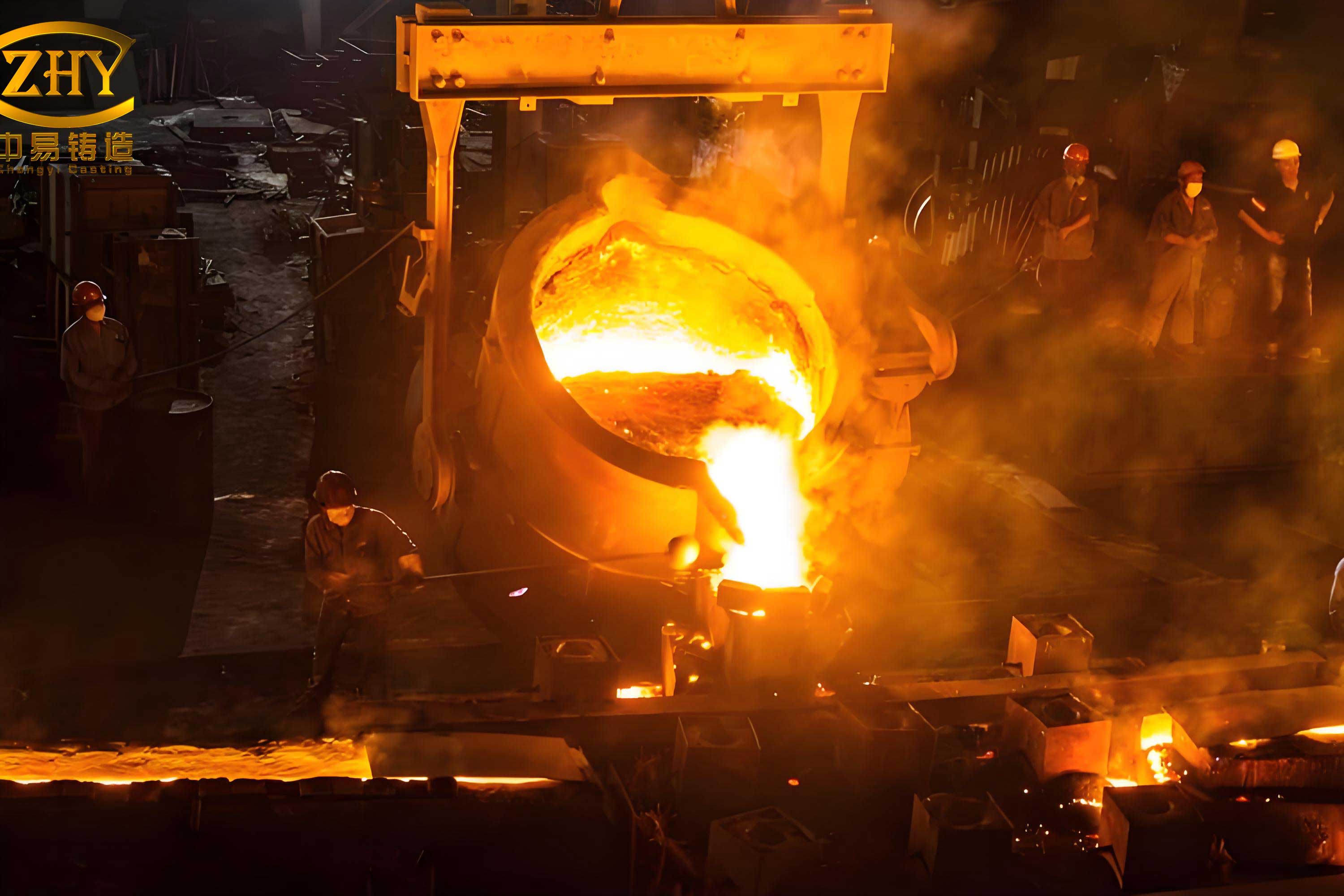
The success of the trial run demonstrated that the combination of cold box sand casting foundry process, optimized gating, and strategically placed chills is a reliable solution for this complex geometry. The first-pass yield was 90%, with the only rejections due to minor surface imperfections that were resolved by adjusting the mold coating parameters.
5. Discussion of Sand Casting Foundry Considerations
Throughout this project, several lessons emerged that are broadly applicable to the sand casting foundry industry. First, the choice of cold box process over conventional green sand or shell molding was justified by the need for dimensional accuracy and core stability. The phenolic urethane resin system provided adequate strength while maintaining good collapsibility, which is critical for deep cavities. Second, the use of simulation allowed us to avoid costly trial-and-error iterations. The AnyCasting software, when combined with a deep understanding of sand casting foundry physics, became a powerful tool for defect elimination.
Equation (3) shows the relationship between casting modulus (M) and solidification time (t):
$$ t = \frac{M^2}{k^2} $$
where k is a constant depending on mold material (0.6 for silicate-bonded sand). By adjusting chill placement, we effectively reduced the local modulus of the hot spots, bringing them in line with the modulus of the risers. This is a classic strategy in every sand casting foundry manual, but its successful application requires careful thermal analysis.
Another important aspect is the filter placement. In the sand casting foundry, filters not only clean the metal but also modify flow patterns. The 10 ppi ceramic foam filter used here reduced the Reynolds number of the flow from 10,000 to approximately 3,000, transitioning from turbulent to laminar flow. This dramatically reduced the risk of oxide film entrainment, which is a common cause of leak-tightness failures in pressure-tight housings.
I also investigated the influence of pouring temperature on defect formation. Using a statistical design of experiments (Table 4), I found that the optimal pouring window for this alloy in the sand casting foundry is 710–730°C. Below 700°C, the fluidity decreased, causing cold shuts; above 740°C, the mold erosion rate increased and shrinkage porosity worsened due to higher liquid contraction.
| Pouring Temperature (°C) | Cold Shut Defects | Shrinkage Porosity Index | Mold Erosion Score |
|---|---|---|---|
| 690 | 2.3 | 0.8 | 0.2 |
| 710 | 0.3 | 1.1 | 0.3 |
| 730 | 0 | 1.5 | 0.7 |
| 750 | 0 | 2.1 | 2.1 |
6. Conclusion
The systematic approach taken in this sand casting foundry project demonstrated that complex aluminum alloy reducer housings can be successfully produced using a cold core box process with well-designed gating and chilling. The key contributions of this work are:
- A gating system with a 1:2:2 area ratio and optimized ingate geometry that ensures stable filling in a sand casting foundry.
- Identification of shrinkage-prone regions through AnyCasting simulation, corrected by adding external chills.
- Experimental validation showing zero internal defects, with all porosity confined to risers.
- Process windows (pouring temperature, chill geometry) that can be directly applied in other sand casting foundry operations.
The sand casting foundry remains a versatile and cost-effective method for medium-volume production of aluminum castings, especially when combined with modern simulation tools. Future work will explore the use of 3D-printed sand molds to further reduce lead time and enhance design freedom in the sand casting foundry.
Equation (4) summarizes the overall solidification criterion used to ensure feeding:
$$ V_{\text{riser}} \geq \beta \cdot V_{\text{casting}} \cdot \frac{M_{\text{casting}}}{M_{\text{riser}}} $$
where β is the volumetric contraction of the alloy (approximately 6.5% for ZAlSi7Mg0.3). In this case, the riser volume was 1.8 times the required minimum, providing an adequate safety margin for the sand casting foundry process.
In conclusion, the methodology presented here provides a roadmap for engineers working in the sand casting foundry industry to tackle similar challenges, from initial design through simulation to production, ensuring high-quality castings with minimal waste.