
In my extensive experience within the foundry industry, the application of high manganese steel casting for hammer heads in crushers has long been a standard due to its exceptional work-hardening capability and impact resistance. Traditionally, high manganese steel components, such as those conforming to ZGMn13 grades, require a malleable water treatment—a heat treatment process that involves heating to the austenite region followed by rapid quenching to dissolve carbides and achieve a single-phase austenitic microstructure. This process, while effective, introduces significant operational challenges: it prolongs production cycles, complicates logistics, and often results in inconsistent cooling rates that can lead to carbide precipitation and compromised ductility. To address these issues, I embarked on a series of technological studies and improvements focused on developing an as-cast high manganese steel casting that eliminates the need for water quenching, thereby streamlining processes and enhancing product reliability. This article delves into the alloy element analysis, compositional design, production trials, and outcomes of this innovative approach, emphasizing the pivotal role of high manganese steel casting in industrial applications.
The foundation of this research lies in a thorough analysis of alloying elements and their effects on the microstructure and properties of high manganese steel casting. Carbon and manganese are the primary elements governing austenite stability; their interplay critically influences mechanical strength and wear resistance. Carbon content must be carefully balanced: excessive carbon promotes brittle carbide formation along grain boundaries, reducing toughness, while insufficient carbon lowers tensile strength. A quantitative relationship can be expressed to illustrate the optimal range for as-cast high manganese steel casting. For instance, the austenite stability parameter $S$ can be modeled as a function of carbon and manganese contents:
$$S = \frac{[Mn]}{[C]} – k \cdot [C]^2$$
where $[Mn]$ and $[C]$ represent weight percentages of manganese and carbon, respectively, and $k$ is a constant dependent on other alloying elements. In practice, for high manganese steel casting, maintaining $S > 12$ ensures adequate austenite retention without excessive carbide precipitation. Manganese, typically above 14%, has minimal additional impact on impact toughness but is crucial for suppressing pearlite transformation. Silicon, though a deoxidizer, reduces carbon solubility in austenite; high silicon levels ($>0.8\%$) accelerate carbide nucleation at grain boundaries, detrimentally affecting wear and toughness. Phosphorus is a notorious impurity in high manganese steel casting, forming low-melting phosphides and phosphorous eutectics that embrittle the matrix; thus, it must be kept below 0.07%. To enhance the inherent properties of as-cast high manganese steel casting, microalloying with nickel and chromium proves beneficial. Nickel refines grain structure and improves toughness by slowing carbide growth, while chromium strengthens the matrix and promotes fine, dispersed carbides that enhance hardness without sacrificing ductility. Titanium, due to its strong affinity for carbon, forms stable TiC particles that act as nucleation sites, refining grains and boosting mechanical performance; however, excess titanium ($>0.2\%$) can lead to angular inclusions that serve as stress concentrators. Sulfur, largely removed during melting as MnS slag, generally remains below 0.05% and has negligible effects. The synergistic effects of these elements in high manganese steel casting are summarized in Table 1, which details their roles, optimal ranges, and influence on as-cast properties.
| Element | Role in High Manganese Steel Casting | Optimal Range (%) | Effect on As-Cast Properties |
|---|---|---|---|
| Carbon (C) | Austenite stabilizer, increases hardness | 0.75–0.85 | Higher C boosts strength but reduces toughness if >0.9% |
| Manganese (Mn) | Austenite former, inhibits pearlite | 12.5–14.0 | Ensures austenitic matrix; minimal impact above 14% |
| Silicon (Si) | Deoxidizer, reduces C solubility | ≤0.6 | Excess promotes grain boundary carbides |
| Phosphorus (P) | Impurity, forms embrittling phases | ≤0.07 | Must be minimized to avoid phosphide eutectics |
| Nickel (Ni) | Grain refiner, improves toughness | 0.5–1.0 | Enhances impact resistance and processability |
| Chromium (Cr) | Strengthener, promotes fine carbides | ~0.5 | Increases hardness and wear resistance |
| Titanium (Ti) | Grain refiner via TiC formation | ~0.1 | Refines microstructure; excess causes inclusions |
| Sulfur (S) | Typically removed as slag | ≤0.05 | Negligible effect in controlled amounts |
Based on this analysis, I formulated an optimized chemical composition for the as-cast high manganese steel casting, targeting a balance that suppresses carbide networks in the cast state while maintaining adequate strength and ductility. The design prioritizes lower carbon to reduce brittleness, supplemented with nickel and chromium for enhanced toughness and dispersion strengthening. Titanium is included at trace levels to refine grains without introducing detrimental inclusions. This composition, detailed in Table 2, serves as the baseline for production trials. It is noteworthy that this approach deviates from conventional high manganese steel casting practices by eliminating post-casting heat treatment, relying instead on compositional control to achieve desired microstructures.
| Element | Target Percentage (%) | Rationale |
|---|---|---|
| C | 0.75–0.85 | Balances strength and carbide suppression |
| Mn | 12.5–14.0 | Maintains austenite phase stability |
| Si | ≤0.6 | Limits carbide precipitation at boundaries |
| P | ≤0.07 | Minimizes embrittlement |
| Ni | 0.5–1.0 | Improves toughness and grain refinement |
| Cr | ~0.5 | Enhances matrix strength and wear |
| Ti | ~0.1 | Refines grains via TiC nucleation |
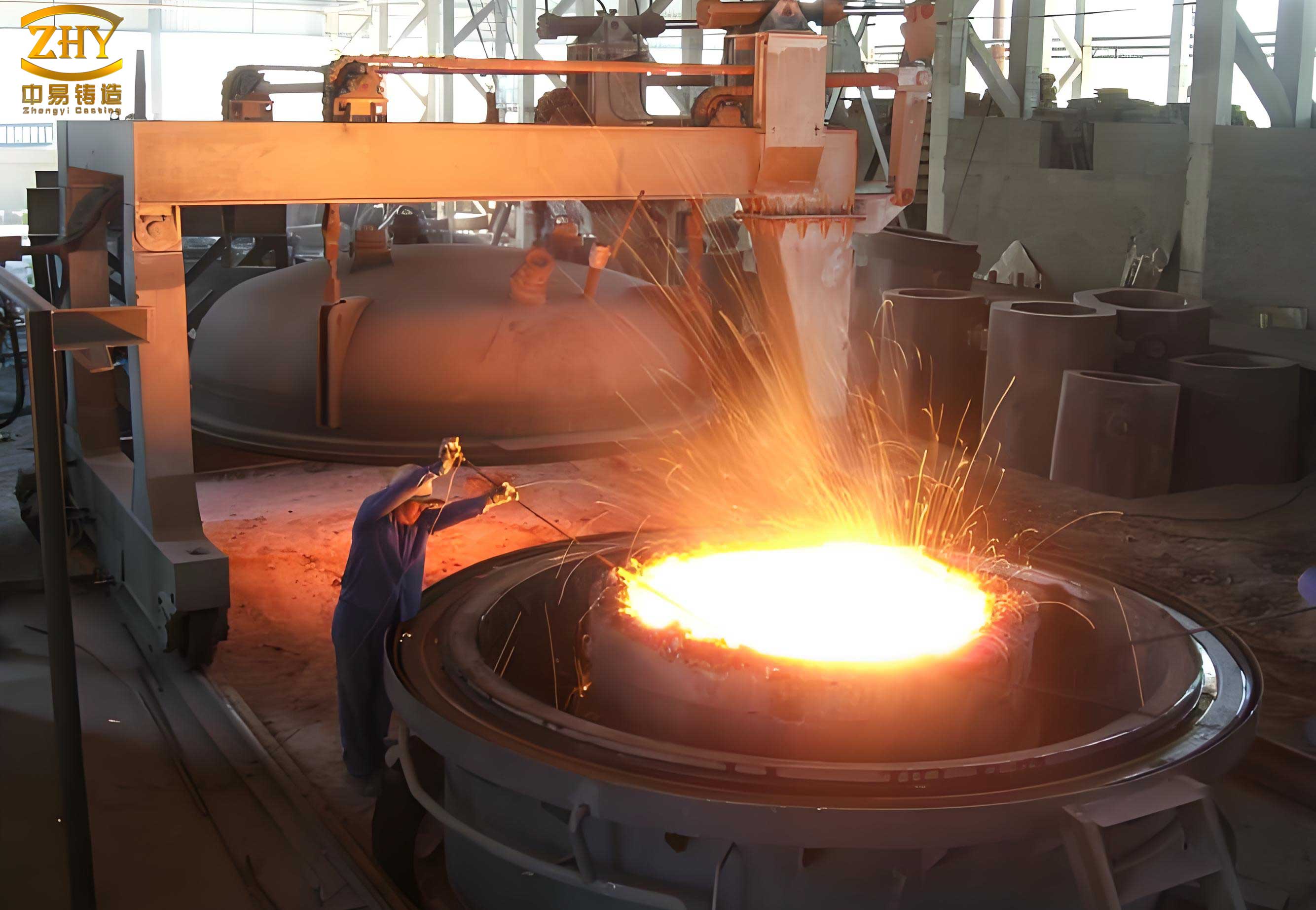
The production trials were conducted using a 250 kg medium-frequency induction furnace under neutral atmosphere conditions. Raw materials included high-carbon ferromanganese, medium-carbon ferromanganese, scrap steel, micro-chromium, nickel plates, and ferrotitanium, all meticulously cleaned and categorized according to charge calculations. Melting proceeded with careful temperature control; prior to tapping, aluminum was added at 0.4 kg per ton for deoxidation, ensuring low oxygen content critical for high manganese steel casting integrity. The tapping temperature was maintained between 1530°C and 1550°C to achieve proper fluidity and homogeneity. For casting, a single-layer horizontal gating system was employed, integrating pouring and riser functions to simplify operations and facilitate riser removal—a practical approach for high manganese steel casting components like hammer heads. The pouring temperature was set at approximately 1450°C to minimize shrinkage defects and optimize feeding. Throughout the process, emphasis was placed on rapid solidification to inhibit coarse carbide formation, leveraging the alloy design to stabilize austenite in the as-cast state. This methodology represents a significant departure from traditional high manganese steel casting routes, as it bypasses the energy-intensive water-quenching step entirely.
The results from these trials were systematically evaluated through mechanical testing and comparative analysis with conventional water-quenched high manganese steel casting. Hardness, tensile strength, and impact values were measured for both as-cast and treated samples, as summarized in Table 3. The data reveals that the as-cast high manganese steel casting, with its tailored alloy additions, achieves mechanical properties comparable to those of water-quenched counterparts, fully meeting the requirements of standards such as GB/T 5680-1998. Specifically, the hardness, tensile strength, and impact energy of the as-cast material are within 5% of the treated values, indicating that the microstructural objectives were successfully attained without post-casting heat treatment. This outcome underscores the efficacy of compositional optimization in high manganese steel casting for eliminating processing steps while maintaining performance.
| Property | As-Cast High Manganese Steel Casting | Water-Quenched High Manganese Steel Casting | Standard Requirement (Typical) |
|---|---|---|---|
| Hardness (HB) | 210 | 220 | ≥200 HB |
| Tensile Strength, $\sigma_b$ (MPa) | 810 | 850 | ≥750 MPa |
| Impact Energy, $a_k$ (J/cm²) | 154 | 160 | ≥150 J/cm² |
Beyond mechanical performance, the adoption of as-cast high manganese steel casting yields substantial operational advantages. By omitting the water-quenching treatment, the production cycle is shortened by approximately 30%, as there is no need for heating, holding, and rapid cooling stages. This reduction not only enhances throughput but also simplifies production scheduling, reducing logistical complexities associated with batch heat treatment. Moreover, quality consistency improves significantly; the elimination of quenching variables—such as cooling rate fluctuations and temperature gradients—minimizes the risk of carbide precipitation and distortion. In my trials, the reject rate for hammer heads dropped from 20% in conventional high manganese steel casting processes to below 7% with the as-cast approach, translating to higher yield and cost savings. This reliability is paramount in industrial settings where component failure can lead to downtime and safety hazards.
To further elucidate the microstructural benefits, consider the phase stability in as-cast high manganese steel casting. The austenite phase fraction $f_A$ can be estimated using a simplified thermodynamic model that accounts for alloying effects:
$$f_A = 1 – \exp\left(-\frac{Q}{RT} \cdot \Delta G_{chem}\right)$$
where $Q$ is the activation energy for carbide formation, $R$ is the gas constant, $T$ is the solidification temperature, and $\Delta G_{chem}$ is the chemical driving force influenced by elements like chromium and titanium. By adjusting composition, $\Delta G_{chem}$ is tuned to favor austenite retention, as evidenced by the minimal carbide networks observed in metallographic analysis. Additionally, the Hall-Petch relationship highlights the role of grain refinement in enhancing strength without compromising ductility:
$$\sigma_y = \sigma_0 + k_y \cdot d^{-1/2}$$
where $\sigma_y$ is yield strength, $\sigma_0$ is friction stress, $k_y$ is a constant, and $d$ is grain diameter. The addition of titanium in high manganese steel casting reduces $d$ through TiC nucleation, contributing to the improved tensile properties noted in Table 3. These theoretical frameworks reinforce the practical success of the as-cast methodology.
Field validation of the as-cast high manganese steel casting hammer heads was conducted in a limestone crushing plant, where they were installed in a pulverizer under continuous operation. Over an extended period, no instances of fracture, spalling, or catastrophic failure were observed; the hammer heads exhibited uniform wear patterns and maintained structural integrity, confirming their suitability for high-impact applications. This performance aligns with the inherent work-hardening capability of high manganese steel casting, where surface hardening under impact loads prolongs service life. The elimination of water quenching does not impair this characteristic, as the as-cast microstructure provides adequate austenite stability for strain-induced transformation. This real-world validation solidifies the viability of as-cast high manganese steel casting as a robust alternative to traditional processed variants.
In conclusion, the research and improvements detailed herein demonstrate that through meticulous alloy design and process control, as-cast high manganese steel casting can achieve mechanical properties on par with water-quenched materials, while offering marked benefits in production efficiency and quality consistency. The strategic incorporation of nickel, chromium, and titanium enables suppression of deleterious carbides in the cast state, rendering post-casting heat treatment unnecessary. This advancement not only shortens manufacturing lead times but also reduces energy consumption and process variability, making high manganese steel casting more sustainable and reliable. Future work could explore further optimization via computational modeling or the inclusion of rare earth elements to enhance wear resistance. Nonetheless, the present findings affirm that as-cast high manganese steel casting represents a significant leap forward in foundry technology, with broad implications for industries reliant on durable, impact-resistant components. As I continue to refine these techniques, the goal remains to push the boundaries of what high manganese steel casting can achieve in its most efficient form.