
In my extensive experience as a foundry engineer specializing in advanced metal casting, I have encountered numerous challenges in producing high-quality castings, particularly in the realm of manganese steel casting foundry operations. The production of high-grade gray iron and high-manganese steel castings demands precise control over metallurgical processes and material selection. This article delves into two critical techniques: secondary inoculation for high-grade gray iron and the use of forsterite sand in high-manganese steel casting foundry applications. Through detailed explanations, tables, and formulas, I aim to share insights that can enhance efficiency and quality in modern foundries, with a focus on the unique demands of manganese steel casting foundry environments.
The foundation of any successful manganese steel casting foundry lies in mastering both ferrous and non-ferrous casting methods. High-grade gray iron, such as HT300, is essential for components like machine tool beds, where strength and wear resistance are paramount. Similarly, high-manganese steel, with its exceptional toughness and work-hardening properties, is indispensable for parts subject to impact and abrasion, such as crusher liners and railway points. However, both materials present specific challenges: gray iron suffers from inoculation fade, while high-manganese steel is prone to chemical burn-on and sand adhesion when traditional silica sand is used. Over the years, I have implemented and refined techniques to address these issues, leading to significant improvements in casting quality and operational efficiency.
Let me begin by discussing secondary inoculation for high-grade gray iron. Inoculation is a process where small amounts of additives, such as ferrosilicon, are introduced into molten iron to promote graphite formation, reduce chilling tendencies, and enhance mechanical properties. However, a common phenomenon known as inoculation fade occurs, where the effectiveness of the inoculant diminishes over time due to factors like oxidation and dissolution. This fade can lead to inconsistent casting properties, especially in high-production settings where delays between inoculation and pouring are inevitable. In a manganese steel casting foundry, where multiple alloys are often handled, maintaining strict timelines for gray iron can be challenging.
To combat inoculation fade, I have adopted secondary inoculation as a standard practice. The primary inoculation is performed at the furnace spout during tapping, typically using 75Si-Fe inoculant at 0.5% of the iron weight. The molten iron is then transferred to a ladle for pouring. Secondary inoculation involves adding a small additional amount of inoculant just before pouring, either at the ladle lip for large castings or in the pouring ladle for smaller ones. This boosts the graphite nucleation sites right before solidification, counteracting the fade effect. The inoculant for secondary treatment is often in powdered or compacted form, with a size range of 0.30–0.60 mm, added at approximately 0.1% of the iron weight. Preheating the inoculant blocks ensures better dissolution and reduces thermal shock.
The effectiveness of this approach can be modeled using a decay function for inoculation potency. Let \( I(t) \) represent the inoculation effect at time \( t \) after primary inoculation. The fade can be expressed as:
$$ I(t) = I_0 \cdot e^{-kt} $$
where \( I_0 \) is the initial effect immediately after primary inoculation, and \( k \) is the decay constant dependent on factors like temperature and iron composition. Secondary inoculation at time \( t_s \) resets the effect, providing a boost \( I_s \), so the total effect at pouring time \( t_p \) becomes:
$$ I_{\text{total}} = I_0 \cdot e^{-k t_p} + I_s \cdot e^{-k (t_p – t_s)} $$
This ensures that the inoculation level remains within the desired range, even with extended holding times. In practice, for a typical high-grade gray iron like HT300, the target chill width on wedge samples (25 mm × 50 mm) should be 5–7 mm after inoculation, compared to 8–12 mm before inoculation. Secondary inoculation helps maintain this consistently.
To illustrate the material compositions involved, here is a table summarizing the charge makeup and chemical composition for producing HT300 gray iron in a manganese steel casting foundry setting:
| Charge Component | Percentage (%) | Element | Composition Range (%) |
|---|---|---|---|
| Pig Iron | 20–25 | C | 2.9–3.1 |
| Return Scrap | 30–35 | Si (Before Inoculation) | 1.0–1.2 |
| Steel Scrap | 40–45 | Si (After Inoculation) | 1.4–1.6 |
| – | – | Mn | 1.0–1.2 |
| – | – | P | <0.15 |
| – | – | S | <0.12 |
The melting is typically done in a cupola furnace, with tapping temperatures above 1400°C to ensure fluidity and proper inoculation response. After secondary inoculation, the iron is covered with charcoal dust to minimize oxidation and poured promptly. This method has proven effective in producing castings with uniform hardness, improved machinability, and absence of defects like hard spots or shrinkage porosity. In a busy manganese steel casting foundry, where equipment like ladles and cranes are shared across different alloy lines, such practices streamline gray iron production without compromising quality.
Now, shifting focus to high-manganese steel castings, which are a staple in abrasive and impact-resistant applications. High-manganese steel typically contains 13–15% Mn, along with about 1.2% C, and is known for its austenitic structure that work-hardens under deformation. However, a major challenge in producing these castings is chemical sand adhesion, often referred to as burn-on or penetration. This occurs because manganese oxide (MnO) formed during melting reacts with silica (SiO₂) in conventional molding sands to form low-melting-point silicates, which bind the sand to the casting surface. This not only increases cleaning costs but can also degrade the casting surface finish.
In my work at various foundries, including those specializing as a manganese steel casting foundry, I have transitioned to using forsterite sand (also known as olivine sand) as a molding material to overcome this issue. Forsterite sand is derived from magnesium iron silicate minerals and offers superior resistance to MnO attack. It is available in two forms: raw (greenish) and calcined (reddish). Raw forsterite sand is obtained by crushing ore directly, while calcined sand undergoes a high-temperature bake to remove bound water and carbonate impurities. Although calcined sand has better properties, raw sand is often preferred due to lower cost and easier processing in typical foundry conditions.
The key advantage of forsterite sand lies in its chemical composition and physical properties. Below is a table detailing its characteristics:
| Property | Value | Description |
|---|---|---|
| Main Components | MgO: ~46%, SiO₂: ~38% | High magnesium oxide content inhibits reaction with MnO. |
| Density | 3.0–3.2 g/cm³ | Higher than silica sand, providing better mold stability. |
| Refractoriness | 1690–1710°C | Sufficient for high-manganese steel pouring temperatures (~1500°C). |
| Thermal Stability | Low expansion | Reduces risks of veining or casting defects. |
The chemical reaction that causes sand adhesion in silica-based sands can be represented as:
$$ \text{MnO} + \text{SiO}_2 \rightarrow \text{MnSiO}_3 $$
where manganese silicate (MnSiO₃) forms a sticky layer that penetrates the sand mold. Forsterite sand, rich in MgO, does not readily participate in such reactions due to the high stability of magnesium silicates. Instead, it maintains its integrity, leading to easy shakeout and minimal cleaning effort. This is particularly beneficial in a manganese steel casting foundry, where post-casting operations can be labor-intensive.
The production process using forsterite sand is similar to that with silica sand. For molding, I typically use raw forsterite sand with binders such as clay (10% addition with 3% water) or sodium silicate (7% addition). The sand is mixed uniformly, and molds are prepared using standard techniques. The mold surface is coated with a refractory wash based on forsterite powder to further enhance surface finish. After pouring and cooling, the sand readily falls away from the casting, often without the need for vigorous mechanical cleaning. This not only saves time but also preserves the delicate surface of high-manganese steel castings, which are prone to work-hardening and require careful handling.
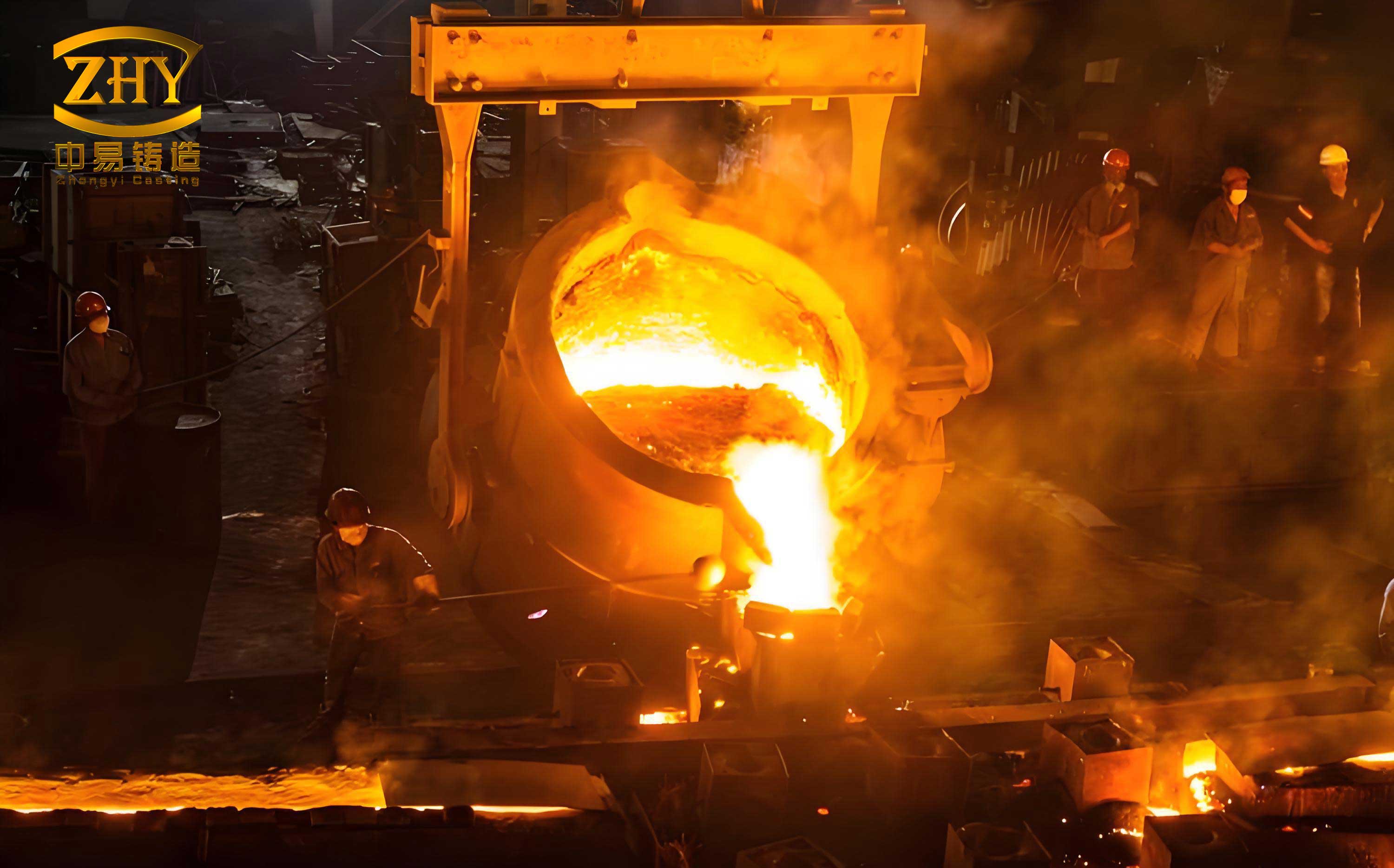
In practice, the benefits of forsterite sand are manifold. First, its high refractoriness and chemical inertness prevent metal penetration, resulting in castings with smooth surfaces and minimal finishing requirements. Second, the sand exhibits good flowability and compactability, making it suitable for complex mold shapes common in manganese steel casting foundry products like crusher jaws or track links. Third, it reduces environmental and health hazards compared to silica sand, which can generate respirable crystalline silica dust. However, it is important to note that forsterite sand has a higher density, which may require adjustments in molding equipment and handling practices.
To quantify the improvements, consider a case study from a manganese steel casting foundry producing wear plates. Using silica sand, the average cleaning time per casting was 2.5 hours, with a scrap rate of 5% due to sand adhesion defects. After switching to forsterite sand, cleaning time reduced to 0.5 hours, and the scrap rate dropped to below 1%. Additionally, the surface roughness improved from an average Ra of 25 µm to 12 µm, enhancing the casting’s performance in service. These gains are critical in competitive foundry markets where efficiency and quality are paramount.
Another aspect I have explored is the integration of these techniques within a holistic foundry management system. In a manganese steel casting foundry, where multiple alloys are processed, scheduling and material handling must be optimized. For instance, secondary inoculation for gray iron can be synchronized with the cooling cycles of high-manganese steel molds to maximize furnace utilization. Similarly, forsterite sand can be recycled with proper reclamation systems, though its higher cost compared to silica sand necessitates careful inventory control. I often use economic models to justify the adoption of such materials. The total cost \( C_{\text{total}} \) per casting can be expressed as:
$$ C_{\text{total}} = C_{\text{material}} + C_{\text{labor}} + C_{\text{energy}} + C_{\text{scrap}} $$
where \( C_{\text{material}} \) includes sand and inoculant costs, \( C_{\text{labor}} \) covers molding and cleaning, \( C_{\text{energy}} \) accounts for melting and baking, and \( C_{\text{scrap}} \) represents losses from defective castings. By reducing \( C_{\text{labor}} \) and \( C_{\text{scrap}} \) through forsterite sand and secondary inoculation, the overall cost often decreases despite higher initial material expenses.
Looking at the metallurgical science behind high-manganese steel, its properties are governed by the austenite phase stability. The classic composition follows the formula for Hadfield steel, with manganese and carbon interacting to suppress martensite formation. The work-hardening behavior can be described using the strain-hardening exponent \( n \) in the Hollomon equation:
$$ \sigma = K \epsilon^n $$
where \( \sigma \) is true stress, \( \epsilon \) is true strain, and \( K \) is a strength coefficient. For high-manganese steel, \( n \) is typically high (around 0.4–0.5), leading to rapid hardening under impact. This makes it ideal for applications in mining and construction, but it also demands precise casting to avoid internal stresses or hot tearing. Using forsterite sand helps maintain uniform cooling rates, reducing thermal gradients that could cause defects.
In conclusion, the techniques of secondary inoculation for gray iron and forsterite sand for high-manganese steel castings represent significant advancements in foundry technology. As a foundry engineer, I have seen firsthand how these methods enhance product quality, reduce waste, and improve operational efficiency. In a modern manganese steel casting foundry, adopting such practices is not just beneficial but often essential to meet the stringent demands of industries like mining, machinery, and transportation. By leveraging detailed process control, backed by data from tables and formulas, foundries can achieve consistent results and maintain competitiveness. The future may bring further innovations, such as automated inoculation systems or engineered synthetic sands, but the principles of understanding material interactions and timing will remain central. I encourage fellow practitioners in the manganese steel casting foundry sector to experiment with these approaches and share insights, as collaboration drives progress in our field.