
As a seasoned professional in the foundry industry, I have dedicated my career to advancing sand casting services through continuous improvement and innovation. Sand casting services are integral to manufacturing complex metal components, offering versatility and cost-effectiveness for a wide range of applications. In this article, I will share my firsthand experiences and insights into optimizing sand casting processes and tooling, emphasizing how these enhancements elevate the quality, efficiency, and reliability of sand casting services. Throughout this discussion, I will repeatedly highlight the critical role of sand casting services in meeting industrial demands, using detailed tables and formulas to summarize key concepts.
My journey began with addressing common challenges in sand casting services, such as shrinkage defects and low yield rates. For instance, in the production of ductile iron gears, traditional methods often relied on overheated risers, which led to variable results. The yield was only 60–70%, and sensitivity to chemical composition fluctuations and pouring temperature instability resulted in a scrap rate of around 30%. This underscored the need for refined sand casting services that prioritize consistency and efficiency.
To overcome these issues, I adopted the equilibrium solidification theory, which leverages the dynamic superposition of contraction and expansion. By adjusting process parameters, we can balance shrinkage and feeding in real-time. This principle guided the redesign of the gating system from an overheated riser to a top-pouring shower-type system. The key parameters are summarized in Table 1.
| Component | Traditional Process (mm) | Improved Process (mm) |
|---|---|---|
| Sprue | Not specified | 75 diameter |
| Runner | Not specified | (55 + 45) × 55 cross-section |
| Ingate | Not specified | 22 × 20 diameter |
| Chills | None | δ=30 thickness applied at critical sections |
| Vents/Risers | Large overheated risers | Small vents (25 mm diameter) and wedge risers (20×80×200 mm) |
This modification eliminated shrinkage porosity at the junction of the rim and spokes, reducing the overall scrap rate to below 3% and increasing the yield to over 90%. The success of this approach hinges on the early graphite expansion, which promotes self-feeding. The equilibrium point can be described by the following formula, where $E$ represents expansion, $S$ denotes shrinkage, and $t$ is time:
$$ \frac{dE}{dt} = k \cdot \frac{dS}{dt} $$
Here, $k$ is a proportionality constant that depends on material properties and cooling rates. By optimizing $k$ through chill placement and gating design, sand casting services achieve superior dimensional stability and reduced defects.
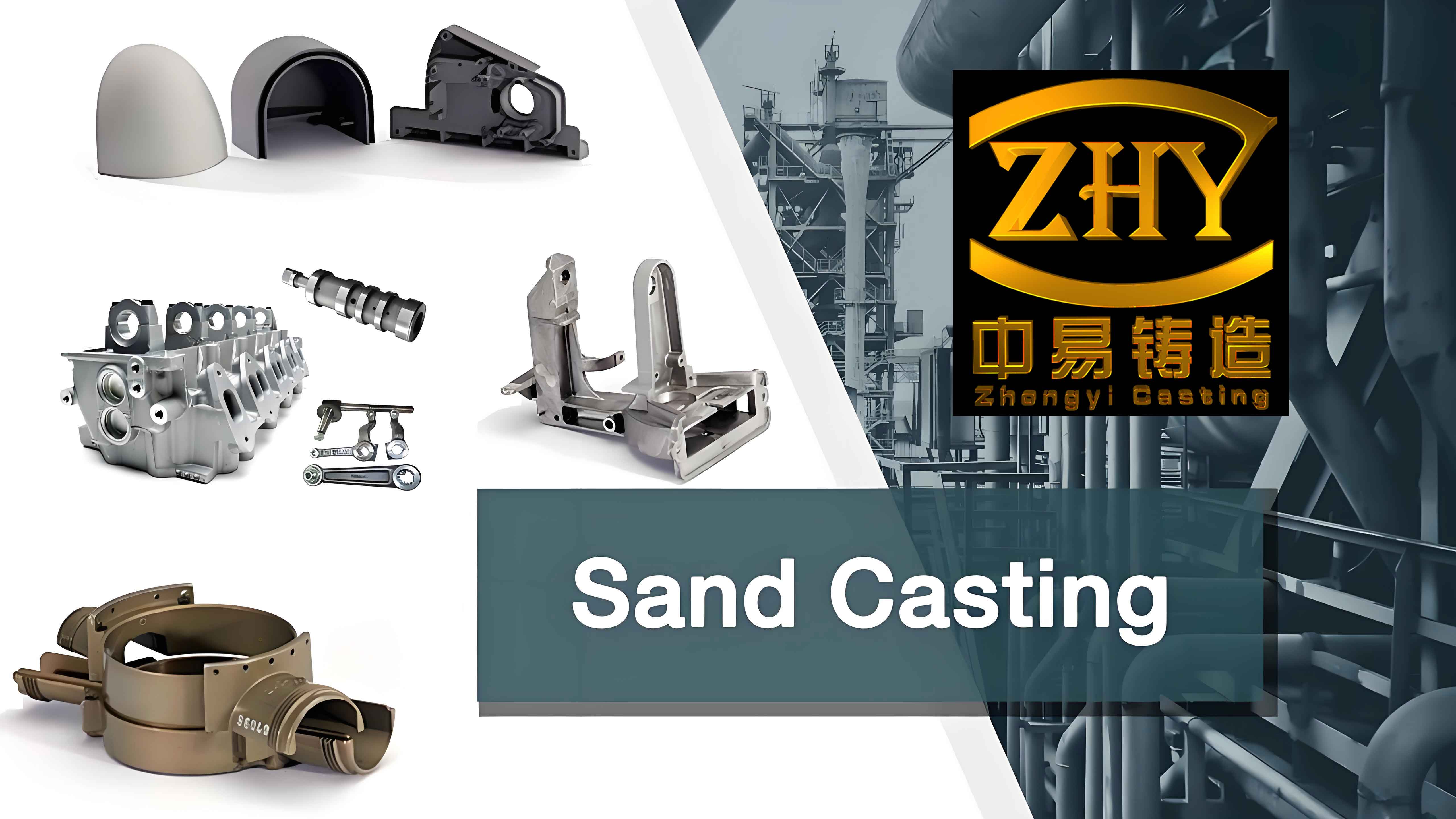
In another project focused on sand casting services for automotive components, I tackled the optimization of core assembly jigs for a model 4115 cylinder block. This complex thin-walled cast iron part required precise tooling to ensure accuracy in sand casting services. The traditional jig designs were often cumbersome and inefficient, so I applied principles from aesthetics, ergonomics, performance theory, and the golden ratio to revamp the structure. The optimized jig, as shown in Table 2, features a welded steel frame with modular components, enhancing both functionality and ease of use.
| Component | Traditional Design | Optimized Design | Benefits for Sand Casting Services |
|---|---|---|---|
| Frame | Cast iron, heavy | Welded steel with cutouts | Reduced weight, improved rigidity, and faster production cycles |
| Main Core Support | Monolithic steel structure | Split HT250 casting | Minimized deformation, enhanced strength, and simplified machining |
| Water Jacket Sliding Support | Bulky with exposed fasteners | Streamlined HT250 with internal bearings | Better aesthetics, reduced material use, and lower energy consumption |
| Locating Pin Sleeves | Complex with large flanges | Simple tubular design | 55% material savings and reduced加工工时 |
| Fasteners | Mixed sizes, external hex | Standardized M6-M16 internal hex screws | Easier maintenance and cleaner appearance |
The golden ratio, approximately 1.618, was used to proportion distances between guide rods and other elements, optimizing the jig’s “specific strength.” This can be expressed mathematically, where $L$ is length and $W$ is width:
$$ \frac{L}{W} \approx \phi = 1.618 $$
By adhering to this ratio, the jig achieves a balance between stability and material efficiency, crucial for high-volume sand casting services. Moreover, the use of standardized components reduces downtime and maintenance costs, further enhancing the reliability of sand casting services.
Beyond specific cases, I have integrated these optimizations into broader sand casting services offerings. For example, the equilibrium solidification theory is not limited to ductile iron but applies to various alloys used in sand casting services. The general formula for solidification time $t_s$ can be derived from Chvorinov’s rule:
$$ t_s = C \cdot \left( \frac{V}{A} \right)^n $$
where $V$ is volume, $A$ is surface area, $C$ is a constant dependent on mold material and metal properties, and $n$ is an exponent typically around 2. By controlling $V/A$ through gating and chilling, sand casting services can predict and manage solidification patterns to minimize defects.
In terms of economic impact, improved sand casting services directly boost profitability. Consider the cost savings from reducing scrap rates and increasing yield. Let $C_p$ be the production cost per unit, $Y$ the yield, and $S$ the scrap rate. The effective cost $C_e$ can be modeled as:
$$ C_e = \frac{C_p}{Y} + S \cdot C_{scrap} $$
where $C_{scrap}$ is the cost associated with scrap handling. For the gear casting example, moving from a 70% yield to 90% yield reduces $C_e$ significantly, demonstrating the value of advanced sand casting services. Table 3 summarizes the financial benefits across different projects.
| Project | Before Optimization | After Optimization | Cost Reduction (%) |
|---|---|---|---|
| Ductile Iron Gear | Yield: 70%, Scrap: 30% | Yield: 90%, Scrap: 3% | Approximately 25% |
| 4115 Cylinder Block Jig | High material and labor costs | Material savings up to 55%, faster assembly | Approximately 20% in tooling costs |
| General Sand Casting Services | Variable quality, high rework rates | Consistent quality, lower defect rates | 15–30% overall efficiency gain |
Furthermore, sand casting services benefit from digital tools and simulation software. For instance, computational fluid dynamics (CFD) models can predict molten metal flow, while finite element analysis (FEA) assesses stress distributions. These tools allow for virtual testing of gating systems and jig designs, reducing trial-and-error in physical sand casting services. The governing equations for fluid flow in sand casting include the Navier-Stokes equations:
$$ \rho \left( \frac{\partial \mathbf{u}}{\partial t} + \mathbf{u} \cdot \nabla \mathbf{u} \right) = -\nabla p + \mu \nabla^2 \mathbf{u} + \mathbf{f} $$
where $\rho$ is density, $\mathbf{u}$ is velocity, $p$ is pressure, $\mu$ is viscosity, and $\mathbf{f}$ represents body forces. By solving these numerically, sand casting services optimize filling sequences to avoid turbulence and air entrapment.
In my practice, I also emphasize sustainability in sand casting services. This involves recycling sand, reducing energy consumption, and minimizing waste. The use of chills and optimized risers not only improves quality but also decreases the amount of metal required, aligning with green manufacturing principles. For example, the mass balance in sand casting can be expressed as:
$$ M_{total} = M_{casting} + M_{risers} + M_{scrap} $$
By minimizing $M_{risers}$ and $M_{scrap}$ through process refinements, sand casting services become more resource-efficient.
Looking ahead, the future of sand casting services lies in automation and smart manufacturing. Integrated sensors in molds and jigs can monitor temperature and pressure in real-time, feeding data into adaptive control systems. This enables predictive maintenance and dynamic adjustments, further enhancing the reliability of sand casting services. The concept of Industry 4.0 can be encapsulated in a formula for overall equipment effectiveness (OEE):
$$ OEE = Availability \times Performance \times Quality $$
For sand casting services, targeting OEE above 85% is achievable through the optimizations discussed, driven by continuous improvement cycles.
In conclusion, my experiences underscore that sand casting services are far from static; they thrive on innovation and meticulous optimization. From adopting equilibrium solidification theory to redesigning tooling with ergonomic principles, every enhancement contributes to higher yields, lower costs, and superior component quality. As the demand for precision castings grows, sand casting services will continue to evolve, leveraging advanced formulas and data-driven approaches. I am committed to pushing these boundaries, ensuring that sand casting services remain a cornerstone of modern manufacturing.
To reiterate, sand casting services encompass a holistic approach that integrates process engineering, tooling design, and economic analysis. By sharing these insights, I hope to inspire further advancements in the field, reinforcing the indispensable role of sand casting services in producing durable and complex metal parts. Whether for automotive, aerospace, or industrial applications, optimized sand casting services deliver unmatched value, and I am proud to contribute to this ongoing journey.