
As global energy reserves decline rapidly amid economic growth, the search for new energy sources has become urgent. In this context, wind power, as an emerging, renewable, and clean energy source, has seen widespread application. Wind energy not only alleviates energy crises but also brings economic benefits, leading to its vigorous development in many regions. Wind power equipment primarily consists of components such as the rotor, gearbox, base, and bearing housing. The rotor, comprising blades and a hub, is critical, with the hub enduring complex forces and moments generated during blade rotation. Consequently, the hub plays a pivotal role in wind power generation. Due to its intricate geometry, significant wall thickness, and stringent quality requirements—including freedom from defects like shrinkage porosity, cracks, gas holes, and slag inclusions through UT and MT inspections—its manufacturing is challenging. Moreover, domestic research on riserless casting is limited. Therefore, studying riserless casting processes for hubs holds substantial practical value. In this study, I explore the design and optimization of riserless sand casting for a large 3.5 MW wind power hub using QT500-14 ductile iron, leveraging numerical simulation to predict and mitigate defects, ultimately producing a compliant casting. This work aims to contribute to the advancement of sand casting products in the renewable energy sector.
The hub, a spherical shell structure with complex blade and shaft holes, has overall dimensions of approximately 3,500 mm × 3,000 mm × 3,200 mm, with main wall thicknesses ranging from 60 mm to 80 mm and a maximum of 350 mm. Its net weight is around 18,000 kg. Such geometry necessitates precise casting工艺 to ensure integrity and performance. The material QT500-14 requires tensile strength ≥500 MPa and elongation ≥14%, posing additional metallurgical challenges. To address this, I investigated two compositions: high-carbon low-silicon and low-carbon high-silicon ductile iron. Through melting in 10 t and 15 t medium-frequency induction furnaces, followed by optimized spheroidization and inoculation, I determined that the low-carbon high-silicon variant offered better performance for sand casting products. This approach reduces alloy additions and costs while meeting mechanical property targets, highlighting the potential for efficient production of sand casting products like hubs.
Casting工艺 design is paramount for successful sand casting products. Given the hub’s complex shape and wall thickness variations, I adopted a riserless casting approach. Ductile iron solidifies in a mushy manner, with a wide liquid-solid coexistence zone that narrows feeding channels. However, graphite precipitation during solidification leads to volumetric expansion, which can compensate for liquid contraction if controlled properly. By optimizing carbon equivalent, mold rigidity, and sand strength, and employing low-temperature rapid pouring to reduce liquid shrinkage, I leveraged graphite expansion for self-feeding. Additionally, external chills were placed at thermal junctions—such as blade hole contours and adjacent bosses—to promote simultaneous solidification and prevent defects. To mitigate slag inclusion, I increased the height of three upper bosses to facilitate slag flotation. The gating system was designed as bottom-gated with an open configuration to ensure smooth, high-flow filling, minimizing turbulence. The cross-sectional area ratio was set as Finner : Fhorizontal : Fvertical = 3 : 1.2 : 1. The parting plane was chosen perpendicular to the hub’s主轴 axis, facilitating pattern withdrawal and core preparation. Mold-making used furan resin self-hardening sand with alcohol-based lead powder coatings applied 3–4 times. Pouring temperature was maintained at 1,280°C–1,300°C, with a total metal weight of 23,000 kg. This comprehensive design underscores the intricacies involved in producing high-quality sand casting products.
To validate the工艺, I employed MAGMASOFT software for numerical simulation of solidification. The model was meshed with 15 million cells, and boundary conditions were defined as shown in Table 1. The simulation focused on temperature field evolution and defect prediction using the finite difference method. Key parameters included heat transfer coefficients and initial temperatures, which are critical for accurate modeling of sand casting products.
| Boundary Condition | Interface | Temperature | Heat Transfer Coefficient |
|---|---|---|---|
| 铸件-冷铁 | Casting-Chill | 20°C | 1,500 W/m²K |
| 铸件-砂型 | Casting-Mold | 1,300°C | 700 W/m²K |
| 砂型-冷铁 | Mold-Chill | 20°C | TempIron |
Table 1: Boundary conditions for numerical simulation of sand casting products.
The solidification process revealed that chills effectively accelerated cooling at thick sections, enhancing temperature gradients and promoting simultaneous solidification. Initially, areas in contact with chills showed rapid temperature drops, confirming their激冷 effect. As solidification progressed, heat conduction led to uniform cooling across the hub. The final temperature field indicated near-simultaneous solidification, validating the chill placement and thickness. This is crucial for defect-free sand casting products, as it prevents isolated hot spots. The temperature distribution can be described by the heat conduction equation:
$$ \frac{\partial T}{\partial t} = \alpha \nabla^2 T $$
where \( T \) is temperature, \( t \) is time, and \( \alpha \) is thermal diffusivity. For sand casting products, this equation governs heat transfer during solidification, influencing microstructure and defect formation.
Defect analysis using MAGMASOFT showed no macroscopic shrinkage cavities in the hub body. Minor cavities occurred only in the elevated boss regions designed for slag collection, which are non-critical. These cavities exhibited a “high center, low periphery” morphology, attributed to graphite expansion constrained by mold rigidity. For shrinkage porosity, the Niyama criterion was applied, which accounts for both structural effects and flow pressure loss. The criterion is expressed as:
$$ G / \sqrt{\dot{T}} \geq C $$
where \( G \) is temperature gradient, \( \dot{T} \) is cooling rate, and \( C \) is a material constant. Results indicated no shrinkage porosity in the hub本体, confirming the工艺’s efficacy for sand casting products. This aligns with the goal of producing sound castings through optimized design.
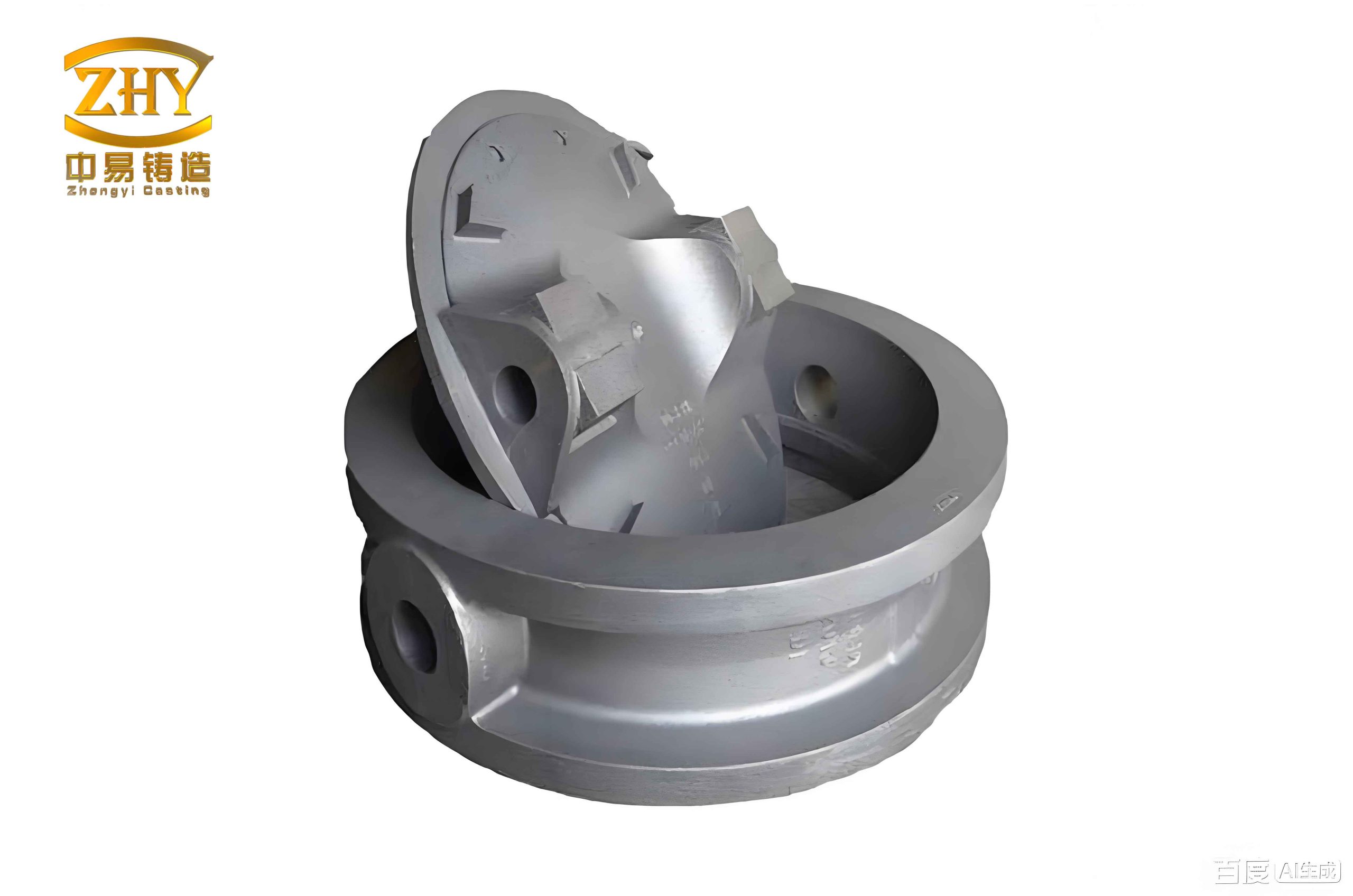
Practical production followed the simulated工艺. Two ladles were used for pouring to achieve low-temperature rapid filling, reducing liquid shrinkage and enhancing self-feeding. After pouring, the casting was insulated, heat-treated, cleaned, and finished via shot blasting. The final hub casting, as shown in the image, underwent 100% ultrasonic testing per standard GB/T25390-2010, with excellent results. Mechanical properties from attached test blocks met targets: spheroidization rate of 90%, graphite size grade 6, tensile strength 520 MPa, yield strength 403 MPa, elongation 18%, and hardness 193 HB. These outcomes demonstrate the viability of riserless sand casting for large, complex sand casting products like wind power hubs.
The success of this project highlights the importance of numerical simulation in optimizing casting工艺 for sand casting products. MAGMASOFT provided insights into temperature fields and defect formation, enabling proactive adjustments without costly trial runs. This approach reduces development time and costs while improving quality. Moreover, the use of low-carbon high-silicon ductile iron QT500-14 offers a cost-effective alternative to heavily alloyed compositions, broadening the applicability of sand casting products in demanding applications.
In conclusion, I have successfully designed and implemented a riserless sand casting工艺 for a 3.5 MW wind power hub. By integrating graphite expansion principles, strategic chill placement, and numerical simulation, I produced a defect-free casting that meets stringent technical requirements. This study advances the manufacturing of large sand casting products, particularly in renewable energy, and underscores the value of simulation-driven design. Future work could explore further optimizations, such as advanced chill materials or real-time process monitoring, to enhance the production of sand casting products. The methodologies presented here can be adapted for other complex castings, contributing to the broader field of metal casting.
To further elaborate on the technical aspects, the solidification behavior of ductile iron in sand casting products can be modeled using empirical relations. For instance, the solidification time \( t_s \) for a casting section can be estimated by Chvorinov’s rule:
$$ t_s = k \left( \frac{V}{A} \right)^2 $$
where \( V \) is volume, \( A \) is surface area, and \( k \) is a constant dependent on mold material and casting conditions. In this hub, varying wall thicknesses lead to different \( V/A \) ratios, necessitating chills to equalize \( t_s \). Additionally, the graphite expansion pressure \( P_g \) during solidification can be approximated as:
$$ P_g = \frac{E_g \cdot \Delta V_g}{V_0} $$
where \( E_g \) is the bulk modulus of graphite, \( \Delta V_g \) is the volume change due to graphite precipitation, and \( V_0 \) is the initial volume. This pressure counteracts shrinkage stresses, aiding self-feeding in riserless sand casting products. Proper mold rigidity, ensured by high-strength furan sand, is critical to harness this effect.
Table 2 summarizes key material properties and process parameters for the hub casting, emphasizing factors relevant to sand casting products.
| Parameter | Value | Unit | Significance |
|---|---|---|---|
| 碳当量 (CE) | 4.3–4.5 | % | Influences graphite expansion and fluidity |
| Pouring Temperature | 1,280–1,300 | °C | Affects liquid shrinkage and filling |
| Mold Rigidity | – | Essential for containing expansion pressure | |
| Chill Thickness | 20–50 | mm | Determines cooling rate at hot spots |
| Solidification Time | ~180 | min | Estimated for thickest section |
Table 2: Material and process parameters for sand casting products like the wind power hub.
The economic and environmental benefits of riserless casting for sand casting products are noteworthy. By eliminating risers, material usage is reduced, lowering costs and minimizing waste. This aligns with sustainable manufacturing practices, crucial for industries like wind energy. Furthermore, the improved yield enhances the competitiveness of sand casting products in global markets. As demand for large, complex castings grows, such innovations will drive advancements in foundry technology.
In summary, this research demonstrates a holistic approach to producing large wind power hubs via riserless sand casting. Through compositional optimization, meticulous工艺 design, and rigorous simulation, I achieved a high-quality sand casting product that meets performance standards. The integration of theoretical principles with practical insights underscores the potential for further innovation in sand casting products. As the wind energy sector expands, refined casting techniques will play a vital role in supplying reliable components, contributing to a sustainable energy future.