
In my extensive experience with material handling systems, particularly in abrasive environments like cement and raw meal plants, the failure of screw conveyor hanger bearings has been a persistent and costly challenge. Conventional rolling-element or sleeve bearings, even with elaborate sealing systems, succumb rapidly to dust ingress, leading to abrasive wear and failure within days or weeks. The continuous maintenance, lubrication needs, and downtime present significant operational hurdles. This article details a fundamental shift in approach, born from practical application: the implementation of a maintenance-free, seal-less hanger bearing manufactured from abrasion-resistant nickel-chromium white cast iron. This solution has proven exceptionally durable, transforming the reliability of conveyors operating in flooded, dust-laden conditions.
The core problem is environmental. In systems such as the one installed beneath a raw meal silo, where the conveyor is directly connected to an air slide and a bag filter, the bearing housing is often completely submerged in fine powder. This creates a scenario where preventing dust entry is virtually impossible for standard seals. Therefore, the philosophy behind the design discussed here is not to prevent ingress, but to utilize the powder itself. The bearing is constructed from a specific grade of white cast iron, a material inherently resistant to abrasive wear, and is designed with intentionally large clearances to facilitate the formation of a stable “powder lubricant film” between the shaft and the bushing.
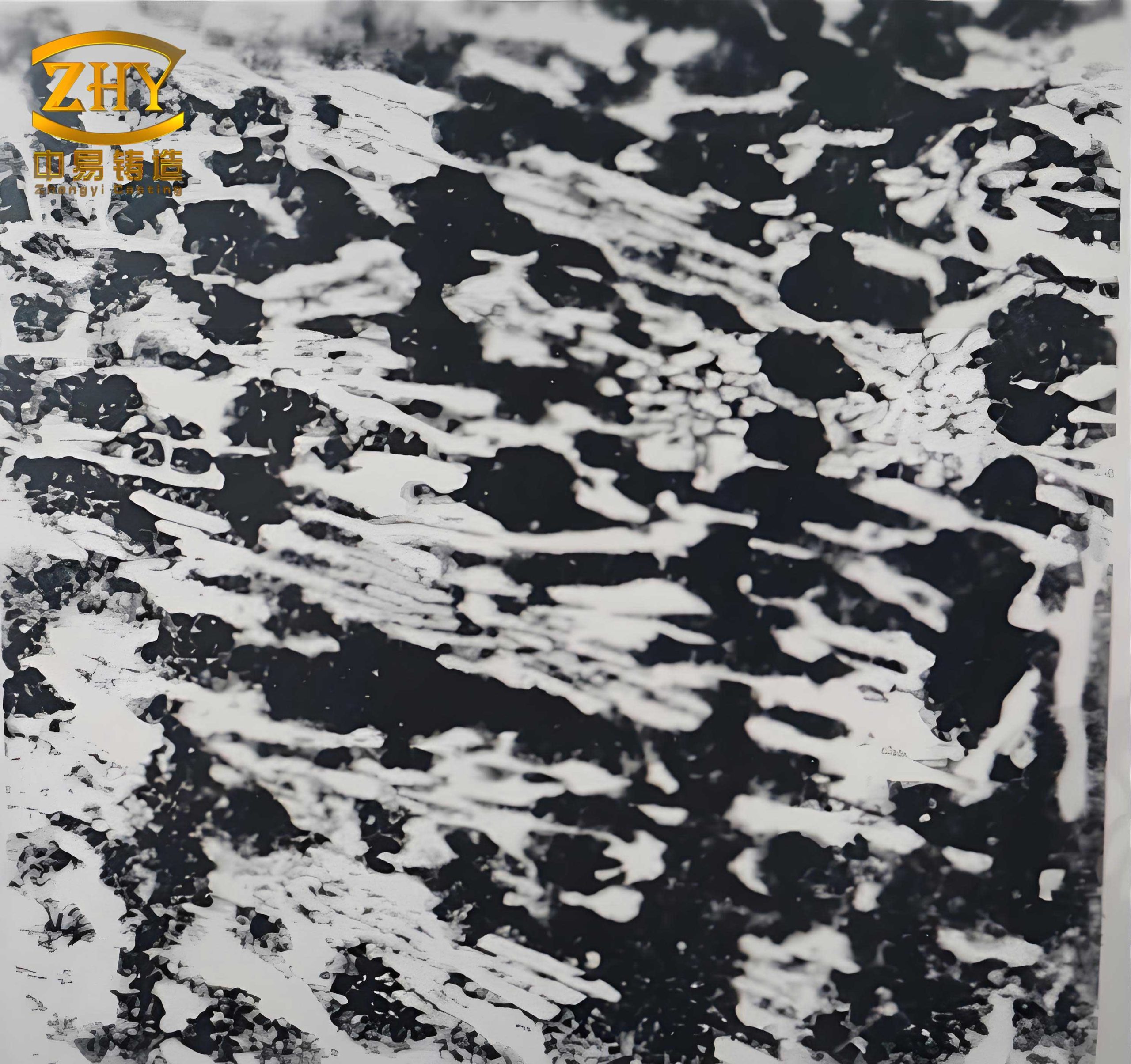
Material Foundation: The Science of Nickel-Chromium White Cast Iron
The success of this bearing hinges entirely on the properties of its material. The specific alloy used, often referred to internationally as “Hard Ni-4” and standardized in China as KmTBNi4Cr2 (equivalent to ASTM A532 Type I, Class A Ni-Cr HC), is a hypereutectic white cast iron. In this family of white cast iron, the carbon is present primarily in the form of hard, interconnected carbides, rather than as graphite. This results in a material that is extremely hard and wear-resistant but also relatively brittle. The addition of nickel (Ni) and chromium (Cr) plays a critical role in modifying the microstructure and enhancing performance.
The primary function of chromium is to promote the formation of hard, chromium-rich carbides (M7C3 type), which are even more abrasion-resistant than the cementite (Fe3C) found in plain white cast iron. Nickel, being an austenite stabilizer, ensures that the metallic matrix (the “background” metal holding the carbides) remains as a tough, austenitic structure, even at slow cooling rates typical of sand casting. This austenitic matrix provides crucial fracture toughness to the otherwise brittle material, preventing catastrophic cracking under impact or thermal stress. The combined effect is a material with exceptional resistance to low-stress, abrasive wear—exactly the condition present when fine, hard particles slide between bearing surfaces.
The chemical composition is tightly controlled. From practical analysis of successful components, the typical ranges are summarized in the table below.
| Component | C | Si | Mn | P | S | Cr | Ni |
|---|---|---|---|---|---|---|---|
| Bushing (Wear Surface) | 3.0 – 3.3 | 0.4 – 0.6 | 0.4 – 0.6 | <0.03 | <0.07 | 1.6 – 2.0 | 3.2 – 4.2 |
| Hollow Shaft (Wear Surface) | 3.2 – 3.5 | 0.4 – 0.7 | 0.5 – 0.7 | <0.03 | <0.07 | 1.7 – 2.1 | 3.8 – 4.5 |
The mechanical properties stem directly from this microstructure. The high volume fraction of hard carbides (typically 25-35%) grants a very high macro-hardness, usually between 55 to 65 HRC. However, a more nuanced understanding comes from considering the wear mechanism. The Archard wear equation, while often simplified for adhesive wear, can be adapted conceptually for abrasive conditions. The volumetric wear rate (V) can be related to the material’s resistance:
$$ V \propto \frac{K \cdot N \cdot s}{H} $$
Where K is a wear coefficient dependent on the abrasive and material pair, N is the normal load, s is the sliding distance, and H is the hardness of the softer material. In this bearing system, both surfaces are made of the same hard white cast iron. However, the presence of the powder film fundamentally changes the interaction, placing the abrasive wear primarily on the entrapped powder particles themselves, drastically reducing the effective wear coefficient K. The extreme hardness (H) of the nickel-chromium white cast iron ensures that if occasional metal-to-metal contact occurs, the wear rate remains minimal.
Bearing Design and Operating Principle
The design philosophy breaks from convention. The bearing assembly consists of a stationary outer bushing and a rotating inner hollow shaft, both cast from nickel-chromium white cast iron. A central steel connecting shaft transmits torque via a 300-degree arc-shaped engagement inside the hollow shaft. This simplifies assembly and disassembly. Crucially, the design omits any seals, grease nipples, or lubrication ports. The manufacturing is also simplified: only the bore of the bushing and the outer diameter of the hollow shaft require machining; all other surfaces remain in the as-cast state.
The most critical design parameter is the radial clearance. Unlike precision journal bearings operating with oil films measured in microns, this bearing employs a clearance orders of magnitude larger. For a shaft diameter of 125 mm, a radial clearance of 1.5 to 2.5 mm is typical. This large clearance serves multiple functions:
- It allows for easy entry and distribution of the powder.
- It accommodates any misalignment or deflection of the long screw conveyor shaft.
- It reduces the velocity gradient within the powder film, minimizing shear heating.
- It prevents jamming or seizure due to thermal expansion or accumulation of oversized particles.
The operational principle is elegantly simple and relies on the formation of a quasi-hydrodynamic “powder lubricant film.” Upon startup of a newly installed or cleaned bearing, with no powder in the clearance, there is initial metal-to-metal contact, often resulting in audible noise (“grunting”). Within a short period (approximately 1-2 hours in a continuously fed system), the powder fills the clearance. Under the shear of rotation, this powder begins to behave as a semi-fluid medium. Particles roll and slide against each other, creating a separating layer. The pressure generation in this granular film can be modeled in a simplified form, drawing analogies from soil mechanics and dense-phase powder flow:
$$ P_f \approx \rho_p \cdot g \cdot h + \tau \cdot \left(\frac{D}{2 \cdot C}\right) $$
Where \( P_f \) is the pressure supporting the load in the film, \( \rho_p \) is the bulk density of the powder, \( g \) is gravity, \( h \) is the effective height of the powder column in the bearing, \( \tau \) is the shear stress of the flowing powder, \( D \) is the shaft diameter, and \( C \) is the radial clearance. Once this stable film is established, the two metal surfaces are separated by a layer of the material being conveyed. Wear is transferred from the expensive white cast iron components to the inexpensive conveyed powder, leading to an extraordinarily low wear rate. The surfaces become polished smooth, with only occasional, non-propagating scratch marks.
| Parameter | Value | Unit |
|---|---|---|
| Screw Diameter | 750 | mm |
| Conveyor Length | 22.5 | m |
| Conveying Capacity | 163 | t/h |
| Inclination Angle | +12 | ° |
| Reducer Ratio | 37.9 : 1 | – |
| Shaft Speed | ~39 | rpm |
| Bearing Diameter x Length | 125 x 150 | mm |
| Design Radial Clearance | 2.0 | mm |
| Material Hardness (HRC) | 58 – 62 | – |
| Bushing Wall Thickness | 12 | mm |
Application Guidelines and Critical Operational Considerations
Successful deployment of this white cast iron bearing system requires adherence to specific guidelines that differ markedly from standard bearing practice.
1. Run-in and Initial Operation: A freshly installed or overhauled bearing must never be run empty. The initial absence of the powder lubricant film will lead to rapid dry sliding contact between the hard white cast iron surfaces. This can generate excessive frictional heat, potentially causing thermal cracking (heat checking) or even localized fusion and胶合 (galling). The conveyor should be started only when material flow is assured. The initial audible noise is normal and will subside as the powder film forms.
2. Strict Prohibition of Lubricants: It is imperative to resist the temptation to introduce grease or oil. A liquid lubricant will agglomerate the powder, forming a thick paste that can bridge the clearance, impede the free flow of the dry powder film, and ultimately lead to clogging and increased torque. The system is designed for dry, granular lubrication only.
3. Material Characteristics: The abrasiveness of the conveyed powder directly influences the long-term wear rate, though it remains low. For instance, the harder clinker minerals in finished cement powder will cause a faster wear rate compared to the softer raw meal. The particle size also matters; a consistent, fine powder (e.g., 80μm sieve residue ~10%) is ideal for forming a stable film. Very coarse or highly variable granulometry may be less effective.
4. Inspection and Failure Modes: During routine inspections, one may observe fine, shallow surface cracks on the bushing or shaft wear surface. These are typically 5-15 mm long, parallel to the axis, and spaced a few millimeters apart. These are not structural failures. They are superficial heat-checking cracks caused by minor thermal cycles during rare moments of film breakdown or startup. They do not propagate deeply into the material and have no measurable effect on the bearing’s performance or lifespan. The dominant wear mode is a slow, uniform polishing. The bearing is considered for replacement only when the clearance has increased sufficiently to cause excessive vibration or a permanent loss of the powder film stability, which in practice takes years.
The lifespan can be modeled as a function of the abrasive wear rate of the white cast iron under the powder-lubricated condition. If we denote the allowable radial wear (total for shaft and bushing) as \( W_{total} \), and the observed wear rate per operating hour as \( w \), the service life \( L \) in hours is:
$$ L = \frac{W_{total}}{w} $$
For this specific alloy and application, with \( W_{total} \) on the order of 5-8 mm and \( w \) being exceptionally small, L translates to service lives exceeding 20,000 operating hours, or approximately 3 years of continuous service, as validated in field applications.
Comparative Advantages and Economic Impact
The transition to a nickel-chromium white cast iron hanger bearing system represents a significant technical and economic advancement over traditional solutions. The benefits are multi-faceted.
| Aspect | Nickel-Chromium White Cast Iron Bearing | Traditional Sealed Sleeve/Roller Bearing |
|---|---|---|
| Initial Design | Simple, no seals, no lubrication points. | Complex, requires multi-stage seals, grease nipples, housings. |
| Maintenance Regime | Zero. No lubrication, no seal replacement. | High. Regular greasing, frequent seal inspection/replacement. |
| Operating Cost | Negligible (no consumables). | Significant (grease, seal kits, labor). |
| Mean Time Between Failure (MTBF) | Very High (>20,000 hours). | Low (100 – 1,000 hours in flooded conditions). |
| Failure Mode | Gradual, predictable clearance increase. | Sudden, catastrophic seizure or bearing cage collapse. |
| Downtime Impact | Scheduled, infrequent replacement. | Unscheduled, frequent stoppages. |
| Environmental Tolerance | Thrives in flooded, dusty conditions. | Seals eventually fail, leading to ingress and rapid wear. |
The economic justification is compelling. The higher initial cost of the specialized white cast iron casting is quickly offset by the elimination of lubrication costs, the drastic reduction in maintenance labor, and, most importantly, the virtual elimination of unplanned production stoppages. The reliability of the conveying system improves dramatically, supporting consistent plant throughput.
Conclusion and Future Perspectives
The application of abrasion-resistant nickel-chromium white cast iron in the design of seal-less, lubricant-free hanger bearings is a powerful example of problem-solving through material science and a re-evaluation of first principles. By accepting dust ingress as an inevitable condition and selecting a material whose properties turn that dust from a destructive agent into a beneficial lubricant, a remarkable leap in durability and reliability is achieved. This white cast iron solution, with its characteristic high hardness and excellent abrasion resistance, has proven capable of delivering multi-year service life in some of the most challenging industrial environments.
Future developments may focus on further optimizing the alloy composition for specific powder characteristics or exploring advanced casting techniques to improve the consistency and soundness of the bushing and shaft castings. Furthermore, the fundamental principle of “powder film lubrication” using wear-resistant materials like this specialized white cast iron could find applications in other areas of bulk handling where sliding contacts and abrasive media coexist, such as in feeder gates, divertor valves, or mixer paddles. The success of this bearing underscores that in engineering, sometimes the most effective solution is not to fight the environment, but to design a system that harnesses it.