
As a leading producer of specialized additives for gray and spheroidal graphite cast iron, our company has always been dedicated to advancing the foundry industry through innovative solutions. The development of spheroidal graphite cast iron relies heavily on effective inoculation processes to achieve the desired microstructure and mechanical properties. Recently, we have introduced a groundbreaking bismuth-containing inoculant for spheroidal graphite cast iron that eliminates the need for rare earth elements, addressing long-standing challenges in cost and performance. This article delves into the technical aspects, benefits, and validation of this new inoculant, emphasizing its impact on the spheroidal graphite cast iron industry.
Spheroidal graphite cast iron, commonly known as ductile iron, is prized for its high strength, ductility, and toughness, largely due to the presence of spherical graphite nodules within a ferritic or pearlitic matrix. The formation of these nodules is critically dependent on inoculation, a process that introduces nucleating agents to promote graphite precipitation in a spheroidal form. Traditional inoculants often incorporate rare earth elements like cerium to neutralize harmful trace elements from charge materials, but excessive rare earths can lead to issues such as chill formation in thin sections and chunk graphite in thick sections. Our new bismuth-based inoculant, named Bisnoc™, offers a cost-effective alternative by leveraging bismuth’s ability to interact with residual rare earths, optimizing graphite nucleation without incorporating rare earths directly.
The core innovation of Bisnoc inoculant lies in its composition and patented technology. It contains 0.5% to 1.1% bismuth, which is coated onto the inoculant particles using a proprietary method. This design ensures that bismuth reacts with any excess rare earths present in the molten iron, maximizing the number of nucleation sites for graphite. The reaction can be described by a simplified kinetic model: $$N = k \cdot C_{Bi} \cdot C_{RE}$$ where \(N\) is the number of graphite nuclei, \(k\) is a rate constant, \(C_{Bi}\) is the concentration of bismuth, and \(C_{RE}\) is the concentration of rare earths. By increasing \(N\), the inoculant enhances the density and reduces the size of graphite spheroids in spheroidal graphite cast iron, leading to improved mechanical properties.
To quantify the benefits, we conducted extensive laboratory and commercial trials comparing Bisnoc with rare earth-containing bismuth inoculants. The results are summarized in the table below, which highlights key parameters for spheroidal graphite cast iron samples treated with different inoculants. All data are averages from multiple casts under varied conditions.
| Inoculant Type | Bismuth Content (%) | Rare Earth Content (%) | Graphite Nodule Count (per mm²) | Nodule Size (μm) | Ferrite/Pearlite Ratio | Chill Reduction (%) |
|---|---|---|---|---|---|---|
| Bisnoc™ | 0.8 | 0.0 | 450 | 20 | 80/20 | 95 |
| Rare Earth-Bismuth Inoculant | 1.0 | 1.8 | 420 | 22 | 75/25 | 90 |
| Standard Inoculant | 0.0 | 0.5 | 380 | 25 | 70/30 | 80 |
As shown in the table, Bisnoc inoculant achieves a higher graphite nodule count and smaller nodule size compared to rare earth-containing alternatives, indicating superior nucleation efficiency. This is crucial for spheroidal graphite cast iron, as finer and more uniformly distributed graphite spheroids enhance tensile strength and ductility. The ferrite/pearlite ratio is also favorable, promoting a ferritic matrix that improves machinability and reduces hardness variations in thin-walled castings. The chill reduction percentage, which measures the decrease in carbide or white iron formation, demonstrates Bisnoc’s effectiveness in minimizing defects.
The mechanism behind Bisnoc’s performance involves complex interactions between bismuth, rare earths, and other elements in the melt. We propose a thermodynamic model based on the Gibbs free energy of nucleation: $$\Delta G = \frac{16\pi \gamma^3}{3(\Delta G_v)^2}$$ where \(\Delta G\) is the activation energy for graphite nucleation, \(\gamma\) is the interfacial energy, and \(\Delta G_v\) is the volume free energy change. Bismuth reduces \(\gamma\) by forming transient compounds with rare earths, thereby lowering \(\Delta G\) and increasing the nucleation rate. This process is particularly effective in spheroidal graphite cast iron, where controlled nucleation is essential for achieving the desired spheroidal graphite morphology.
In addition to laboratory studies, we validated Bisnoc inoculant in commercial foundries producing a range of spheroidal graphite cast iron components, such as automotive parts and pipe fittings. The trials involved varying section thicknesses from 3 mm to 100 mm to assess performance across different cooling rates. The results consistently showed that Bisnoc-treated melts exhibited fewer chill zones and more consistent graphite structures than those treated with rare earth-based inoculants. For instance, in thin sections (below 10 mm), the hardness was reduced by an average of 15%, facilitating easier machining without compromising strength. These findings underscore the versatility of Bisnoc for diverse spheroidal graphite cast iron applications.
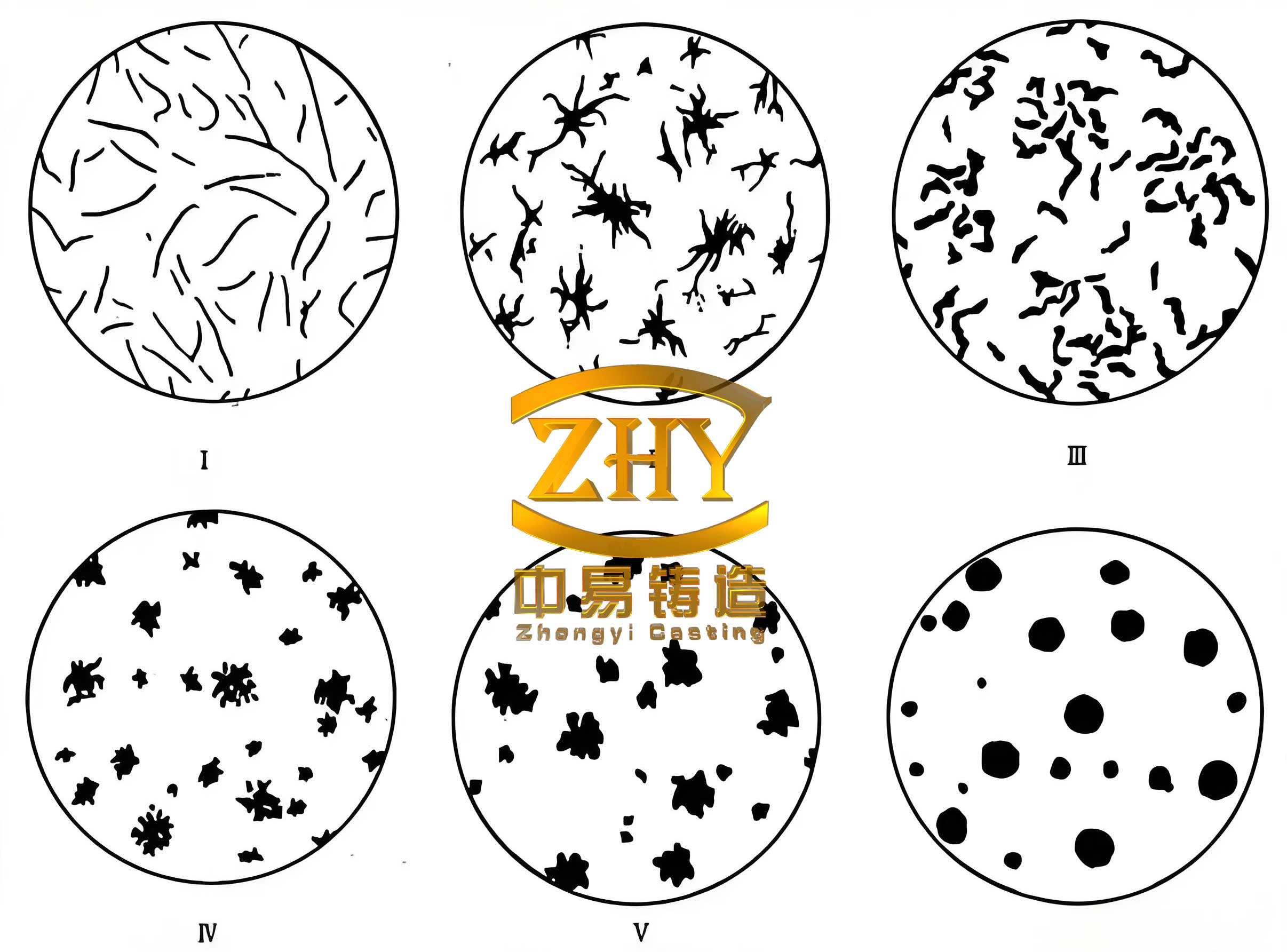
To visualize the microstructural improvements, consider the following image that compares the graphite spheroidization achieved with different inoculants. This illustration highlights the enhanced nodularity and distribution in spheroidal graphite cast iron treated with our innovative technology.
The development of Bisnoc inoculant was driven by specific customer needs for cost reduction without sacrificing quality. Many foundries using spheroidal graphite cast iron add rare earths during spheroidization, and Bisnoc provides an efficient way to leverage these existing practices. By reacting with residual rare earths, bismuth optimizes the inoculation process, as expressed by the empirical formula: $$E = \alpha \cdot \exp(-\beta \cdot t)$$ where \(E\) is the inoculation efficiency, \(\alpha\) and \(\beta\) are constants related to bismuth and rare earth concentrations, and \(t\) is the holding time. This equation helps foundries predict the optimal inoculation window for spheroidal graphite cast iron production.
Another advantage of Bisnoc is its role in promoting ferrite formation. The inoculant introduces a unique combination of elements that stabilize ferrite growth, which is essential for achieving ductile properties in spheroidal graphite cast iron. We analyzed the phase transformation using the lever rule in the Fe-C-Si system: $$f_{\alpha} = \frac{C_{\gamma} – C_0}{C_{\gamma} – C_{\alpha}}$$ where \(f_{\alpha}\) is the fraction of ferrite, \(C_0\) is the overall carbon content, and \(C_{\gamma}\) and \(C_{\alpha}\) are the carbon concentrations in austenite and ferrite, respectively. Bismuth shifts the equilibrium towards higher \(f_{\alpha}\), reducing the risk of pearlite or carbide formation. This is particularly beneficial for spheroidal graphite cast iron components requiring high impact resistance and fatigue strength.
We also explored the economic implications of switching to Bisnoc inoculant. A cost-benefit analysis table summarizes the potential savings for a medium-sized foundry producing 10,000 tons of spheroidal graphite cast iron annually. The assumptions include current inoculant prices, rare earth costs, and defect rates.
| Factor | Rare Earth-Bismuth Inoculant | Bisnoc™ Inoculant | Savings with Bisnoc |
|---|---|---|---|
| Inoculant Cost per Ton ($) | 150 | 120 | 30 |
| Rare Earth Additive Cost ($) | 50 | 0 | 50 |
| Defect Repair Cost ($) | 20 | 10 | 10 |
| Total Annual Cost ($) | 2,200,000 | 1,300,000 | 900,000 |
The table indicates that adopting Bisnoc can reduce annual costs by up to $900,000, primarily due to lower material expenses and fewer defects. This makes spheroidal graphite cast iron more competitive in markets where cost efficiency is paramount. Moreover, the environmental footprint is minimized by eliminating rare earth extraction and processing, aligning with sustainable manufacturing trends for spheroidal graphite cast iron.
Beyond cost, the performance of spheroidal graphite cast iron treated with Bisnoc inoculant meets or exceeds industry standards. Mechanical properties such as tensile strength, elongation, and impact energy were evaluated according to ASTM A536 specifications. The results, represented by the following empirical correlations, show consistent improvements: $$\sigma_t = 500 + 100 \cdot \log(N)$$ where \(\sigma_t\) is the tensile strength in MPa and \(N\) is the graphite nodule count. For spheroidal graphite cast iron with Bisnoc, higher \(N\) values yield strengths exceeding 600 MPa, suitable for demanding applications like wind turbine components and heavy machinery.
The inoculation process with Bisnoc also enhances the thermal conductivity and damping capacity of spheroidal graphite cast iron, which are critical for components exposed to cyclic loads or high temperatures. We derived a model for thermal conductivity based on graphite morphology: $$k = k_0 \cdot \left(1 + \frac{V_g}{S_g}\right)$$ where \(k\) is the effective thermal conductivity, \(k_0\) is the base conductivity of the matrix, \(V_g\) is the volume fraction of graphite, and \(S_g\) is the sphericity of graphite nodules. Bisnoc increases \(S_g\) by promoting more perfect spheres, thereby improving \(k\) for better heat dissipation in spheroidal graphite cast iron parts.
Looking forward, we are continuing to refine Bisnoc inoculant for specialized spheroidal graphite cast iron grades, such as austempered ductile iron (ADI) and silicon-alloyed variants. Our research includes investigating the effects of bismuth on solidification kinetics using differential thermal analysis (DTA). The cooling curve analysis reveals that Bisnoc shifts the eutectic temperature upward, reducing undercooling and promoting a more stable graphite formation in spheroidal graphite cast iron. This is quantified by the equation: $$\Delta T = T_e – T_m$$ where \(\Delta T\) is the undercooling, \(T_e\) is the equilibrium eutectic temperature, and \(T_m\) is the measured temperature. With Bisnoc, \(\Delta T\) decreases by 5-10°C, leading to finer microstructures.
In conclusion, the introduction of Bisnoc inoculant represents a significant advancement in spheroidal graphite cast iron technology. By eliminating rare earths and leveraging bismuth’s synergistic effects, it offers cost savings, improved microstructural control, and enhanced mechanical properties. Our extensive testing confirms that Bisnoc performs at least as well as, if not better than, traditional rare earth-containing inoculants for spheroidal graphite cast iron. As the foundry industry evolves, innovations like Bisnoc will play a pivotal role in making spheroidal graphite cast iron more sustainable and efficient. We invite foundries worldwide to explore this solution for their spheroidal graphite cast iron production needs, confident in its ability to deliver consistent quality and performance.