
In my extensive experience with centrifugal fan design and manufacturing, the impeller has always been the heart of the system. Its geometry and integrity dictate performance, efficiency, and, critically, noise levels. For low-noise applications, forward-curved, multi-blade impellers are ubiquitous. However, their manufacture has long been constrained by a significant technological bottleneck. The traditional method involved fabricating the front shroud, backplate, blades, and hub separately and then joining them via riveting. While functional, this assembly is prone to failures such as blade fracture, rivet loosening, and overall deformation over extended operational periods, compromising reliability. A far superior alternative is an integral, one-piece casting which offers unmatched structural integrity and damping characteristics, especially when cast from aluminum alloys.
The motivation for pursuing integral sand casting for these components is twofold: performance and durability. Aluminum alloys, in particular, exhibit excellent damping properties. The internal friction and hysteresis losses within the alloy’s crystalline structure help convert vibrational mechanical energy into heat, thereby passively reducing aerodynamic and mechanically induced noise. An integrally cast aluminum impeller presents smoother flow passages with no disruptive joints, further minimizing flow resistance and associated noise. Crucially, its monolithic structure possesses demonstrably higher strength compared to its riveted counterpart. While this integral approach has been successfully adopted for larger impellers with wider flow channels (typically >40mm x 80mm), a persistent challenge remained for smaller, high-performance units characterized by narrow-flow channels (often <30mm x 20mm). These compact impellers feature a high blade count (often 26 or more), thin blade profiles (~2mm), and a closed-shroud structure, making them seemingly impossible to mold and demold using conventional foundry techniques. This article details the innovative sand casting process I developed to overcome these exact challenges.
Structural Challenges and Casting Imperatives
The target impeller is a complex geometry. It consists of a one-piece aluminum casting integrating a front shroud with a central inlet, a backplate (or base disc), and a full set of forward-curved blades arranged circumferentially. A steel sleeve is cast-in-place at the hub for shaft mounting. The defining difficulty lies in the blade passage. The blades are short, closely spaced, and curved, creating a long, narrow, tortuous cavity that is completely enclosed by the front and back shrouds. From a foundry perspective, this translates to an intricate core that must be formed and then removed or dissolved—a task deemed impossible with standard cores or investment casting wax patterns for this scale and fineness.
| Aspect | Traditional Riveted Construction | Proposed Integral Sand Casting |
|---|---|---|
| Structural Integrity | Lower; prone to fatigue at joints. | High; monolithic structure. |
| Noise Damping | Lower; steel panels reflect vibration. | High; aluminum alloy dissipates vibration. |
| Flow Path Quality | Disrupted by rivets and seams. | Smooth and continuous. |
| Manufacturing Complexity | High (multiple fabrication & assembly steps). | Consolidated into a single casting process. |
| Feasibility for Narrow Channels | Only viable method historically. | Now achievable with novel core-making. |
The fundamental molding problem can be summarized by the need to create a negative of the impeller’s internal air passages. In conventional thinking, once a core for such an enclosed cavity is formed, there is no physical path to extract it. This led to the widespread belief that integral sand casting of such impellers was not feasible, relegating them to fabricated assembly. My solution hinged on fundamentally rethinking the core-making process itself.
Determining the Casting Solution: The Movable Blade Model
Initial trials with conventional pattern methods quickly highlighted the demolding dilemma. A pattern combining the blades and backplate, even with draft angles, resulted in severe sand tearing and core damage during withdrawal due to the blade thinness and proximity. Simply increasing the draft was not a solution for 2mm-thick blades. Investment casting was also evaluated and dismissed for the same core-removal reason.
The breakthrough came from decomposing the problem. Instead of a solid core or a single-piece pattern, I conceived a segmented, assembly-based core box. The central innovation is the Movable Blade Model. In this approach, the core box used to form the impeller’s internal cavity is itself an assembly:
- Individual Blade Models: Each of the 26+ blades is precision-machined (e.g., by wire EDM) as a separate steel insert. Their profile accuracy is critical, with tolerances within ±0.1mm. Crucially, these blade models are elongated, extending approximately 40mm beyond the modeled backplane.
- Rotational-Direction Adjustable Backplate Model: This is a plate representing the impeller’s backplate, fabricated with precise holes corresponding to the blade roots. A key feature is its two-sided design with internal registers, allowing a hub boss model to be attached on either side, effectively making the core box configurable for either left or right-hand rotation impellers with a single set of components.
- Core Box Outer Frame: A containing frame that holds the assembled blade and backplate models in the correct spatial arrangement.
The assembly sequence is pivotal: The elongated blade models are inserted into the holes on the backplate model, and this whole assembly is placed inside the outer frame. The core sand (in this case, a self-curing resin-bonded sand) is then packed around it. After the core cures, the foundational trick is executed: the backplate model is first detached, and then, because the blades are individual and extend outwards, they can be sequentially withdrawn straight out from the cured sand core. What remains is a perfect, monolithic sand core depicting the intricate network of impeller channels. This solved the previously insurmountable demolding problem.
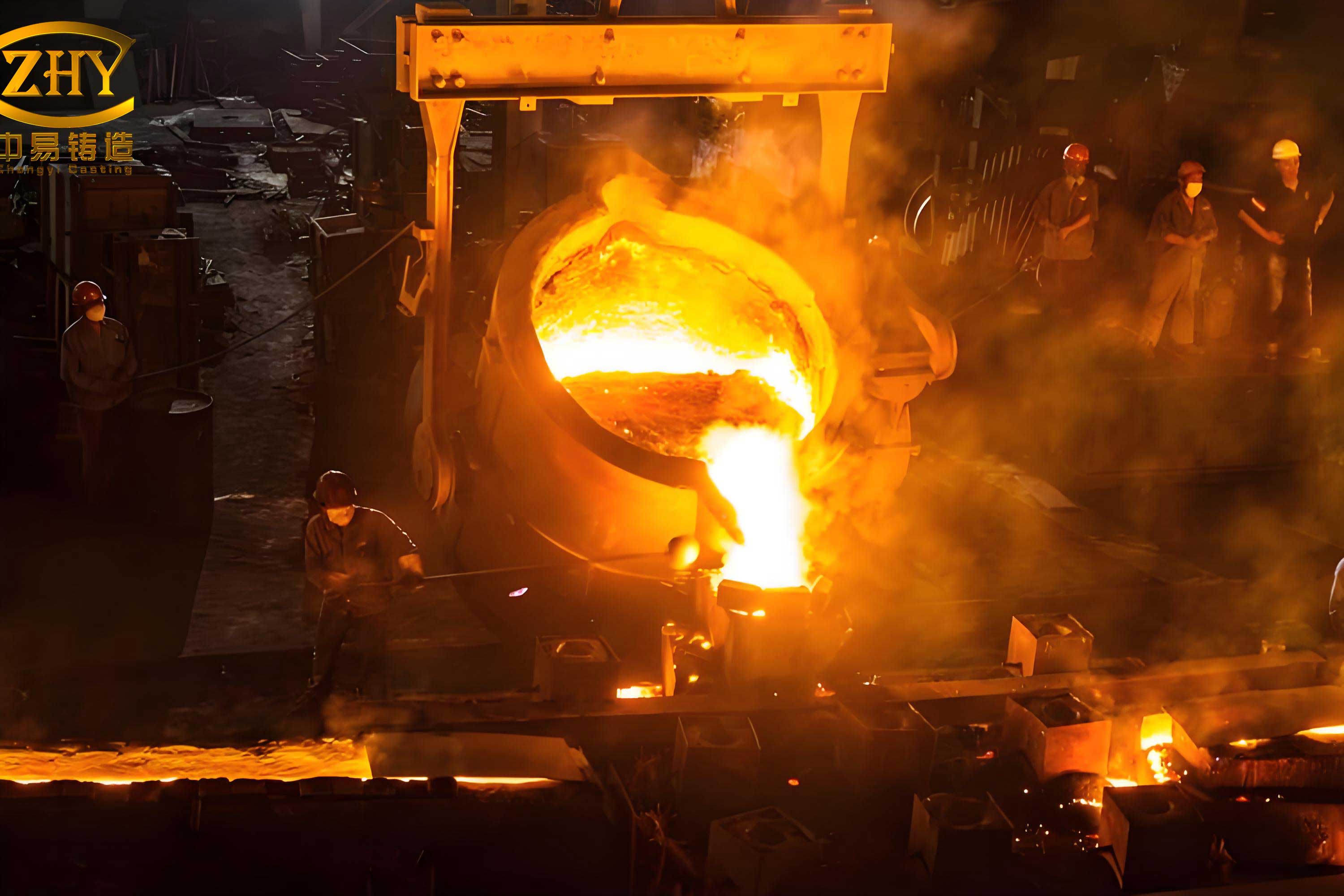
The Integral Sand Casting Process: A Step-by-Step Exposition
The complete sand casting process utilizing this movable-blade core technology is systematic and robust. The mold is typically a two-part green sand mold (cope and drag) with the complex internal geometry defined by the resin sand core.
1. Core Making with the Movable Blade Assembly
The core is the most critical element. I use a cold-setting resin sand, typically a furan resin like KJN-III, mixed with washed silica sand. The sulfate ester is used as a catalyst.
- Process: The movable blade models are inserted into the adjustable backplate, which is set for the desired impeller rotation. This assembly is secured within the core box outer frame. The resin-sand mixture is rammed around it. After the mandated curing time, the assembly is disassembled in reverse order: the outer frame is opened, the backplate model is unbolted and removed, and finally, each blade model is cleanly pulled straight out along its axis. The resulting core is fragile but geometrically precise.
- Core Reinforcement: To withstand the metallostatic pressure during pouring, a reinforcing “core cage” or lattice made of steel wire is embedded within the sand during ramming. This is essential for preventing core shift or fracture.
The core-making success relies on the precise fit between blade models and backplate holes (clearance ~0.05mm) to prevent resin seepage and ensure easy withdrawal.
2. Mold Making for the External Contour
The external shape of the impeller (the outer cylindrical surfaces and the front shroud face) is formed by conventional green sand casting molds. A simple split pattern for the impeller’s outer profile is used to create the cope and drag in green sand. The sand properties are controlled for adequate strength and permeability:
- Green compressive strength: ~ 0.3 – 0.5 kPa.
- Permeability: >30.
The gating and feeding system is crafted in the drag. Given the impeller’s geometry—a solid backplate region and a more open front shroud—a bottom gating system is employed. This ensures the mold fills progressively from the bottom (the thickest section), maintaining a favorable temperature gradient for directional solidification towards the feeder.
3. Mold Assembly and Casting
The cured resin sand core is carefully placed into the lower drag mold. The preheated steel hub sleeve (heated to ~300°C to drive off moisture and improve bonding) is positioned onto core prints in the drag. The cope is then placed on top, completing the mold assembly. The molten metal, in this case ZL104 (a common Al-Si-Mg casting alloy), is poured at a temperature between 760-800°C.
- Pouring Practice: The pour is started rapidly to ensure quick filling of the thin blade sections, avoiding mistruns. It is then slowed and controlled, with possible final feeding to compensate for shrinkage in the thick backplate region. The feeder head provides the necessary liquid metal reserve.
- Solidification: The mold is left to cool completely for several hours before shakeout.
The key process parameters can be summarized for reproducibility:
| Parameter | Specification or Range | Purpose/Rationale |
|---|---|---|
| Core Sand | Resin-bonded Silica Sand (Furan) | High strength & accuracy for complex core. |
| Mold Sand | Green Sand (Clay-bonded) | Good collapsibility and productivity. |
| Pouring Temperature | 760 – 800 °C | Fluidity for thin sections without excessive gas pick-up. |
| Gating System | Bottom Gating | Promotes directional solidification, reduces turbulence. |
| Steel Sleeve Preheat | ~300 °C | Ensures dry surface and promotes metallurgical bond. |
| Blade Model Clearance | ~0.05 mm | Allows clean withdrawal without damaging core. |
4. Post-Casting Processing
After shakeout, the casting is cleaned, inspected (including non-destructive testing for critical areas), and undergoes machining. The front and back faces, outer diameter, and hub bore are machined to final dimensions. The blade channels may receive a light polishing to ensure aerodynamic smoothness. The final surface finish can achieve a roughness (Ra) of 6.3 µm or better.
Technical Analysis and Advantages Quantified
The superiority of this integral sand casting process is not merely qualitative; it can be framed through engineering principles.
1. Aerodynamic and Acoustic Performance: The uninterrupted flow path reduces turbulence. The pressure loss coefficient across the impeller can be conceptually lower. While the exact noise reduction is system-dependent, the damping effect of the aluminum structure can be linked to the specific damping capacity (SDC) of the material, which is significantly higher for alloys like ZL104 than for low-carbon steel used in riveted impellers.
2. Structural Strength: The absence of stress-concentrating rivet holes and the monolithic structure greatly enhance fatigue life. The yield strength of the as-cast and heat-treated aluminum structure provides a robust safety margin. The integrity under dynamic loading (vibration, shock) is markedly improved, a critical factor for demanding applications.
3. Manufacturing Efficiency and Cost: Although the core-making process is specialized, it consolidates what was a multi-step fabrication (stamping, forming, riveting) into a single molding and pouring operation. The pattern equipment (movable blades and backplate) serves for both rotational directions, maximizing utility. For batch production, this leads to lower unit cost and higher consistency. The process yield (percentage of sound castings) achieved with this method can exceed 72%, which is excellent for such a complex part.
The benefits of this specific sand casting approach over other potential methods for such geometries are decisive:
| Method | Feasibility for Narrow Channels | Typical Accuracy | Relative Cost for Medium Batch | Key Limitation |
|---|---|---|---|---|
| 5-Axis CNC Machining | Very Low (Tool Interference) | Excellent | Very High | Impossible to machine enclosed cavities. |
| Investment Casting | Low | Good | High | Cannot remove ceramic core from tiny passages. |
| Traditional Sand Casting (Solid Core) | None | Moderate | Low | No method to extract core. |
| Proposed Movable-Blade Sand Casting | High | Good to Very Good | Medium to Low | Requires precise pattern engineering. |
Production Results and Validation
The practical application of this sand casting process has been thoroughly validated. Over 200 impellers have been successfully produced. The dimensional consistency of the cast blades ensures excellent aerodynamic balance. The impellers routinely achieve a G2.5 dynamic balance grade, with residual unbalance mass often below 0.03g. This directly translates to lower vibration levels in the final fan assembly.
Comparative testing against equivalent riveted impeller fans demonstrates measurable reductions in overall sound pressure levels. Furthermore, the structural robustness has been proven under stringent environmental stress tests, including prolonged vibration and shock tests, after which the performance parameters remain stable.
Conclusion
The development of the movable-blade model technique for core-making represents a significant advancement in the sand casting of geometrically constrained components. It successfully solves the historic demolding impasse associated with integral casting of forward-curved, multi-blade, narrow-flow channel impellers. This process enables the production of aluminum alloy impellers that combine high structural strength, superior aerodynamic and acoustic performance, and manufacturing efficiency. The technical and economic viability of this method, as proven in production, establishes it as a superior alternative to traditional fabrication for a wide range of similar complex, enclosed structures in centrifugal machinery. The principles demonstrated here—using dissociable tooling to create otherwise un-extractable cores—can be adapted and extended to other challenging casting applications beyond the field of turbomachinery.
The success of this sand casting process underscores that limitations in traditional methods can often be overcome by innovative approaches to pattern and core box design, unlocking the full potential of metal casting for manufacturing high-performance, integrated components.