
In the rapidly evolving automotive industry, the demand for lightweight and integrated components has become paramount to reduce manufacturing costs and enhance performance. As a response to this trend, we have developed an integrated sand foundry technology for producing large aluminum alloy automotive chassis. This foundry technology addresses the challenges associated with manufacturing such complex, thin-walled structures through innovative approaches in alloy selection, melt purification, grain refinement, filling control, dimensional accuracy, and internal quality assurance. The application of this foundry technology enables the production of chassis components that meet stringent design requirements while offering superior mechanical properties and isotropic behavior.
The structural characteristics of the integrated automotive chassis pose significant challenges in foundry technology. With overall dimensions of approximately 3,846 mm in length, 1,545 mm in width, and 693 mm in height, and a total mass of 167 kg, the chassis features minimal wall thicknesses of 3.5 mm and numerous deep, narrow ribs. The central battery plate region has a uniform thickness of 6 mm, contributing to the complexity of the casting process. Key difficulties in this foundry technology include preventing cold shuts and misruns due to the thin-walled nature, minimizing deformation and cracking from thermal stresses, and controlling dimensional tolerances across the large span. These issues necessitate a holistic approach to foundry technology, integrating advanced simulation and experimental validation.
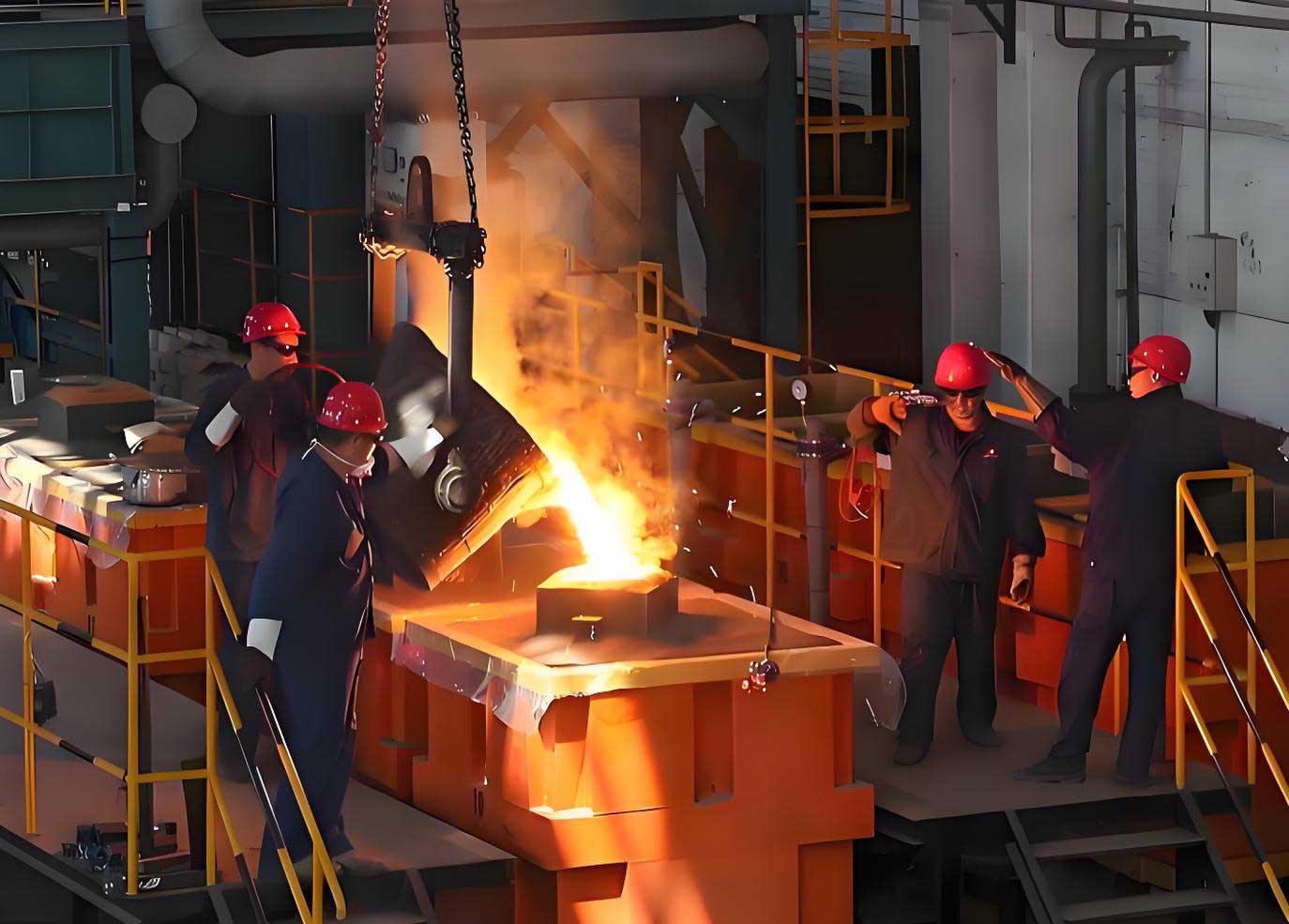
Alloy selection is a critical aspect of this foundry technology. While AlSi10MnMg is commonly used in high-pressure die-casting for structural parts, its limited fluidity makes it unsuitable for sand casting applications. Therefore, we opted for ZL101A aluminum alloy, which offers excellent fluidity and mechanical properties tailored for sand foundry technology. The composition control in this foundry technology involves stringent measures to minimize impurity elements such as iron and copper, which can degrade mechanical performance. The typical chemical composition of ZL101A alloy used in this foundry technology is summarized in Table 1.
| Element | Si | Mg | Ti | Fe | Cu | Mn | Al |
|---|---|---|---|---|---|---|---|
| Content | 6.5-7.5 | 0.25-0.45 | 0.08-0.20 | ≤0.20 | ≤0.10 | ≤0.10 | Bal. |
Melt purification is a cornerstone of this foundry technology, ensuring high-quality alloy with minimal inclusions and gas porosity. We implemented a low-temperature silicon addition process to reduce melting temperatures, thereby minimizing hydrogen absorption and oxide formation. The refining process employs high-purity argon rotary degassing combined with flux treatment, represented by the following equation for inclusion removal efficiency:
$$ \frac{dC}{dt} = -k \cdot A \cdot (C – C_s) $$
where \( C \) is the concentration of inclusions, \( t \) is time, \( k \) is the mass transfer coefficient, \( A \) is the bubble surface area, and \( C_s \) is the saturation concentration. This foundry technology achieves a refining efficiency of over 90%, as verified by reduced density index values below 0.1. Grain refinement in this foundry technology utilizes a multi-element approach involving Ti and B additions, with the nucleation potency described by the free growth model:
$$ \Delta T_{fg} = \frac{4\sigma}{\Delta S_v \cdot d} $$
where \( \Delta T_{fg} \) is the undercooling for free growth, \( \sigma \) is the solid-liquid interfacial energy, \( \Delta S_v \) is the entropy change per unit volume, and \( d \) is the particle diameter. This foundry technology results in a grain size of approximately 50-100 μm, enhancing mechanical properties.
Filling control in this foundry technology is vital to avoid defects in thin-walled sections. The initial gating system with 4 ingates proved insufficient, leading to incomplete filling. Through iterative optimization in this foundry technology, we increased the number of ingates to 13, raised the mold tilt angle to 8°, and preheated the sand molds to 100°C. The modified gating system design ensures laminar flow and complete filling, with key parameters listed in Table 2.
| Parameter | Pouring Temperature (°C) | Pouring Rate (kg/s) | Cooling Time (h) | Tilt Angle (°) |
|---|---|---|---|---|
| Value | 780 ± 5 | 1.5 | 5 | 8 |
The mold design in this foundry technology employs 3D-printed furan resin sand for the cavity and phenolic resin sand for non-forming surfaces. This approach in foundry technology reduces lead times by eliminating pattern making and enhances dimensional accuracy. The thermal behavior during filling is modeled using the Navier-Stokes equations coupled with energy conservation:
$$ \rho \left( \frac{\partial \mathbf{v}}{\partial t} + \mathbf{v} \cdot \nabla \mathbf{v} \right) = -\nabla p + \mu \nabla^2 \mathbf{v} + \rho \mathbf{g} $$
$$ \rho c_p \left( \frac{\partial T}{\partial t} + \mathbf{v} \cdot \nabla T \right) = \nabla \cdot (k \nabla T) + Q $$
where \( \rho \) is density, \( \mathbf{v} \) is velocity, \( p \) is pressure, \( \mu \) is dynamic viscosity, \( \mathbf{g} \) is gravity, \( c_p \) is specific heat, \( T \) is temperature, \( k \) is thermal conductivity, and \( Q \) is heat source. This foundry technology ensures that the alloy remains above the liquidus temperature throughout filling, preventing premature solidification.
Dimensional accuracy in this foundry technology is achieved through meticulous mold segmentation and assembly. The sand molds are divided into components with interlocking features to prevent core shifts during pouring. The coefficient of thermal expansion for the sand system is critical, and we use the relation:
$$ \alpha = \frac{1}{L_0} \frac{dL}{dT} $$
where \( \alpha \) is the linear expansion coefficient, \( L_0 \) is initial length, and \( dL/dT \) is the change in length with temperature. Heat treatment distortion is minimized in this foundry technology by using custom fixtures during solution treatment at 540°C for 4 hours, followed by water quenching and artificial aging at 160°C for 6 hours. Mechanical straightening and stress relief annealing further ensure dimensional stability in this foundry technology. Full-scale inspection using tape measures confirms that all dimensions fall within the specified tolerances of ±2 mm.
Internal quality control in this foundry technology involves strategic placement of chills at rib intersections and risers on large planar areas to promote directional solidification. The solidification time \( t_s \) can be estimated using Chvorinov’s rule:
$$ t_s = k \left( \frac{V}{A} \right)^n $$
where \( V \) is volume, \( A \) is surface area, and \( k \) and \( n \) are constants dependent on the mold material. In this foundry technology, X-ray inspection reveals a defect-free internal structure, with porosity levels below 1%. Mechanical properties from本体 samples, as shown in Table 3, demonstrate isotropic behavior and meet automotive standards.
| Sample ID | Tensile Strength (MPa) | Yield Strength (MPa) | Elongation (%) |
|---|---|---|---|
| 1 | 307 | 240 | 4.1 |
| 2 | 302 | 243 | 4.3 |
| 3 | 306 | 246 | 4.2 |
The fatigue performance of components produced by this foundry technology is evaluated using the Basquin equation:
$$ \sigma_a = \sigma_f’ (2N_f)^b $$
where \( \sigma_a \) is stress amplitude, \( \sigma_f’ \) is fatigue strength coefficient, \( N_f \) is cycles to failure, and \( b \) is fatigue strength exponent. Testing under cyclic loading conditions shows that the chassis withstands over 10^6 cycles at 150 MPa, validating the durability achieved through this foundry technology.
In conclusion, the integrated sand foundry technology developed for large aluminum alloy automotive chassis represents a significant advancement in casting methodologies. This foundry technology successfully addresses the challenges of thin-walled, complex structures through comprehensive control of alloy composition, melt quality, filling behavior, dimensional stability, and internal integrity. The use of 3D-printed sand molds in this foundry technology facilitates rapid prototyping and production, making it ideal for low-volume manufacturing. Future work in this foundry technology will focus on further optimizing the gating design and incorporating real-time monitoring systems to enhance process robustness. Overall, this foundry technology demonstrates the potential to revolutionize automotive component manufacturing by enabling the production of high-performance, lightweight chassis with reduced assembly requirements and costs.