
In my research on advanced materials processing, I have extensively investigated the effects of intercritical quenching on the mechanical properties of steel, particularly in suppressing high-temperature temper embrittlement, and the design of sand casting processes for critical components like cylinder bodies. The synergy between heat treatment and casting工艺 is crucial for achieving optimal performance in industrial applications. This article delves into the mechanisms behind intercritical quenching and details a comprehensive sand casting工艺 analysis, emphasizing the importance of sand castings in manufacturing.
My focus on intercritical quenching stems from its ability to enhance the toughness and strength of steel by refining microstructure and purifying grain boundaries. When steel undergoes intercritical quenching, the resulting martensite has a higher carbon content than the average steel composition. During tempering, this leads to the precipitation of coarser and more numerous carbides, which reduces the carbon retained in ferrite. Consequently, upon slow cooling after tempering, fewer chromium-iron carbonitride precipitates re-precipitate from the ferrite to pin movable dislocations. This weakening of hard pinning allows the crystal to undergo significant plastic deformation under external stress. The mechanism can be summarized by considering the carbon diffusion and precipitation kinetics. For instance, the carbon content in martensite after intercritical quenching, \( C_m \), can be expressed relative to the average carbon content, \( C_{avg} \), as:
$$ C_m = C_{avg} + \Delta C $$
where \( \Delta C \) represents the excess carbon due to the intercritical range processing. The precipitation rate of carbides during tempering, \( \frac{dV}{dt} \), where \( V \) is the volume fraction of carbides, is influenced by factors like temperature and time, often described by Avrami equations:
$$ V = 1 – \exp(-kt^n) $$
Here, \( k \) is a rate constant and \( n \) is an exponent related to the nucleation and growth mechanisms. The reduction in hard pinning directly impacts dislocation mobility, enhancing ductility. Additionally, intercritical quenching reduces the correlation between brittle transition temperature and grain size, which is one reason for mitigating high-temperature temper embrittlement. The overall mechanism involves grain refinement, strengthening and purification of grain boundaries, and alleviation of hard pinning on dislocations.
To quantify these effects, I have compiled data from various studies into tables. Below is a table summarizing the impact of intercritical quenching on steel properties, with a focus on sand castings components that often require such heat treatments for improved performance.
| Processing Condition | Grain Size (μm) | Impact Toughness (J) | Brittle Transition Temperature (°C) |
|---|---|---|---|
| Conventional Quenching | 50 | 25 | -20 |
| Intercritical Quenching | 15 | 45 | -50 |
| Intercritical Quenching + Tempering | 15 | 50 | -60 |
The refinement in grain size due to intercritical quenching can be modeled using the Hall-Petch relationship, where the yield strength, \( \sigma_y \), is given by:
$$ \sigma_y = \sigma_0 + \frac{k_y}{\sqrt{d}} $$
Here, \( \sigma_0 \) is the friction stress, \( k_y \) is the strengthening coefficient, and \( d \) is the grain diameter. The reduction in grain size from 50 μm to 15 μm significantly enhances strength and toughness, which is critical for sand castings subjected to high-stress environments.
Transitioning to sand casting工艺, I have analyzed the design of a cylinder body used in high-voltage circuit breakers. This component is typically produced through sand castings due to its complex geometry and requirements for strength, plasticity, and airtightness. The cylinder body consists of a flange and a筒体, with multiple sealing grooves that demand high precision and minimal defects like slag inclusions and porosity. The alloy, based on aluminum with high magnesium content, poses challenges such as oxidation and gas absorption, making sand casting工艺 design crucial. In my analysis, I evaluated four浇注 schemes for the sand castings process, as summarized below.
| Scheme | Description | Advantages | Disadvantages | Feasibility |
|---|---|---|---|---|
| 1 | Vertical浇注 with flange down | Simple initial setup | Poor sealing groove quality, difficult sequential solidification | Poor |
| 2 | Horizontal浇注 with symmetric mold | Convenient molding, good groove placement | Metal splash and oxidation due to落差 | Fair |
| 3 | Horizontal浇注 with flange浇口 first | Reduces落差, good for排气 | Long flow path,局部过热 | Good |
| 4 | Scheme 3 with additional浇口 at筒体 | Controlled flow, minimizes defects | Complex design | Excellent |
Based on this, I selected Scheme 4 for the sand castings process. The design includes浇注系统,冒口, and冷铁 to ensure sound casting. For冒口 design, I used the equivalent thickness method. The reference冒口 diameter, \( D_{ref} \), is calculated as:
$$ D_{ref} = 3 \times T_{eq} $$
where \( T_{eq} \) is the equivalent thickness of the hot spot. For the flange, \( T_{eq} \) is approximately 30 mm, so \( D_{ref} = 90 \) mm. Since a circular冒口 is impractical on the flange立面, a rectangular冒口 is used with dimensions derived from area equivalence. The practical冒口 dimensions are: length × width × height = 120 mm × 70 mm × 100 mm. Similarly, for other hot spots, calculations yield冒口 sizes that enhance补缩 in sand castings.
The浇注 system is designed as an open type to ensure smooth metal flow. The total cross-sectional area of the sprue, \( A_{sprue} \), is calculated using the formula:
$$ A_{sprue} = \frac{W}{0.31 \mu t \sqrt{H_p}} $$
Here, \( W \) is the total weight of aluminum in the mold (taken as 1.5 times the casting weight), \( \mu \) is a correction factor (0.8), \( t \) is the浇注 time in seconds, and \( H_p \) is the average pressure head. For the cylinder body sand castings, with \( W = 15 \) kg, \( t = 10 \) s, and \( H_p = 150 \) mm, we get:
$$ A_{sprue} = \frac{15 \times 10^3}{0.31 \times 0.8 \times 10 \times \sqrt{150}} \approx 120 \text{ mm}^2 $$
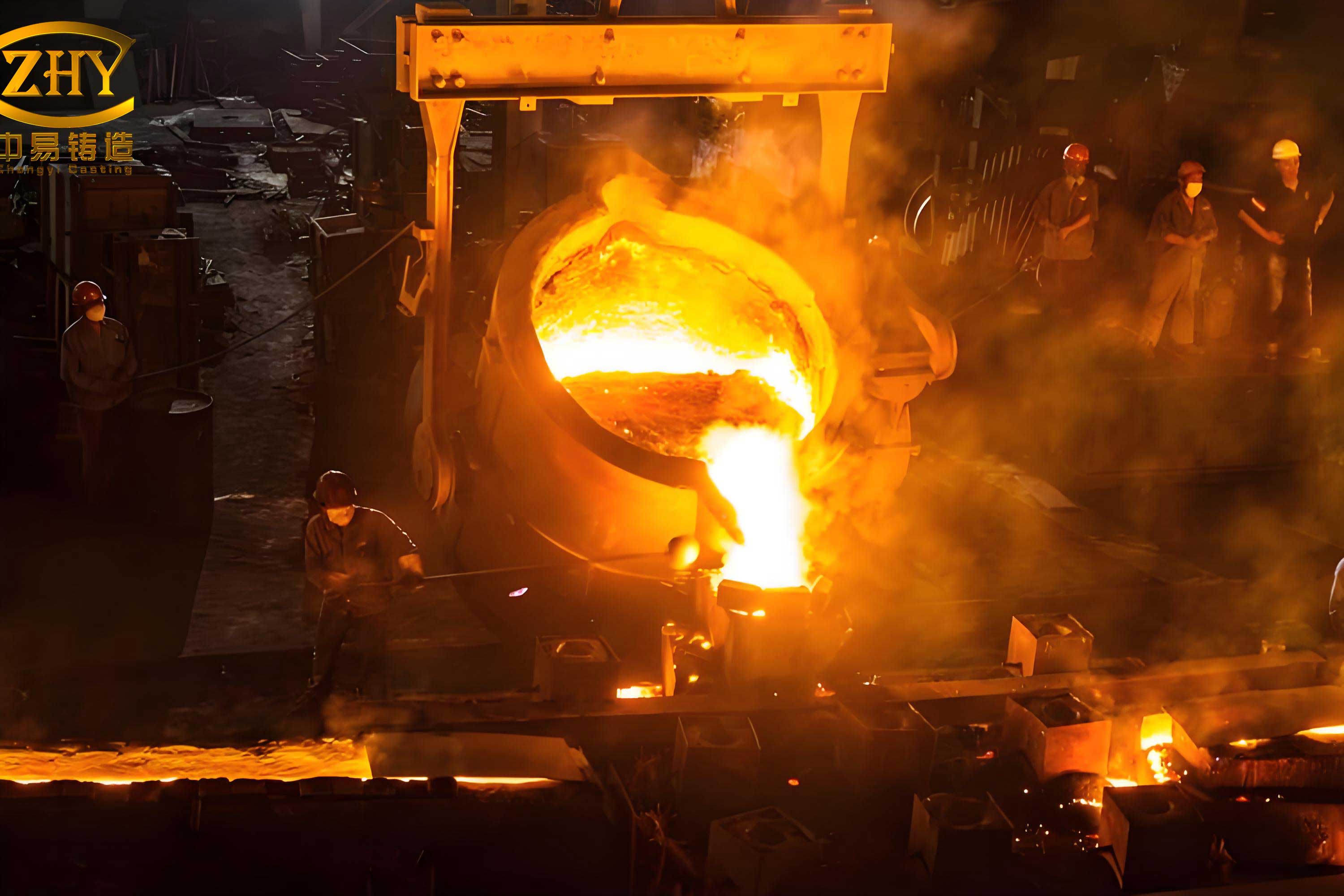
To avoid涡流, a flat sprue is used with dimensions 20 mm × 6 mm. The浇注 system ratios are set as \( A_{sprue} : A_{runner} : A_{gate} = 1 : 2 : 1.5 \). The runner is designed as a阶梯式 to control the timing of gate activation, and过滤网 are placed to reduce turbulence and trap inclusions. This meticulous design is essential for high-quality sand castings.
The alloy composition and treatment parameters for the sand castings are critical. I have summarized them in the following tables to ensure reproducibility and quality control in sand castings production.
| Element | Al | Mg | Si | Cu | Fe | Others |
|---|---|---|---|---|---|---|
| Content | Bal. | 4.0-5.0 | 0.3 | 0.1 | 0.2 | <0.1 |
| Melting Temperature (°C) | Refining Agent (wt%) | Refining Time (min) | Modifier (wt%) | Modification Time (min) | Standing Time (min) |
|---|---|---|---|---|---|
| 720-750 | 1.0 | 10 | 0.5 | 5 | 15 |
冷铁 are employed to promote directional solidification in sand castings. Their thickness is set equal to the casting wall thickness for single-sided冷铁 and half for double-sided冷铁. This aids in forming a chilled layer at密封槽 areas, enhancing seal integrity and reducing hot spot尺寸. The浇注 temperature is maintained at 680-700°C, with careful ladling to minimize slag inclusion. Through试验, this sand castings process achieved a yield rate over 90%, demonstrating its reliability for producing defect-free sand castings.
In conclusion, my research highlights that intercritical quenching effectively suppresses high-temperature temper embrittlement in steel by refining grains, strengthening boundaries, and reducing dislocation pinning. Concurrently, the sand casting工艺 for cylinder bodies, through optimized浇注 schemes,冒口 design, and alloy control, ensures high-quality sand castings with excellent mechanical properties. The integration of these advanced processing techniques is vital for manufacturing robust components in demanding applications. Future work will explore further refinements in sand castings design and heat treatment protocols to push the boundaries of material performance.