
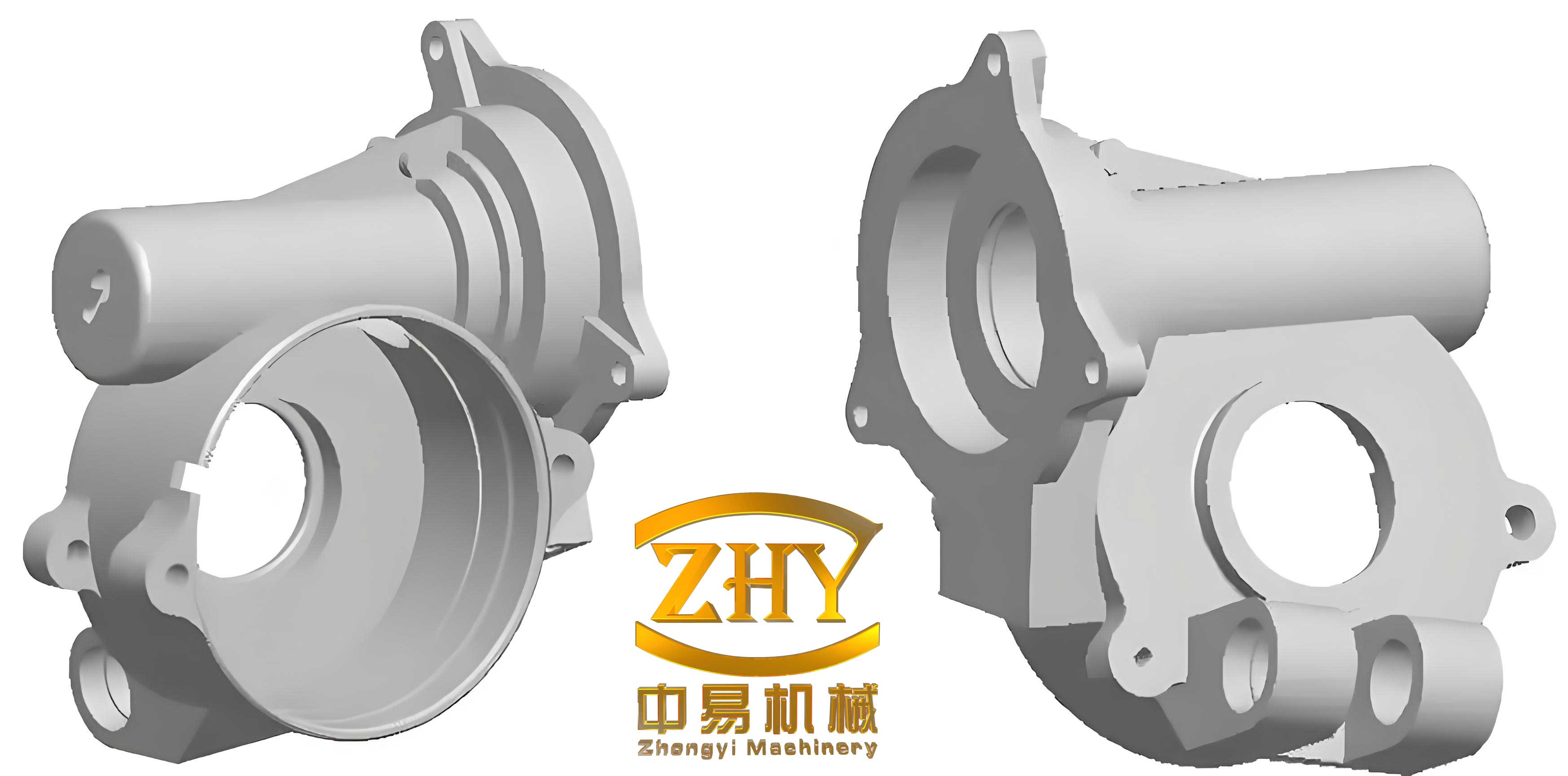
In our pursuit of manufacturing high-performance components for advanced inertial guidance systems, we faced the challenge of producing a critical aluminum alloy shell casting with exceptionally complex geometry and stringent requirements. This shell casting, serving as a gyroscope housing, demanded meticulous attention to detail in every aspect of the fabrication process. Our team embarked on a comprehensive project to leverage investment casting, a method we believed was uniquely suited for such intricate shell castings. The journey involved optimizing materials, refining processes, and validating outcomes to ensure that the final shell castings met all specifications for aerospace applications. Throughout this document, I will detail our approach, insights, and the technical nuances that define the production of these precision shell castings.
The primary component, a gyroscope shell casting, presented several defining characteristics that dictated our工艺 strategy. These shell castings are not merely enclosures but integral structural elements where performance is paramount. Below is a summary of the key specifications for these shell castings:
| Feature | Requirement |
|---|---|
| Structural Complexity | Highly intricate with thick sections over 8 mm and thin walls as low as 1.5 mm. |
| Surface Roughness | Must achieve a surface finish of Ra ≤ 3.2 µm to ensure minimal friction and optimal performance. |
| Internal Quality | Free from cold shuts, cracks, and misruns; porosity limited to Grade 2 per relevant standards. |
| Dimensional Tolerance | Critical tolerances as tight as ±0.1 mm to ensure precise assembly and function. |
| Mechanical Strength | Tensile strength ≥ 200 MPa, with adequate ductility and fatigue resistance for dynamic loads. |
Given these demands, we evaluated multiple casting methods for producing these shell castings. Pressure casting was considered for its high precision and surface quality, but the extreme complexity of the cavity, with undercuts and cores that were impractical to extract, rendered it unsuitable.石膏型 casting, while popular abroad for complex thin-walled parts, was in a nascent experimental stage domestically, and our timeline for delivering viable shell castings precluded lengthy development cycles. Consequently, we turned to investment casting, a technique renowned for its ability to replicate intricate details and achieve high integrity in shell castings. Collaborating with a leading facility experienced in aerospace components, we initiated trials that ultimately yielded shell castings meeting over 90% of quality targets, sufficient for prototype and initial production needs.
The success in producing these shell castings hinged on a holistic工艺 approach, integrating careful material selection and controlled process parameters. Below, I outline the core stages of our investment casting process for these aluminum alloy shell castings.
Wax Pattern Formulation and Injection
For shell castings with such fine features, the wax pattern is the foundation of dimensional accuracy. We required a pattern material with excellent replicability to capture the mold’s surface, low shrinkage to minimize distortion, high mechanical strength at room temperature to withstand handling, and good wettability for uniform ceramic coating. After testing various blends, we adopted a zero-draft wax formulation tailored for precision shell castings. The composition and properties are summarized in the tables below.
| Component | Percentage (wt.%) |
|---|---|
| Rosin | 40 |
| Microcrystalline Wax | 35 |
| Polyethylene | 15 |
| Other Additives (e.g., stearic acid) | 10 |
| Property | Value |
|---|---|
| Melting Point | 68-72 °C |
| Penetration Hardness (25°C) | 4.5-5.5 mm |
| Flowability | 180-200 mm (spiral flow test) |
| Linear Shrinkage | 0.8-1.0% |
The linear shrinkage, critical for dimensional stability in shell castings, can be expressed as:
$$ \text{Shrinkage} = \frac{L_{\text{mold}} – L_{\text{wax}}}{L_{\text{mold}}} \times 100\% $$
where \( L_{\text{mold}} \) is the mold dimension and \( L_{\text{wax}} \) is the wax pattern dimension after cooling. We maintained this below 1% to ensure accuracy.
Wax injection was performed on automated equipment with strictly controlled parameters to produce consistent patterns for our shell castings. The settings are detailed in Table 3.
| Parameter | Value |
|---|---|
| Injection Pressure | 0.5-0.7 MPa |
| Injection Temperature | 58-62 °C |
| Mold Temperature | 22-25 °C |
| Holding Time | 30-40 seconds |
| Cooling Time | 3-5 minutes |
Ceramic Shell Build-Up
The ceramic shell is pivotal in defining the surface quality and dimensional fidelity of the final shell castings. For aluminum alloys, the shell must exhibit high permeability to allow gas escape, adequate strength to withstand metallostatic pressure, and a smooth inner surface to replicate fine details. We employed a single-pour, multi-layer shell system, utilizing different refractory materials for the face and backup coats. The shell build-up process is summarized in Table 4.
| Layer | Binder | Refractory Flour | Sand Stucco | Drying Conditions |
|---|---|---|---|---|
| Primary Coat | Silica Sol | Zircon Flour | Zircon Sand | 22-25°C, 50-60% RH, 4-6 hrs |
| Secondary Coats (2-3) | Silica Sol | Zircon Flour | Zircon Sand | 22-25°C, 50-60% RH, 4-6 hrs |
| Intermediate Coats (2-3) | Ethyl Silicate | Calcined Kaolin | Calcined Kaolin | 22-25°C, 40-50% RH, 6-8 hrs |
| Seal Coat | Ethyl Silicate | Fused Alumina | Fused Alumina | 22-25°C, 40-50% RH, 8-10 hrs |
The selection of refractories was based on their properties: zircon flour offers high chemical inertness and a fine surface finish for shell castings, while calcined kaolin provides good strength and collapsibility. Fused alumina enhances high-temperature stability. The strength of the shell as a function of temperature is crucial. For a shell with calcined kaolin, the tensile strength \( \sigma \) varies with temperature \( T \) (in °C) approximately as:
$$ \sigma(T) = \sigma_0 \cdot e^{-k(T – T_0)} $$
where \( \sigma_0 \) is the strength at room temperature, \( k \) is a material constant, and \( T_0 \) is reference temperature. Our tests showed that reducing the Al₂O₃ content in kaolin below 45% lowered room-temperature strength, improving collapsibility for shell castings without compromising high-temperature performance.
Permeability \( P \) of the shell, vital for avoiding gas defects in shell castings, relates to temperature and pore structure:
$$ P = \frac{C \cdot d^2 \cdot \phi}{\mu \cdot L} $$
where \( C \) is a constant, \( d \) is pore diameter, \( \phi \) is porosity, \( \mu \) is gas viscosity, and \( L \) is shell thickness. We optimized coating viscosity and stucco粒度 to achieve permeability above 20 GPU at casting temperatures.
Dewaxing and Shell Firing
Dewaxing was conducted in a high-pressure autoclave using steam at 0.6-0.8 MPa for 10-15 minutes, following a “fast-in, slow-out” principle to quickly remove wax without shell cracking. Subsequent firing of the shell castings’ molds was performed to dehydrate the silica gel, burn out residual wax, and develop final strength. The firing cycle involved heating to 900-950°C at a rate of 100-150°C/hour, holding for 2 hours, and then cooling to 600°C for pouring. This ensured the shell had adequate hot strength and low residual carbon for aluminum shell castings.
Alloy Melting and Pouring
The shell castings were made from ZL101A (A356 equivalent) aluminum-silicon alloy, chosen for its excellent fluidity, low shrinkage, and good mechanical properties. The composition targets are in Table 5.
| Element | Percentage (wt.%) |
|---|---|
| Si | 6.5-7.5 |
| Mg | 0.25-0.45 |
| Al | Balance |
| Impurities (Fe, Cu, etc.) | < 0.2 each |
Melting was done in a resistance crucible furnace under a protective flux. Key steps included degassing with hexachloroethane tablets (0.3-0.5% of charge) at 720-740°C, followed by skimming. The melt temperature was kept below 750°C to minimize gas pickup. The total melt-to-pour time was under 2 hours to prevent degradation. Pouring parameters for the shell castings were critical: preheated shells at 300-400°C, pouring temperature of 700-720°C, and a fill time of 5-8 seconds to ensure complete filling of thin sections without turbulence. The fluidity index \( F \) for the alloy can be approximated as:
$$ F = k \cdot (T_{\text{pour}} – T_{\text{liquidus}}) $$
where \( k \) is a constant, \( T_{\text{pour}} \) is pouring temperature, and \( T_{\text{liquidus}} \) is the liquidus temperature (~615°C for ZL101A). Our settings ensured \( F \) was sufficient for the complex shell castings.
Castings Cleaning and Heat Treatment
After solidification, shell removal was achieved via mechanical vibration and water jetting, carefully avoiding damage to the delicate shell castings. Heat treatment was essential to meet mechanical specs. The regimen included solutionizing at 535±5°C for 6-8 hours, quenching in hot water (60-80°C), and artificial aging at 155±5°C for 4-6 hours. Table 6 compares mechanical properties of investment-cast test bars versus sand-cast counterparts, demonstrating the viability of our process for high-strength shell castings.
| Casting Method | Tensile Strength (MPa) | Yield Strength (MPa) | Elongation (%) |
|---|---|---|---|
| Investment Casting (Our Process) | 210-230 | 160-180 | 4-6 |
| Sand Casting (Reference) | 230-250 | 180-200 | 5-8 |
The data shows investment-cast shell castings achieved ~90% of the sand-cast strength, with adequate ductility for service. The slight reduction is attributed to finer microstructures in sand casts, but our shell castings met the minimum 200 MPa requirement consistently.
Challenges and Ongoing Improvements
Despite overall success, we encountered difficulties in shell removal, where aggressive methods sometimes led to cracking or distortion in the shell castings. This remains an area for refinement, potentially via modified shell compositions with higher collapsibility or advanced decoring techniques. We are exploring organic binders or alternative refractory systems to enhance post-cast disintegration without compromising shell integrity during pouring.
In conclusion, the production of complex aluminum shell castings via investment casting demands an integrated approach from pattern to heat treatment. Our工艺, emphasizing optimized wax formulations, tailored ceramic shells, controlled melting, and precise pouring, has proven effective in delivering shell castings with high dimensional accuracy, surface quality, and mechanical performance. The repeated focus on shell castings throughout this process underscores their critical role in advanced engineering applications. Future work will aim to further improve shell collapsibility and reduce costs, ensuring that investment casting remains a cornerstone for manufacturing precision shell castings in aerospace and beyond.