
The art of casting bronze bells presents a unique set of challenges within the broader field of metalworking. These objects are not merely static sculptures; they are dynamic, acoustic instruments whose final quality is judged by both visual perfection and sonic purity. Achieving the required structural integrity, intricate surface detail, and precise acoustic properties in a single pour is a complex undertaking. Traditional trial-and-error methods for developing a casting process are costly, time-consuming, and often unreliable for such large, critical castings. In my work, I have leveraged the power of numerical simulation to systematically analyze and optimize the sand casting process for a large bronze bell, successfully minimizing defects and ensuring product quality.
The foundation of this work lies in the sand casting process itself, one of the oldest and most versatile methods for shaping metal. In this process, a reusable pattern is used to form a cavity within compacted sand molds. Molten metal is then poured into this cavity, where it solidifies to form the casting. The flexibility of sand molds allows for the production of very large and geometrically complex parts, making it the ideal choice for artistic and monumental castings like bells. The properties of the molding sand, the design of the gating and feeding system, and the thermal management of the solidification process are all critical factors that determine the final quality of the sand castings.
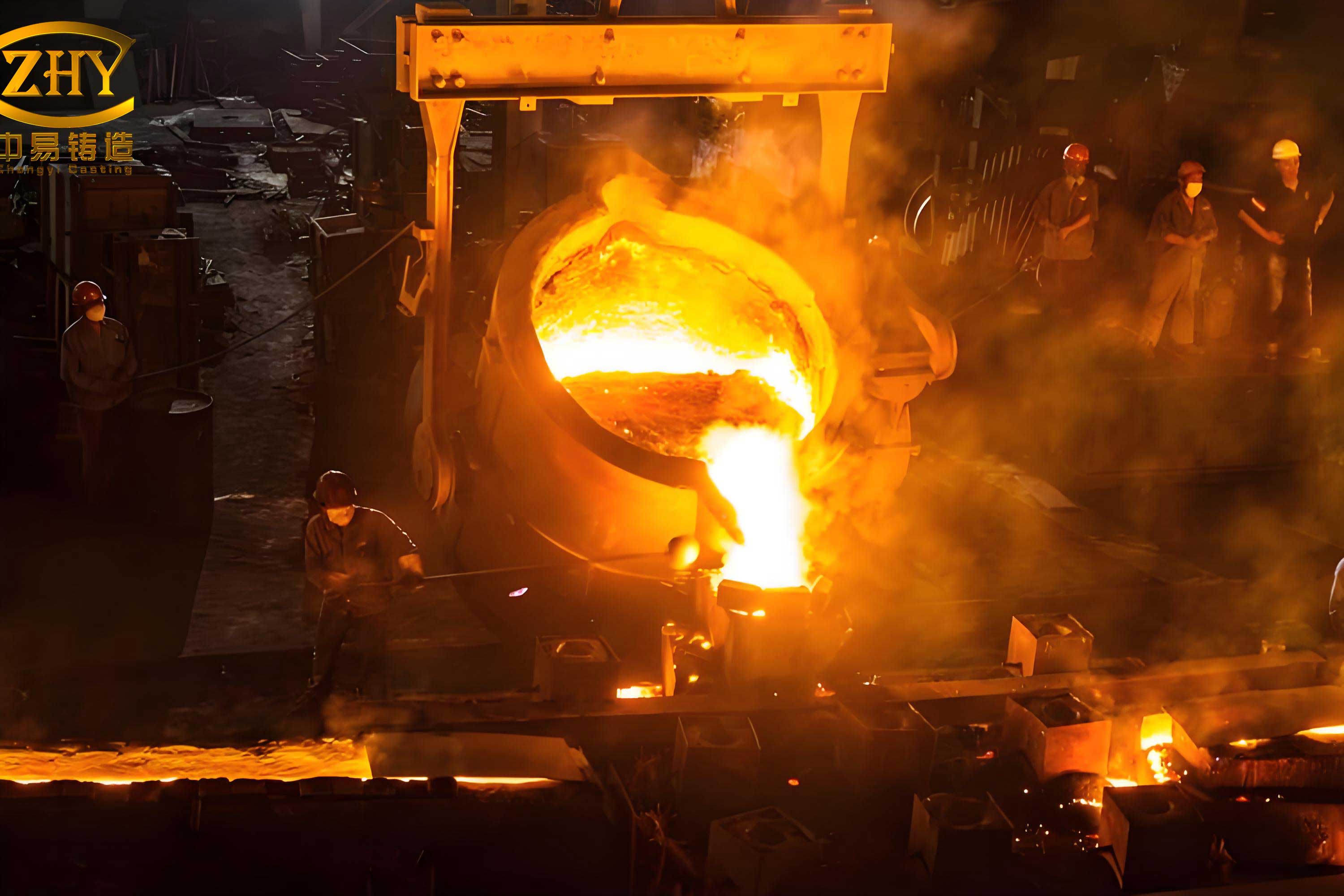
While sand casting offers great geometric freedom, it introduces significant challenges in controlling the solidification process. The relatively low thermal conductivity of the sand mold leads to slower cooling compared to metal molds. This can result in pronounced thermal gradients and, if not managed correctly, severe shrinkage defects such as macro-porosity (shrinkage cavities) and micro-porosity (shrinkage porosity). For a bronze bell, which is subject to mechanical impact from the clapper and must sustain vibrational modes, these defects are particularly detrimental. They act as stress concentrators, reducing mechanical strength and dramatically damping the acoustic vibrations, leading to a poor, muted sound. Therefore, the primary goal in process design is to achieve directional solidification, where the molten metal in the feeding system (risers) remains liquid longest and continuously feeds molten metal to compensate for the volumetric shrinkage as the casting itself solidifies from the outer surfaces inward.
My approach centers on the use of ProCAST, a sophisticated finite element-based simulation software dedicated to casting processes. This tool allows for the virtual prototyping of the entire casting process. By creating a digital twin of the mold assembly, filling it with virtual metal, and simulating the coupled phenomena of fluid flow, heat transfer, and solidification, I can predict the final outcome before any metal is melted. The software calculates key results such as temperature distribution over time, solidification sequence, and the predicted location and severity of shrinkage and porosity defects. This predictive capability transforms process development from an art into a science, enabling data-driven optimization of the gating and risering system design for sand castings.
Methodology: Simulation Setup for the Bronze Bell
The bell chosen for this study was a substantial component, with a height of 2700 mm, a bottom diameter of 2100 mm, and a final weight of approximately 6.85 metric tons. The alloy selected was a tin bronze (similar to C90300), commonly used for bell casting due to its favorable acoustic damping characteristics, castability, and patina. The mold material was furan resin-bonded sand. The simulation workflow followed a structured sequence:
- 3D Geometry and Mesh Generation: A detailed 3D solid model of the bell, including the initial gating system (sprue, runners, ingates), risers, and external chills, was created. This assembly was embedded within a block representing the sand mold. The complex geometry was then discretized into a finite element mesh. For accuracy in capturing fluid flow and thermal gradients, a sufficiently fine mesh was critical. The final model consisted of several million tetrahedral elements.
- Material Property Assignment: Accurate thermophysical data is the cornerstone of reliable simulation. The properties for the bronze alloy and the furan sand were assigned from the ProCAST material database and supplemented with literature values. Key properties included:
- Thermal conductivity ($k$) as a function of temperature.
- Specific heat capacity ($C_p$).
- Density ($\rho$).
- Latent heat of fusion ($L$).
- Liquidus and solidus temperatures ($T_l$, $T_s$).
The properties for the H13 steel chills were also defined. These data govern the heat transfer equations solved during simulation:
The governing energy equation incorporating phase change can be represented as:
$$ \rho C_p \frac{\partial T}{\partial t} = \nabla \cdot (k \nabla T) – \rho L \frac{\partial f_s}{\partial t} $$
where $f_s$ is the solid fraction.
- Pouring Temperature: 1080°C for the bronze.
- Mold and Chill Initial Temperature: 25°C and 20°C, respectively.
- Interface Heat Transfer Coefficients (HTC): These values model the thermal resistance at contacts. A HTC of 500 W/m²·K was set for the metal-sand interface, and 1000 W/m²·K for the metal-chill interface.
- Pouring Time: Calculated based on empirical formulas for sand castings.
The essential parameters for the simulation are summarized in the table below:
| Category | Parameter | Value / Material |
|---|---|---|
| Materials | Casting Alloy | Tin Bronze (Cu-Sn-Zn) |
| Mold Material | Furan Resin Sand | |
| Chill Material | H13 Tool Steel | |
| Thermal Properties (Example) | Bronze Thermal Conductivity | ~48 W/m·K |
| Sand Thermal Conductivity | ~0.72 W/m·K | |
| Bronze Latent Heat (L) | ~218 kJ/kg | |
| Sand Porosity | ~43% | |
| Process Conditions | Pouring Temperature | 1080 °C |
| Mold Initial Temperature | 25 °C | |
| Metal-Sand HTC | 500 W/m²·K | |
| Metal-Chill HTC | 1000 W/m²·K |
Initial Process Design and Simulation Findings
The initial gating design was based on established principles for heavy-section sand castings. A top-pouring “shower gate” or rain-gate system was chosen. In this design, multiple small ingates located at the top of the mold cavity allow metal to fall in streams into the mold. This aids in venting and acts as a slag trap. The cross-sectional areas of the gating system were calculated using empirical formulas common in foundry practice for sand castings.
The choke area (minimum cross-section) $F_{choke}$ was determined by:
$$F_{choke} = \frac{G}{0.31 \mu t \sqrt{H_p}}$$
where $G$ is the total metal mass (kg), $\mu$ is the total flow loss coefficient, $t$ is the pouring time (s), and $H_p$ is the average static pressure head (cm). The pouring time $t$ was estimated by:
$$t = S_1 \sqrt{\delta G}$$
where $S_1$ is a constant (typically 2) and $\delta$ is the casting wall thickness (mm).
Based on these calculations, a sprue diameter of 70 mm, a square runner of 70×70 mm, and 16 ingates of 100×8 mm each were designed. Two risers were placed at the very top of the bell (crown) to feed the upper sections and a pre-cast hanging loop. Six layers of external steel chills, 48 chills per layer, were placed around the thick “sound bow” or lip region of the bell to accelerate its cooling and reduce the freezing range relative to the thinner upper walls.
The ProCAST simulation of this initial design revealed significant issues during the solidification phase. While the filling sequence was orderly, the analysis of the solidification time and thermal gradients highlighted a problem. The simulation contour plot showed a large disparity in solidification times between the rapidly cooling thin upper sections and the slower-cooling thick lip section, despite the presence of chills. The thermal center, or the last point to solidify, was not in the risers but within the thick section of the bell’s lip itself. This is a classic condition for the formation of shrinkage porosity.
The software’s porosity prediction module confirmed this. A significant volume of macro- and micro-shrinkage was predicted in the critical sound bow area. This region is paramount for the bell’s acoustic response and mechanical strength. Defects here would lead to a bell that could crack upon striking or produce a dull, thudding sound instead of a clear, sustained tone. The initial design, therefore, failed to achieve the required directional solidification for sound sand castings. The risers were not effectively feeding the thickest section due to the long thermal path and early freezing of the feeding channels from the top.
Process Optimization: Implementing a Step-Gating System
Analysis of the simulation results pointed to the root cause: the single-tier top gating system created a “short circuit” for feeding. The upper parts of the casting solidified first, isolating the thick lower section from the liquid metal in the risers. To correct this, the gating strategy required modification to promote sequential solidification from the bottom of the casting upwards, towards the risers.
The optimized design replaced the single-tier rain gate with a three-tier step-gating system. In this new design, the main runner feeds into three separate horizontal runner levels. Each level has its own set of ingates connecting to the mold cavity at different heights: bottom, middle, and top. The total cross-sectional area of the ingates was maintained, but they were redistributed as 32 smaller ingates (80×4 mm) across the three levels.
The theoretical foundation for this change lies in better control of the thermal gradient. A bottom-gating system generally promotes more favorable temperature gradients for directional solidification. The step-gate is a practical compromise for tall castings like this bell; it minimizes splash and turbulence by initially filling from the bottom gates, while the higher-level gates engage as the metal level rises, ensuring complete filling and helping to maintain a hotter thermal field in the upper parts of the mold cavity as solidification progresses from the bottom upwards.
The simulation was rerun with this new geometry. The filling analysis showed a much more controlled fill: metal first entered through the bottom ingates, rising steadily in the cavity, then through the middle and finally the top ingates. Most importantly, the solidification simulation showed a dramatically improved pattern. The thermal gradients were realigned. The thick lip section, now fed directly by the lower and middle ingates with hotter metal later in the pour, began to solidify earlier relative to the sections above it. The solidification front now progressed more uniformly from the lip upwards towards the bell’s crown and the risers. The last point to solidify was correctly shifted into the riser necks.
The porosity prediction results provided clear validation. The volume of predicted shrinkage in the critical sound bow region was reduced by over 90%. The remaining minor porosity was isolated to non-critical areas within the riser bodies themselves, which are later removed during machining. This confirmed that the optimized three-tier system successfully established a feeding path that supported directional solidification, a fundamental requirement for producing dense, high-integrity sand castings.
The comparative results of key metrics are summarized below:
| Performance Metric | Initial Rain-Gate Design | Optimized 3-Tier Step-Gate Design |
|---|---|---|
| Filling Pattern | Top-down, multiple streams. Higher potential for turbulence. | Bottom-up, controlled rise. Lower turbulence. |
| Thermal Gradient | Disordered; thick section (lip) is thermal center. | Ordered; solidification progresses from lip upward to risers. |
| Predicted Shrinkage in Critical Lip Area | Severe macro- and micro-porosity predicted. | Negligible porosity predicted; defects confined to risers. |
| Directional Solidification Achievement | Failed. Risers isolated from thick section. | Successful. Risers effectively feed entire casting. |
Discussion and Practical Implementation
The transition from a rain-gate to a step-gate system for this large bell casting illustrates a critical principle in gating design for sand castings: the goal is not merely to fill the mold, but to manage the thermal history of the solidifying metal to facilitate feeding. The simulation provided an unambiguous visual and quantitative comparison of how different gating architectures directly influence the thermal field, which in turn dictates the location and severity of shrinkage defects.
The mechanism of improvement can be explained through the concept of “thermal centering.” The initial design placed the hottest metal at the top of the mold at the start of the pour. As heat transferred to the sand, a steep temperature gradient was established with the hottest zone remaining at the top and the coolest at the bottom (near the early-poured metal). This worked against feeding the thick lip. The step-gate system essentially “injects” fresh, hot metal at multiple levels during the fill. The lower gates introduce heat into the bottom region later in the cycle, effectively repositioning the thermal center and creating a more favorable temperature gradient aligned with the geometric need for bottom-up solidification.
Guided by the simulation results, the optimized three-tier gating system was implemented in the actual production of the bell. The pouring was conducted using the simulated parameters as a guide. The resulting rough casting was inspected thoroughly. Visual and non-destructive testing confirmed the absence of major shrinkage defects in the critical sound bow region. The casting was sound, allowing for successful finishing and tuning. The final bell met all aesthetic and, most importantly, acoustic requirements, producing a clear, resonant tone with the expected duration and harmonic profile. This successful outcome validates the virtual optimization process and highlights the practical value of simulation in solving complex problems in sand castings.
Furthermore, this study underscores several broader advantages of using simulation like ProCAST for sand castings development:
- Risk Mitigation: It identifies potential failures (like major shrinkage) before tooling is made or metal is poured, saving enormous cost associated with scrapped large castings.
- Design Insight: It provides a deep understanding of the physical phenomena (fluid flow, heat transfer) that are otherwise invisible during the actual casting process.
- Optimization Speed: Multiple “what-if” scenarios (chill size/location, riser design, gating layout) can be tested in days rather than the weeks or months required for physical trials.
- Knowledge Capture: The simulation model and results become a digital record of the process rationale, invaluable for future similar projects or for training.
Conclusion
In this detailed investigation, the application of ProCAST numerical simulation was demonstrated to be an exceptionally powerful tool for optimizing the sand casting process for a large, acoustically sensitive bronze bell. The initial process, based on conventional rain-gating, was found through simulation to promote an unfavorable solidification sequence that led to predicted severe shrinkage porosity in the bell’s critical sound bow. By analyzing these results, the root cause was identified as a misalignment between the thermal gradients and the geometric requirements for effective feeding.
The optimized solution involved a fundamental change to a three-tier step-gating system. Subsequent simulation of this new design confirmed a dramatic improvement: the solidification pattern was successfully redirected to progress directionally from the thickest sections upward toward the risers, thereby eliminating the predicted shrinkage defects in the critical area. This virtual optimization was conclusively validated by the production of a sound, high-quality casting that met all functional and aesthetic requirements.
This work conclusively shows that for complex and demanding sand castings like musical bells, numerical simulation is no longer just an advanced tool but a necessary component of a robust engineering process. It enables a scientific, data-driven approach to gating and risering design, ensuring first-pass success, reducing material and energy waste, and guaranteeing the highest quality in the final product. The methodology and insights gained are directly applicable to a wide range of other challenging sand castings where controlling solidification behavior is paramount to performance.