
In the realm of aerospace manufacturing, investment casting serves as a pivotal technique for producing complex, thin-walled components with high dimensional precision and superior mechanical properties. Our work focuses on the investment casting process for a thin-walled adjusting blade segment used in the exhaust nozzle of an advanced aircraft engine. This component is a slender, plate-like structure with intricate features including a head circular boss, a lifting lug, diagonal ribs, and a base plate. The base plate thickness is merely 1 mm, with diagonal ribs of 0.8 mm height, and the overall dimensions are approximately 600 mm × 50 mm × 1.8 mm. The material selected for this investment casting is JG4246A, a Ni₃Al-based equiaxed cast superalloy developed by Central Iron and Steel Research Institute, which exhibits excellent high-temperature mechanical properties and oxidation resistance up to 1 200 ℃. The chemical composition of this alloy is summarized in Table 1.
| Element | C | Cr | Al | Ti | W | Mo | Hf | B | O | N | Ni |
|---|---|---|---|---|---|---|---|---|---|---|---|
| Content | 0.11 | 7.94 | 7.89 | 0.89 | 1.99 | 4.03 | 0.56 | 0.0096 | 0.0003 | 0.0002 | Bal. |
| Element | Fe | Si | Mn | P | S | Bi | Sb | Pb | Sn | As | |
| Content | 0.049 | 0.014 | 0.0009 | <0.004 | 0.0013 | <0.00001 | <0.0001 | <0.0001 | 0.0002 | <0.0005 |
Investment casting of such a thin and long component presents significant challenges: the base plate is prone to warping, the thin walls make thickness uniformity difficult to control, and the narrow, lengthy flow channels increase the risk of incomplete filling and shrinkage porosity. Additionally, the internal stress from the gating system can easily cause cracks or distortion. To address these issues, we employed a ZG1.5-type vacuum induction furnace for melting the master alloy, followed by remelting and pouring in a ZG0.025-type vacuum induction furnace. The entire process was meticulously designed, from wax pattern fabrication to shell building, gating system optimization, and final pouring parameters.
Wax Pattern Preparation
In investment casting, the quality of the wax pattern directly determines the dimensional accuracy of the final metal casting. For the adjusting blade segment, we used a F28-44B mid-temperature wax with good dimensional stability to produce a one-piece wax pattern using a metal die. Because the component is long, thin, and easily deformed, we carefully controlled the injection parameters: the nozzle temperature of the wax injection machine was maintained at (70 ± 5) °C, and the holding pressure time was set to (30 ± 5) s. The resulting wax patterns exhibited high surface quality with no defects such as voids, shrinkage, or cracks. After ejection, each pattern was placed on a flat glass plate to minimize distortion during cooling and storage.
Shell Mold Fabrication
The shell mold, a critical element in investment casting, must withstand high temperatures and provide a smooth surface finish. Given the length of the component, we adopted a high-strength silica sol-based shell system. The shell consisted of two layers: a face coat and backup coats. The face coat used silica sol with 325-mesh zircon flour as the refractory, and the stucco material was 100-mesh corundum sand. This combination ensured a smooth, chemically stable surface capable of resisting molten alloy attack. The backup layers employed silica sol with mullite powder as the binder, stuccoed with mullite sand of gradually coarser grain sizes (from 30–60 mesh to 16–30 mesh). A total of seven layers were applied: one face coat and six backup coats. Each layer was allowed to dry for at least 12 hours under controlled humidity. After full drying, the shell was dewaxed in an autoclave and pre-sintered to achieve adequate strength for pouring.
Gating System Design
The gating system in investment casting must ensure smooth filling of the thin cavity and provide efficient feeding during solidification to avoid shrinkage defects. We experimentally compared three gating system designs, all based on a side-gating configuration with four cavities per cluster. The three designs are summarized in Table 2.
| Design | Description | Number of Ingates | Configuration |
|---|---|---|---|
| Design 1 | Multiple transverse ingates | 14 rows | Segmented, horizontal |
| Design 2 | Longitudinal segmented ingates | 8 rows | Segmented, vertical |
| Design 3 | Single longitudinal continuous ingate | 1 (full length) | Continuous, vertical bar along side |
Design 1 and Design 2 employed segmented ingates. Although they were expected to distribute metal flow, the castings produced with these designs exhibited significant distortion and shrinkage porosity in the base plate, as revealed by fluorescent penetrant inspection. The shrinkage defects (indicated by fluorescent indications) were attributed to local overheating in the shell where the segmented ingates were located, causing slower solidification and consequent porosity. In contrast, Design 3, with a single continuous longitudinal ingate running the full length of the component, provided a simpler flow path and more uniform temperature distribution. The resulting castings showed minimal distortion and no shrinkage defects. Therefore, we selected Design 3 as the optimal gating system for this investment casting.
To further verify the efficacy of Design 3, we performed numerical simulation using ProCAST software. A finite element model of the casting plus gating system was constructed, and the pouring parameters were set as follows: shell preheat temperature 1 000 °C, pouring temperature 1 470 °C. The simulation analyzed mold filling and solidification, with particular attention to flow behavior and temperature fields. The results indicated a smooth, progressive mold filling pattern and a nearly directional solidification sequence. The predicted shrinkage porosity volume was only 0.007 412 cm³, confirming the low shrinkage tendency. This matched the experimental observations well.
Pouring Process Parameters
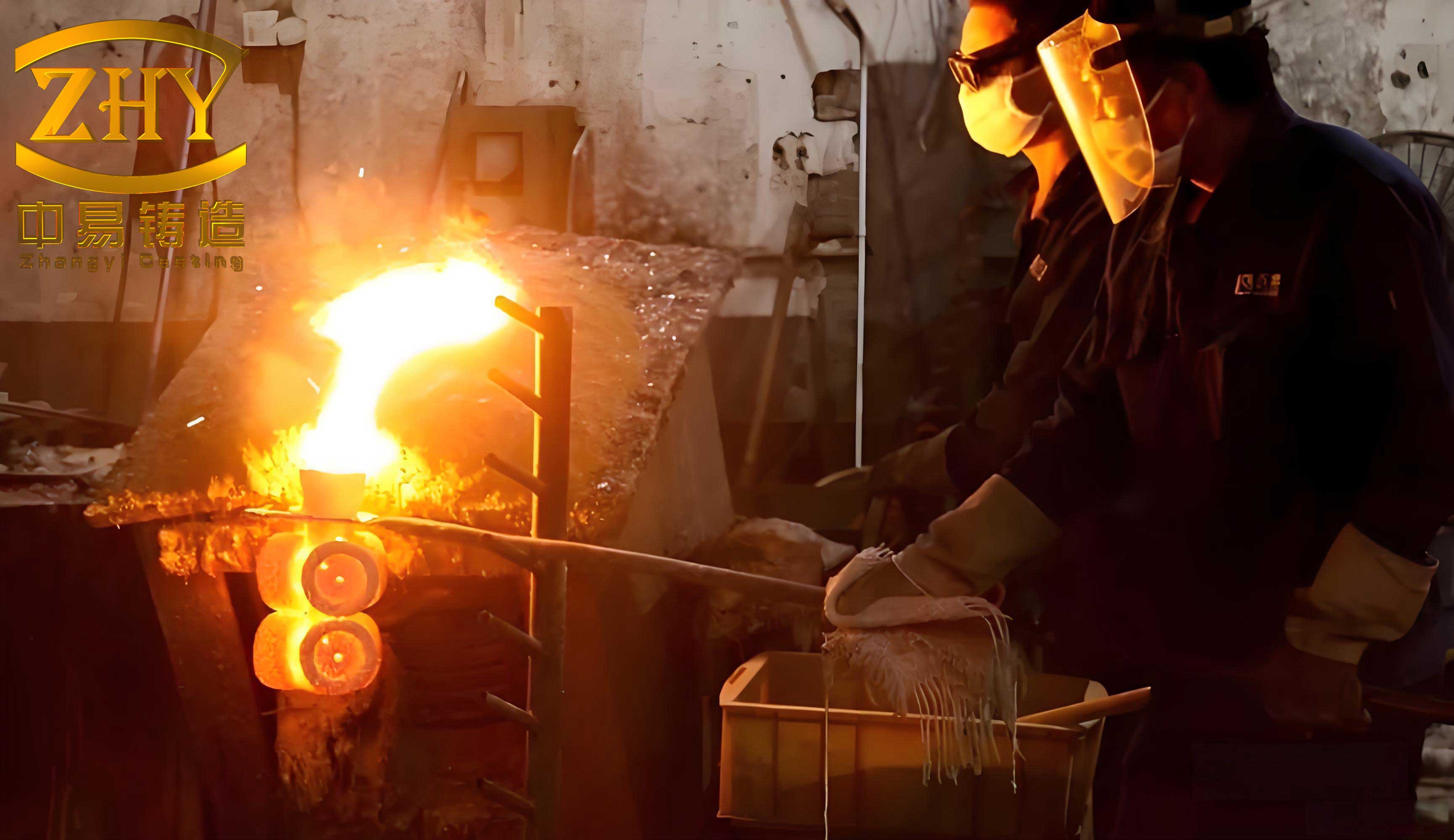
For thin-walled investment castings, achieving complete filling of the complex cavity requires precise control of thermal conditions. We employed a vacuum gravity pouring setup with a sand-backing process. The shell mold was placed in a preheated furnace at 1 000 °C, and the pouring temperature of the molten alloy was 1 470 °C. The high shell temperature reduces the thermal gradient between the melt and the mold, slowing down the cooling rate of the melt and thereby improving its fluidity. The pouring temperature itself directly affects the viscosity and fillability of the liquid metal; higher temperature promotes better flow. Table 3 lists the key pouring parameters used in our investment casting trials.
| Parameter | Value |
|---|---|
| Shell preheat temperature | 1 000 °C |
| Pouring temperature | 1 470 °C |
| Vacuum level | ≤ 1 × 10⁻² Pa |
| Mold material | Silica sol bonded mullite/zircon |
| Pouring method | Bottom gating (single longitudinal ingate) |
After pouring, the castings were allowed to cool in the vacuum chamber before being removed. The castings then underwent cutting, grinding to remove the ingate, and hot sizing to correct any minor distortions. Finally, non-destructive testing (fluorescent penetrant and radiographic inspection) confirmed that the castings were free from porosity, cracks, and other metallurgical defects, meeting all technical specifications.
Control of Casting Distortion
Thin-walled investment castings are particularly sensitive to thermal stresses and non-uniform shrinkage, which can lead to distortion. In our initial trials using Design 3, we observed that the castings exhibited a noticeable deformation in the width direction, primarily near the middle lifting lug. The deformation pattern is shown schematically in Figure 5 of the original reference (not reproduced here). The likely cause was the asymmetric geometry of the lug, which created uneven thermal contraction. To counteract this, we introduced a wax pattern dummy block (a symmetrical compensation feature) on the opposite side of the lug, effectively making the cross-section symmetric about the centerline. This simple modification equalized the shrinkage forces and eliminated the width-wise distortion. After implementing this change, the castings produced showed no measurable deviation in width, as verified by coordinate measuring machine inspection.
The relationship between thermal stress and distortion can be described by the thermal stress equation:
$$ \sigma = E \cdot \alpha \cdot \Delta T $$
where:
E = Young’s modulus of the alloy (approx. 200 GPa at elevated temperatures),
α = coefficient of thermal expansion (approx. 16 × 10⁻⁶ /°C for Ni-based superalloys),
ΔT = temperature difference between the hot and cold regions during solidification.
For a typical ΔT of 200 °C, the thermal stress can reach up to 640 MPa, which may exceed the yield strength at high temperatures, causing plastic deformation. By balancing the geometry with a dummy block, we reduced the ΔT gradient across the part, thus minimizing distortion.
Another critical parameter in investment casting is the solidification time, which affects the feeding efficiency and the formation of shrinkage porosity. The solidification time for a plate-like casting can be approximated by Chvorinov’s rule:
$$ t = \frac{M^2}{K^2} $$
where:
t = solidification time,
M = modulus (volume/surface area) of the casting,
K = mold constant that depends on the thermophysical properties of the metal and mold.
For the base plate of thickness 1 mm, the modulus is very small, leading to very rapid solidification. However, the gating system must remain liquid to feed the solidifying shrinkage. In our optimized design, the single longitudinal ingate provided a large thermal mass that stayed molten longer, ensuring adequate feeding.
Summary of Experimental Results
To provide a clear overview, we compiled the results from the three gating system designs in Table 4.
| Design | Shrinkage Porosity | Width Distortion | Filling Defects |
|---|---|---|---|
| Design 1 (14 transverse ingates) | Present (fluorescent indications) | Large ( > 0.5 mm) | None |
| Design 2 (8 longitudinal ingates) | Present (fluorescent indications) | Moderate ( ~ 0.3 mm) | None |
| Design 3 (single continuous ingate) | Absent (simulated porosity volume 0.0074 cm³) | Initially present (0.2 mm) until dummy block added; eliminated afterwards | None |
The numerical simulation for Design 3 also provided the temperature field evolution. A key parameter is the thermal gradient at the solidification front, which influences the formation of equiaxed or columnar grains. The fluid flow during filling was simulated using the Navier-Stokes equations combined with the heat transfer equation. The simulation results confirmed that the flow front advanced uniformly without air entrapment, as shown by the velocity field contours. The final shrinkage porosity volume of 0.007 412 cm³ is negligible for an investment casting of this size.
Conclusion
In summary, the investment casting process for the thin-walled adjusting blade segment was successfully developed through systematic optimization of wax pattern, shell mold, gating system, and pouring parameters. The key findings are:
- The single continuous longitudinal ingate (Design 3) outperformed segmented ingates by providing smoother filling, reduced thermal gradients, and elimination of shrinkage porosity.
- High shell preheat temperature (1 000 °C) and pouring temperature (1 470 °C) ensured complete filling of the thin cavity without causing excessive thermal stress.
- The width-direction distortion caused by asymmetric geometry was effectively mitigated by adding a dummy block to balance the shrinkage forces.
- The final investment castings met all dimensional and metallurgical requirements, demonstrating the feasibility of producing large, thin-walled Ni₃Al-based superalloy components via investment casting.
This work highlights the importance of a holistic approach in investment casting, where mold design, thermal management, and geometric compensation must be carefully tailored to the specific component. The techniques developed here can be extended to other thin-walled, complex investment castings in aerospace applications.