
In my extensive career as a foundry engineer, I have dedicated myself to understanding and resolving the myriad challenges associated with metal casting defect formation. The pursuit of high-quality castings, particularly in gray iron, often hinges on a delicate balance between alloy composition, process parameters, and geometric design. A common metal casting defect, such as shrinkage porosity, hard spots, or distortion, can lead to significant scrap rates and financial losses. This article synthesizes my firsthand experiences and analyses concerning low-alloying of gray iron and specific case studies on component failure, aiming to provide a comprehensive guide for mitigating these issues. I will delve into the intricacies of element addition, process optimization, and the fundamental principles that govern the occurrence of metal casting defect.
The foundation of preventing metal casting defect in gray iron begins with its chemical composition. Low-alloying is a powerful strategy to enhance mechanical properties like tensile strength and hardness without resorting to full heat treatment. However, this approach is fraught with pitfalls that can inadvertently promote various metal casting defect. The primary concern is the inhibition of graphitization and the promotion of chill, or white iron formation. Elements such as chromium (Cr) and vanadium (V) are potent carbide stabilizers. While they are excellent for promoting a pearlitic matrix and refining the structure, their excessive use leads to a pronounced risk of forming hard, brittle carbides at the eutectic cell boundaries, a severe metal casting defect that impairs machinability and toughness. The key is to achieve complete pearlitization without inducing chill. From my practice, I have found that a synergistic approach using multiple elements in small amounts is most effective. For instance, combining molybdenum (Mo) and copper (Cu) can offset the chilling tendency of Cr while still refining the pearlite. The relationship between alloy addition and the resultant microstructure can be summarized by the following conceptual formula for the chilling tendency index, \( C_t \), which I often use for estimation:
$$ C_t = k_1 \cdot \%Cr + k_2 \cdot \%V – k_3 \cdot \%Si – k_4 \cdot \%Cu $$
Where \( k_1, k_2, k_3, k_4 \) are empirical coefficients specific to the foundry’s melting practice and section thickness. A positive \( C_t \) indicates a heightened risk for this specific metal casting defect.
To systematically address the metal casting defect related to alloying, I have developed a sequential methodology for alloy addition when aiming for high-strength grades with minimal alloy use:
- Step 1: Carbon Equivalent Adjustment – After fixing the carbon equivalent (CE), which is calculated as \( CE = C + \frac{1}{3}(Si + P) \), the first action is to lower the silicon content as much as possible. This increases the inherent strength of the iron but requires careful control to avoid graphitization issues.
- Step 2: Addition of Elements to Delay Free Ferrite – Elements like tin (Sn) or antimony (Sb) in trace amounts (often below 0.1%) are added to suppress the formation of soft free ferrite, ensuring a fully pearlitic matrix.
- Step 3: Addition of Quench-Promoting Elements for Pearlite Refinement – To strengthen the pearlitic matrix itself, small additions of elements like chromium or molybdenum are introduced. These refine the pearlite lamellar spacing, significantly increasing hardness and strength.
- Step 4: Utilization of Complementary Element Effects – This is where the art of foundry engineering shines. Using composite additions such as Cr-Cu, Cr-Mo, or Mo-Cu can create a synergistic effect. For example, copper promotes pearlite but has minimal chilling effect, so it can counteract the white iron tendency of chromium while Mo refines the structure. The optimal combination depends heavily on the casting modulus (volume-to-surface area ratio).
The interaction of common alloying elements and their influence on key metal casting defect risks is best captured in a table:
| Alloying Element | Effect on Graphitization | Effect on Pearlite Formation | Risk of White Iron Formation (Chill) | Typical Addition Range (wt.%) | Primary Associated Metal Casting Defect if Over-added |
|---|---|---|---|---|---|
| Chromium (Cr) | Strongly inhibits | Strongly promotes | Very High | 0.1 – 0.3 | Chill, shrinkage porosity, carbide networks |
| Molybdenum (Mo) | Mildly inhibits | Refines and stabilizes | Moderate | 0.2 – 0.5 | Localized chill in thin sections |
| Copper (Cu) | Very mild effect | Promotes | Low | 0.5 – 1.2 | Minimal, but can affect machinability at high levels |
| Tin (Sn) | Mildly inhibits | Strongly promotes | Low to Moderate | 0.05 – 0.1 | Embrittlement, inverse chill |
| Vanadium (V) | Strongly inhibits | Promotes carbide formation | Extremely High | 0.1 – 0.2 | Severe chill, hard spots, shrinkage |
Another critical factor often overlooked is phosphorus content. In general gray iron, phosphorus is around 0.1%. However, when alloying, phosphorus can easily form hard, brittle phosphide eutectic networks, especially with elements like chromium and vanadium. This constitutes another detrimental metal casting defect that severely reduces impact strength. My rule is to keep phosphorus below 0.06% in alloyed irons to avoid this issue. The propensity for phosphide formation can be related to a phosphide potential, \( P_p \), which I approximate as:
$$ P_p = \%P \times (\%Cr + 2 \times \%V) $$
Keeping \( P_p < 0.01 \) is a good practical target to prevent this metal casting defect.
Inoculation is an indispensable tool in the fight against metal casting defect like chill and undercooled graphite. Even with careful alloying, the inherent chilling tendency must be counteracted at the moment of solidification. Effective inoculation with ferrosilicon-based inoculants modifies the eutectic solidification, promoting type A graphite and reducing undercooling. The inoculation effect, however, fades with time (fade effect), so late stream inoculation is often my preferred method. The number of graphite nodules in ductile iron or the graphite form in gray iron is crucial. While adding cerium (Ce) or magnesium (Mg) in trace amounts can increase nodule count in ductile iron, it also tends to reduce graphite nodule size, which must be balanced against mechanical property requirements.
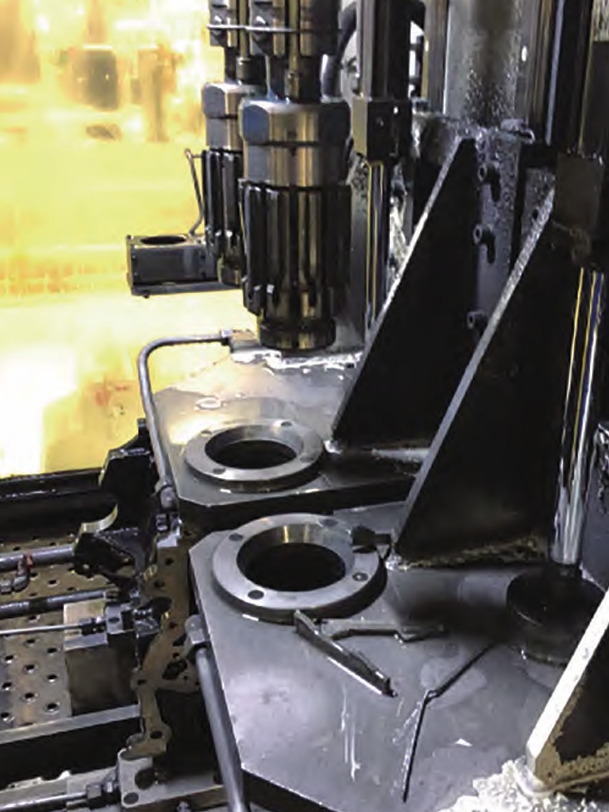
The complexity of preventing metal casting defect is not limited to chemistry; it extends profoundly into the realm of casting design and process execution. A vivid example from my work involves a motorcycle wheel hub bushing, a small but critical component. The part, weighing only about 0.25 kg, had several thermal hotspots with a nominal wall thickness of only 5 mm. The original process used green sand molding without feeders, leading to severe shrinkage porosity in the hub’s inner diameter after machining—a classic metal casting defect causing a scrap rate of 40-50%. The financial impact was substantial. Our analysis pinpointed the issue: the combination of alloy composition favoring pearlite but also increasing shrinkage tendency, coupled with inadequate feeding at the thermal junctions. The solution was multi-pronged. First, we tightened the chemical composition: Carbon between 3.2-3.4%, Silicon 1.8-2.0%, Manganese 0.6-0.8%, and we minimized Chromium to below 0.15%. Second, we increased the pouring temperature to above 1380°C to improve fluidity and feeding. The most significant change was a minor but critical design modification: we added small recesses (0.5 mm deep) at the three thermal hotspot locations on the casting’s inner diameter. This effectively made the wall section more uniform, eliminating the isolated hot spots. The revised design, combined with the controlled chemistry, completely eradicated the shrinkage metal casting defect, bringing the scrap rate to near zero. This case underscores that even a slight geometry change, guided by solidification simulation or empirical knowledge, can be more powerful than complex alloy adjustments in solving a feeding-related metal casting defect.
Another pervasive metal casting defect, especially in large, thin-walled plates, is warping and distortion. I encountered this in the production of an end cover plate for textile machinery. The plate measured 1500 mm x 800 mm x 10 mm, weighing 80 kg. The material was HT200 gray iron. The recurring metal casting defect was a buckling or bowing of the central area by 5-10 mm, rendering the part unusable. The root cause was non-uniform cooling and the development of residual stresses. Our corrective actions focused entirely on process optimization to ensure uniform thermal conditions. We implemented a top-gating system with the sprue placed along the thinner edge of the pattern. The gating system was designed as an open type with a ratio of 1.0 (sprue) : 1.2 (runner) : 1.5 (ingates). The key innovation was tilting the mold by 5-10 degrees during pouring. This tilt, combined with a relatively high pouring temperature (1360-1380°C) and fast pouring time (15-20 seconds), ensured a more sequential and uniform filling, reducing thermal gradients. Furthermore, we applied graphite powder to the mold surface, vented the cope with numerous small vents, ensured uniform mold hardness (85-90 units), and clamped the mold securely with bolts. The result was the complete elimination of the distortion metal casting defect. The governing principle here can be related to the thermal stress, \( \sigma_{th} \), developed during cooling:
$$ \sigma_{th} = E \cdot \alpha \cdot \Delta T $$
Where \( E \) is Young’s modulus, \( \alpha \) is the thermal expansion coefficient, and \( \Delta T \) is the temperature difference across the casting section. By minimizing \( \Delta T \) through uniform filling and cooling, we minimized \( \sigma_{th} \) and thus the driving force for this geometric metal casting defect.
To encapsulate the relationship between casting modulus (M), which is the volume-to-cooling-surface-area ratio, and the required alloy addition for a fully pearlitic matrix, I have developed empirical charts for our production. However, a simplified correlation can be expressed for a base iron with CE around 4.0. The required total alloy factor, \( A_f \), to achieve >95% pearlite without free ferrite for a given modulus M (in cm) is approximated by:
$$ A_f = a \cdot \exp(-b \cdot M) + c $$
Where \( a, b, c \) are constants derived from plant data. For our conditions, \( a \approx 0.5, b \approx 0.7, c \approx 0.1 \). \( A_f \) is the sum of the weighted contributions of pearlite-promoting elements: \( A_f = \%Cr + 0.5 \times \%Mo + 0.3 \times \%Cu + 2 \times \%Sn \). This formula helps quickly estimate the minimum alloy needed to prevent the metal casting defect of soft ferrite formation in heavier sections, while avoiding excess that causes chill in thinner sections.
The interplay between process parameters and the occurrence of metal casting defect is systematic. Below is a summary table of common metal casting defect in low-alloyed gray iron, their root causes linked to alloying/process, and the recommended corrective actions based on my experience:
| Metal Casting Defect | Primary Manifestation | Alloying-Related Cause | Process-Related Cause | Corrective Strategy |
|---|---|---|---|---|
| Shrinkage Porosity | Interdendritic voids, often in hot spots | High alloy content (Cr, V) reducing graphitization expansion; High CE increasing liquid shrinkage | Inadequate feeding (no risers, poor gating); Low pouring temperature | Optimize CE; Use FeSi inoculation; Modify design to eliminate hot spots; Increase pouring temperature; Implement effective risering. |
| Chill / White Iron | Hard, unmachinable carbide surface layer | Excess of carbide-stabilizers (Cr, V); Low Si content; Lack of inoculant | High cooling rate (thin section, metal chills); Low pouring temperature | Balance alloy additions with Si and Cu; Use powerful, late inoculation; Increase pouring temperature; Consider mold coating. |
| Free Ferrite Soft Spots | Soft areas in matrix, reducing hardness | Insufficient pearlite-promoters (Sn, Cu, Cr) for section size; High Si content | Slow cooling in heavy sections; Excessive inoculant | Add pearlite stabilizers per modulus; Control Si content; Ensure moderate cooling rate (e.g., use chills). |
| Distortion / Warping | Geometric deviation from intended shape | Non-uniform microstructure (e.g., mixed pearlite/ferrite) creating differential contraction | Non-uniform filling/cooling; Poor mold support; High residual stress | Use uniform gating (tilted pour); Ensure mold rigidity and even hardness; Stress relieve if necessary; Optimize casting geometry. |
| Carbide Networks (Phosphides) | Brittle intercellular phases | High P combined with carbide formers (Cr, V) | Rapid solidification favoring eutectic segregation | Keep P < 0.06%; Limit Cr/V additions; Moderate cooling rate. |
In conclusion, the mitigation of metal casting defect in gray iron, especially when employing low-alloying strategies, is a multidimensional challenge. It requires a deep understanding of metallurgical principles, a methodical approach to alloy selection and addition sequencing, and a relentless focus on process control and casting design. From my perspective, the most effective philosophy is one of prevention: use the minimum amount of alloy necessary to achieve the desired properties, leverage the synergistic effects of composite additions, and never underestimate the power of a well-designed gating system and a minor geometric modification. Inoculation remains a cornerstone practice to combat chilling, a prevalent metal casting defect. For large, thin-walled castings, controlling thermal gradients through innovative pouring techniques is paramount to avoid distortion, another costly metal casting defect. Ultimately, each foundry must develop its own empirical relationships between composition, modulus, and process settings, as the behavior of molten iron is uniquely influenced by local materials and practices. The constant vigilance against metal casting defect is what drives continuous improvement in foundry operations, leading to higher quality, reduced waste, and greater economic efficiency. The journey to perfect castings is iterative, but with a systematic approach grounded in science and enriched by practical experience, significant reductions in metal casting defect occurrence are not just possible—they are achievable.