
In my extensive experience with precision metal casting, the investment casting process has proven to be an exceptionally effective method for producing complex, thin-walled box-shaped parts, such as gearbox housings for drilling equipment. Traditional fabrication methods like welding and assembly or sand casting often lead to high production costs, extended cycles, and poor dimensional accuracy or surface quality. Through rigorous experimentation and batch production, I have successfully applied the investment casting process to manufacture such components, overcoming challenges related to pattern making, shell building, and solidification control. This article delves into a detailed analysis of the entire investment casting process for box-type parts, focusing on wax pattern fabrication, shrinkage compensation, gating and risering design, shell construction techniques, and thermal processing parameters. The investment casting process, when properly engineered, enables the production of high-integrity castings with minimal machining requirements.
The foundation of a successful investment casting process lies in the creation of accurate and robust wax patterns. For box-shaped components with large internal cavities and small external openings, pattern making presents unique difficulties. I have developed and employed two distinct strategies depending on the specific geometry. For a gearbox housing with a particularly restricted internal access, I adopted a split-pattern and assembly approach. The wax pattern is initially injected in two separate halves, which are then meticulously joined. To ensure precise alignment and strong bonding without relying on cumbersome wax welding or solvent adhesion, I devised the use of pre-heated steel pins, often made from 14-gauge iron wire, as assembly aids. These pins, heated to approximately 50°C, are evenly pressed into the joint interface of the aligned pattern halves, which are held in place by a fixed core. The pins act as internal reinforcements, locking the halves together. Subsequently, the seam and pin entry points are smoothed over with a wax wash applied by a heated knife or brush. This method ensures dimensional stability and rapid assembly. Crucially, these pins typically flow out during the subsequent dewaxing stage; any remnants dissolve upon contact with the molten metal during pouring, thus not compromising the final casting quality. The investment casting process benefits greatly from such innovative pattern assembly techniques that maintain precision.
For another gearbox design with slightly larger internal access, I implemented a method combining a removable core and loose blocks to form the internal geometry. The main challenge here was stabilizing the loose blocks within the die, as their small support points led to unreliable positioning and dimensional inaccuracy. My solution involved machining four small process holes on both sides of each loose block. Steel rods, approximately 1.5 mm in diameter, are inserted through these holes, passing through the die’s side walls and directly into the blocks. This effectively transfers the block’s weight and any lateral forces to the robust die walls, ensuring precise and stable positioning during wax injection. After wax injection, the rods are removed, and the holes are plugged with wax rods of identical diameter, followed by surface smoothing. This approach significantly enhances the dimensional consistency of the wax pattern, a critical factor for the subsequent stages of the investment casting process. The ability to adapt pattern-making techniques to part geometry is a hallmark of a flexible investment casting process.
Determining the correct pattern shrinkage allowance is not straightforward for box-shaped castings due to differential constraints during solidification. Based on empirical analysis of the interaction between the ceramic shell’s thermal expansion and the metal’s contraction, I assign distinct shrinkage rates to different features of the part. For the main body walls and internal cavities, which are heavily constrained by the shell, a reduced shrinkage rate of 0.8% to 1.0% is applied. For isolated features like pads, bosses, and flanges on the planar surfaces, which experience less restraint, a standard shrinkage rate of 1.0% to 1.2% is used. For long, extended features such as mounting feet, which are subject to complex inward contraction tendencies and external tensile forces, an intermediate shrinkage rate of 1.2% is specified. This nuanced approach to shrinkage compensation is vital for achieving net-shape dimensions in the final casting through the investment casting process.
The design of the gating and feeding system is paramount to eliminate shrinkage defects in the thick sections of the box casting, such as bearing boss zones and mounting feet. Employing a top-gating system where metal is poured directly through the risers, combined with strategic use of external chills and judicious reliance on directional solidification for self-feeding, has proven highly effective. The key dimensions for the ingates and risers are derived from the thermal characteristics of the casting, specifically the hot spot dimensions. The formulas I have developed and validated through production are as follows. The cross-sectional area of the ingate is calculated based on the hot spot diameter and the height of the metal head:
$$A_{gate} = k \cdot D_{hot} \cdot \sqrt{H_{gate}}$$
where \(A_{gate}\) is the ingate cross-sectional area (mm²), \(D_{hot}\) is the diameter of the hot spot (mm), \(H_{gate}\) is the ingate height (mm), and \(k\) is an empirical coefficient ranging from 1.2 to 1.4. The physical dimensions of the ingate are then determined:
$$H_{gate} = 12 \text{ to } 14 \text{ mm}$$
$$W_{gate} = (0.5 \text{ to } 1.0) \cdot B$$
$$L_{gate} = 6 \text{ to } 8 \text{ mm}$$
Here, \(W_{gate}\) is the ingate width (mm), \(B\) is the width of the casting section at the ingate connection point (mm), and \(L_{gate}\) is the ingate length (mm). The riser dimensions are subsequently calculated to provide adequate feed metal:
$$A_{riser} = m \cdot A_{hot}$$
$$W_{riser} = A_{riser} / L_{riser}$$
$$H_{riser} = n \cdot (W_{riser} + L_{riser}) / 2$$
In these formulas, \(A_{riser}\) is the riser cross-sectional area (mm²), \(A_{hot}\) is the area of the hot spot (mm²), with \(m\) typically between 6 and 8. \(W_{riser}\) and \(L_{riser}\) are the riser width and length (mm), respectively, and \(H_{riser}\) is the riser height (mm), with \(n\) ranging from 1.5 to 1.8. For areas where riser placement is impractical, external chills are used to promote directional solidification. The required mass and contact area of the chill are given by:
$$M_{chill} = V_c \cdot \rho \cdot \frac{M_c – M_a}{M_c}$$
$$A_{contact} = p \cdot A_{hot}$$
where \(M_{chill}\) is the chill mass (g), \(V_c\) is the volume of the casting region to be chilled (cm³), \(\rho\) is the metal density (g/cm³), \(M_c\) and \(M_a\) are the modulus (volume/surface area ratio) of the chilled region and the adjacent region, respectively (cm). \(A_{contact}\) is the contact area between the chill and the casting (mm²), \(A_{hot}\) is the hot spot area (mm²), and \(p\) is an empirical factor between 1.5 and 1.7. Furthermore, the investment casting process for these box parts leverages self-feeding within the casting itself. The large surface area creates a long flow path for the molten metal. As the metal flows from the top gates to the lower thick sections, its temperature drops significantly, approaching the solidification point. This reduces the solidification contraction in these lower sections. Subsequently, hotter metal from above continues to feed these areas, establishing a temperature gradient that encourages simultaneous solidification at the junctions between thick and thin walls, effectively creating a natural feeding mechanism. These calculated and strategic approaches are integral to a robust investment casting process.
| Coating Layer | Component Ratio (by weight) | Viscosity (seconds, Φ4 mm cup) | Additives (wt.%) | Remarks |
|---|---|---|---|---|
| Primary (1st & 2nd) | Silica flour (320 mesh) : 1 Ethyl silicate binder (or equivalent) : 1.0-1.2 |
40-50 (Spring/Autumn) 50-60 (Summer) 60-70 (Winter) |
Wetting agent: 0.3-0.5 Defoamer: 0.1-0.3 |
High viscosity to prevent slurry run-off on large flat surfaces. |
| Back-up (3rd onward) | Fused silica sand (50-100 mesh) : 1 Binder : 0.9-1.0 |
30-50 | – | Additional flour is added from the 4th layer to increase thickness. |
The shell-building stage in the investment casting process requires careful execution, especially for large, flat surfaces prone to distortion or cracking. Several specific measures are implemented. First, due to the substantial weight of the wax assembly and the growing shell, the gate connections alone cannot support the mass during handling and stuccoing. I use specially made sand supports placed beneath the wax pattern. These supports are molded from sodium silicate-bonded sand, contoured to match the casting’s bottom shape, and coated with the primary slurry. Reinforcement bars, around 6 mm in diameter, are embedded within these supports, with their ends protruding for securing with wires. These wires are routed through the gate wax model and supported at the top by additional sand pads, culminating in a lifting loop that centralizes the entire weight, protecting the pattern and facilitating stuccoing operations.
Second, to counteract slurry drainage on large vertical surfaces—which can cause sand inclusion and poor finish—the primary slurry formulation is critical. The powder-to-liquid ratio is maintained at 1.0:1.0 to 1.2:1.0. Seasonal viscosity adjustments are necessary: 40-50 seconds in spring/autumn, 50-60 seconds in summer, and 60-70 seconds in winter. Despite the higher viscosity, to avoid sand entrapment, the first stucco layer uses a finer, 50-70 mesh refractory sand. Third, to prevent warping or cracking of large planar shell sections, a reinforcing steel mesh framework is embedded within the shell during the application of the 4th or 5th slurry layer for external surfaces. For internal large surfaces, 4-gauge iron wires are fixed across the cavity. The slurry compositions and hardening parameters that have yielded consistent results are summarized in the following tables. These parameters are fine-tuned for the specific investment casting process for box components.
| Coating Layer Type | Binder Module | Refractory Flour (mesh) | Viscosity (s) | Wetting Agent JFC-1 (%) | Defoamer n-Octanol (%) |
|---|---|---|---|---|---|
| Primary (for 1st & 2nd coats) | M=3.1-3.3 | 320 | 40-50 | 0.3-0.5 | 0.1-0.3 |
| Back-up (3rd coat onward) | M=3.0-3.2 | 50-100 | 30-50 | – | – |
| Coating Layer | Stucco Sand Mesh | NH₄Cl Solution Concentration (%) | Hardening Time (min) | Drying Time (min) |
|---|---|---|---|---|
| Primary (1st) | 50-70 | 20-25 | 3-5 | 40-50 |
| Transition (2nd) | 70-100 | 20-22 | 5-8 | 30-40 |
| Back-up (3rd) | 100-120 | 22-24 | 8-12 | 20-30 |
| Back-up (4th-6th) | 20-40 | 24-26 | 12-15 | 30-40 |
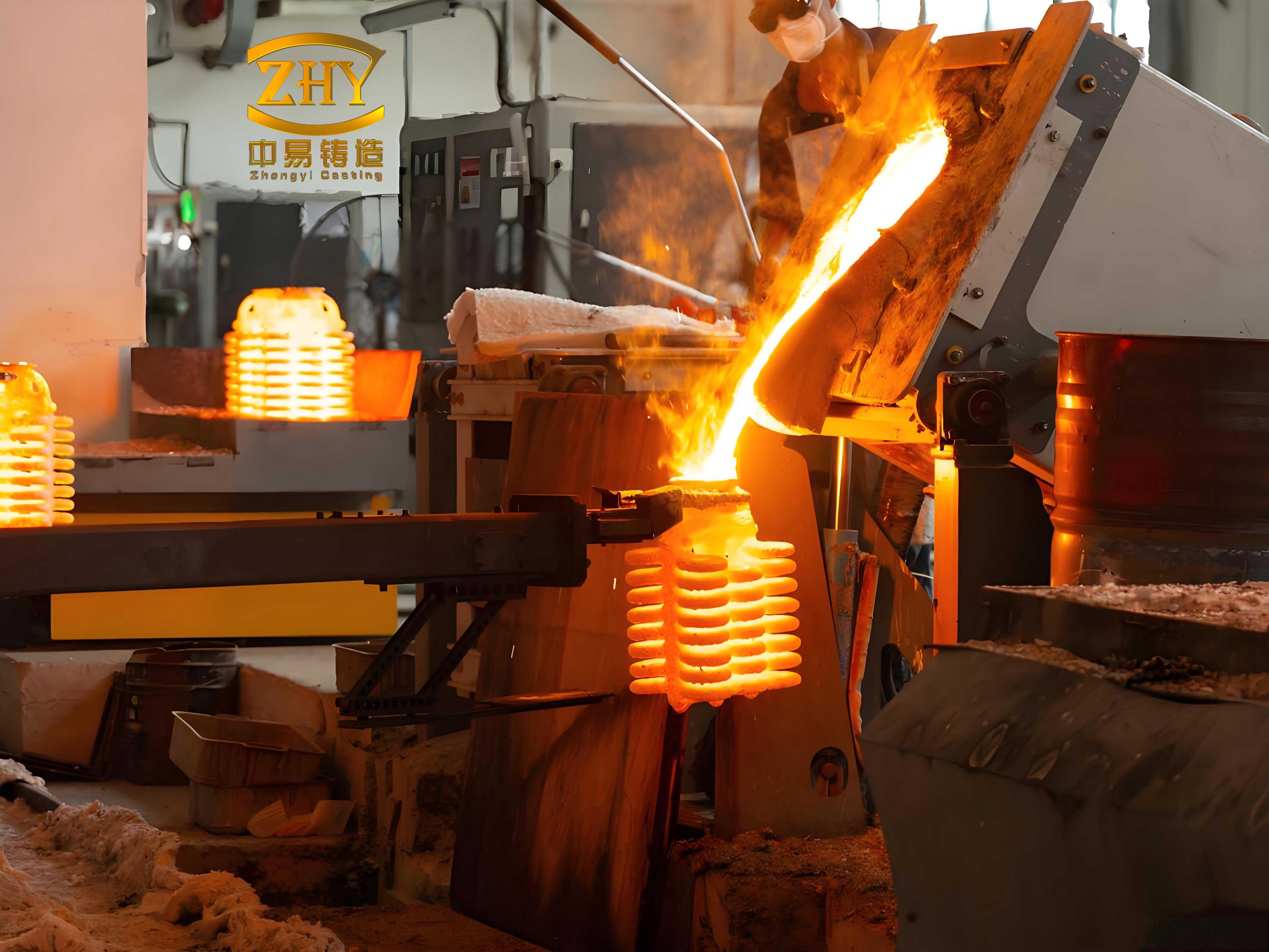
The final thermal stages of the investment casting process—shell firing and metal pouring—are orchestrated to complement the designed feeding system. Prior to firing, support frames are placed inside the shell cavity beneath the gates and risers and are fixed in place with sodium silicate sand to the shell bottom. This prevents upward distortion of the upper shell due to metallostatic pressure during pouring. To maximize the effectiveness of the external chills and enhance the casting’s self-feeding capability, a “cold shell” pouring technique is adopted. The shells are fired without investment in a furnace at approximately 900°C and held for 1 to 2 hours. They are then removed and allowed to cool in ambient air to around 200-300°C before being packed into flasks and densely backed up with dry sand. This controlled cooling ensures the shell retains sufficient strength while being at a lower temperature to promote rapid solidification directionality from the chills.
Given the use of cold shells, the pouring temperature is appropriately elevated to maintain fluidity for complete filling. The molten steel is tapped from the furnace at 1630-1650°C, with a target pouring temperature in the range of 1610-1630°C. The pouring rate is controlled to be relatively rapid, at 3-5 kg per second, to ensure a swift and continuous fill. This combination of parameters—cold shell, elevated pouring temperature, and fast fill—has been proven successful in practice. The thick sections solidify directionally towards the risers and chills without forming shrinkage porosity, while the thin walls and bosses are fully fed under sufficient metallostatic pressure. This results in sound castings with high dimensional accuracy and excellent surface finish, achieving a yield rate of over 85% in production runs. The entire investment casting process, from wax pattern engineering to thermal control during pouring, must be viewed as an integrated system for complex box-shaped parts.
In-depth consideration of pattern assembly, differential shrinkage, scientifically calculated feeding systems, reinforced shell building, and optimized thermal cycles are all critical. The investment casting process offers unparalleled advantages for manufacturing intricate, box-like components that are difficult to produce by other methods. The formulas and techniques presented here, derived from practical application, provide a reliable framework. Key aspects like the ingate area calculation \(A_{gate} = k \cdot D_{hot} \cdot \sqrt{H_{gate}}\) and the chill mass calculation \(M_{chill} = V_c \cdot \rho \cdot (M_c – M_a)/M_c\) are essential tools for process design. Furthermore, the use of internal reinforcements like steel pins in wax patterns and external reinforcements like mesh in ceramic shells addresses the specific challenges of large, flat geometries. The successful implementation of this comprehensive investment casting process demonstrates its viability for high-quality, cost-effective production of critical box-shaped castings in industries such as mechanical drilling equipment. Continuous refinement of each step, from pattern making to pouring, ensures the investment casting process remains at the forefront of precision manufacturing for complex components.