
As a researcher in advanced manufacturing, I have extensively studied the investment casting process, particularly for complex ductile iron parts like brake cams. The investment casting process offers unparalleled advantages in producing near-net-shape components with excellent surface finish and dimensional accuracy. This article delves into the intricacies of the investment casting process, focusing on key aspects such as mold design, alloy melting, and parameter optimization, supported by tables and formulas to encapsulate the technical details. Throughout this discussion, the investment casting process will be emphasized as a critical methodology for enhancing quality in ductile iron applications.
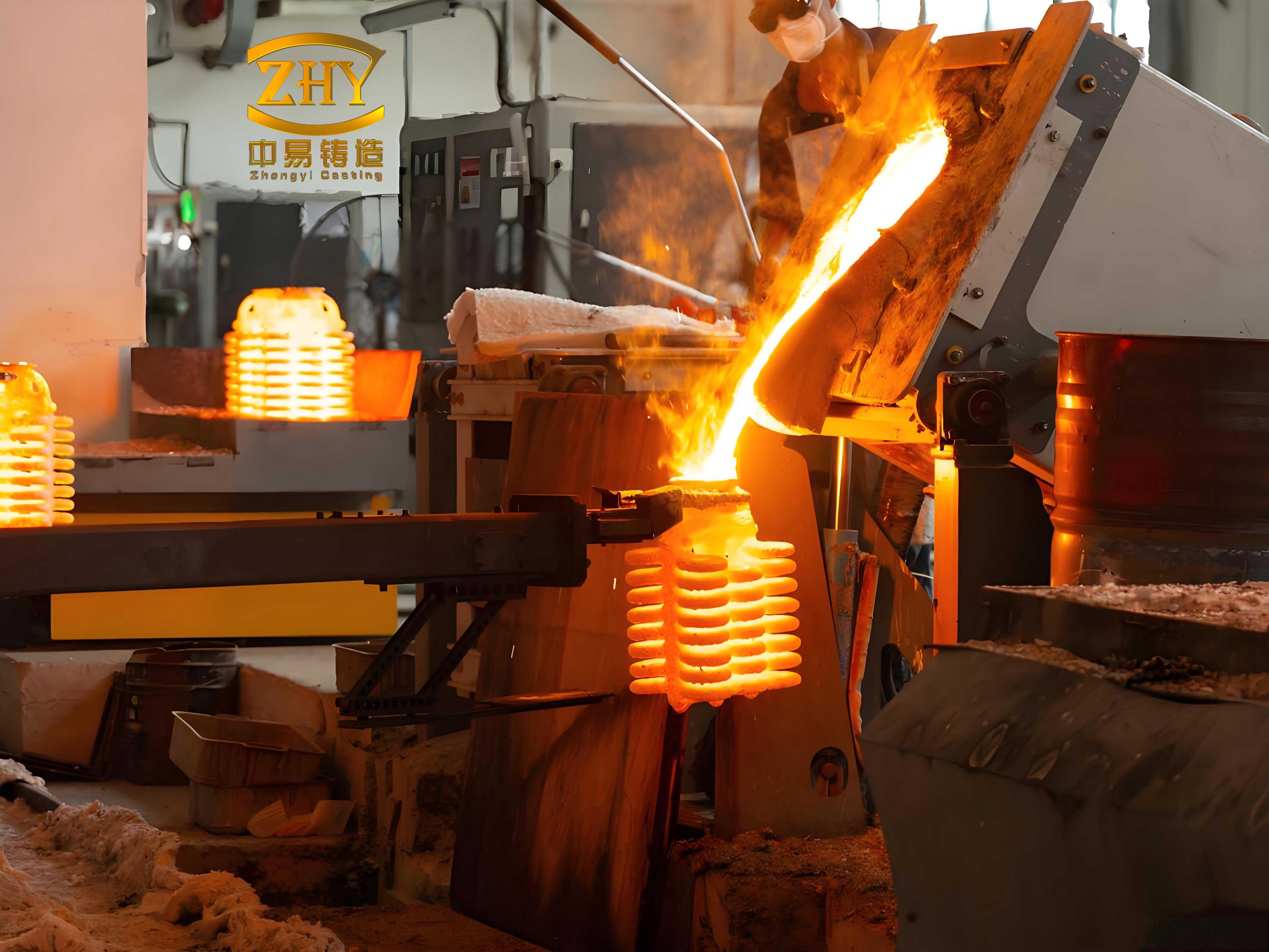
The investment casting process begins with a thorough analysis of the component geometry. For instance, consider a brake cam with complex helical surfaces, which poses challenges for traditional sand casting. Using the investment casting process, we can achieve precise replication of such features. The cam’s dimensions include a spiral diameter of 75 mm, a central cylinder of 42 mm diameter, and a total length of 68 mm, with wall thickness varying from 5 mm to 12 mm. To summarize, Table 1 outlines the key dimensional parameters.
| Feature | Dimension (mm) | Tolerance (mm) |
|---|---|---|
| Spiral Diameter | 75 | ±0.5 |
| Cylinder Diameter | 42 | ±0.3 |
| Total Length | 68 | ±0.8 |
| Wall Thickness Range | 5-12 | ±0.2 |
| Machining Allowance | 1.2 | – |
In the investment casting process, compensating for shrinkage is crucial. The total shrinkage factor ($S_t$) accounts for alloy shrinkage ($S_a$), wax pattern shrinkage ($S_w$), and mold expansion/contraction ($S_m$). For simplification, we use: $$S_t = 1.01 \times L$$ where $L$ is the nominal length. This equation guides the pattern scaling to ensure dimensional accuracy. Moreover, leveraging the self-feeding characteristics of ductile iron, we employ a gating system designed to enhance feeding without risers, a hallmark of advanced investment casting process techniques.
Moving to mold design, the investment casting process relies on precision tooling. The mold, typically made from aluminum alloy, is machined on CNC centers to maintain tight tolerances. The gating system and parting lines are strategically placed, as illustrated in the 3D models, to facilitate smooth metal flow and easy ejection. Table 2 summarizes the mold design parameters critical to the investment casting process.
| Parameter | Value | Rationale |
|---|---|---|
| Mold Material | Aluminum Alloy | Lightweight, machinable |
| Gating Type | Semi-closed System | Enhances self-feeding |
| Parting Line Location | Along Cylinder Axis | Minimizes flash |
| Surface Finish | Ra ≤ 1.6 μm | Ensures pattern precision |
The investment casting process involves intricate shell building. We use low-temperature wax for patterns and silica sol-based coatings. The primary layer, crucial for surface quality, employs zircon flour and sand, while backup layers use alumina and quartz sand. Manual stuccoing builds over seven layers, ensuring shell strength. The shell’s thermal properties impact solidification; thus, controlling shell temperature ($T_s$) is vital. The heat transfer during preheating can be modeled as: $$Q = k \cdot A \cdot \frac{\Delta T}{d}$$ where $Q$ is heat flux, $k$ is thermal conductivity, $A$ is area, $\Delta T$ is temperature difference, and $d$ is shell thickness. In the investment casting process, we preheat shells to around 700°C to reduce thermal shock and regulate cooling rates.
Alloy melting is another cornerstone of the investment casting process. For ductile iron QT450-10, we melt in a medium-frequency induction furnace. The chemical composition targets are shown in Table 3, adhering to standards for ductile iron in the investment casting process.
| Element | Target Range | Function |
|---|---|---|
| Carbon (C) | 3.9-4.2 | Graphite formation |
| Silicon (Si) | 1.3-1.5 | Ferrite promotion |
| Manganese (Mn) | ≤0.2 | Minimizes carbides |
| Magnesium (Mg) | 0.03-0.06 | Graphite spheroidization |
| Rare Earth (RE) | 0.02-0.04 | Enhances nodularity |
| Phosphorus (P) | ≤0.05 | Reduces brittleness |
| Sulfur (S) | ≤0.02 | Prevents interference |
In the investment casting process, melting involves overheating to 1550°C for homogenization, followed by composition adjustments. The spheroidization treatment uses rare-earth magnesium alloy via the sandwich method. The reaction kinetics can be expressed as: $$\frac{d[Mg]}{dt} = -k[Mg]^2$$ where $[Mg]$ is magnesium concentration and $k$ is a rate constant, highlighting the need for precise control to avoid fading. Post-inoculation with 75% ferrosilicon ensures fine graphite nucleation. Pouring temperature ($T_p$) is critical; we maintain it around 1420°C to balance fluidity and shrinkage. The solidification time ($t_s$) in the investment casting process can be estimated using Chvorinov’s rule: $$t_s = B \cdot \left(\frac{V}{A}\right)^n$$ where $V$ is volume, $A$ is surface area, $B$ is a mold constant, and $n$ is an exponent typically near 2. For our cam, with varying wall thickness, this dictates localized cooling rates.
The investment casting process for ductile iron must address its mushy solidification behavior. Due to slow cooling in preheated shells, graphite nodule integrity and matrix structure are sensitive. The cooling rate ($\dot{T}$) influences graphite size: $$\dot{T} = \frac{T_p – T_s}{t_s}$$ where lower $\dot{T}$ promotes larger graphite but risks defects. We optimize by controlling shell temperature and pouring parameters. Microstructurally, the investment casting process aims for “bull’s eye” ferrite surrounding spheroidal graphite. The graphite nodule count ($N_g$) per unit area relates to inoculation efficacy: $$N_g = C \cdot e^{-E_a/RT}$$ where $C$ is a constant, $E_a$ is activation energy, $R$ is gas constant, and $T$ is temperature. Table 4 compares microstructural features under different investment casting process conditions.
| Parameter | Optimal Condition | Suboptimal Condition | Impact |
|---|---|---|---|
| Graphite Nodularity | >90% | <70% | Affects ductility |
| Nodule Count (per mm²) | 150-200 | <100 | Influences strength |
| Ferrite Percentage | >85% | <70% | Determines toughness |
| Impact Energy (J/cm²) | 9.5-10.5 | <8.0 | Meets specifications |
| Defect Incidence | Low (inclusions, shrinkage) | High | Reduces yield |
Through the investment casting process, we achieve a balance between microstructure and properties. The impact energy, measured via standard specimens, aligns with requirements, thanks to controlled inoculation and cooling. Fracture surfaces exhibit mixed modes—cleavage and dimples—reflecting the matrix’s ferritic-cementitic blend. The investment casting process parameters, such as shell preheat temperature and pouring rate, directly affect these outcomes. For instance, the probability of shrinkage porosity ($P_s$) can be modeled as: $$P_s = 1 – \exp\left(-\int_{0}^{t_s} \frac{V_s(t)}{V} dt\right)$$ where $V_s(t)$ is the volume of solid at time $t$. By enhancing self-feeding in the gating system, we minimize $P_s$.
Optimizing the investment casting process involves iterative refinement. We adjusted parameters like pouring temperature to 1420°C and shell temperature to 700°C, which reduced defects like inclusions and shrinkage. The yield rate improved from 86% to 95%, demonstrating the efficacy of the investment casting process. Key relationships are summarized in Table 5, highlighting the interdependencies in the investment casting process.
| Variable | Influences | Optimal Range | Equation/Relationship |
|---|---|---|---|
| Pouring Temperature ($T_p$) | Fluidity, shrinkage | 1410-1430°C | $T_p = T_l – \Delta T_c$, where $T_l$ is liquidus |
| Shell Temperature ($T_s$) | Cooling rate, defect formation | 680-720°C | $\dot{T} \propto (T_p – T_s)$ |
| Alloy Composition | Graphite morphology, matrix | See Table 3 | $[Mg]_{res} > 0.03\%$ for nodularity |
| Gating Design | Feeding efficiency, turbulence | Semi-closed, tapered | $A_g : A_c : A_r = 1 : 1.2 : 1.5$ (area ratios) |
| Inoculation Amount | Nodule count, fading resistance | 0.8-1.2% FeSi | $N_g \propto [Si]_{inoc}$ |
The investment casting process is not just about parameters; it’s a holistic approach. For example, the thermal gradient ($G$) during solidification affects microstructure uniformity: $$G = \frac{\partial T}{\partial x}$$ where $x$ is distance. In the investment casting process, preheated shells reduce $G$, promoting equiaxed grains but requiring careful control to avoid segregation. Additionally, the investment casting process benefits from computational modeling to simulate fluid flow and solidification, though that’s beyond this article’s scope.
In conclusion, the investment casting process proves indispensable for producing high-integrity ductile iron components like brake cams. By integrating precise mold design, controlled melting, and optimized pouring techniques, the investment casting process achieves superior surface finish, dimensional accuracy, and mechanical properties. The investment casting process, as detailed through tables and formulas, underscores the science behind the art, ensuring repeatability and quality. As we continue to refine the investment casting process, its applications will expand, driven by advancements in materials and process control. Ultimately, the investment casting process stands as a testament to manufacturing excellence, blending tradition with innovation.
Throughout this exploration, the investment casting process has been central to our discussion, highlighting its versatility and critical role in modern foundry practices. The investment casting process, when mastered, transforms challenging geometries into reliable parts, embodying the synergy of engineering and craftsmanship. This deep dive into the investment casting process reaffirms its value for ductile iron and beyond, paving the way for future enhancements in precision casting technologies.