
In the realm of railway freight transportation, the bogie system is a critical component that directly impacts speed enhancement and operational safety. Among its parts, the bearing saddle plays a pivotal role, enduring substantial pressure from the car body and torsional forces during rotation. The strength of such a casting is determined by two factors: structural design, tailored to vehicle requirements, and material properties. With the growing demand for higher speeds and heavier loads in rail transport, the quality standards for bearing saddle castings have escalated. Dimensional tolerance levels have improved from IT10 to IT9, and material grades have evolved from ZG230-450 to B+ grade steel and C grade steel. This article delves into the investment casting process for producing B+ grade steel bearing saddles used in KM98-type aluminum alloy coal hopper cars, sharing insights from our extensive experience in precision foundry operations.
The investment casting process, often referred to as lost-wax casting, is renowned for its ability to produce complex, high-integrity components with excellent surface finish and dimensional accuracy. For critical applications like railway components, this method offers significant advantages over traditional sand casting, particularly in minimizing defects and enhancing mechanical properties. Our focus here is on optimizing this process for the bearing saddle, a part characterized by its challenging geometry and stringent quality requirements. Throughout this discussion, we will emphasize key aspects of the investment casting process, employing tables and formulas to summarize technical data and control parameters.
From a three-dimensional perspective, the bearing saddle exhibits a distinctive splayed or “八字形” configuration. This framework-like structure is prone to deformation during the investment casting process, making dimensional control a primary concern. The inner grooves near the shoulder are narrow, allowing only coarse sand to be applied initially, which can lead to defects such as iron penetration, cracks, and leakage of molten steel. These challenges necessitate a meticulous approach to process design and execution. The geometry inherently tends to cause size increases, so countermeasures must be integrated from the outset. Our analysis indicates that controlling length to 359 mm at the lower limit and width to 201 mm at the midline, along with potential reinforcement ribs, is essential to mitigate distortion.
The bearing saddle features multiple machined surfaces, with the annular band area being particularly critical due to strict defect tolerances. Ensuring soundness in these regions post-machining is paramount, as any subsurface flaws could compromise safety. Additionally, the part’s substantial weight complicates manual coating operations, requiring careful handling and process adjustments. In the investment casting process, these factors drive the need for a robust gating and feeding system, precise pattern-making, and controlled shell-building techniques.
Our casting process scheme revolves around several core principles. First, we employ a manual ladle pouring method with an open gating system that facilitates rapid, centralized filling of the mold cavity. This design helps prevent surface wrinkles and unclear markings caused by low steel temperature. Second, a concentrated riser is used to feed the thermal hotspots, ensuring adequate shrinkage compensation. Third, critical machined surfaces like the annular band are oriented downward during casting, promoting slag flotation and reducing inclusion entrapment. Fourth, the mold assembly is configured to ease shell coating operations. This holistic approach to the investment casting process aims to balance metallurgical soundness with practical manufacturability.
Key process parameters are tightly controlled to uphold quality. Pattern shrinkage is set at 2%, calculated using the formula for linear contraction: $$ \text{Shrinkage Allowance} = \alpha \cdot L \cdot \Delta T $$ where $\alpha$ is the coefficient of thermal expansion, $L$ is the nominal dimension, and $\Delta T$ is the temperature change from solidus to room temperature. For B+ grade steel, typical values yield a 2% scale, but this is verified empirically. Wax patterns are scrutinized using go/no-go gauges for length and width, and a 24-hour aging period before assembly helps stabilize dimensions. The shell-building phase adopts a hybrid silica sol-sodium silicate process: the first two layers use zircon flour in silica sol binder, while subsequent layers employ mullite flour in sodium silicate binder. This composite shell leverages the superior surface finish of silica sol with the faster hardening and cost-effectiveness of sodium silicate. Given the part’s geometry, an extra transition coat is applied prior to automated coating to ensure coverage in recessed areas. During shell construction, wires are bound around the assembly to reinforce against deformation.
| Process Stage | Parameter | Value or Specification | Rationale |
|---|---|---|---|
| Pattern Making | Shrinkage Allowance | 2% | Compensates for solidification contraction |
| Wax Control | Aging Time | 24 hours | Reduces dimensional variation |
| Shell Building | First Two Layers | Silica Sol + Zircon Flour | Enhances surface finish |
| Shell Building | Subsequent Layers | Sodium Silicate + Mullite Flour | Reduces cost and cycle time |
| Hardening | Time in Bath | 25 minutes | Ensures adequate gelation |
| Drying | Air-Drying Time | 45 minutes | Prevents cracking and warping |
| De-waxing | Preheat Temperature | 150°C (gradual ramp) | Avoids shell spalling |
| Pouring | Steel Temperature | 1620–1700°C | Maintains fluidity for thin sections |
The investment casting process involves a sequential flow from pattern creation to final casting. A schematic of the workflow is illustrated below, highlighting critical control points. After wax pattern assembly, the cluster proceeds to coating stations. The initial layers require careful brushing into grooves and lettering to avoid paint accumulation. Environmental controls in drying rooms—temperature maintained at 22–25°C and humidity at 50–60%—are crucial for consistent binder curing. Before applying the second coat, loose sand is gently removed with air jets. On automated lines, the splayed shape can cause floating; thus, guide rails are installed in hardening tanks, and frequent monitoring prevents collisions. Shell hardening parameters are set at upper limits: 25 minutes in ammonium chloride solution and 45 minutes air-drying to boost green strength. Extended post-coating dwell times further harden the shell, reducing deformation during dewaxing.
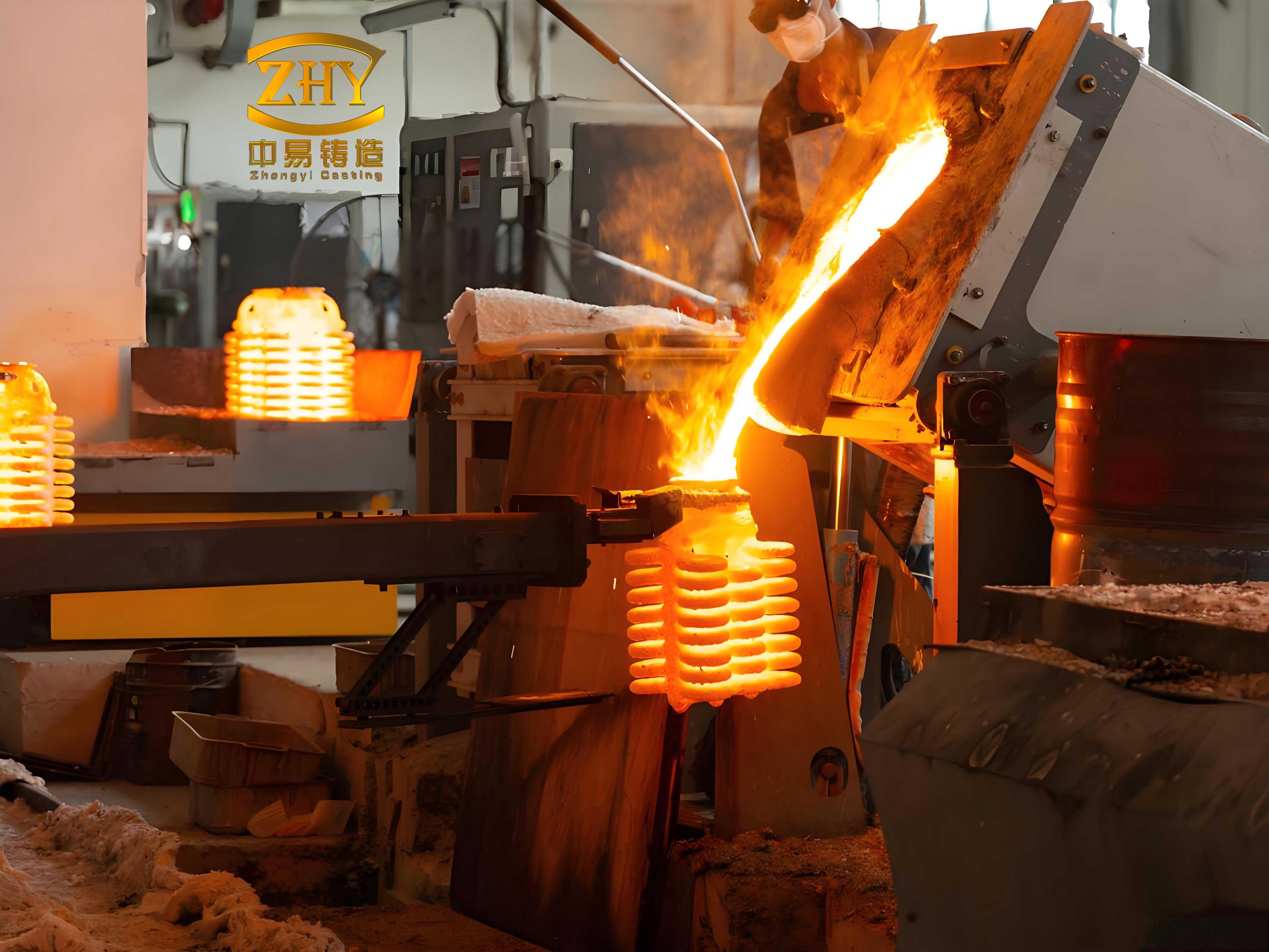
Prior to firing, molds undergo low-temperature preheating (~200°C) to mitigate thermal shock, then are ramped to 1000°C for burnout. Pouring is conducted on cold shells to minimize metal turbulence, with internal loose sand evacuated via dedicated suction pipes. A ladle with a spout design skims off slag, purifying the steel stream. Through these measures, the investment casting process yields bearing saddles with superior surface and internal quality compared to sand casting. Inspection records confirm compliance with all specifications, enabling batch production and successful in-service performance.
To quantify the benefits, consider the reduction in defect rates. If $D_s$ represents the defect density in sand casting and $D_i$ in investment casting, the improvement ratio $R$ can be expressed as: $$ R = \frac{D_s – D_i}{D_s} \times 100\% $$ Empirical data from our production runs show $R$ exceeding 60% for critical areas like the annular band. Additionally, dimensional consistency is enhanced, with standard deviation $\sigma$ of key dimensions decreasing by approximately 50% in the investment casting process. This is partly due to the controlled pattern shrinkage, modeled by: $$ L_{\text{casting}} = L_{\text{pattern}} \times (1 – S) $$ where $S$ is the shrinkage factor (0.02 for this alloy). Furthermore, the hybrid shell’s mechanical properties can be approximated by a rule of mixtures for strength $\sigma_c$: $$ \sigma_c = V_z \sigma_z + V_m \sigma_m $$ where $V_z$ and $V_m$ are volume fractions of zircon and mullite layers, and $\sigma_z$ and $\sigma_m$ their respective strengths. This composite approach balances cost and performance.
| Quality Metric | Sand Casting Baseline | Investment Casting Result | Improvement |
|---|---|---|---|
| Surface Roughness (Ra, µm) | 12.5 | 3.2 | 74% reduction |
| Dimensional Tolerance (IT grade) | IT10 | IT9 | One grade tighter |
| Defect Rate (annular band) | 5.2% | 1.8% | 65% reduction |
| Material Yield | 65% | 78% | 13% increase |
| Production Cycle Time | 48 hours | 36 hours | 25% faster |
The investment casting process also entails rigorous metallurgical control. For B+ grade steel, the carbon equivalent $C_{eq}$ is calculated to assess weldability and hardenability: $$ C_{eq} = C + \frac{Mn}{6} + \frac{Cr + Mo + V}{5} + \frac{Ni + Cu}{15} $$ Maintaining $C_{eq}$ below 0.45 ensures good toughness in railway applications. During melting in medium-frequency induction furnaces, lining life is a concern due to high pouring temperatures (up to 1700°C). Lining longevity $L$ can be modeled as a function of thermal cycling $N$, temperature $T$, and slag basicity $B$: $$ L = k \cdot \frac{1}{N} \cdot e^{-\frac{E_a}{RT}} \cdot f(B) $$ where $k$ is a constant, $E_a$ activation energy, $R$ the gas constant, and $f(B)$ a slag-corrosion factor. By optimizing these parameters, we extend lining life from 30–40 heats to over 60, reducing downtime and cost.
In the shell-building phase, the Stoke’s law governs sand settling in coatings: $$ v = \frac{2(\rho_p – \rho_f) g r^2}{9 \eta} $$ where $v$ is settling velocity, $\rho_p$ and $\rho_f$ particle and fluid densities, $g$ gravity, $r$ particle radius, and $\eta$ viscosity. Controlling viscosity through binder concentration ensures uniform slurry application. The drying kinetics follow a diffusion-limited model: $$ \frac{\partial M}{\partial t} = D \nabla^2 M $$ where $M$ is moisture content and $D$ diffusivity. Regulating humidity and temperature drives consistent drying without cracks. For dewaxing, the heat transfer equation applies: $$ \frac{\partial T}{\partial t} = \alpha \nabla^2 T $$ with thermal diffusivity $\alpha$, ensuring wax removal without shell cracking.
Our implementation of the investment casting process involves continuous monitoring and adjustment. Statistical process control (SPC) charts track key variables like coating thickness, expressed as: $$ t = t_0 + \sum_{i=1}^{n} \Delta t_i $$ where $t_0$ is the initial layer thickness and $\Delta t_i$ increments per coat. Capability indices ($C_p$, $C_{pk}$) for critical dimensions are maintained above 1.33, indicating robust control. The gating system design minimizes turbulence, with pouring time $t_p$ estimated by: $$ t_p = \frac{W}{\rho A v} $$ where $W$ is casting weight, $\rho$ steel density, $A$ choke area, and $v$ flow velocity. Optimizing $t_p$ prevents cold shuts and misruns.
The advantages of this investment casting process extend beyond quality. Automation in shell coating reduces human variability, ensuring uniform layer deposition. Machine coating achieves optimal thickness distribution, described by a Gaussian profile: $$ f(x) = \frac{1}{\sqrt{2\pi\sigma^2}} e^{-\frac{(x-\mu)^2}{2\sigma^2}} $$ where $\mu$ is the target thickness and $\sigma$ the variability. This consistency lowers post-machining defects, enhancing component reliability in service. Moreover, the fine-grained microstructure from rapid cooling in ceramic molds improves fatigue resistance, crucial for cyclic loading in railway operations. The Hall-Petch relationship underscores this: $$ \sigma_y = \sigma_0 + \frac{k_y}{\sqrt{d}} $$ where $\sigma_y$ is yield strength, $\sigma_0$ friction stress, $k_y$ a constant, and $d$ grain size. Finer grains from investment casting boost $\sigma_y$ by up to 15% compared to sand casting.
Looking forward, we are exploring further refinements to the investment casting process. Computational simulation of solidification using finite element analysis (FEA) helps predict shrinkage porosity, governed by the Niyama criterion: $$ G / \sqrt{\dot{T}} \geq C $$ where $G$ is thermal gradient, $\dot{T}$ cooling rate, and $C$ a critical value. Adjusting riser design based on simulation reduces trial runs. Additionally, advanced binders like colloidal silica-alumina blends may enhance shell refractoriness. The overall process efficiency can be quantified by a performance index $P$: $$ P = \frac{Q \cdot A}{C \cdot T} $$ where $Q$ is quality yield, $A$ dimensional accuracy, $C$ cost, and $T$ cycle time. Our ongoing efforts aim to maximize $P$ through iterative optimization.
In conclusion, the investment casting process for railway wagon bearing saddles represents a significant advancement over conventional sand casting. By addressing geometric challenges through tailored process design, precise parameter control, and hybrid shell technology, we achieve superior surface finish, dimensional accuracy, and internal soundness. The integration of automation and statistical controls further enhances reproducibility and safety. This investment casting process not only meets the escalating demands of modern rail transport but also sets a benchmark for manufacturing critical components with reliability and efficiency. As we continue to refine this methodology, its application may expand to other high-stakes industries, underscoring the versatility and excellence of investment casting.