
In the field of precision manufacturing, investment casting is a critical technique for producing high-integrity casting parts, especially for aerospace applications. As an engineer specializing in this area, I have focused on optimizing the process for complex shell casting parts made from high-temperature alloys. These casting parts often exhibit intricate geometries, significant wall thickness variations, and stringent quality requirements, making them prone to defects such as porosity, cracks, and dimensional inaccuracies. This article delves into a comprehensive study aimed at overcoming these challenges through systematic adjustments in pattern making, shell building, and melting-pouring parameters. The goal is to enhance the yield and performance of such casting parts, which are essential components in advanced engines. Throughout this work, the term “casting parts” will be emphasized to underscore their centrality in precision casting.
The casting parts under investigation are shell-shaped components utilized in critical assemblies. These casting parts are fabricated using K403 high-temperature alloy, known for its excellent mechanical properties at elevated temperatures but also for its susceptibility to casting defects due to its solidification characteristics. The chemical composition of K403 alloy is detailed in Table 1, which influences the fluidity, shrinkage, and thermal behavior during casting. Understanding this composition is vital for tailoring the process to minimize issues in the final casting parts.
| Element | Content | Element | Content |
|---|---|---|---|
| C | 0.11–0.18 | Ce | ≤ 0.01 |
| Cr | 10.00–12.00 | Fe | ≤ 2.00 |
| Co | 4.50–6.00 | Si | ≤ 0.50 |
| W | 4.80–5.50 | Mn | ≤ 0.50 |
| Mo | 3.80–4.50 | S | ≤ 0.01 |
| Ti | 2.30–2.90 | P | ≤ 0.02 |
| Al | 5.30–5.90 | Ni | Balance |
The 3D model of the shell casting part reveals a complex structure with pillars, varying diameters, and a wall thickness of 6.5 mm. Such geometry leads to multiple hot spots, making it a challenging near-net-shape casting part. The primary technical difficulties include: (1) difficulty in pattern removal and dimensional distortion due to complexity; (2) susceptibility to shell cracking and flash during pouring; and (3) propensity for porosity, cold shuts, and insufficient filling owing to thermal gradients. These issues necessitate a holistic approach to process optimization for reliable production of casting parts.
To address these challenges, I initiated a series of experiments focusing on pattern making, shell building, and melting-pouring stages. The optimization efforts are rooted in fundamental principles of casting science, often expressed through mathematical models. For instance, the linear shrinkage during pattern making can be approximated by: $$ \Delta L = \alpha L_0 (T_{\text{mold}} – T_{\text{room}}) $$ where \(\Delta L\) is the length change, \(\alpha\) is the coefficient of thermal expansion, \(L_0\) is the initial length, and \(T_{\text{mold}}\) and \(T_{\text{room}}\) are mold and room temperatures, respectively. This formula highlights the importance of temperature control in achieving dimensional accuracy for casting parts.
In pattern making, precise wax patterns are crucial for defect-free casting parts. Key parameters include wax temperature, mold temperature, injection pressure, and holding time. Based on empirical trials, I optimized these as follows: wax temperature at 55–63°C, mold temperature at 25–35°C, injection pressure at 15–25 bar, and holding time at 15–20 s. These settings ensure adequate fluidity and minimal shrinkage, reducing surface defects like cold shuts in the wax patterns, which directly translate to better casting parts. Initially, segmented wax patterns were assembled, but this led to dimensional deviations up to 2.2 mm in critical features of the casting parts. To eliminate this, I redesigned the tooling for integral wax patterns, enhancing consistency. The dimensional control can be modeled using a tolerance stack-up equation: $$ T_{\text{total}} = \sqrt{\sum_{i=1}^{n} T_i^2} $$ where \(T_{\text{total}}\) is the overall tolerance and \(T_i\) are individual tolerances. By adopting integral patterns, the number of tolerance contributors decreases, improving precision for casting parts.
Shell building is another critical phase for robust casting parts. The shell must possess sufficient strength to withstand thermal stresses during pouring. I employed a multi-layer process with specific slurries and stucco materials, as summarized in Table 2. To mitigate porosity in thick sections of casting parts, I introduced a shell-thinning technique after the fourth coating layer by applying soft wax to selected areas, such as inner gates and holes. This promotes faster cooling in hot spots, reducing shrinkage porosity. The heat transfer in the shell can be described by Fourier’s law: $$ q = -k \frac{dT}{dx} $$ where \(q\) is heat flux, \(k\) is thermal conductivity, and \(\frac{dT}{dx}\) is temperature gradient. Thinning the shell locally increases the gradient, accelerating solidification in critical regions of casting parts. Additionally, shell preheating at 950–1000°C was adopted to balance fluidity and solidification rates.
| Layer | Slurry | Viscosity | Stucco | Drying/Air Dry | Ammonia Dry | Ventilation |
|---|---|---|---|---|---|---|
| 1 | Silica Sol-Zircon Flour | 40–50 s | White Alumina WAF70 | ≥ 12 h | – | – |
| 2 | Ethyl Silicate Hydrolyzate-Shangdian Flour | 37–42 s | Shangdian Sand 36 mesh | ≥ 20 min | 10 min | ≥ 10 min |
| 3–8 | Ethyl Silicate Hydrolyzate-Shangdian Flour | 13–15 s | Shangdian Sand 24 mesh | ≥ 20 min | 10 min | ≥ 10 min |
| Sealing | Ethyl Silicate Hydrolyzate-Shangdian Flour | 13–15 s | – | ≥ 12 h | – | – |
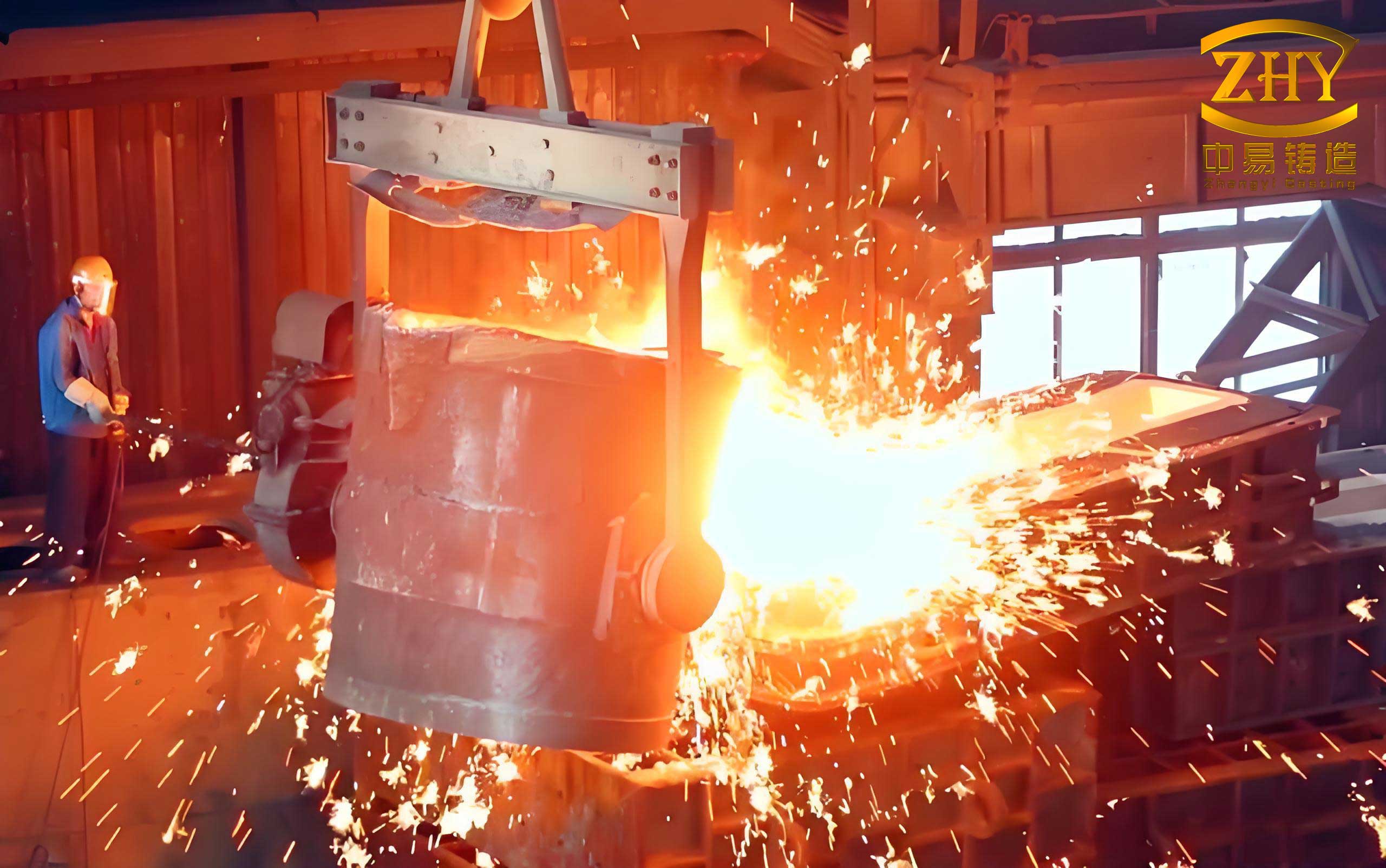
Melting and pouring parameters directly affect the integrity of casting parts. The gating system must support the mold and act as a riser for feeding. Pouring temperature and speed are optimized to ensure complete filling while minimizing defects. I selected a pouring temperature of 1430°C ± 10°C, which is approximately 80°C above the liquidus temperature, to enhance fluidity. The pouring speed was set at 2–3 seconds per mold to maintain a high dynamic pressure for efficient mold filling. These parameters are summarized in Table 3. The fluidity of the alloy can be estimated using: $$ F = C \frac{\rho g h}{\mu} $$ where \(F\) is fluidity, \(C\) is a constant, \(\rho\) is density, \(g\) is gravity, \(h\) is head height, and \(\mu\) is viscosity. Higher pouring temperature reduces \(\mu\), improving \(F\) for complex casting parts. Additionally, the solidification time for casting parts can be predicted by Chvorinov’s rule: $$ t_s = B \left( \frac{V}{A} \right)^2 $$ where \(t_s\) is solidification time, \(B\) is a mold constant, \(V\) is volume, and \(A\) is surface area. Optimizing gating design helps control the \(V/A\) ratio, promoting directional solidification in casting parts.
| Shell Preheat Temperature (°C) | Pouring Temperature (°C) | Pouring Speed (s/mold) |
|---|---|---|
| 950–1000 | 1430 ± 10 | 2–3 |
To validate the optimized process, I conducted a production trial with 40 shell casting parts. The results showed a significant improvement: 35 casting parts met all quality standards, yielding an 87.5% acceptance rate. Dimensional inspections confirmed that deviations were within allowable limits, and metallographic analysis revealed reduced porosity and cold shuts. This demonstrates the effectiveness of the integrated approach for manufacturing high-quality casting parts. The success rate can be modeled using a binomial probability distribution: $$ P(X = k) = \binom{n}{k} p^k (1-p)^{n-k} $$ where \(n\) is the number of trials, \(k\) is the number of successes, and \(p\) is the probability of success. With \(p\) increased from previous lower values to 0.875, the process reliability for casting parts is enhanced.
In conclusion, the optimization of investment casting for complex shell casting parts involves meticulous control across multiple stages. Key achievements include: (1) adopting integral wax patterns to eliminate assembly-induced dimensional errors in casting parts; (2) implementing shell-thinning techniques to enhance cooling in hot spots, reducing porosity in casting parts; and (3) fine-tuning melting and pouring parameters to ensure complete filling and sound solidification. These measures not only improve the quality of the specific shell casting parts but also provide a reference for similar casting parts in precision investment casting. Future work could explore advanced simulation tools to further predict and mitigate defects in casting parts, leveraging formulas and data-driven approaches. The continuous evolution of such processes is essential for meeting the demanding standards of aerospace casting parts.