
In my extensive experience within the manufacturing sector, I have observed that the quality of machine tool castings is a pivotal factor influencing the overall performance and longevity of machine tools. Given that machine tool castings constitute approximately 70% to 80% of the total weight of a machine tool, their properties—such as high compressive and tensile strength, excellent dimensional accuracy, high elastic modulus, superior wear resistance, effective damping capacity, good machinability and castability, low surface roughness, and precise dimensional stability—are critical. This article delves into the key challenges in controlling the quality of machine tool castings, drawing from my practical insights and structured around these essential quality requirements. I will explore macro-level quality control methodologies and specific technical aspects across the casting process, incorporating tables and formulas to summarize critical data and relationships.
The typical casting process for machine tool castings can be broadly categorized into three main stages: molding and core-making, melting and pouring, and post-processing. Each stage consists of numerous interlinked steps, where fluctuations in any parameter can significantly impact the final quality of machine tool castings. Due to the complexity, this discussion will focus on the overarching aspects, emphasizing how systematic control can mitigate variability and enhance consistency in producing high-quality machine tool castings.
Macro-Level Quality Control Methods
From my perspective, establishing a robust quality assurance system is fundamental to achieving consistent quality in machine tool castings. This involves comprehensive quality management practices that strengthen foundational processes and integrate human responsibilities into a cohesive framework. By standardizing and streamlining operations, companies can ensure that every phase of production adheres to predefined protocols, thereby minimizing defects and optimizing efficiency. Process control is arguably the most influential factor in determining the quality of machine tool castings. It begins with identifying critical control points along the production workflow—typically those prone to defects or with significant impact on final properties. For each control point, specific content, standards, control methods, and tools must be defined. In practice, I have implemented reporting forms and record sheets at these points to facilitate self-inspection, mutual checks, and specialized inspections, fostering a proactive approach to quality assurance. This not only prevents issues but also prepares the groundwork for maintaining the integrity of machine tool castings.
Moreover, effective communication of casting processes to operators is crucial. By ensuring that workers understand and master the technical details, they can actively contribute to process refinement and innovation. Technicians should clarify key control aspects, empowering operators to execute procedures conscientiously and creatively. Management must oversee the molding stages, serving as a final checkpoint for quality control. Externally, a customer feedback network, managed by a dedicated service department, can relay quality information back to relevant internal units. Internally, treating subsequent processes as “customers” of prior steps discourages blame-shifting and promotes accountability. Regular inter-departmental coordination and feedback loops enable continuous problem-solving and quality enhancement for machine tool castings.
To illustrate the relationship between key parameters and quality outcomes in machine tool castings, consider the following formula for carbon equivalent (CE), which influences mechanical properties and castability:
$$ CE = C + \frac{1}{3}Si $$
This equation highlights how carbon and silicon content interact to affect the microstructure and performance of machine tool castings. Controlling CE within optimal ranges is essential for achieving desired strength and reducing casting stresses.
| Control Point | Control Content | Standard Reference | Control Method |
|---|---|---|---|
| Molding Sand Preparation | Moisture content, permeability, compressive strength | ASTM B926 | Regular testing and adjustment based on environmental conditions |
| Melting Operation | Chemical composition, temperature | ISO 4990 | Spectroscopic analysis and thermocouple monitoring |
| Pouring Process | Pouring temperature, rate | Internal specifications | Automated control systems with manual verification |
| Post-Processing Inspection | Dimensional accuracy, surface defects | ISO 8062 | Coordinate measuring machines (CMM) and visual checks |
Key Technologies in Molding and Core-Making
The molding and core-making stage is where the foundation for quality machine tool castings is laid. As I have often emphasized, any compromise in model quality can negate even the best efforts in subsequent melting and pouring stages, leading to poor surface finish and dimensional inaccuracies. Modern casting practices for machine tool castings increasingly adopt innovative methods, techniques, and equipment to optimize alloy properties and meet stringent industrial demands. The choice of molding method profoundly impacts both quality and cost. In practical applications, factors such as casting size, shape, production volume, usage requirements, and available facilities dictate the selection from various molding techniques. Common methods for machine tool castings include solid pattern two-part molding, split pattern two-part molding, cut-out molding, false cope molding, sweep molding, pit molding, and three-part molding. Each method has its advantages and limitations; for instance, solid pattern molding is simple but may not suit complex geometries, while three-part molding accommodates intricate designs but increases complexity. Selecting the appropriate method requires prioritizing quality objectives while considering process simplicity, efficiency, cost-effectiveness, and feasibility.
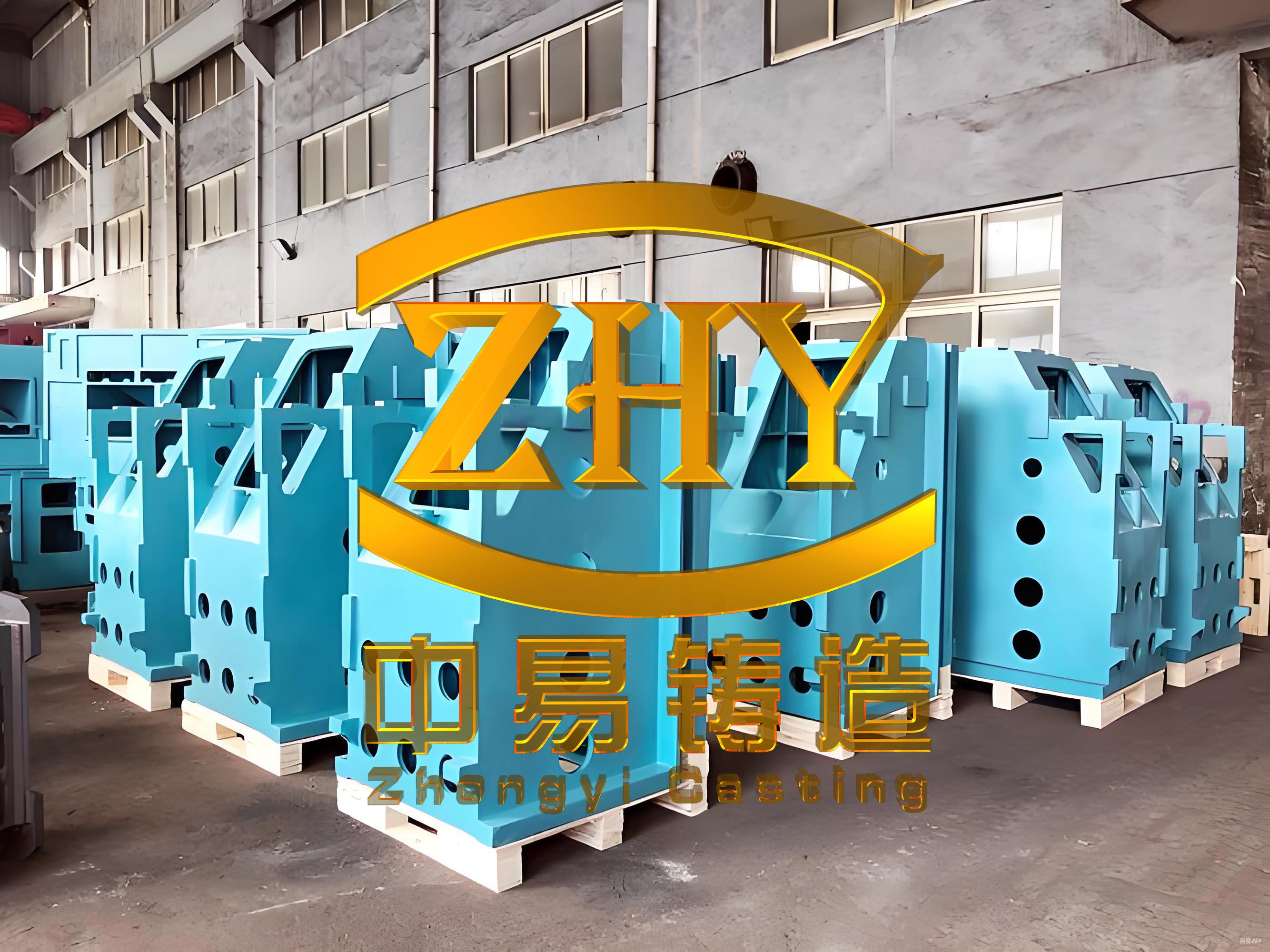
Raw material quality is another critical aspect. If base materials like sand and binders are subpar, no amount of processing can rectify inherent defects. While textbooks and standards provide broad ranges for molding materials and sand properties—such as grain size distribution, clay content, and moisture levels—these are often too generic for specific production environments. In my work, I have found that directly applying these ranges without customization can lead to inconsistencies in machine tool castings. Instead, tailored control limits based on local conditions and historical data are necessary for stability. For example, gas defects in machine tool castings often stem from poor sand permeability, high moisture content, or inadequate venting in molds and cores. Similarly, sand inclusions may arise from weak mold or core strength, uneven sand mixing, or excessive gas-forming materials. Thus, meticulous control over these elements is imperative.
The shell-making process, particularly in investment casting for precision machine tool castings, requires stringent oversight. Operational lapses in coating application and drying can cause surface and near-surface defects. I recommend maintaining stable drying humidity between 80% and 90%, ensuring uniform environmental temperature and humidity, and regularly analyzing coating slurry properties like viscosity, SiO₂ content, and pH. Additionally, minimizing residual wax in shells through repeated dewaxing cycles can prevent defects. The relationship between sand properties and defect formation can be expressed through empirical formulas, such as the permeability index (P) for gas escape:
$$ P = k \cdot \frac{A}{\mu} $$
where \( k \) is a constant, \( A \) is the cross-sectional area, and \( \mu \) is the viscosity. Optimizing this for machine tool castings reduces porosity risks.
| Molding Method | Advantages | Disadvantages | Typical Applications |
|---|---|---|---|
| Solid Pattern Two-Part | Simple, cost-effective for simple shapes | Limited to uncomplicated geometries | Small to medium-sized machine bases |
| Split Pattern Two-Part | Handles moderate complexity, good dimensional control | Higher pattern cost | Housings and frames |
| Three-Part Molding | Suitable for complex parts with undercuts | Increased time and labor | Intricate structural components |
| Pit Molding | Ideal for large, heavy castings | Space-intensive, slower production | Large machine beds and columns |
Key Technologies in Melting and Pouring
Melting and pouring are pivotal stages where the metallurgical quality of machine tool castings is defined. Numerous parameters, such as chemical composition and pouring temperature, play decisive roles. Most machine tool castings are made of gray iron, and industry trends favor high carbon equivalent and high strength to achieve low casting stress, good machinability, and castability. In my observations, domestic production often has lower carbon equivalents compared to international standards, suggesting room for optimization. Additionally, a higher silicon-to-carbon ratio (around 0.6) can prevent chilling in thin sections, enhance uniformity, strength, and hardness, and reduce residual stress. However, excessive carbon equivalent may promote ferrite formation, undermining overall performance. Thus, low-alloying with elements like chromium or molybdenum is often necessary to stabilize pearlite and refine graphite under high carbon equivalent conditions.
During melting, charge composition adjustments are vital. I typically keep pig iron additions below 10%, increase scrap steel proportions appropriately, and control molten iron temperatures between 1500°C and 1550°C. In pouring, chemical composition directly affects properties; for example, carbon content influences cementite formation and hardness. Raising carbon equivalent can enhance graphite expansion during solidification and reduce shrinkage porosity, but overdoing it may lead to coarse graphite and diminished mechanical properties in machine tool castings. Defects like slag inclusions often result from inadequate slag removal, improper gating system design, or contaminated alloy liquid. To prevent sand inclusions, gating systems must be clean, and mold compaction should be uniform. Key measures include setting accurate gating and venting systems, controlling alloy composition (e.g., carbon, silicon, phosphorus, titanium, and residual rare earths and magnesium), elevating pouring temperatures suitably, and managing mold humidity.
The interaction between elements can be modeled using regression formulas for mechanical properties. For instance, the tensile strength (\( \sigma_t \)) of gray iron machine tool castings might relate to carbon (C) and silicon (Si) as:
$$ \sigma_t = a \cdot C + b \cdot Si + c \cdot CE + d $$
where \( a, b, c, d \) are constants derived from experimental data. Such models aid in fine-tuning compositions for optimal performance.
| Parameter | Control Range | Influence on Quality | Monitoring Technique |
|---|---|---|---|
| Carbon Equivalent (CE) | 3.8–4.2 | Affects strength, castability, and stress | Chemical analysis |
| Silicon-to-Carbon Ratio | 0.55–0.65 | Reduces chilling, improves uniformity | Spectrometry |
| Pouring Temperature | 1380–1420°C | Minimizes defects like misruns and shrinkage | Thermocouples and pyrometers |
| Alloy Additions (e.g., Cr, Mo) | 0.2–0.5% | Enhances pearlite stability and hardness | Weight-based dosing systems |
Key Technologies in Post-Processing
Post-processing, though often overlooked, is where the final attributes of machine tool castings are refined. This stage includes cooling, shakeout, gate removal, shot blasting, fettling, rust removal, and packaging. Inadequate post-processing can nullify previous efforts, leading to high rejection rates. As I have learned, critical control points in shakeout, fettling, and rust prevention are essential for dimensional stability, stress relief, surface roughness, and shape integrity. For instance, improper cooling rates can induce residual stresses that compromise the accuracy of machine tool castings. Shot blasting must be calibrated to remove sand without damaging surfaces, and fettling should address fins and irregularities without introducing stress concentrations.
Moreover, comprehensive testing is indispensable. I advocate for metallographic examinations to assess microstructure, alongside tests for elastic modulus, casting stress, and distortion. The elastic modulus (\( E \)) for machine tool castings can be correlated with graphite morphology and matrix structure, often expressed as:
$$ E = \frac{\sigma}{\epsilon} $$
where \( \sigma \) is stress and \( \epsilon \) is strain. Monitoring these parameters ensures that machine tool castings meet rigorous application demands. Implementing statistical process control (SPC) in post-processing, such as tracking dimensional variations with control charts, helps maintain consistency.
| Post-Processing Step | Key Activities | Quality Metrics | Common Defects Addressed |
|---|---|---|---|
| Cooling and Shakeout | Controlled cooling rates, vibration removal | Dimensional stability, crack prevention | Thermal stresses, distortions |
| Gate Removal and Fettling | Cutting, grinding, and smoothing | Surface finish, geometry conformity | Burns, uneven edges |
| Shot Blasting | Abrasive cleaning | Surface cleanliness, adhesion preparation | Sand residues, scale |
| Final Inspection | Dimensional checks, NDT | Compliance with specifications | Subsurface flaws, dimensional errors |
In conclusion, the quality of machine tool castings is intrinsically linked to the broader mechanical manufacturing industry, serving as an indicator of a nation’s casting proficiency. Enhancing this quality requires an integrated approach that combines technical precision with rigorous quality management. By addressing key issues across macro-controls, molding, melting, pouring, and post-processing, and leveraging formulas and tables for data-driven decisions, manufacturers can achieve stringent control without oversights. Through continuous improvement and adherence to best practices, the production of high-performance machine tool castings can be consistently realized, supporting advancements in global manufacturing.