
As a researcher deeply involved in the advancement of vacuum metallurgy, I have witnessed the growing demand for large-scale casting parts in the aviation industry, particularly for engine casings. The development of commercial aircraft engines, such as those for the C919 program, necessitates high-quality, large-sized casting parts produced via vacuum precision casting. This process relies on specialized furnaces, and in this article, I will explore the market, technology, and future of large vacuum precision casting furnaces, with a focus on their role in manufacturing critical casting parts. The keyword “casting parts” will be emphasized throughout, as these components are central to aerospace applications.
The aviation sector increasingly requires large, thin-walled casting parts for engine casings, which demand precise control over metallurgical properties. Vacuum precision casting furnaces enable the production of such casting parts by minimizing impurities and ensuring uniform solidification. In my analysis, I will delve into the technical nuances, using formulas and tables to summarize key points, and provide insights into the latest domestic innovations that aim to achieve self-reliance in this field.
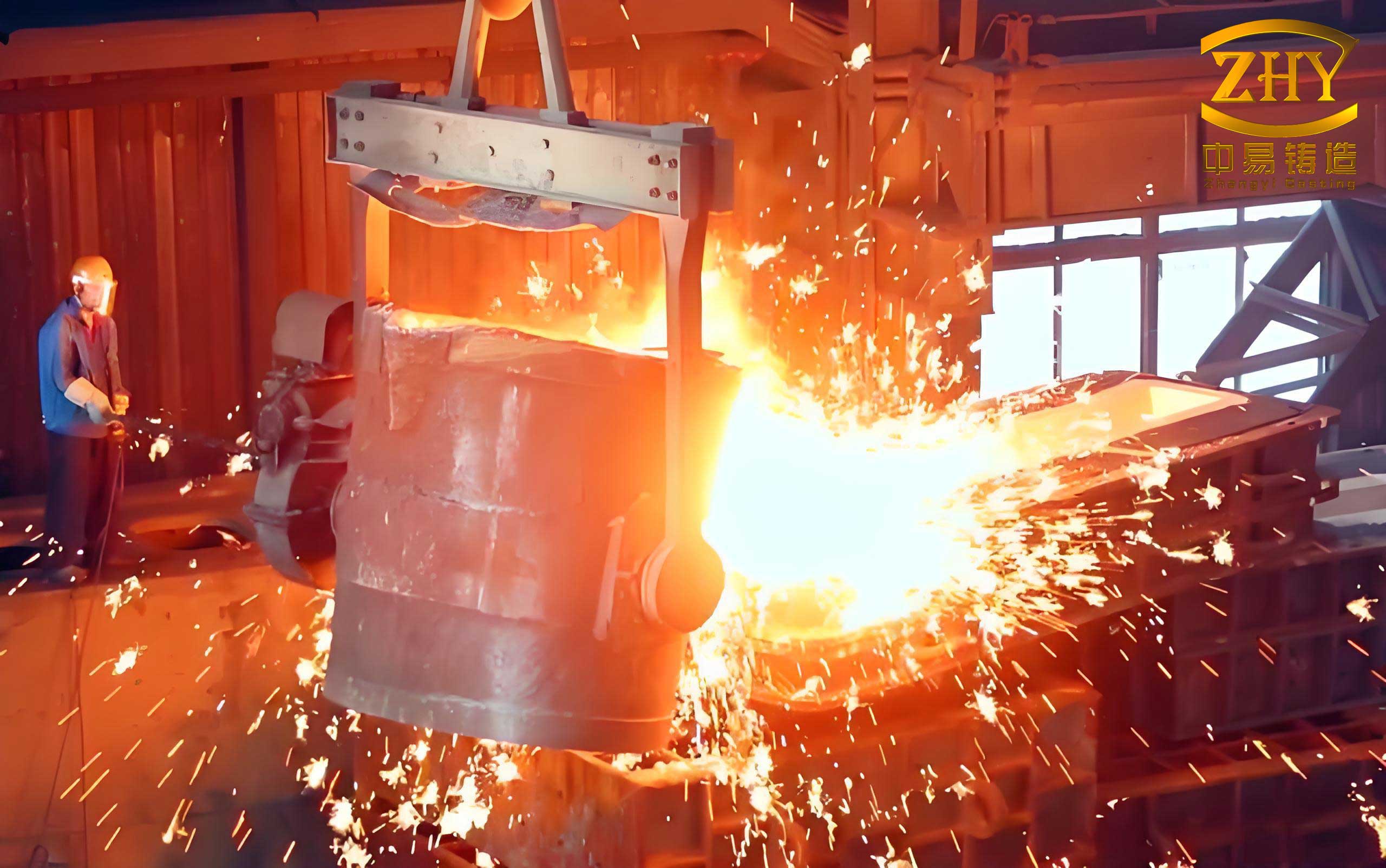
The image above illustrates typical aviation casting parts, highlighting their complex geometries and the need for advanced casting techniques. These casting parts are often made from superalloys and require stringent quality standards, which large vacuum precision casting furnaces help meet.
Market Analysis for Large Vacuum Precision Casting Furnaces
The global market for large vacuum precision casting furnaces is driven by the expansion of commercial aviation, especially in regions like China where domestic aircraft programs are burgeoning. Based on industry forecasts, the demand for casting parts such as engine casings is expected to grow significantly over the next two decades. For instance, projections indicate that China’s aircraft fleet could exceed 10,000 units by 2041, directly correlating with the need for more furnaces to produce these casting parts. Currently, the supply of large furnaces (e.g., 800 kg capacity) is limited, with only a handful of units worldwide, mostly imported from Western manufacturers. This dependency poses risks due to geopolitical tensions and export restrictions, underscoring the urgency for domestic development.
To quantify this, I have compiled a table summarizing the market trends for casting parts and associated furnace demand:
| Region | Annual Demand for Large Casting Parts (units) | Required Furnace Capacity (kg) | Growth Rate (2024-2040) |
|---|---|---|---|
| China | 500-700 | 800 | 8% |
| North America | 300-400 | 500-800 | 4% |
| Europe | 200-300 | 500 | 3% |
This table shows that China’s demand for casting parts is the highest, driven by projects like the CJ-1000A engine. The furnace capacity required aligns with the size of casting parts, typically ranging from 500 kg to 800 kg for large casings. The growth rates indicate a robust market, necessitating investments in furnace technology. Moreover, the production of casting parts often involves complex geometries, as seen in thin-walled casings, which require furnaces with precise control systems. In my assessment, the shortage of domestic large furnaces is a bottleneck that must be addressed to sustain the aviation industry’s growth.
Technical Overview of Vacuum Precision Casting Furnaces
Vacuum precision casting furnaces are designed to melt and cast superalloys under low-pressure conditions, reducing oxidation and improving the integrity of casting parts. The fundamental principle involves inductive heating, where an alternating current generates a magnetic field that induces eddy currents in the metal charge, leading to Joule heating. The power density can be expressed using the formula for electromagnetic induction:
$$ P = \frac{1}{2} \sigma \omega^2 B^2 r^2 $$
where \( P \) is the power density (W/m³), \( \sigma \) is the electrical conductivity of the metal (S/m), \( \omega \) is the angular frequency (rad/s), \( B \) is the magnetic flux density (T), and \( r \) is the radius of the charge (m). This formula highlights the importance of frequency and coil design in efficiently melting metals for casting parts. For large furnaces, optimizing these parameters is crucial to achieve uniform heating and minimize energy loss.
Furnaces are typically categorized into vertical and horizontal layouts, each with advantages for specific casting parts. Vertical layouts, common in smaller furnaces (25-200 kg), feature a熔炼室 above a铸型室, allowing for gravity-assisted pouring. However, for large casting parts exceeding 500 kg, horizontal layouts are preferred due to stability and space considerations. The following table compares the two layouts for producing casting parts:
| Layout Type | Max Capacity for Casting Parts (kg) | Advantages | Disadvantages |
|---|---|---|---|
| Vertical | 200 | Compact design, good for small casting parts | Limited height, unstable for large casting parts |
| Horizontal | 1000+ | Stable for large casting parts, easier maintenance | Larger footprint, higher cost |
Horizontal layouts, as used in 800 kg furnaces, often incorporate a熔炼室 and铸型室 arranged side-by-side, with a vacuum isolation valve in between. This design facilitates the handling of large molds for casting parts and allows for dynamic compensation during pouring. The thermal dynamics during casting can be modeled using the heat transfer equation:
$$ \frac{\partial T}{\partial t} = \alpha \nabla^2 T $$
where \( T \) is temperature (K), \( t \) is time (s), and \( \alpha \) is thermal diffusivity (m²/s). Controlling temperature gradients is vital to prevent defects in casting parts, such as shrinkage or porosity. In practice, furnaces employ automated systems to regulate cooling rates, ensuring high-quality casting parts with consistent microstructure.
Advanced Technologies in New Domestic Large Vacuum Precision Casting Furnaces
To address the reliance on imported equipment, a new domestic large vacuum precision casting furnace has been developed, specifically tailored for producing aviation casting parts. This furnace features an 800 kg capacity and incorporates several innovative technologies. One key aspect is the yoke-less induction coil system, which eliminates traditional magnetic yokes to reduce the overall size and improve electromagnetic efficiency. The design leverages CAE simulations to optimize coil geometry, as shown in the electromagnetic analysis below. The magnetic field distribution can be calculated using Maxwell’s equations, simplified for axisymmetric cases:
$$ \nabla \times \left( \frac{1}{\mu} \nabla \times \mathbf{A} \right) = \mathbf{J} $$
where \( \mathbf{A} \) is the magnetic vector potential (Wb/m), \( \mu \) is permeability (H/m), and \( \mathbf{J} \) is current density (A/m²). By simulating this, the coil achieves higher efficiency, reducing power consumption for melting metals used in casting parts.
The furnace also includes a dual-drive translation system for coil movement, enhancing precision during pouring for casting parts. This system uses servo motors controlled by algorithms to ensure smooth motion, critical for maintaining a short metal stream during casting. The dynamic compensation can be expressed as a control function:
$$ \Delta z = k_p e(t) + k_i \int e(t) dt $$
where \( \Delta z \) is the adjustment in mold height (m), \( e(t) \) is the error in position, and \( k_p \), \( k_i \) are control gains. This ensures accurate alignment between the crucible and mold, reducing turbulence and improving the surface finish of casting parts.
Furthermore, the furnace employs an all-electric drive system, eliminating hydraulic components to enhance reliability and reduce maintenance—a common issue in older furnaces. The following table summarizes the technical specifications of this new furnace compared to a leading foreign model, focusing on aspects relevant to casting parts production:
| Parameter | New Domestic Furnace | Foreign Furnace (e.g., VIM-IC 70E) |
|---|---|---|
| Capacity for Casting Parts (kg) | 800 | 700 |
| Coil Design | Yoke-less, higher efficiency | With yoke, traditional |
| Power Efficiency (%) | 85-90 | 80-85 |
| Vacuum Level (Pa) | 0.1 | 0.1 |
| Automation Level | Fully automated for casting parts | Semi-automated |
| Maintenance Requirements | Low (electric drive) | High (hydraulic system) |
This comparison shows that the domestic furnace offers competitive or superior features, particularly in efficiency and automation, which are essential for mass-producing high-quality casting parts. The yoke-less coil, for instance, reduces heat loss and allows for faster melting cycles, increasing throughput for casting parts. Additionally, the integration of real-time monitoring systems enables data-driven optimization of casting parameters, further enhancing the consistency of casting parts.
Future Prospects and Challenges in Large Vacuum Precision Casting
Looking ahead, the development of large vacuum precision casting furnaces will continue to evolve to meet the escalating demands for aviation casting parts. Key trends include the adoption of Industry 4.0 technologies, such as IoT sensors and AI-based process control, to predict and prevent defects in casting parts. For example, machine learning algorithms can analyze thermal data to optimize pouring schedules, reducing scrap rates. The relationship between process variables and casting quality can be modeled using regression equations:
$$ Q = \beta_0 + \beta_1 T + \beta_2 V + \beta_3 P $$
where \( Q \) represents the quality metric of casting parts (e.g., tensile strength), \( T \) is pouring temperature (K), \( V \) is pouring velocity (m/s), \( P \) is vacuum pressure (Pa), and \( \beta \) are coefficients derived from historical data. Such models empower manufacturers to fine-tune furnace operations for each batch of casting parts.
Another area of innovation is the use of advanced materials for furnace components, like refractory linings with higher thermal stability, to extend service life during the production of casting parts. Research into multi-physics simulations will also play a role, combining electromagnetic, thermal, and fluid dynamics to design furnaces that minimize energy consumption while maximizing the yield of casting parts. The table below outlines potential technological advancements and their impact on casting parts production:
| Technology | Expected Impact on Casting Parts | Timeframe |
|---|---|---|
| AI-Driven Process Control | Reduce defects in casting parts by 20% | 2025-2030 |
| Advanced Refractories | Increase furnace uptime for casting parts by 30% | 2024-2028 |
| Hybrid Heating Systems | Improve energy efficiency for casting parts by 15% | 2026-2032 |
However, challenges remain, such as the high initial cost of large furnaces and the need for skilled operators to manage complex casting processes for casting parts. Domestic manufacturers must also navigate supply chain issues for critical components like high-power frequency converters. In my view, collaborative efforts between academia and industry will be crucial to overcome these hurdles, ensuring a steady supply of advanced furnaces for casting parts.
Conclusion
In conclusion, large vacuum precision casting furnaces are indispensable for manufacturing high-performance casting parts in the aviation sector. Through my analysis, I have highlighted the market dynamics, technical intricacies, and innovations in domestic furnace design. The new yoke-less, fully electric furnace represents a significant step toward self-reliance, offering enhanced efficiency and reliability for producing casting parts. As the demand for casting parts grows with the expansion of commercial aviation, continued investment in furnace technology will be vital. By leveraging formulas, simulations, and automated systems, the industry can achieve higher quality and productivity in casting parts, ultimately supporting the global transition to more sustainable and independent aerospace manufacturing. The journey ahead involves embracing digitalization and material science to refine these furnaces, ensuring they meet the ever-evolving standards for casting parts in next-generation engines.