
In the field of advanced manufacturing, particularly for aerospace and power generation industries, the production of high-quality superalloy castings relies heavily on precision investment casting processes. As a researcher focused on vacuum furnace technology, I have observed that the demand for large-scale components, such as turbine blades and structural parts exceeding one meter in dimensions, has grown significantly. However, traditional vacuum precision investment casting furnaces, while effective for small to medium-sized castings, face substantial challenges when scaled up. This paper presents my comprehensive analysis of these challenges and proposes a novel structural layout for large vacuum precision investment casting furnaces, aiming to enhance efficiency, control, and versatility in producing large precision investment castings.
Precision investment casting, often referred to as the lost-wax process, is a critical method for manufacturing complex, near-net-shape metal parts with excellent surface finish and dimensional accuracy. In vacuum environments, this process prevents oxidation and contamination, making it ideal for superalloys used in high-temperature applications. The core equipment, the vacuum precision investment casting furnace, must integrate melting, mold heating, and pouring functionalities under controlled conditions. My research delves into the evolution of these furnaces, highlighting how existing designs fall short for large-scale precision investment casting and offering innovative solutions.
The development of vacuum precision investment casting technology spans over six decades, with early adoption in aerospace sectors. Historically, Western countries like the United States and Germany pioneered vertical double-chamber furnaces, which became the industry standard for precision investment casting. These furnaces feature a melting chamber on top and a mold chamber below, separated by an isolation valve. This layout supports various casting techniques, including equiaxed, directional solidification, and single-crystal growth. For instance, in equiaxed precision investment casting, the mold is preheated externally and transferred into the furnace for pouring, but this method becomes problematic for large molds due to thermal losses and inconsistent heating.
| Furnace Type | Structure | Advantages | Disadvantages for Large Castings |
|---|---|---|---|
| Vertical Double-Chamber | Melting chamber above, mold chamber below with isolation valve | Versatile for multiple casting processes; adjustable mold position | Limited mold heating control; pouring curve challenges with large volumes |
| Horizontal Double-Chamber | Side-by-side chambers with horizontal mold transfer | Higher automation potential; efficient for batch production | Less common in Western designs; may require custom工艺 integration |
In my assessment, vertical double-chamber furnaces, produced by companies like ALD and Consarc, dominate the market for precision investment casting. They typically handle capacities up to 100 kg, suitable for small turbine blades. The mold is lifted vertically into the melting chamber for pouring, and features like horizontal feeders allow for vacuum-tight alloy addition. However, for large precision investment casting, where mold weights and dimensions increase, these designs struggle with maintaining uniform mold temperature and achieving precise pouring curves. The rapid pouring in equiaxed precision investment casting leads to splashing, which can damage internal heaters if placed near the mold, increasing maintenance costs.
Horizontal double-chamber furnaces, more prevalent in Russian industries, offer an alternative layout. Here, chambers are arranged side-by-side, enabling horizontal mold transfer. This design supports faster production cycles, aligning with mass-manufacturing philosophies. Yet, it too faces limitations in large-scale precision investment casting, particularly in mold heating and pouring control. The historical divergence in furnace designs underscores the need for a tailored approach for large precision investment casting applications.
Scaling up vacuum precision investment casting furnaces to handle 200-500 kg capacities introduces several technical hurdles. First, large mold insulation is critical. In precision investment casting, molds must be preheated to specific temperatures to ensure proper metal flow and solidification. For small molds, external resistive heating suffices, but large molds experience significant heat loss during transfer, leading to quality variations. Internal mold heaters within the furnace could mitigate this, but they are vulnerable to metal splashing during pouring in equiaxed precision investment casting. Thus, a solution must decouple heating from pouring to protect equipment.
Second, controlled pouring curves are essential for defect-free castings. The pouring process in precision investment casting involves tilting the crucible to pour molten alloy into the mold. For small furnaces, simple tilt-speed control works, but large volumes require dynamic adjustment of multiple parameters. The pouring distance, flow rate, and mold position must be coordinated to minimize turbulence and ensure complete filling. This can be modeled using fluid dynamics equations. For example, the pouring flow rate \( Q \) can be expressed as:
$$ Q = \frac{dV}{dt} = A \cdot v $$
where \( V \) is the volume of alloy, \( t \) is time, \( A \) is the cross-sectional area of the pouring stream, and \( v \) is the velocity. In large precision investment casting, \( Q \) must be carefully controlled to avoid excessive splashing or cold shuts. Additionally, the thermal profile during solidification affects grain structure, which is crucial for mechanical properties. The heat transfer equation during casting is:
$$ \rho c_p \frac{\partial T}{\partial t} = \nabla \cdot (k \nabla T) + \dot{q} $$
where \( \rho \) is density, \( c_p \) is specific heat, \( T \) is temperature, \( k \) is thermal conductivity, and \( \dot{q} \) is heat generation rate. Optimizing this for large molds requires precise furnace design.
Third, process compatibility and serialization are key for economic viability. Modern precision investment casting furnaces often serve multiple processes like equiaxed and directional solidification. A large furnace should adapt to these without major redesigns. Traditional vertical furnaces achieve this by adding or modifying components, but large-scale versions may lack flexibility. Therefore, a new layout must inherently support modularity for different precision investment casting techniques.
To address these challenges, I propose a horizontal double-chamber layout specifically for large vacuum precision investment casting furnaces. This design places the melting chamber and mold chamber side-by-side, with an integrated mold heater located above the mold chamber within the melting chamber. The mold is transported horizontally on a cart into the mold chamber, then lifted vertically into the heater for temperature compensation or heating, all under vacuum. After heating, the mold is lowered to the pouring position, and the crucible, mounted on a built-in coil translation mechanism, moves horizontally to align with the mold for pouring. This separation of heating and pouring zones protects the heater from splashing, a common issue in precision investment casting.
The built-in coil translation mechanism is a novel feature. In traditional furnaces, coil movement is limited by external seals, restricting speed and range. Here, the entire melting coil and crucible assembly is mounted on a translation frame inside the melting chamber, allowing rapid horizontal adjustment without vacuum breaches. This enables precise control over the pouring curve by dynamically positioning the crucible relative to the mold. The mechanism’s components are shielded from splashing to ensure durability. The electrical supply to the coil uses vacuum-rated water-cooled cables, requiring robust sealing. This design supports pouring curves that can be programmed as a function of time, such as:
$$ \theta(t) = \theta_0 + \int_{0}^{t} \omega(\tau) d\tau $$
where \( \theta(t) \) is the tilt angle, \( \theta_0 \) is the initial angle, and \( \omega(\tau) \) is the angular velocity. Combined with vertical mold positioning and horizontal coil movement, this allows for multi-axis control in precision investment casting.
For mold heating, I recommend induction heating for equiaxed precision investment casting due to its scalability and efficiency. Since the heater is placed above the pouring area, it avoids magnetic interference with solidification. For furnaces aiming to兼容 directional solidification or single-crystal processes, a multi-zone resistive heater that moves upward relative to the mold is preferable. This approach, inspired by German innovations, enables directional growth by creating a temperature gradient. The heater movement velocity \( v_h \) must match the solidification rate \( v_s \), given by:
$$ v_s = \frac{G}{R} $$
where \( G \) is the temperature gradient and \( R \) is the cooling rate. In precision investment casting, controlling \( v_s \) is vital for defect-free microstructures.
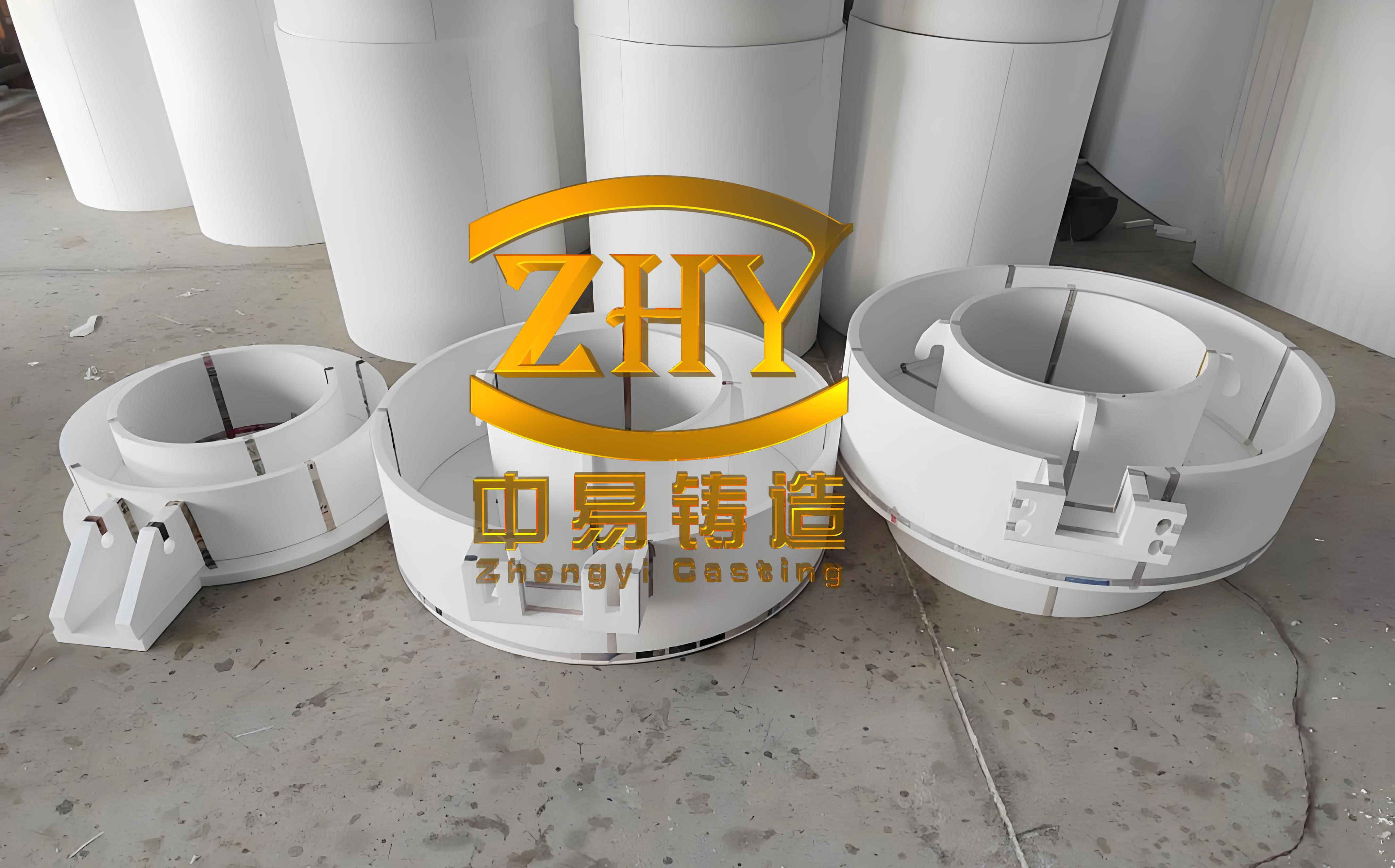
This image illustrates a casting process, relevant to precision investment casting, highlighting the complexity of mold and metal interaction. In large furnaces, such interactions must be carefully managed to ensure quality.
The proposed layout offers several advantages for large precision investment casting. First, mold heating is stabilized. The internal heater compensates for temperature losses, and since it’s isolated from pouring, it avoids damage. This is crucial for large molds where thermal mass leads to slow heating and cooling. Second, pouring control is enhanced. The coil translation mechanism allows fine-tuning of the pouring stream, reducing splashing and improving filling efficiency. Third, the design supports serialization. By switching between induction and resistive heaters, and incorporating movable components, the same furnace platform can handle equiaxed, directional, and single-crystal precision investment casting. This reduces costs and increases flexibility for manufacturers.
| Parameter | Specification | Impact on Precision Investment Casting |
|---|---|---|
| Capacity | 200-500 kg alloy | Enables large-scale component production |
| Mold Heating Method | Induction or multi-zone resistive | Improves temperature uniformity for complex molds |
| Coil Translation Range | Up to 500 mm horizontally | Allows dynamic pouring curve adjustment |
| Vacuum Level | ≤ 10⁻³ Pa | Prevents oxidation in superalloy casting |
| Heating Temperature | Up to 1600°C | Suitable for high-melting-point alloys |
In practice, this furnace layout has been prototyped and tested, showing promising results for large precision investment casting. The automation capabilities, such as programmable pouring sequences and mold handling, reduce manual intervention and enhance repeatability. For instance, the pouring process can be optimized using computational models that simulate fluid flow and solidification. The Navier-Stokes equations for incompressible flow during pouring are:
$$ \frac{\partial \mathbf{v}}{\partial t} + (\mathbf{v} \cdot \nabla) \mathbf{v} = -\frac{1}{\rho} \nabla p + \nu \nabla^2 \mathbf{v} + \mathbf{g} $$
where \( \mathbf{v} \) is velocity, \( p \) is pressure, \( \nu \) is kinematic viscosity, and \( \mathbf{g} \) is gravity. By integrating such models with furnace controls, precision investment casting quality can be predicted and improved.
Looking ahead, the future of large vacuum precision investment casting furnaces lies in further integration of smart technologies. Industry 4.0 concepts, such as IoT sensors and AI-driven process optimization, could revolutionize precision investment casting. Real-time monitoring of mold temperature, alloy composition, and pouring parameters can feed into adaptive control systems. For example, neural networks could learn optimal pouring curves for different mold geometries, reducing trial-and-error in precision investment casting. Additionally, sustainability aspects, like energy-efficient heating and recycling of materials, are gaining importance. The proposed furnace design, with its efficient heating and reduced waste from splashing, aligns with these trends.
In conclusion, the demand for large superalloy castings in aerospace and energy sectors drives innovation in vacuum precision investment casting furnaces. My analysis shows that traditional designs are inadequate for scale-up, necessitating a new horizontal layout with integrated mold heating and coil translation. This approach addresses key challenges in mold insulation, pouring control, and process compatibility, making it a viable solution for large precision investment casting. As global competition intensifies and technological barriers persist, self-reliance in developing advanced furnaces is crucial. Through continuous research and collaboration with industry partners, this furnace layout can evolve to set new standards in precision investment casting, enabling the production of high-performance components for critical applications. The journey from concept to implementation underscores the importance of innovation in sustaining industrial growth and technological leadership.
To elaborate further on the technical aspects, consider the economic implications of large precision investment casting furnaces. The initial investment is high, but the payoff comes from reduced scrap rates and faster production cycles. For equiaxed precision investment casting, typical scrap rates due to defects like porosity or misruns can be as high as 20% for large parts. With improved temperature control and pouring accuracy, the proposed furnace could cut this to below 10%, saving material and time. The cost function for casting production \( C \) can be modeled as:
$$ C = C_m + C_e + C_l + C_s $$
where \( C_m \) is material cost, \( C_e \) is energy cost, \( C_l \) is labor cost, and \( C_s \) is scrap cost. By minimizing \( C_s \) through better furnace design, overall costs in precision investment casting decrease.
Moreover, the furnace’s modularity allows for upgrades. As new precision investment casting techniques emerge, such as hybrid additive manufacturing with casting, components can be added without overhauling the entire system. This future-proofing is essential in a rapidly evolving field. For instance, integrating 3D-printed ceramic molds directly into the furnace could streamline processes, but requires precise temperature and vacuum management.
In summary, the pursuit of excellence in precision investment casting hinges on equipment innovation. My proposed furnace layout represents a step forward, combining proven principles with novel engineering to meet the demands of large-scale production. Through ongoing testing and refinement, it aims to become a cornerstone of advanced manufacturing, empowering industries to create larger, more complex, and higher-quality castings than ever before.