
As an experienced engineer in the field of machine tool manufacturing, I have long recognized that the appearance quality of products is a critical component of overall quality. This is especially true for machine tools, where the aesthetic appeal of castings directly influences user perception and market competitiveness. In this article, I will share my insights on enhancing the matching quality of machine tool casting surfaces, drawing from years of hands-on experience. The term “machine tool casting” will be frequently emphasized, as it is central to our discussion. Machine tool castings constitute a significant portion of most machine tools, and their alignment at joint surfaces plays a pivotal role in外观 quality. However, achieving precise matching has been a persistent challenge due to the complexity of processes involved. Through a comprehensive analysis of design, casting processes, machining, and production, I aim to outline strategies that can significantly reduce assembly rework and improve overall efficiency.
In my work, I have observed that the matching quality of machine tool casting surfaces is often compromised by inconsistencies across various stages of production. This article will delve into each环节, highlighting how improvements can be made. To begin, let’s consider the design phase, which sets the foundation for all subsequent processes. A key issue I frequently encounter is the lack of clear specifications on drawings. For instance, when part numbers for matching castings are not annotated, information about “matching” fails to propagate downstream. This is particularly problematic in specialized factories where different units handle various components. Without this information, it becomes impossible to control dimensions effectively during casting and machining. Moreover, design drawings often omit requirements for matching surfaces, leading to ambiguous工艺 guidelines. I recall a case involving a cylindrical grinder bed where the front and rear beds had inconsistent dimensioning methods for their joint surfaces. This resulted in significant misalignment, as shown in the following analysis.
To quantify the impact of dimensioning methods, I often use size chain analysis. Consider a joint surface with dimensions labeled as in the original design. Let’s define the cumulative tolerance as the sum of individual tolerances in a size chain. For a machine tool casting, if we have a dimension chain with n components, the maximum cumulative tolerance Δ can be expressed as:
$$ \Delta = \sum_{i=1}^{n} \delta_i $$
where δ_i is the tolerance for the i-th component. In the case of the front and rear beds, the original dimensioning led to a cumulative tolerance of up to ±2.5 mm for misalignment. By unifying the dimensioning methods and optimizing the placement of “closed loops” in the size chain, we can reduce this error. For example, when the closed loop is set on a non-matching component, the cumulative tolerance for matching surfaces decreases. I have summarized this in Table 1, which compares different dimensioning schemes.
| Dimensioning Scheme | Maximum Cumulative Tolerance for Misalignment (mm) | Maximum Cumulative Tolerance for Width Difference (mm) |
|---|---|---|
| Original Drawing | ±2.5 | ±3.0 |
| Scheme 1 (Unified, closed loop on largest dimension) | ±1.2 | ±1.5 |
| Scheme 2 (Closed loop on non-matching component) | ±0.8 | ±1.0 |
This table clearly shows that standardized dimensioning can cut errors by half, directly benefiting the matching quality of machine tool casting surfaces. Another design aspect I often address is structural complexity. For instance, a headstock housing with uneven profile heights at its sides makes it difficult to maintain continuity in casting, especially with draft angles. Simplifying such profiles by aligning centerlines or using rectangular shapes can greatly enhance appearance. Additionally, certain structural features, like circular bosses on exposed surfaces, are prone to misalignment due to casting tolerances. In my practice, I recommend replacing these with counterbores where possible, as it minimizes visible mismatches. This is particularly relevant for machine tool casting components that are front-facing, such as tailstock housings or bed ways.
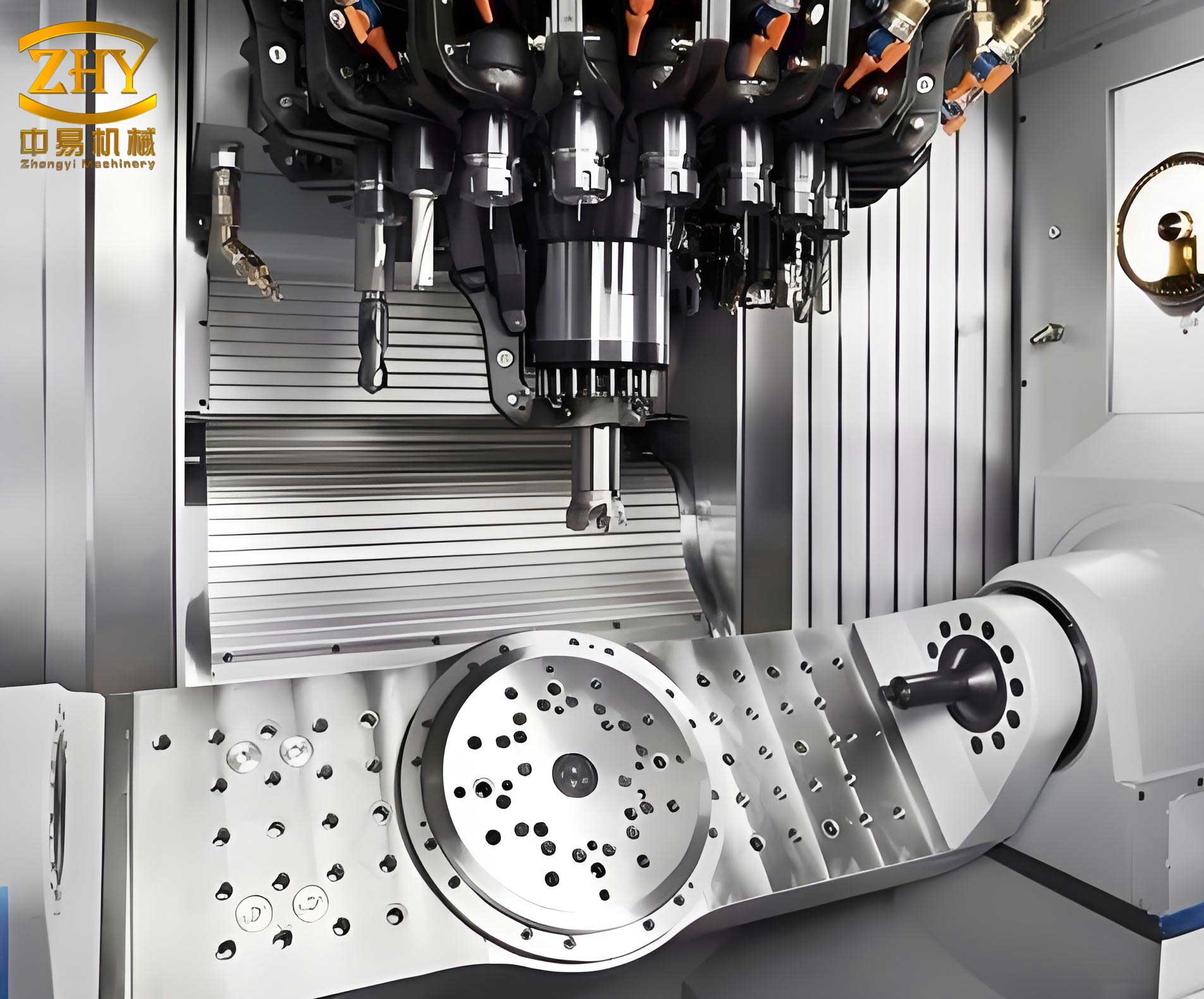
Moving to casting processes, I have found that工艺 decisions significantly influence the matching quality of machine tool castings. One critical factor is the selection of parting lines. Based on my experience, if the parting line is perpendicular to the matching surface, it introduces taper and enlarges dimensions, making control challenging. Conversely, a parting line parallel to but offset from the matching surface preserves both shape and size. I often use the following relationship to assess this: for a casting with parting line angle θ, the dimensional change ΔD at the joint can be approximated as:
$$ \Delta D = h \cdot \tan(\theta) $$
where h is the height of the casting section. By minimizing θ or choosing an offset parting line, we can reduce ΔD. Another key aspect is shrinkage allowance. For machine tool castings made of different materials, such as aluminum alloys paired with gray iron, shrinkage rates vary. I typically calculate the required model尺寸 using empirical data. For example, the shrinkage rate ε for gray iron is around 1%, while for aluminum it can be 1.2%. The model dimension L_model for a casting dimension L_final is given by:
$$ L_{\text{model}} = L_{\text{final}} \cdot (1 + \epsilon) $$
However, for complex shapes, I often adjust this through trial runs and create templates for model repair. This ensures consistency across multiple patterns, which is crucial for long-term production of machine tool castings.工艺装备, such as mold boxes and cores, also play a role. In one project, a bed casting produced with a split mold had poor定位, leading to deviations up to 5 mm in pad surfaces. By implementing reliable locating devices and using inspection templates during core assembly, we reduced this to within 1 mm. This highlights the importance of integrating casting process design with machining requirements. For instance, if a machining process uses a cast hole as a datum, but its position has high variability, it can exacerbate mismatches. Coordination between casting and machining工艺 is essential, as I learned from a case where adjusting the datum to a more stable feature improved alignment.
In machining processes, I emphasize the need for strategic compensation. Take the example of a double-face grinding machine column and base. The casting dimensions for the column often vary by ±3 mm. If the machining process simply follows nominal dimensions, it can result in protruding edges. Instead, I design the process to use a补偿 dimension that absorbs casting variations. Let’s denote the casting dimension as C with tolerance ±δ_c, and the machining dimension as M with tolerance ±δ_m. The final assembled misalignment Δ_a can be expressed as:
$$ \Delta_a = \sqrt{(\delta_c)^2 + (\delta_m)^2} $$
By selecting M such that it correlates negatively with C, we can minimize Δ_a. For instance, if C is larger, M is machined smaller to offset the difference. This approach requires careful planning but has proven effective in enhancing the matching quality of machine tool casting joints. Additionally,夹具 design is crucial. I recall a drill jig for a front cover that used scribed lines for定位, leading to errors due to wear. By redesigning it with a contour-matching fixture, we improved定位 accuracy by 30%. Similarly, for a pad machining, using the width dimension as a datum instead of a guide way reduced misalignment by half. These examples underscore how machining工艺 can either mitigate or amplify casting imperfections.
Model manufacturing is another area where I focus attention. Inconsistent patterns for the same part number can cause variations in machine tool casting dimensions. I advocate for using durable materials and robust structures to prevent deformation. For example, wooden models may warp over time, so I prefer resin or metal for critical castings. Moreover,细节 like fillet radii must be controlled; oversized fillets at joint surfaces can enlarge the mating area post-machining. I often specify radii within ±0.5 mm of design values to ensure proper fit. The equation for fillet radius impact on dimension is:
$$ D_{\text{effective}} = D_{\text{nominal}} + 2r \cdot (1 – \cos(\alpha)) $$
where r is the fillet radius and α is the angle of the joint. By keeping r small, we minimize D_effective deviations.
Casting production practices directly affect the quality of machine tool castings. During molding, low sand compaction can lead to swelling, increasing dimensions by up to 2 mm in my observations. I recommend using high-pressure molding to achieve uniform density. Core making also requires precision; loose core box screws or excessive ramming force can distort cores, causing mismatches of 1-3 mm. In合箱, improper core placement is a common issue. I use positioning gauges to ensure cores are within ±0.5 mm of nominal positions. The force during clamping should be balanced to avoid lift or shift, which I quantify with the formula:
$$ F_{\text{clamp}} = k \cdot A \cdot P $$
where k is a safety factor, A is the projected area, and P is the metallostatic pressure. By calculating F_clamp accurately, we prevent dimensional changes.清砂 is often overlooked; uneven cleaning can leave protrusions that hinder matching. I implement standardized cleaning procedures with calibrated tools to maintain surface integrity.
In machining operations, adherence to工艺 is vital. For a surface grinder column, failing to level the casting before machining resulted in twisted joints. The angular error φ can be related to the height difference Δh over length L:
$$ \phi = \arctan\left(\frac{\Delta h}{L}\right) $$
By leveling within 0.1 mm/m, we keep φ below 0.005°, ensuring better alignment. Tooling maintenance is equally important; worn fixtures can introduce errors of 0.2-0.5 mm. I schedule regular inspections to keep equipment within tolerance.
To summarize, improving the matching quality of machine tool castings requires a holistic approach. From design to production, each环节 must be optimized. I have found that clear communication of matching requirements, standardized dimensioning, and coordinated processes yield the best results. Economically, it is wise to differentiate requirements based on visibility; exposed surfaces demand higher precision, while hidden ones can be looser. In some cases, redesigning joints to non-matching profiles is more cost-effective. For critical matches, I specify tight tolerances on drawings or use pre-assembly修整. The key is to balance quality with cost, ensuring that machine tool castings meet aesthetic and functional standards without excessive rework.
In conclusion, the journey to enhance machine tool casting matching quality is continuous. By leveraging尺寸 chain analysis, process control, and interdisciplinary collaboration, we can achieve significant improvements. I encourage fellow engineers to prioritize this aspect, as it not only boosts product appeal but also streamlines production. The future of machine tool manufacturing hinges on such细节, and I am committed to advancing these practices through innovation and shared knowledge. Remember, every machine tool casting tells a story of precision and care—let’s make it a compelling one.