
As a researcher in the field of railway vehicle components, I have been deeply involved in the development of lightweight designs for critical parts such as gearbox housings. The metro gearbox is a vital component in the power transmission system of urban rail vehicles, subjected to complex dynamic loads during operation. To ensure safety and reliability, the housing must exhibit high strength and toughness, with strict requirements against casting defects like shrinkage porosity, cold shuts, and cracks. Traditionally, these housings are made from ductile cast iron, with a wall thickness of around 10–12 mm. However, in response to energy efficiency goals and carbon reduction policies, lightweighting has become a priority. The direct approach to lightweighting involves optimizing the structural design to reduce wall thickness while maintaining mechanical integrity. This presents significant challenges, as thinner walls can impair metal fluidity and lead to casting defects. In this article, I will detail our comprehensive study on the lightweighting process for metro gearbox housings using ductile cast iron, focusing on structural optimization, casting工艺 adjustments, and熔炼 enhancements to achieve a 20% weight reduction.
The traditional production process for metro gearbox housings employs ductile cast iron, typically grade QT450-10, with a wall thickness of 10–12 mm and a weight of approximately 170 kg. These are thin-walled castings produced using furan resin sand molding and medium-frequency furnace melting. The melting temperature is around 1500°C, and the pouring temperature is about 1400°C. While this method has been effective, it leaves room for improvement in terms of weight savings. The lightweighting initiative aims to reduce the wall thickness to 6–7 mm, which requires a meticulous reevaluation of the entire manufacturing chain to ensure quality and performance.
Structural design optimization is the cornerstone of lightweighting. Through finite element analysis (FEA), we simulated the stress distribution and fatigue behavior of the gearbox housing under operational loads. The model was meshed to account for complex geometries, and simulations confirmed that with a reduced wall thickness of 6–7 mm, the housing could still meet safety standards. The maximum stress under static loading was found to be 171.1 MPa, well below the yield strength of 310 MPa for ductile cast iron. For fatigue strength, assessed against a material fatigue limit of 98 MPa, all surface nodes fell within the Goodman fatigue diagram, ensuring durability. This validation allowed us to proceed with the lightweight design, targeting a weight of about 135 kg, which represents a 20% reduction. The success of this optimization hinges on the inherent properties of ductile cast iron, such as its high ductility and strength, which make it suitable for thin-section applications.
Casting工艺 design is critical to accommodate the thinner walls. One key aspect is enhancing the fluidity of the molten metal to prevent defects like cold shuts and misruns. Fluidity, defined as the ability of molten metal to fill the mold cavity, is influenced by several factors. For ductile cast iron, we focused on化学成分 adjustments, mold conditions, and gating system design. The流动性 of iron can be expressed in terms of its spiral length in a standard test, which correlates with composition and temperature. A common empirical relationship for fluidity (L) in mm is given by:
$$ L = k \cdot (T – T_{liq}) \cdot \sqrt{t} $$
where \( k \) is a constant dependent on composition, \( T \) is the pouring temperature, \( T_{liq} \) is the liquidus temperature, and \( t \) is time. For ductile cast iron, increasing the carbon and silicon content improves fluidity. Based on experimental data, we established optimal ranges. The table below summarizes the effect of carbon equivalent (CE) on fluidity for ductile cast iron in furan resin sand molds:
| CE (C + Si/3) (%) | Pouring Temperature (°C) | Spiral Length (mm) |
|---|---|---|
| 4.5 | 1300 | 800 |
| 4.2 | 1300 | 600 |
| 3.8 | 1300 | 400 |
For our lightweight housing, we targeted a化学 composition by mass fraction: C: 3.5–3.8%, Si: 2.5–2.8%, Mn: <0.5%. This higher carbon and silicon content enhances fluidity without compromising the mechanical properties of ductile cast iron. Additionally, we considered the role of mold temperature. Preheating the mold reduces the temperature gradient between the metal and the mold, thereby improving fluidity. In winter conditions, we used industrial heaters to raise the mold temperature to around 80°C before pouring, which significantly reduced casting defects. This practice is now recommended for all薄壁 ductile cast iron castings to ensure consistency.
The gating system was redesigned to facilitate rapid and smooth filling. A simplified gating structure minimizes flow resistance, and we increased the pouring head height to enhance pressure-driven flow. However, excessive head height can cause turbulence and oxidation, so we balanced it through simulation. Using MAGMA software, we performed flow field simulations for both the upper and lower housing halves. The results showed uniform temperature distribution throughout the thin-walled sections at 25%, 50%, 75%, and 100% filling, with no isolated cold spots or risks of cold shuts. The filling process was stable, free from splashing or air entrapment. The gating design included multiple ingates to ensure even metal distribution, as illustrated in the simulations. The fluid flow can be modeled using the Bernoulli equation for incompressible flow:
$$ P + \frac{1}{2} \rho v^2 + \rho g h = \text{constant} $$
where \( P \) is pressure, \( \rho \) is density, \( v \) is velocity, \( g \) is gravity, and \( h \) is height. By optimizing these parameters, we achieved a gating system that supports the lightweight design of ductile cast iron housings.
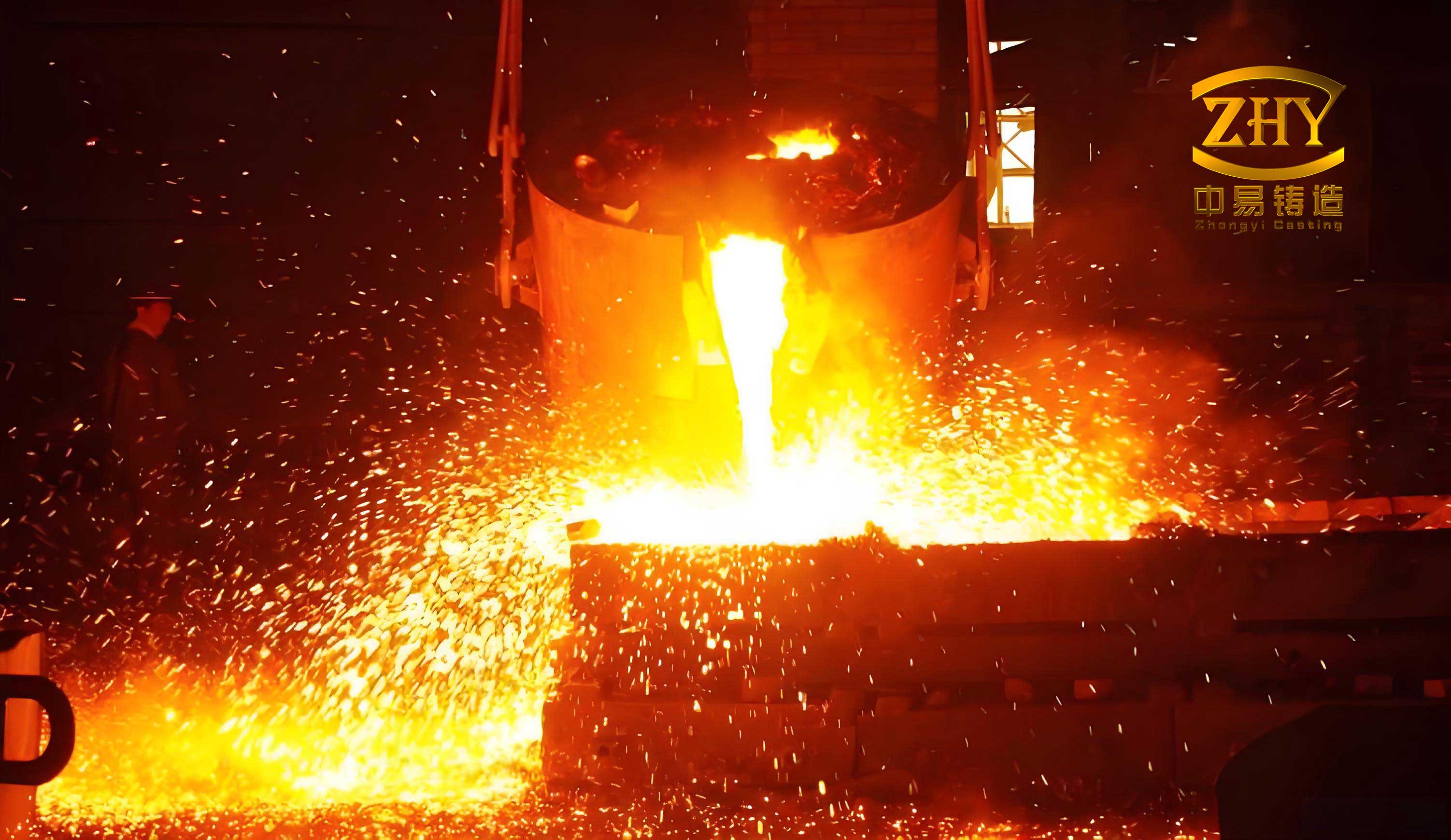
熔炼工艺 plays a pivotal role in the quality of ductile cast iron. We adjusted the melting temperature to 1520°C and adopted the盖包球化法 (covered ladle nodularization process) for treatment. Compared to the conventional冲入法 (open ladle process), the covered ladle method offers several advantages. First, it reduces temperature loss during nodularization. In a 1-ton ladle, the temperature drop is about 80°C with the covered ladle, versus 120°C with the open method. This allows for a lower melting temperature of 40°C less to achieve the same pouring temperature of 1440°C, leading to energy savings. Second, it minimizes metal splashing, improving workplace safety and reducing氧化. Third, the ability to move the ladle during treatment缩短s the time to pouring, mitigating球化衰退 (nodularization fading) and enhancing球化等级 (nodularization grade). The reaction kinetics for nodularization in ductile cast iron can be described by:
$$ \frac{d[Mg]}{dt} = -k [Mg]^n $$
where \( [Mg] \) is the magnesium concentration, \( k \) is the rate constant, and \( n \) is the order of reaction. The covered ladle helps maintain a more consistent镁 concentration, ensuring a high nodule count in the ductile cast iron microstructure. We also emphasized charge preparation: removing rust, sand, and oil from raw materials like pig iron, scrap steel, and returns, and drying alloys such as nodulizers and inoculants to improve metal purity. This is crucial for thin-walled ductile cast iron castings, where inclusions can act as stress raisers.
To validate the lightweighting process, we conducted a small-batch trial production of 24 sets of gearbox housings. All castings were inspected for defects using X-ray radiography and wet fluorescent magnetic particle testing. The results showed no cold shuts, shrinkage porosity, or slag inclusions. The mechanical properties met the QT450-10 specifications, with tensile strength above 450 MPa and elongation over 10%. The microstructure exhibited well-formed graphite nodules in a ferritic matrix, characteristic of high-quality ductile cast iron. The table below summarizes the key properties achieved:
| Property | Value | Standard Requirement |
|---|---|---|
| Tensile Strength (MPa) | 460-480 | >450 |
| Yield Strength (MPa) | 320-340 | >310 |
| Elongation (%) | 12-15 | >10 |
| Nodule Count (per mm²) | 120-150 | >100 |
The success rate was 100%, demonstrating the stability of the process for批量 production. This lightweighting approach not only reduces weight but also aligns with sustainable manufacturing practices by lowering energy consumption during熔炼 and operation. The use of ductile cast iron remains central to this achievement, as its combination of strength and ductility allows for aggressive thinning without compromising performance.
In conclusion, the lightweighting of metro gearbox housings through structural optimization to 6–7 mm wall thickness is feasible and effective, resulting in a 20% weight reduction. Our comprehensive study covered structural仿真,化学成分 tuning, mold preheating, gating system design, and advanced熔炼 techniques like the covered ladle nodularization process. The小批量 trials confirmed the工艺 reliability, with all castings meeting stringent quality standards. This research provides a robust framework for lightweighting其他 ductile cast iron components in轨道交通 and beyond, contributing to energy efficiency and carbon neutrality goals. Future work could explore further alloying additions or heat treatments to enhance the properties of ductile cast iron for even thinner sections. The versatility of ductile cast iron continues to make it a material of choice for demanding applications, and with ongoing innovations, its role in lightweighting will only grow.
Throughout this study, the importance of ductile cast iron cannot be overstated. Its unique microstructure, characterized by spherical graphite nodules embedded in a metallic matrix, imparts exceptional mechanical properties that are essential for thin-walled designs. The fluidity enhancements we implemented rely on the inherent behavior of ductile cast iron, and the成功 of the lightweighting process is a testament to the material’s adaptability. As we move forward, we plan to integrate更多 advanced simulation tools, such as machine learning models, to predict casting outcomes for ductile cast iron with even greater accuracy. The formula for stress in thin-walled structures can be expressed as:
$$ \sigma = \frac{P \cdot r}{t} $$
where \( \sigma \) is the hoop stress, \( P \) is internal pressure, \( r \) is radius, and \( t \) is wall thickness. For our gearbox housing, with reduced \( t \), the stress increases, but the high strength of ductile cast iron compensates for this. This balance is key to lightweighting, and our work shows that with careful engineering, ductile cast iron can meet the挑战 of modern轨道交通 design.