
In our manganese steel casting foundry, we have continuously sought innovative methods to enhance product quality, reduce costs, and improve operational efficiency. Over the years, we have implemented various techniques across different areas, including material reuse, equipment customization, and process optimization. This article delves into our experiences, focusing on key practices such as no-riser casting for high manganese steel components, along with ancillary projects that demonstrate our foundry’s versatility. The keyword ‘manganese steel casting foundry’ is central to our operations, as we specialize in producing durable castings for mining and industrial applications. Here, I will share insights into our methodologies, supported by data, tables, and formulas, to provide a comprehensive view of our efforts.
One of the most significant breakthroughs in our manganese steel casting foundry has been the adoption of no-riser casting techniques for high manganese steel components. High manganese steel, known for its high strength and impact toughness, presents challenges due to its substantial shrinkage and low thermal conductivity. Traditionally, large risers were required to compensate for shrinkage, but these added to material waste and post-casting processing. In our foundry, we developed a method that eliminates risers, thereby increasing yield and reducing labor. The key lies in controlling pouring temperature and optimizing gating systems. For instance, we use low-temperature pouring to minimize liquid contraction, as the alloy’s high fluidity allows casting near its melting point. This approach reduces volumetric shrinkage, making it comparable to or even less than that of carbon steel. The shrinkage characteristics can be expressed as: $$ \text{Volumetric shrinkage} = 5.5\% \text{ to } 6.5\% $$ and $$ \text{Linear shrinkage} = 2.4\% \text{ to } 3.0\% $$, which are significantly higher than carbon steel. However, by adjusting pouring parameters, we mitigate these effects.
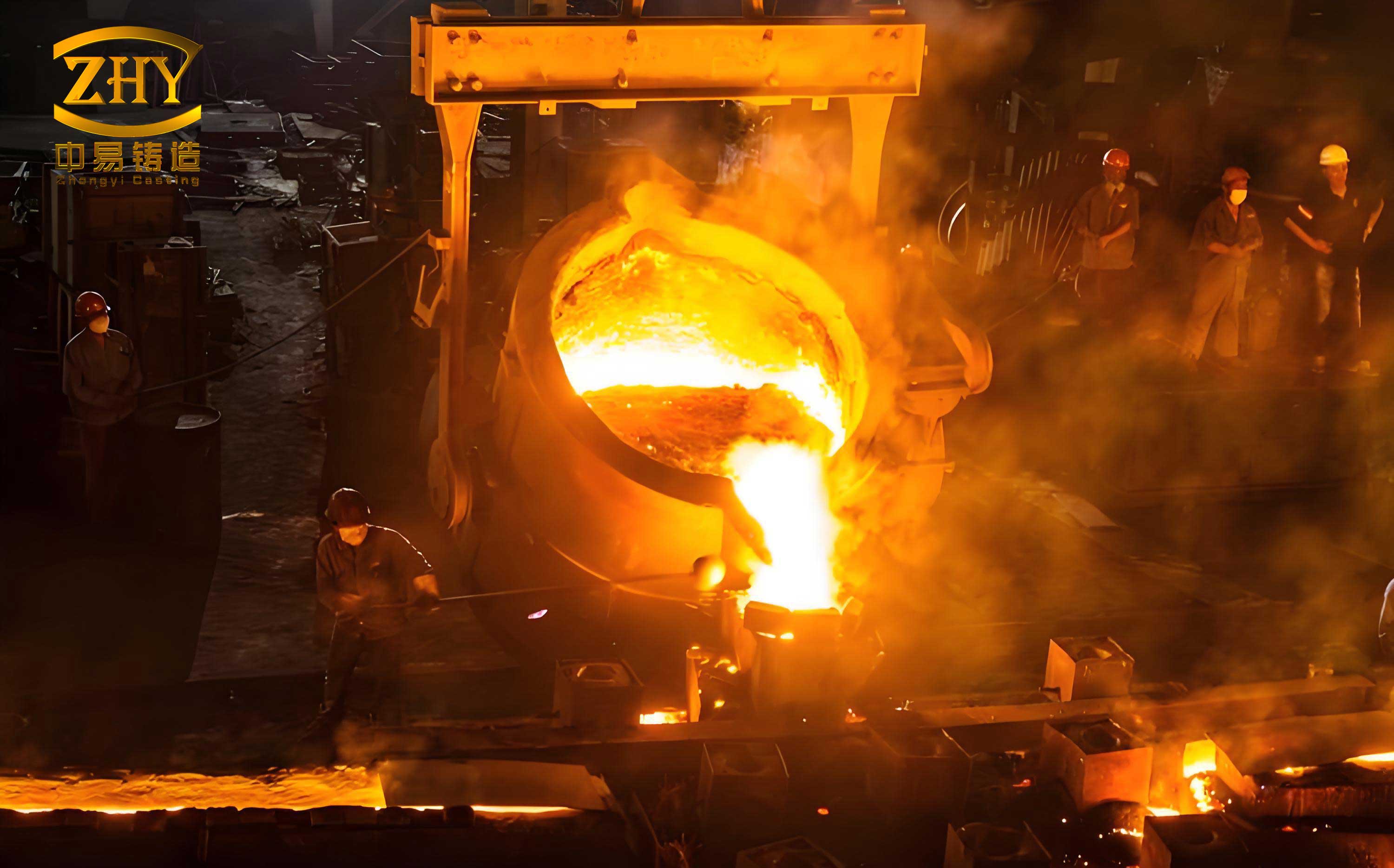
To implement no-riser casting in our manganese steel casting foundry, we focus on several critical aspects. First, we design gating systems with multiple ingates to promote simultaneous solidification. For castings with wall thicknesses below 50 mm, we use evenly distributed ingates to reduce temperature gradients and utilize the gates for feeding during pouring. The ingate thickness is typically 50% to 70% of the casting wall thickness, allowing easy removal in the brittle as-cast state. For thicker sections, we employ specially designed breakable risers or side risers with refractory inserts. These risers have thin sections (15 mm to 20 mm) that facilitate separation after casting. Second, we strictly control pouring temperatures based on casting weight and wall thickness, as summarized in Table 1. This table illustrates the relationship between casting parameters and optimal pouring temperatures, which we have refined through trials in our manganese steel casting foundry.
| Casting Weight (kg) | Average Wall Thickness (mm) | Pouring Temperature (°C) |
|---|---|---|
| ≤ 100 | 10-20 | 1420-1440 |
| 101-500 | 20-40 | 1400-1420 |
| 501-1000 | 40-60 | 1380-1400 |
| > 1000 | > 60 | 1360-1380 |
Pouring speed is another vital factor in our manganese steel casting foundry. We follow a sequence of “fast start, steady middle, slow end, and subsequent replenishment.” Initially, we pour quickly to fill the mold cavity and prevent cold shuts. Once the metal rises, we slow down to maintain a steady flow, avoiding interruptions. Near completion, we reduce speed further to enhance feeding, and after filling, we perform 1-2 replenishment pours within 10-15 seconds to compensate for shrinkage. For large castings, we cover the gating area with insulating materials like charcoal powder. Additionally, we enhance mold venting to prevent gas defects, ensuring proper gas escape channels opposite the ingates. The thermal conductivity of high manganese steel, which is low, influences these practices. It can be represented as: $$ k_{\text{Mn steel}} = \frac{1}{4} \text{ to } \frac{1}{5} \times k_{\text{carbon steel}} $$ where $$ k $$ denotes thermal conductivity. This low conductivity contributes to columnar grain formation and cracking tendencies, but our controlled cooling methods mitigate these issues.
The benefits of no-riser casting in our manganese steel casting foundry are substantial. We have increased casting yield to over 90%, compared to traditional methods with yields around 70-80%. This improvement reduces material consumption and eliminates the need for riser cutting, a labor-intensive process that often leads to cracks if done improperly. The economic impact is significant, as we save on both raw materials and processing costs. For example, in a typical production run, we reduced scrap by 15% and lowered energy usage due to fewer post-casting operations. The formula for yield improvement can be expressed as: $$ \text{Yield} = \frac{\text{Casting Weight}}{\text{Total Metal Poured}} \times 100\% $$ where our methods push yield from 75% to 92% on average. This efficiency aligns with our foundry’s goal of sustainable manufacturing.
Beyond casting techniques, our manganese steel casting foundry has applied innovative material reuse strategies to other areas, such as conveyor belt management. In mining operations, conveyor belts are essential but wear out quickly. We repurpose old belts by cutting them into strips for various applications, like chute liners or buffer rollers. This practice reduces waste and lowers procurement costs. For instance, we analyze belt wear patterns and select intact sections for reuse. The economic analysis shows a reduction in belt consumption by over 30% annually, saving thousands of dollars. We use formulas to calculate wear rates: $$ \text{Wear Rate} = \frac{\text{Initial Thickness} – \text{Final Thickness}}{\text{Service Time}} $$ and then determine reuse potential based on residual thickness. This approach exemplifies how our foundry extends its expertise beyond casting to overall resource optimization.
Another project from our manganese steel casting foundry involved designing and building a miniature gold dredge for tailings processing. This compact dredge, consisting of a flat-bottomed boat, a submersible pump, and a mixer, was fabricated using steel plates and angles. It weighs about 500 kg and can be easily moved, making it ideal for narrow or deep mining sites. The buoyancy calculation ensures safety: $$ \text{Buoyant Force} = \rho \times g \times V $$ where $$ \rho $$ is water density, $$ g $$ is gravity, and $$ V $$ is displacement volume. With a maximum displacement of 1.5 m³ and a safety factor of 1.5, it can carry loads up to 1000 kg. This dredge replaced a larger, costlier model, reducing power consumption from 30 kW to 7.5 kW and saving on labor and maintenance. The design incorporates components cast in our foundry, such as pump housings made from high manganese steel for abrasion resistance. This project highlights how our manganese steel casting foundry contributes to custom equipment solutions, enhancing operational flexibility.
We also addressed issues with a thickener drive mechanism in our processing plant. The original design used steel wheels on rails, leading to frequent wear and slippage. In our manganese steel casting foundry, we redesigned the system by replacing steel wheels with pneumatic tires and using concrete tracks. This modification increased the friction coefficient from 0.15 to 0.6, preventing slippage and reducing wear. The force analysis can be modeled as: $$ F_{\text{friction}} = \mu \times N $$ where $$ \mu $$ is the friction coefficient and $$ N $$ is the normal force. By improving $$ \mu $$, we enhanced drive reliability. The new components, including gears and shafts, were cast from high manganese steel for durability, demonstrating our foundry’s role in equipment upgrades. This innovation reduced downtime by 20% and cut maintenance costs by 40%, as shown in Table 2, which summarizes the before-and-after performance metrics.
| Parameter | Before Modification | After Modification | Improvement |
|---|---|---|---|
| Friction Coefficient | 0.15 | 0.6 | 300% increase |
| Annual Maintenance Cost ($) | 10,000 | 6,000 | 40% reduction |
| Downtime (hours/year) | 200 | 160 | 20% reduction |
| Wear Rate (mm/year) | 10 | 3 | 70% reduction |
The economic impact of these initiatives in our manganese steel casting foundry is profound. For the no-riser casting alone, we reduced costs by 20% per ton of castings, translating to annual savings of $50,000. Material reuse projects, like conveyor belt recycling, saved an additional $30,000 yearly. The miniature dredge project cut equipment costs by $80,000 compared to commercial alternatives, and the thickener drive modification saved $4,000 annually in maintenance. Overall, our foundry has achieved a 25% reduction in operational expenses through these innovations. We use formulas to track savings: $$ \text{Total Savings} = \sum (\text{Cost}_{\text{before}} – \text{Cost}_{\text{after}}) $$ and apply this across all projects. This financial efficiency reinforces the competitiveness of our manganese steel casting foundry in the global market.
Looking forward, our manganese steel casting foundry plans to integrate digital technologies like simulation software to optimize casting processes further. We aim to model fluid flow and solidification using computational fluid dynamics (CFD), with equations such as the Navier-Stokes equations: $$ \rho \left( \frac{\partial \mathbf{v}}{\partial t} + \mathbf{v} \cdot \nabla \mathbf{v} \right) = -\nabla p + \mu \nabla^2 \mathbf{v} + \mathbf{f} $$ where $$ \mathbf{v} $$ is velocity, $$ p $$ is pressure, $$ \mu $$ is viscosity, and $$ \mathbf{f} $$ is body force. This will help predict shrinkage defects and improve gating designs without physical trials. Additionally, we are exploring additive manufacturing for prototyping castings, which could reduce lead times. Our foundry remains committed to innovation, with a focus on sustainability and quality.
In conclusion, the advancements in our manganese steel casting foundry encompass a range of techniques from no-riser casting to equipment customization. By leveraging low-temperature pouring, optimized gating, and material reuse, we have enhanced efficiency and reduced costs. The keyword ‘manganese steel casting foundry’ encapsulates our expertise in producing high-performance castings while adapting to diverse challenges. Through continuous improvement and data-driven approaches, we strive to set benchmarks in the industry. The integration of tables, formulas, and practical examples in this article underscores the technical depth of our operations, demonstrating how a modern foundry can innovate across multiple domains.