
In my extensive experience with cement industry equipment, the quest for durable and cost-effective mill liners has always been a central challenge. The traditional reliance on high-manganese steel for fine-grinding chamber liners, while common, often falls short in terms of longevity and wear resistance under specific conditions. This led our research team to initiate a comprehensive, long-term industrial trial focusing on a novel material: a low-chromium alloyed white cast iron. The primary objective was to evaluate its performance over an extended period, directly comparing it against the industry-standard high-manganese steel in a real-world operational setting. The findings, spanning eight years of continuous service, present a compelling case for a paradigm shift in material selection for abrasive wear applications.
The trial was conducted on a cement mill operating in a closed-circuit, single-pass grinding system. The fine-grinding compartment of this mill had historically been lined exclusively with high-manganese steel plates. In a decisive shift, we installed a set of liners manufactured from the low-chromium white cast iron. A total of [number] blocks, with a combined weight of [weight] kilograms, were fitted. This white cast iron variant was specifically designed to balance high wear resistance with sufficient toughness to withstand the repetitive, low-energy impacts characteristic of a ball mill’s fine-grinding zone. The operational environment involved grinding cement clinker, with the mill processing over a million tons of cement during the observation period.
After eight years of relentless service, the inspection of the low-chromium white cast iron liners revealed exceptional performance. The wear was remarkably uniform and minimal across all plates. The working surfaces remained smooth and polished, devoid of the typical gouges, pitting, or severe scratch patterns often seen in degraded liners. Critically, there was no evidence of cracking, plastic deformation, or spalling—failures that commonly plague less stable materials. The integrity of each liner block was fully preserved. To quantify this, we measured the wear through weight loss and dimensional analysis.
The wear data forms the core of our evaluation. The wear loss rate for the white cast iron liners was calculated to be exceptionally low. From this data, the average reduction in liner thickness was extrapolated. These values starkly contrast with those from the high-manganese steel liners installed adjacently for direct comparison. The high-manganese steel showed a significantly higher wear loss rate, with some areas worn through, indicating they had exceeded their service life well before the eight-year mark. Historical data from the plant indicated a normal service life of only [number] years for high-manganese steel liners in this application. The quantitative comparison is best summarized in the following table:
| Material | Wear Loss Rate (%) | Calculated Avg. Thickness Loss (mm) | Observed Surface Condition | Structural Integrity |
|---|---|---|---|---|
| Low-Chromium White Cast Iron | $$W_{wi} = k_{1} \cdot t$$ | $$ \Delta h_{wi} = \frac{W_{wi} \cdot \rho_{wi}}{A_{wi}} $$ | Uniform, smooth, no severe abrasion marks | No cracks, no deformation, no spalling |
| High-Manganese Steel (Reference) | $$W_{hmn} = k_{2} \cdot t^{n}$$ where \( n > 1 \) | $$ \Delta h_{hmn} = \frac{W_{hmn} \cdot \rho_{hmn}}{A_{hmn}} $$ | Non-uniform, localized wear-through, severe gouging | Failed due to excessive wear before 8 years |
In the equations above, \(W\) represents the wear loss rate (as a percentage of initial mass), \(t\) is service time, \(k\) is a material-specific wear coefficient, \(\Delta h\) is the average thickness loss, \(\rho\) is material density, and \(A\) is the nominal surface area. The linear relationship for white cast iron (\(n \approx 1\)) versus the potential accelerating wear in high-manganese steel (\(n > 1\)) is a key finding.
The wear progression of the white cast iron liner was essentially linear with time. This indicates a constant wear rate, a highly desirable characteristic for predictive maintenance and life-cycle costing. The underlying reason is attributed to the homogeneous microstructure achieved through alloying. The addition of controlled amounts of chromium, along with trace elements like copper and a rare-earth孕育 treatment, significantly enhances the hardenability of the white cast iron. This results in a consistent microstructure from the surface to the core, primarily comprising a martensitic matrix with uniformly dispersed secondary carbides and a network of eutectic carbides. The hardness is high and uniform throughout the section. Therefore, during service, there is no rapid transition or breakdown of a softer subsurface layer that could lead to accelerated wear, a phenomenon sometimes observed in other materials. The hardness can be related to abrasive wear resistance by models such as the Archard equation, adapted for abrasion:
$$ V = K \cdot \frac{L \cdot s}{H} $$
where \(V\) is the volume of material worn away, \(K\) is a dimensionless wear coefficient, \(L\) is the normal load, \(s\) is the sliding distance, and \(H\) is the material hardness. The high and stable hardness \(H\) of the white cast iron directly contributes to the low wear volume \(V\).
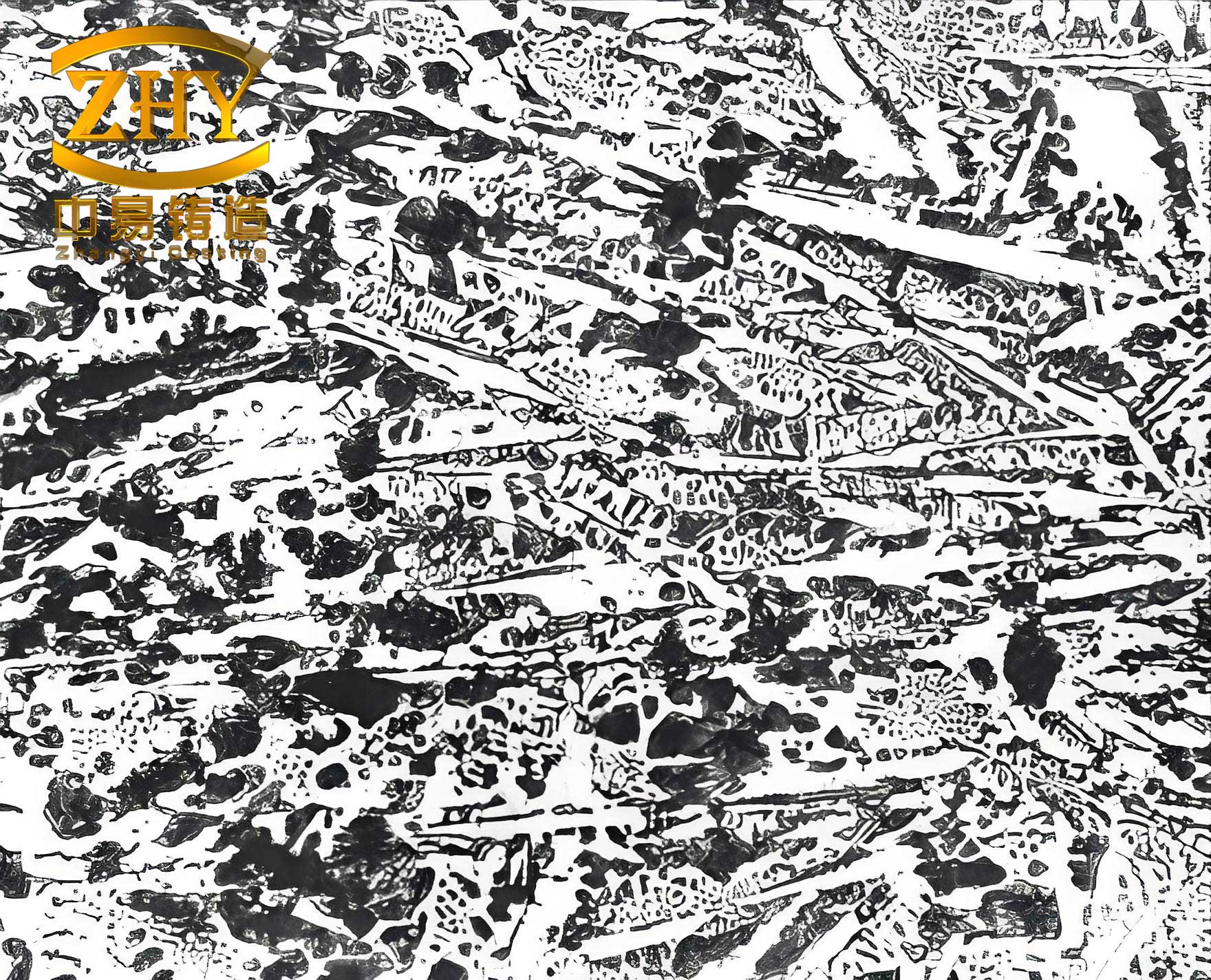
The exceptional microstructural stability of this white cast iron under service conditions is paramount. Unlike some metastable alloys, it undergoes no phase transformations during operation, ensuring exceptional dimensional and shape stability. This property makes it ideally suited for liner applications, particularly for designs utilizing a self-locking, bolt-free mounting system. The precise and unchanging geometry allows for secure fitment, especially in complex profiles like conical classifying liners where differential expansion or deformation could cause loosening. This is an area where high-manganese steel, with its potential for work-hardening and deformation, can be less reliable.
Based on the linear wear model, we can conservatively extrapolate the service life of this white cast iron. Projecting the wear rate forward, we estimate that even at a wear loss rate significantly higher than the current level, the liners would maintain service for well over fifteen years. At that point, the average thickness reduction would still be within limits that preserve the liner’s structural strength and stiffness, preventing fracture or collapse. This leads to a powerful conclusion: for a new mill equipped with these low-chromium white cast iron liners in its fine-grinding compartment, the liner lifetime could realistically surpass the entire economic depreciation period of the mill itself, effectively becoming a permanent component. The life prediction can be modeled simply as:
$$ t_{life} = \frac{h_{initial} – h_{min}}{\dot{h}} $$
where \(t_{life}\) is the predicted service life, \(h_{initial}\) is the initial liner thickness, \(h_{min}\) is the minimum safe thickness, and \(\dot{h}\) is the constant wear rate (thickness loss per year) derived from our long-term data.
The physical and mechanical properties of this low-chromium white cast iron were thoroughly characterized and are central to its performance. The alloy composition, while proprietary in exact proportions, is based on iron-carbon-chromium with micro-additions. After a suitable heat treatment cycle involving austenitizing and quenching, it achieves an optimal microstructure. Its key properties are summarized below:
| Property | Symbol | Value (Typical Range) | Test Standard / Notes |
|---|---|---|---|
| Transverse Rupture Strength | $$\sigma_{tr}$$ | $$800 – 1000 \, \text{MPa}$$ | Provides resistance to fracture under bending loads in the mill. |
| Deflection at Fracture | $$\delta$$ | $$2.0 – 3.5 \, \text{mm}$$ | Indicates a degree of tolerance to deflection before failure. |
| Impact Toughness (Unnotched Charpy) | $$A_{kv}$$ | $$6 – 10 \, \text{J}$$ | Sufficient for the low-energy, high-frequency impact in ball mill grinding. |
| Macrohardness (Rockwell C) | $$HRC$$ | $$58 – 65$$ | Primary source of abrasion resistance. High and uniform. |
| Microhardness of Eutectic Carbides | $$HV_{carbide}$$ | $$1300 – 1600 \, \text{HV}$$ | Extremely hard phases that resist cutting and gouging by abrasive particles. |
| Matrix Microhardness | $$HV_{matrix}$$ | $$600 – 750 \, \text{HV}$$ | Hard martensitic base supporting the carbides. |
An important aspect of this white cast iron is its manufacturability. It can be melted in standard industrial furnaces, such as medium-frequency induction furnaces. A significant cost and resource advantage comes from its ability to utilize lower-grade, high-carbon ferrochromium as the chromium source, which is often more readily available and economical than pure chromium or low-carbon ferrochromium. After casting, the components can be machined in a softened (annealed) state and subsequently heat-treated to regain full hardness, offering flexibility in manufacturing complex shapes. This combination of performance and practical production economics underpins its potential for widespread adoption.
The trial conditions also provided insights into the environmental robustness of this white cast iron. Due to less-than-optimal clinker cooling, the temperature inside the cement mill occasionally exceeded 100°C. The white cast iron liners demonstrated excellent thermal stability, with no signs of thermally induced stresses, microstructural degradation, or distortion. This suggests that this material is also a strong candidate for applications in combined grinding and drying operations, such as in raw material mills or coal mills, where elevated temperatures are常态. Furthermore, while our primary trial was in a dry grinding process, analogous experience with grinding media (balls) made of similar white cast iron compositions indicates that the superior wear resistance translates to wet grinding environments as well, albeit with a potentially reduced wear ratio advantage compared to dry grinding. The corrosion-erosion mechanisms in wet mills can be complex, but the inherent chemical resistance imparted by chromium in the white cast iron provides a baseline defense.
From a broader application perspective, this low-chromium white cast iron is not limited to cement mill liners. Its combination of high abrasion resistance and adequate toughness for repetitive, low-stress impacts makes it suitable for a variety of severe wear components. Examples include wear plates at material transfer points subject to high-velocity abrasive streams, elbows and bends in pneumatic conveying lines, slurry pump casings, and components in mining and mineral processing equipment. The economic rationale for substituting high-manganese steel with this white cast iron in appropriate applications is compelling, promising substantial savings in maintenance downtime, replacement part costs, and overall resource consumption.
In conclusion, the eight-year industrial trial provides robust, long-term validation for the performance of low-chromium alloyed white cast iron as a liner material in cement grinding mills. The data unequivocally demonstrates its superiority over traditional high-manganese steel in terms of wear rate, service life, and operational stability under the specific conditions of a fine-grinding chamber. The wear behavior is linear and predictable, the material is microstructurally stable, and it offers practical manufacturing benefits. The successful implementation of this white cast iron technology can lead to significant technical and economic advancements in the cement industry and beyond, promoting greater efficiency and sustainability in abrasive wear management. The transition from high-manganese steel to advanced white cast iron alloys like this one represents a meaningful step forward in materials engineering for heavy industry.