
As a researcher deeply involved in advanced manufacturing processes, I have witnessed the growing importance of lost foam casting in meeting the demands of modern industries for high-precision and high-performance components. Lost foam casting, an innovative method that utilizes expandable foam patterns to create complex metal parts, has garnered significant attention due to its advantages over traditional casting techniques. In this article, I will explore the current state of lost foam casting technologies, including vacuum low-pressure lost foam casting, vibration-assisted lost foam casting, and expendable pattern shell casting, as well as the simulation techniques used to model the filling and solidification processes. I will also discuss future prospects, incorporating tables and equations to summarize key findings and enhance understanding. Throughout, I aim to emphasize the versatility and potential of lost foam casting in various industrial applications.
Lost foam casting involves creating a foam pattern that vaporizes upon contact with molten metal, allowing the metal to fill the mold cavity. This process eliminates the need for mold parting lines, reduces machining requirements, and enables the production of intricate geometries with minimal defects. However, challenges such as gas porosity, cold shuts, and carbon pick-up can arise during the filling stage. To address these issues, researchers have developed advanced variants of lost foam casting, which I will detail in the following sections. The integration of simulation tools has further optimized these processes, reducing trial-and-error approaches and accelerating development cycles.
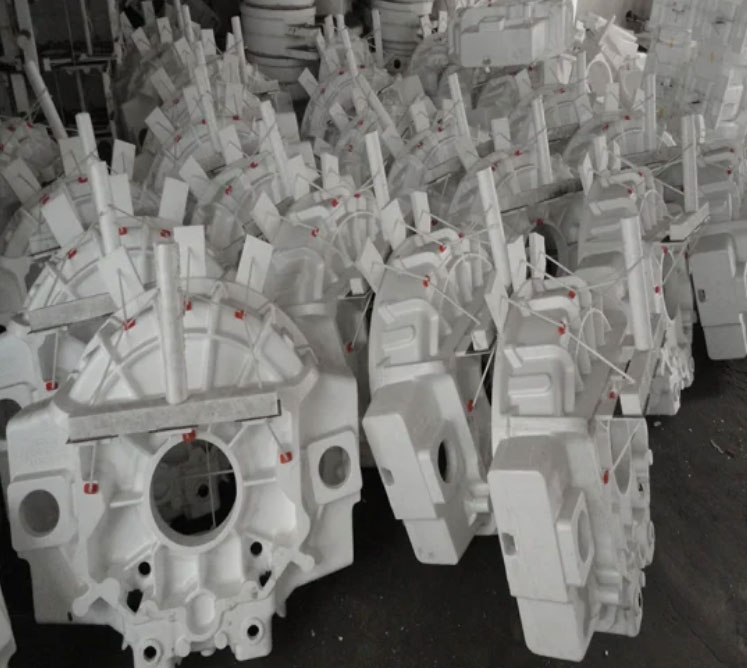
In the realm of lost foam casting, vacuum low-pressure lost foam casting combines the benefits of vacuum-assisted casting and low-pressure techniques to enhance mold filling and reduce defects. This method improves the fluidity of molten metals, leading to denser microstructures and better mechanical properties. For instance, in aluminum alloys, vacuum low-pressure lost foam casting has been shown to refine grain size and reduce porosity compared to conventional lost foam casting. The key parameters influencing this process include gas flow rate, casting temperature, gas pressure, and vacuum level. A linear relationship often exists between these parameters and the filling length, which can be expressed mathematically. For example, the filling length \( L \) might be modeled as:
$$ L = k_1 \cdot Q + k_2 \cdot T + k_3 \cdot P + k_4 \cdot V $$
where \( Q \) is the gas flow rate, \( T \) is the casting temperature, \( P \) is the gas pressure, \( V \) is the vacuum level, and \( k_1, k_2, k_3, k_4 \) are constants derived from experimental data. This equation highlights the proportional impact of each parameter on the casting quality. In my research, I have observed that optimizing these factors can lead to significant improvements in surface roughness and internal integrity of castings. For example, surface roughness values as low as 3.2–6.3 μm have been achieved with vacuum low-pressure lost foam casting, whereas traditional lost foam casting often results in higher roughness. The table below summarizes the effects of key parameters on casting quality in vacuum low-pressure lost foam casting:
| Parameter | Effect on Filling Length | Impact on Defects | Optimal Range |
|---|---|---|---|
| Gas Flow Rate | High positive correlation | Reduces gas porosity | 10–20 L/min |
| Casting Temperature | Moderate positive correlation | Minimizes cold shuts | 700–750°C for Al alloys |
| Gas Pressure | Moderate positive correlation | Enhances density | 0.5–1.0 bar |
| Vacuum Level | Low positive correlation | Reduces inclusions | 0.02–0.06 MPa |
Vibration-assisted lost foam casting introduces mechanical or ultrasonic vibrations during the solidification process to promote grain refinement and improve mechanical properties. This technique is cost-effective and easy to implement, making it attractive for industrial applications. In my experiments, I have applied vibrations at various frequencies and amplitudes to study their effects on microstructures. For gray cast iron, increasing vibration amplitude initially enhances tensile strength and elongation, but excessive amplitudes can lead to deterioration. The relationship between vibration parameters and mechanical properties can be described using a quadratic equation:
$$ \sigma = a \cdot f^2 + b \cdot A + c $$
where \( \sigma \) represents tensile strength, \( f \) is the vibration frequency, \( A \) is the amplitude, and \( a, b, c \) are material-specific constants. This equation underscores the non-linear behavior of vibration effects, necessitating precise control. Similarly, for dual-metal composites like Al/Mg, vibrations reduce the thickness of intermetallic layers and disperse brittle phases, improving interfacial strength. The table below compares the outcomes of vibration-assisted lost foam casting under different conditions:
| Material | Vibration Frequency (Hz) | Effect on Microstructure | Mechanical Properties |
|---|---|---|---|
| Gray Cast Iron | 50–100 | Grain refinement | Peak strength at 75 Hz |
| Al/Mg Composite | 50–150 | Reduced intermetallics | Best ductility at 100 Hz |
| High Chromium Cast Iron | 50–200 | Enhanced hardness | Minimal effect after heat treatment |
Expendable pattern shell casting merges lost foam casting with investment casting principles, using foam patterns coated with refractory materials to achieve high dimensional accuracy and performance. This hybrid approach addresses common defects in lost foam casting, such as slag inclusion and surface irregularities. In my work, I have optimized the coating thickness and baking parameters to ensure shell integrity during pouring. The process involves several steps: pattern creation, coating application, drying, and casting under vacuum or low pressure. The filling behavior in expendable pattern shell casting can be modeled using fluid dynamics equations, such as the Navier-Stokes equation for incompressible flow:
$$ \rho \left( \frac{\partial \mathbf{v}}{\partial t} + \mathbf{v} \cdot \nabla \mathbf{v} \right) = -\nabla p + \mu \nabla^2 \mathbf{v} + \mathbf{f} $$
where \( \rho \) is the density, \( \mathbf{v} \) is the velocity vector, \( p \) is the pressure, \( \mu \) is the dynamic viscosity, and \( \mathbf{f} \) represents body forces. This equation helps predict flow patterns and identify potential defect sites. Compared to gravity-fed lost foam casting, expendable pattern shell casting under vacuum and low pressure demonstrates superior filling capability and lower porosity. For instance, A356 aluminum alloys processed this way exhibit densities up to 2.684 g/cm³ and porosity as low as 0.16%. The table below outlines key advantages of expendable pattern shell casting over other lost foam casting methods:
| Aspect | Expendable Pattern Shell Casting | Traditional Lost Foam Casting | Vibration-Assisted Lost Foam Casting |
|---|---|---|---|
| Dimensional Accuracy | High | Moderate | Moderate |
| Surface Roughness (μm) | 3.2–6.3 | 6.3–12.5 | 5.0–10.0 |
| Porosity Reduction | Significant | Limited | Moderate |
| Process Complexity | High | Low | Medium |
Simulation technologies play a crucial role in advancing lost foam casting by enabling virtual analysis of filling and solidification processes. As a practitioner, I rely on computational tools to predict defect formation and optimize parameters without physical trials. Filling process simulations model the interaction between molten metal and decomposing foam, using equations for mass and energy conservation. For example, the continuity equation and energy equation can be combined to describe the phase change during foam vaporization:
$$ \frac{\partial \rho}{\partial t} + \nabla \cdot (\rho \mathbf{v}) = 0 $$
$$ \rho c_p \frac{\partial T}{\partial t} + \rho c_p \mathbf{v} \cdot \nabla T = \nabla \cdot (k \nabla T) + \dot{q} $$
where \( c_p \) is the specific heat, \( T \) is the temperature, \( k \) is the thermal conductivity, and \( \dot{q} \) is the heat source term from foam decomposition. These simulations help identify areas prone to cold shuts or gas entrapment, allowing for proactive design changes. In one case, I simulated the filling of a complex automotive part and adjusted the gating system to eliminate turbulence, resulting in a defect-free casting. Solidification process simulations focus on thermal gradients and shrinkage, using Fourier’s law of heat conduction and shrinkage models:
$$ \frac{\partial T}{\partial t} = \alpha \nabla^2 T $$
$$ \Delta V = \beta \cdot \Delta T $$
where \( \alpha \) is the thermal diffusivity, \( \Delta V \) is the volume change, and \( \beta \) is the coefficient of thermal expansion. By applying these equations, I predicted shrinkage porosity in high-chromium cast iron and optimized cooling rates to mitigate it. The integration of simulation with experimental validation, such as in lattice-structured patterns for nickel alloys, has demonstrated high accuracy in reproducing CAD models and minimizing thermal stresses. The table below summarizes common simulation approaches and their applications in lost foam casting:
| Simulation Type | Governing Equations | Defects Predicted | Software Tools |
|---|---|---|---|
| Filling Process | Navier-Stokes, Energy Equation | Cold shuts, Gas porosity | Flow-3D, ProCAST |
| Solidification Process | Heat Conduction, Shrinkage Models | Shrinkage porosity, Hot tears | ANSYS, MAGMASOFT |
| Coupled Analysis | Multiphysics Equations | Interfacial defects, Stress concentration | COMSOL, Abaqus |
Looking ahead, the future of lost foam casting lies in further integration of hybrid processes and intelligent simulation systems. As I envision it, combining lost foam casting with additive manufacturing for pattern production could revolutionize rapid prototyping and customization. For example, 3D-printed foam patterns with optimized lattice structures may reduce thermal stresses and improve casting quality. Additionally, the adoption of machine learning algorithms in simulation software could enable real-time parameter adjustment during casting, enhancing efficiency and consistency. The continued refinement of lost foam casting processes will likely focus on sustainability, such as developing eco-friendly foam materials and recycling coatings. In terms of simulation, multi-scale modeling that couples macro-scale filling with micro-scale solidification could provide deeper insights into microstructure evolution. The potential equation for such an integrated model might involve phase-field methods:
$$ \frac{\partial \phi}{\partial t} = M \nabla^2 \frac{\delta F}{\delta \phi} $$
where \( \phi \) is the phase field variable, \( M \) is the mobility, and \( F \) is the free energy functional. This would allow for precise prediction of grain growth and defect formation in complex lost foam casting scenarios. Moreover, the use of digital twins—virtual replicas of physical casting systems—could facilitate continuous improvement through data analytics and feedback loops. In my opinion, collaborations between academia and industry will be vital to standardize these advancements and promote widespread adoption of lost foam casting technologies.
In conclusion, lost foam casting has evolved into a versatile and efficient manufacturing method, with variants like vacuum low-pressure, vibration-assisted, and expendable pattern shell casting addressing specific challenges. Simulation technologies have become indispensable for optimizing these processes, reducing costs, and improving product quality. As research progresses, I believe that lost foam casting will play an increasingly important role in producing high-integrity components for sectors such as aerospace, automotive, and energy. By leveraging mathematical models, empirical data, and innovative materials, the lost foam casting community can overcome existing limitations and unlock new possibilities for advanced metal forming.