
In my experience with the lost foam casting process, producing complex components like forklift axle housings presents unique challenges and opportunities. This article delves into the intricate journey of optimizing the lost foam casting process for a specific axle housing, highlighting the iterative improvements that led to successful production. The lost foam casting process, known for its precision and flexibility, was chosen for this project due to its ability to handle intricate geometries without the need for cores or parting lines. Throughout this narrative, I will emphasize the critical aspects of the lost foam casting process, using tables and formulas to encapsulate key data and theoretical underpinnings.
The axle housing in question is a critical structural component, fabricated from ZG270-500 steel, with a single weight of 125 kg. Its dimensions include a length of 802 mm, a housing height of 323 mm, and two shaft necks each 180 mm long. The wall thickness varies significantly, from a maximum of 65 mm at the shaft necks to a minimum of 13 mm at the housing body. This disparity in wall thickness is a primary source of casting difficulties, necessitating careful control over the lost foam casting process. The mechanical machining requirements further underscore the need for high dimensional accuracy and surface quality, which the lost foam casting process can provide.
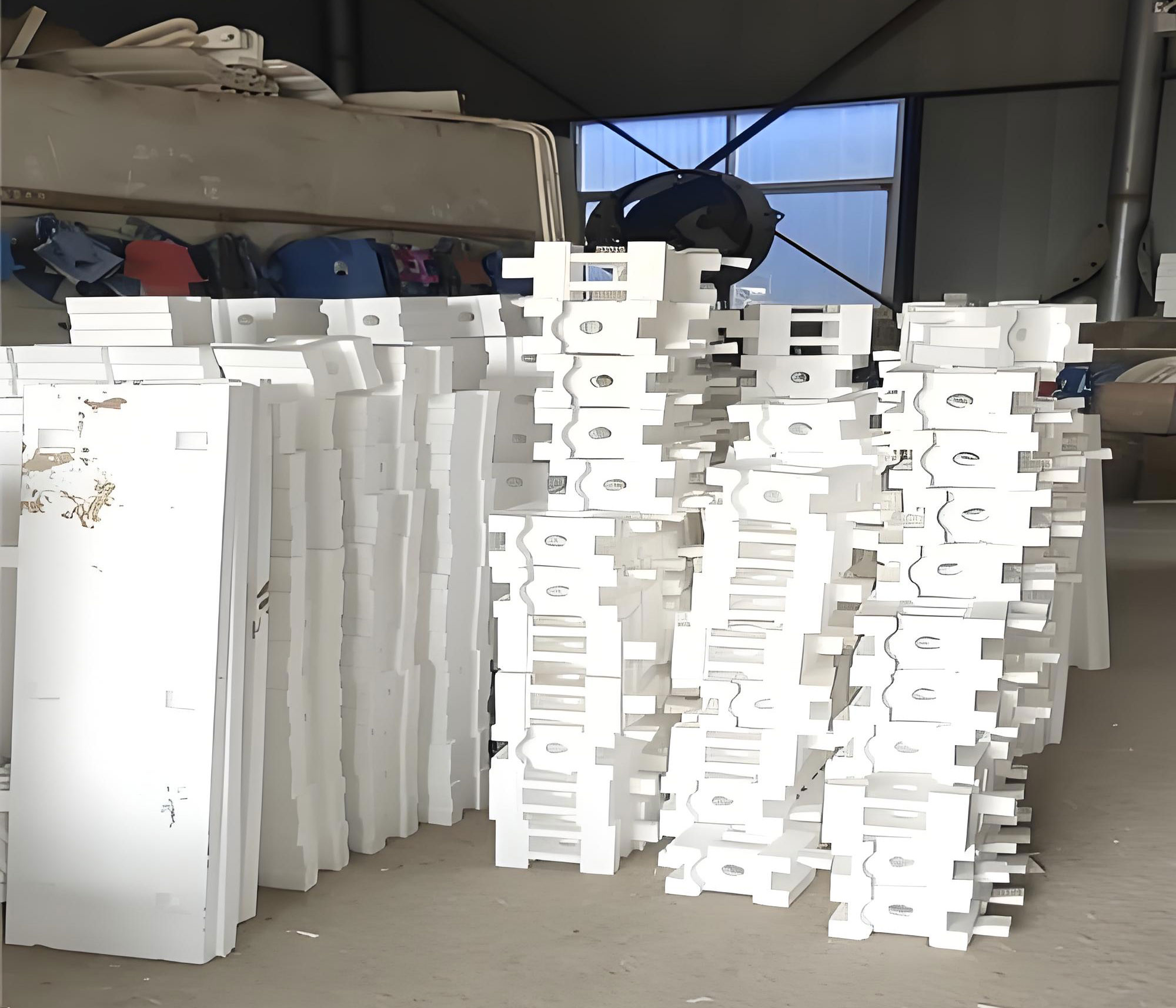
The advantages of the lost foam casting process for such components are manifold. It eliminates the need for molds and cores, ensuring excellent integrity and reproducibility. The flexibility in gating and riser design allows for tailored feeding and solidification control. However, the process is not without its challenges. For the axle housing, issues such as cold shuts, shrinkage porosity, and cracking were prevalent initially, driven by the severe wall thickness variations and constrained contraction. The internal cavity of the housing, resembling a hemispherical shell, posed significant difficulties in achieving adequate sand compaction and vacuum pressure during the lost foam casting process, leading to defects like collapse and cracking.
In the initial implementation of the lost foam casting process, the pattern was fabricated from expandable polystyrene (EPS) using metal molds, split into two halves and manually assembled. The foam density was set at 2.2 g/cm³, with gates and risers handcrafted and attached. A specialized coating from Hubei Yichang Sandou was applied in three layers, achieving a thickness of approximately 1.5 mm. The molding sand was artificial quartz sand with a grain size of 2-3 mm. A dedicated flask with four-side vacuum extraction (no bottom extraction) was used, with one casting per flask. The gating system, as initially designed, featured four ingates positioned near the junction of the circular housing and shaft necks, connected by a “井”-shaped runner. Each shaft neck had a feeding riser, and the pouring cup diameter was 60 mm. The pattern was tilted at 30° to the horizontal plane to facilitate vacuum application to the internal sand core. Melting was conducted in a medium-frequency induction furnace with a quartz sand lining, and pouring was done via a shaking ladle at a temperature of 1540°C. The vacuum sequence involved a pre-burn pressure of 0.065 MPa, reduced to 0.03 MPa after pattern burnout, with a pouring time exceeding 45 seconds and a post-pouring pressure hold of 5 minutes.
Despite these measures, the initial lost foam casting process yielded unsatisfactory results. The most severe defects were collapse of the mold during pouring and cracking of the housing along the horizontal plane. The cracks exhibited torn, oxidized surfaces, indicating poor metal fusion and excessive stress. Collapse occurred primarily in the internal cavity of the housing, attributed to insufficient vacuum pressure within the sand core. The tilting of the pattern, intended to enhance vacuum exposure, proved inadequate. The absence of bottom vacuum in the flask exacerbated the issue, creating an uneven pressure field. The cracking was analyzed to stem from several factors: non-uniform metal flow from the ingates due to the tilted orientation, leading to cold shuts and convection; low pouring temperature and prolonged pouring time causing excessive heat loss; and restricted contraction due to high sand core strength from prolonged vacuum holding.
To address these issues, a comprehensive redesign of the lost foam casting process was undertaken. The improvements are summarized in Table 1, which contrasts the initial and modified parameters.
| Parameter | Initial Process | Modified Process |
|---|---|---|
| Pattern Orientation | Tilted 30° | Horizontal |
| Number of Ingates | 4 | 6 |
| Runner Configuration | “井”-shaped | Circular (with breaks) |
| Internal Vacuum Aid | None | Φ220 mm annular auxiliary vacuum tube |
| Contraction Allowance | None | 3-4 Φ80 mm straw rope balls in housing core |
| Pouring Temperature | 1540°C | 1580°C |
| Pouring Time | >45 s | ≤30 s |
| Vacuum Release Timing | Not specified | Auxiliary vacuum released 30 s after pouring |
The introduction of an annular auxiliary vacuum tube, centrally located around the housing, was pivotal. This tube, controlled independently, ensured sufficient vacuum pressure within the internal sand core, preventing collapse. The formula for vacuum pressure decay in porous media can be expressed as:
$$ P(x) = P_0 e^{-\alpha x} $$
where \( P(x) \) is the pressure at distance \( x \) from the vacuum source, \( P_0 \) is the initial pressure, and \( \alpha \) is the attenuation coefficient dependent on sand permeability and foam presence. By adding the auxiliary tube, the effective distance \( x \) was reduced, mitigating pressure loss and enhancing core stability. The horizontal placement of the pattern, combined with six evenly distributed ingates and a circular runner, promoted symmetrical and rapid mold filling. This minimized thermal gradients and reduced the risk of cold shuts. The straw rope balls placed in the housing core acted as compressible buffers, accommodating contraction stresses and preventing cracking. Their effect on reducing restraint can be modeled using Hooke’s law for composite materials:
$$ \sigma_c = E_c \epsilon_c $$
where \( \sigma_c \) is the stress in the composite core, \( E_c \) is the effective Young’s modulus (lowered by the straw ropes), and \( \epsilon_c \) is the strain due to contraction. The strategic release of the auxiliary vacuum 30 seconds after pouring further alleviated constraints on solidifying metal, allowing for more free contraction.
The increase in pouring temperature to 1580°C and the reduction in pouring time to under 30 seconds were critical for improving fluidity and reducing heat loss. The heat transfer during pouring can be described by the governing equation for transient conduction with phase change:
$$ \rho C_p \frac{\partial T}{\partial t} = \nabla \cdot (k \nabla T) + \dot{q}_{latent} $$
where \( \rho \) is density, \( C_p \) is specific heat, \( k \) is thermal conductivity, \( T \) is temperature, \( t \) is time, and \( \dot{q}_{latent} \) is the latent heat release rate. By pouring hotter and faster, the temperature gradient \( \nabla T \) was minimized, ensuring better fusion and reducing shrinkage defects. The lost foam casting process inherently involves the decomposition of the foam pattern, which absorbs heat. The energy balance during pattern burnout can be approximated as:
$$ Q_{pattern} = m_{pattern} \cdot \Delta H_{vaporization} $$
where \( Q_{pattern} \) is the heat absorbed, \( m_{pattern} \) is the mass of the foam, and \( \Delta H_{vaporization} \) is the enthalpy of vaporization. This heat loss must be compensated by the superheat of the metal, justifying the higher pouring temperature.
The modified lost foam casting process yielded dramatic improvements. Collapse was entirely eliminated, and cracking was no longer observed. The castings passed post-processing inspections, including shot blasting and magnetic particle testing. The success of these modifications underscores the importance of a holistic approach in the lost foam casting process, where vacuum management, gating design, and thermal controls are intricately linked. To further elucidate the thermal dynamics, Table 2 summarizes key thermal parameters involved in the lost foam casting process for this component.
| Parameter | Symbol | Value | Unit |
|---|---|---|---|
| Pouring Temperature (Initial) | \( T_{p,initial} \) | 1540 | °C |
| Pouring Temperature (Modified) | \( T_{p,modified} \) | 1580 | °C |
| Liquidus Temperature of ZG270-500 | \( T_{liquidus} \) | ~1520 | °C |
| Solidus Temperature of ZG270-500 | \( T_{solidus} \) | ~1480 | °C |
| Pattern Decomposition Onset | \( T_{decompose} \) | ~400 | °C |
| Heat of Vaporization of EPS | \( \Delta H_{vap} \) | ~1000 | kJ/kg |
| Specific Heat of Steel | \( C_{p,steel} \) | 0.46 | kJ/kg·K |
| Thermal Conductivity of Sand | \( k_{sand} \) | 0.5-1.0 | W/m·K |
The lost foam casting process is highly sensitive to vacuum parameters. In the modified setup, the vacuum pressures were optimized based on empirical testing. The relationship between vacuum pressure, sand compaction, and core strength can be derived from the theory of granular mechanics. The effective stress \( \sigma’ \) in the sand under vacuum is given by:
$$ \sigma’ = \sigma – u $$
where \( \sigma \) is the total stress and \( u \) is the pore pressure (negative under vacuum). Higher vacuum increases \( |u| \), thereby increasing \( \sigma’ \) and the shear strength of the sand, which follows the Mohr-Coulomb criterion:
$$ \tau = c + \sigma’ \tan \phi $$
where \( \tau \) is shear strength, \( c \) is cohesion, and \( \phi \) is the angle of internal friction. The auxiliary vacuum tube ensured that \( \sigma’ \) remained sufficiently high in the housing core to resist the metallostatic pressure during pouring, which can be calculated as:
$$ P_{metal} = \rho_{metal} g h $$
with \( \rho_{metal} \) being the density of steel (~7800 kg/m³), \( g \) the acceleration due to gravity, and \( h \) the height of the metal column. For the housing, \( h \) is approximately 0.3 m, giving \( P_{metal} \approx 23 \, kPa \). The vacuum pressure of 0.065 MPa (65 kPa) provided a safety factor against collapse.
Another critical aspect of the lost foam casting process is the control of shrinkage and feeding. The volumetric shrinkage \( \beta \) of steel during solidification is typically 3-4%. The required feeding volume \( V_f \) can be estimated as:
$$ V_f = \beta V_{casting} $$
where \( V_{casting} \) is the volume of the casting. For the axle housing, with a volume of approximately 0.016 m³ (125 kg / 7800 kg/m³), \( V_f \) is about 0.0005 m³. The risers in the modified design were sized to provide this volume, with their dimensions optimized using modulus calculations. The modulus \( M \) is defined as the volume-to-surface area ratio:
$$ M = \frac{V}{A} $$
Risers are designed to have a modulus greater than that of the casting section they feed, ensuring they solidify last. In the lost foam casting process, riser design is facilitated by the flexibility of foam attachment, but careful thermal analysis is needed to account for the insulating effect of the foam and coating.
The coating used in the lost foam casting process plays a dual role: it provides a barrier between the metal and sand, and it helps control the rate of foam decomposition. The coating thickness \( \delta_c \) influences the heat transfer coefficient \( h_c \) at the metal-coating interface. A simple model for the thermal resistance \( R_c \) of the coating is:
$$ R_c = \frac{\delta_c}{k_c} $$
where \( k_c \) is the thermal conductivity of the coating. Thicker coatings can slow down heat transfer, potentially leading to misruns, but they also improve surface finish. In this case, a thickness of 1.5 mm was maintained, as it provided a balance between these factors.
The success of the modified lost foam casting process is evident in the consistent production of sound castings. The integration of multiple improvements—vacuum enhancement, gating redesign, thermal management, and contraction allowance—demonstrates the systemic nature of process optimization. Each change addressed a specific root cause, yet their synergies were crucial. For instance, the horizontal pattern orientation not only improved metal flow but also simplified the application of the auxiliary vacuum tube. Similarly, the higher pouring temperature compensated for the heat loss due to faster pouring, maintaining adequate fluidity.
In conclusion, the lost foam casting process for forklift axle housings was transformed from a defect-prone operation to a reliable production method through targeted interventions. The key lessons revolve around the importance of vacuum control in complex internal cavities, the need for symmetrical and rapid filling to avoid thermal defects, and the strategic management of contraction stresses. The lost foam casting process, with its inherent flexibility, allowed for these adjustments without major tooling changes, showcasing its adaptability. Future work could involve computational modeling to further refine the parameters, but the empirical approach described here provides a robust foundation. The lost foam casting process continues to be a valuable technique for complex castings, and this case study adds to the body of knowledge on its practical application.
To encapsulate the entire journey, I have compiled a comprehensive table of all process variables and their impacts, as shown in Table 3. This table serves as a quick reference for practitioners of the lost foam casting process facing similar challenges.
| Process Variable | Initial Setting | Modified Setting | Primary Effect | Key Formula/Relation |
|---|---|---|---|---|
| Pattern Orientation | 30° tilt | Horizontal | Improved metal flow symmetry, reduced convection | Flow symmetry index \( S = \frac{\sum Q_i}{\sum |Q_i|} \) where \( Q_i \) is flow rate per ingate |
| Number of Ingates | 4 | 6 | Reduced filling time, lower thermal gradient | Pouring time \( t_p \propto \frac{1}{n \cdot A_{gate}} \) with \( n \) = number of ingates, \( A_{gate} \) = ingate area |
| Runner Design | “井”-shaped | Circular with breaks | Uniform pressure distribution, minimized flow resistance | Pressure drop \( \Delta P \propto \frac{L}{D_h} \) where \( L \) = runner length, \( D_h \) = hydraulic diameter |
| Auxiliary Vacuum | None | Φ220 mm tube | Enhanced core strength, prevented collapse | Vacuum pressure decay \( P(x) = P_0 e^{-\alpha x} \) |
| Contraction Aids | None | Straw rope balls | Reduced restraint, prevented cracking | Effective modulus \( E_c = V_s E_s + V_r E_r \) with \( V \) = volume fraction, subscripts \( s \) = sand, \( r \) = rope |
| Pouring Temperature | 1540°C | 1580°C | Improved fluidity, reduced cold shuts | Superheat \( \Delta T = T_p – T_{liquidus} \) |
| Pouring Time | >45 s | ≤30 s | Minimized heat loss, better fusion | Heat loss \( Q_{loss} = h A (T – T_\infty) t_p \) |
| Vacuum Release Timing | Not controlled | 30 s after pour | Allowed free contraction, reduced stress | Stress \( \sigma = E \alpha \Delta T \) during cooling |
| Coating Thickness | 1.5 mm | 1.5 mm (maintained) | Balanced insulation and surface quality | Thermal resistance \( R_c = \delta_c / k_c \) |
| Sand Grain Size | 2-3 mm | 2-3 mm (maintained) | Adequate permeability and compactability | Permeability \( K \propto d^2 \) where \( d \) = grain diameter |
This detailed exploration of the lost foam casting process for forklift axle housings highlights the iterative nature of foundry engineering. By systematically addressing each defect through mechanical, thermal, and procedural adjustments, a robust process was established. The lost foam casting process, with its unique characteristics, demands a deep understanding of interrelated parameters, and this case study provides a template for similar applications. As the lost foam casting process evolves, such empirical refinements coupled with analytical models will continue to drive advancements in casting quality and efficiency.