
In my research, I have focused on advancing casting technologies for titanium alloys, which are critical materials in aerospace, marine, and chemical industries due to their high strength-to-weight ratio, corrosion resistance, and biocompatibility. Traditional casting methods, such as machined graphite molding and investment casting, face significant limitations, including high costs, long lead times, and surface quality issues. This has driven my exploration of lost foam casting as a complementary technology. Lost foam casting, while widely used for steels and aluminum, is underutilized for titanium alloys due to technical challenges. Here, I present a comprehensive study on lost foam cladding casting for titanium alloys, detailing its advantages, technological framework, and application potential.
The inherent reactivity of titanium with common mold materials like SiO₂ and Al₂O₃ necessitates expensive refractories such as graphite, ZrO₂, or Y₂O₃. In China, titanium casting production has grown from 417 tons in 2017 to an estimated 1,000 tons in 2020, highlighting a burgeoning market. However, existing methods struggle to meet demands for high quality, low cost, and short delivery. Lost foam casting offers a promising alternative by enabling near-net-shape fabrication with minimal post-processing. My work aims to bridge this gap by developing a lost foam cladding process tailored for titanium, integrating foam pattern fabrication with ceramic shell investment techniques.
Historical Context and Principles of Lost Foam Casting
Lost foam casting, also known as evaporative pattern casting, was pioneered in the 1950s using expandable polystyrene (EPS) foam patterns to replace wooden molds. By the 1960s, it was industrialized for ferrous and non-ferrous metals. The process involves creating a foam replica of the desired part, coating it with a refractory slurry, and embedding it in unbonded sand. During pouring, the foam vaporizes, allowing molten metal to fill the cavity. Key advantages include:
- Reduced surface roughness and high dimensional accuracy.
- Design flexibility, as complex geometries can be produced as single pieces without cores or parting lines.
- Simplified operations, eliminating mold assembly and reducing labor intensity.
However, challenges like carbon pickup and gas porosity from foam decomposition have limited its use for titanium. My research adapts lost foam casting by combining it with precision shell molding, where a ceramic shell is built around the foam pattern and fired to remove the foam before vacuum casting. This hybrid approach mitigates contamination risks while retaining lost foam casting benefits.
Technological Framework for Titanium Alloy Lost Foam Cladding Casting
The lost foam cladding casting process for titanium alloys involves sequential steps: pattern fabrication, shell building, dewaxing and firing, and vacuum pouring. I have optimized each stage to ensure compatibility with titanium’s high reactivity.
First, foam patterns are machined from EPS or similar polymer blocks with properties suited for titanium casting: tensile strength ≥2 MPa, bending strength ≥8 MPa, and thermal stability ≥80°C. Patterns are designed as integrated assemblies to minimize joints. For instance, gating systems are attached using adhesives, and surface smoothing is achieved through wax impregnation to enhance shell quality.
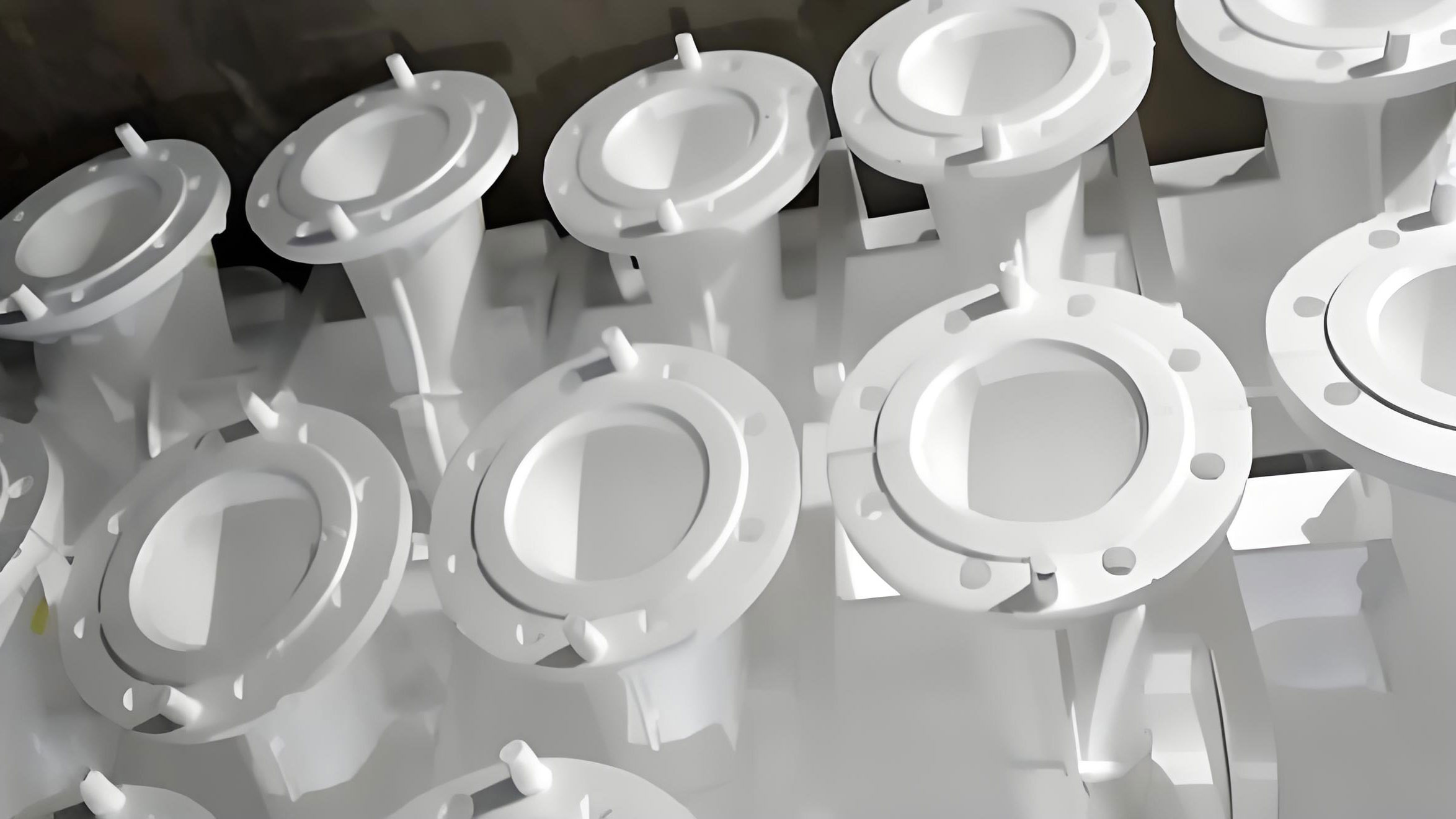
Next, ceramic shells are applied. The face coat uses zirconium acetate binders with rare-earth powders and zircon sand to prevent titanium-mold reactions. Backup layers employ silica sol with mullite flour and sand. Viscosity is controlled precisely: 33–38 seconds for the face coat, 21–27 seconds for initial backups, and 13–20 seconds for subsequent layers. After drying, shells are fired in a kiln with staged heating: ramp to 300°C with ventilation to initiate foam vaporization, slow heating to 700°C for 0.5 hours to complete removal, and final sintering at 1,100°C for 5 hours to strengthen the shell.
Vacuum casting is conducted in a furnace with inert atmosphere to prevent oxidation. Titanium alloys like ZTC4 are melted and poured into the preheated shells. Post-casting, parts undergo hot isostatic pressing (HIP), inspection, and finishing.
Mathematical Modeling and Simulation
To optimize the lost foam casting process, I employ numerical simulations using software like ProCAST. The thermal and fluid dynamics during titanium pouring can be described by governing equations. For instance, heat transfer follows Fourier’s law:
$$q = -k \nabla T$$
where \(q\) is heat flux, \(k\) is thermal conductivity, and \(\nabla T\) is temperature gradient. The energy equation for solidification includes latent heat release:
$$\rho c_p \frac{\partial T}{\partial t} = \nabla \cdot (k \nabla T) + \rho L \frac{\partial f_s}{\partial t}$$
Here, \(\rho\) is density, \(c_p\) is specific heat, \(L\) is latent heat, and \(f_s\) is solid fraction. Fluid flow is modeled using the Navier-Stokes equations with Boussinesq approximation for buoyancy effects:
$$\frac{\partial \mathbf{u}}{\partial t} + (\mathbf{u} \cdot \nabla) \mathbf{u} = -\frac{1}{\rho} \nabla p + \nu \nabla^2 \mathbf{u} + \mathbf{g} \beta (T – T_0)$$
where \(\mathbf{u}\) is velocity, \(p\) is pressure, \(\nu\) is kinematic viscosity, \(\mathbf{g}\) is gravity, \(\beta\) is thermal expansion coefficient, and \(T_0\) is reference temperature.
Simulation results for a sample titanium component show temperature distribution and shrinkage porosity. For example, in a ZTC4 casting, the temperature difference during solidification is around 200°C, with hot spots at top and bottom regions leading to isolated shrinkage. A top-gating system is designed to feed these areas, reducing defects by 50% compared to initial predictions. This validates lost foam cladding casting as analogous to investment casting for simulation purposes.
Experimental Studies and Results
I conducted experiments on ZTC4 titanium alloy castings produced via lost foam cladding casting. The component had dimensions requiring CT4 accuracy per GB/T 6614 standards. Key parameters are summarized below:
| Property | Value |
|---|---|
| Tensile Strength | ≥2 MPa |
| Bending Strength | ≥8 MPa |
| Thermal Stability | ≥80°C |
The shell-building process involved multiple coats, with drying times optimized to prevent cracking. After firing, the shell integrity was confirmed through visual inspection. Casting was performed under vacuum at 1,650°C, followed by HIP at 920°C and 100 MPa for 2 hours.
| Condition | Tensile Strength (MPa) | Yield Strength (MPa) | Elongation (%) |
|---|---|---|---|
| GB/T 6614 Requirement | ≥835 | ≥765 | ≥6 |
| As-Cast (Experimental) | 930 | 833 | 15 |
| After HIP | 945 | 845 | 16 |
Non-destructive testing revealed shrinkage porosity in lower sections pre-HIP, aligning with simulation predictions. Post-HIP, defects were eliminated, meeting Class II B inspection standards. Surface roughness averaged Ra 6.3 µm, comparable to investment casting. Microstructural analysis showed no inclusions or anomalies, with an alpha-beta phase distribution typical for ZTC4.
The economic analysis highlights cost savings: foam patterns are 80% cheaper than photopolymer resins for investment casting, and overall costs are 30% lower than machined graphite molding for large, complex parts. Lead times are shortened by 40% due to reduced pattern fabrication and mold assembly steps.
Advantages and Application Prospects
Lost foam casting for titanium alloys offers distinct advantages over conventional methods. Compared to machined graphite molding, it eliminates surface flow lines and cold shuts, improves fillability for thin walls (down to 4 mm), and reduces environmental dust pollution. Versus investment casting, it avoids expensive metal dies and wax injection equipment for small-batch production. The technology is particularly suited for medium-to-large components in aerospace frames, marine propellers, and chemical reactors, where design flexibility and cost efficiency are paramount.
Potential applications include integrated structural parts that previously required assembly from multiple pieces. For example, a turbine housing with internal channels can be cast as a single unit using lost foam cladding casting, reducing weight and improving performance. The process also supports rapid prototyping for custom medical implants, leveraging titanium’s biocompatibility.
However, challenges remain, such as controlling foam decomposition residues and ensuring shell permeability during titanium pouring. Future work will focus on advanced foam materials with lower carbon content and optimized shell compositions to enhance thermal shock resistance.
Formulas for Process Optimization
To further refine lost foam casting, I derive formulas for key parameters. The foam vaporization rate during firing can be estimated using Arrhenius-type kinetics:
$$r = A e^{-E_a / (RT)}$$
where \(r\) is reaction rate, \(A\) is pre-exponential factor, \(E_a\) is activation energy, \(R\) is gas constant, and \(T\) is temperature. For EPS foam, typical values are \(A = 10^{10}\) s⁻¹ and \(E_a = 150\) kJ/mol.
Shell strength after firing relates to porosity and binder content. The effective modulus \(E_{\text{shell}}\) can be expressed as:
$$E_{\text{shell}} = E_0 (1 – \phi)^n$$
with \(E_0\) as dense material modulus, \(\phi\) as porosity, and \(n \approx 2\) for ceramic networks. Optimal porosity for titanium casting is 20–30% to balance strength and permeability.
Metal velocity during filling is critical to avoid turbulence. For a top-gating system, the initial velocity \(v\) is given by Torricelli’s law:
$$v = \sqrt{2 g h}$$
where \(h\) is metallostatic head. To ensure laminar flow, Reynolds number should be below 2,000:
$$\text{Re} = \frac{\rho v D}{\mu} < 2000$$
with \(D\) as characteristic diameter and \(\mu\) as dynamic viscosity.
Comparative Analysis with Other Casting Methods
The following table summarizes how lost foam cladding casting compares to existing titanium casting techniques:
| Method | Cost | Lead Time | Surface Roughness (Ra) | Minimum Wall Thickness | Suitability for Large Parts |
|---|---|---|---|---|---|
| Machined Graphite | High | Medium | 12.5–25 µm | 4 mm | Good |
| Investment Casting | Very High | Long | 3.2–6.3 µm | 2 mm | Limited |
| Lost Foam Cladding Casting | Low | Short | 6.3–12.5 µm | 3 mm | Excellent |
This demonstrates that lost foam casting strikes a balance between economy and precision, making it viable for batch production of intricate titanium components.
Future Directions and Conclusion
My research underscores the viability of lost foam cladding casting for titanium alloys. By integrating foam pattern technology with ceramic shell investment, we achieve castings with competitive mechanical properties, surface quality, and dimensional accuracy. The process reduces costs by minimizing material waste and eliminating secondary operations like core assembly.
Future endeavors will explore automated foam machining for consistency, advanced simulation tools to predict defect formation, and hybrid materials for enhanced shell performance. Collaboration with industry partners will facilitate scaling up for commercial production.
In conclusion, lost foam casting represents a transformative approach for titanium casting, addressing limitations of traditional methods. Its adoption could accelerate the use of titanium in weight-sensitive and corrosive environments, contributing to technological advancements across sectors. As I continue to refine this technique, the goal is to establish lost foam casting as a standard option in the titanium foundry portfolio.