
In the field of lost foam casting, the use of expendable pattern plates, commonly referred to as lost foam plates, has revolutionized manufacturing processes across various industries, including construction, refrigeration, packaging, and insulation. Lost foam casting, also known as EPC (Expendable Pattern Casting), involves creating patterns from foam materials that vaporize upon contact with molten metal, leaving behind a precise casting. This technique relies heavily on materials such as expandable polystyrene (EPS), styrene-methyl methacrylate copolymer (STMMA), and expandable polypropylene (EPMMA). Over the years, global companies like BASF and Dow Chemical have advanced research in this area, leading to improved applications and efficiencies. In this article, I will delve into the structural properties, manufacturing equipment, process parameters, and performance characteristics of EPS-based lost foam plates, drawing from extensive production experience. I will also address common challenges encountered during manufacturing and propose practical solutions, emphasizing the importance of optimizing parameters for high-quality output in lost foam casting and EPC processes.
The foundation of producing high-quality lost foam plates lies in the careful selection and treatment of raw materials. Typically, EPS beads are chosen based on the specifications of the cast parts, such as wall thickness and overall dimensions. The bead size directly influences the final product’s density and surface quality, as it determines the expansion behavior during pre-foaming. In lost foam casting, larger beads may be preferred for thicker sections to ensure uniform vaporization, whereas finer beads suit intricate designs. The pre-foaming process is critical in EPC, as it involves heating the beads with steam to initiate expansion, driven by the vaporization of internal blowing agents like pentane. This step must be meticulously controlled to achieve the desired density, which typically ranges from 16 to 30 kg/m³ for EPS plates. The relationship between pre-foaming time and density can be expressed mathematically, highlighting the inverse correlation observed in production. For instance, the density decrease over time under constant steam pressure and agitation can be modeled approximately as:
$$ \rho(t) = \rho_0 e^{-kt} $$
where $\rho(t)$ is the density at time $t$, $\rho_0$ is the initial density, and $k$ is a constant dependent on factors like pentane content and steam pressure. This formula underscores the need for precise timing in lost foam casting to avoid under- or over-expansion, which could compromise the EPC process.
Key equipment in the manufacturing of lost foam plates includes intermittent foaming machines, aging silos, and plate forming machines. For example, the W-140 intermittent foamer utilizes steam pressures between 0.65 MPa and 0.75 MPa, with compressed air aiding in uniform bead expansion. During pre-foaming, parameters such as steam penetration time (16–18 seconds), holding time (2 seconds), and discharge time (25–35 seconds) are optimized based on the target density. The aging process follows, where beads are stored in ventilated silos to equilibrate internal and external pressures and reduce moisture content. This stage is vital for enhancing bead fusion during later forming steps in EPC. The plate forming machine, such as the SPB-6000, then molds the aged beads into plates through steps like mold preheating, filling, steam heating, cooling, and demolding. Cooling methods, including vacuum cooling and water cooling, are chosen based on efficiency and product requirements; vacuum cooling, for instance, reduces cycle times but requires careful control to prevent defects. The entire technical route for lost foam casting can be summarized as: material selection → pre-foaming → aging → plate forming, with each step intricately linked to ensure optimal performance in EPC applications.
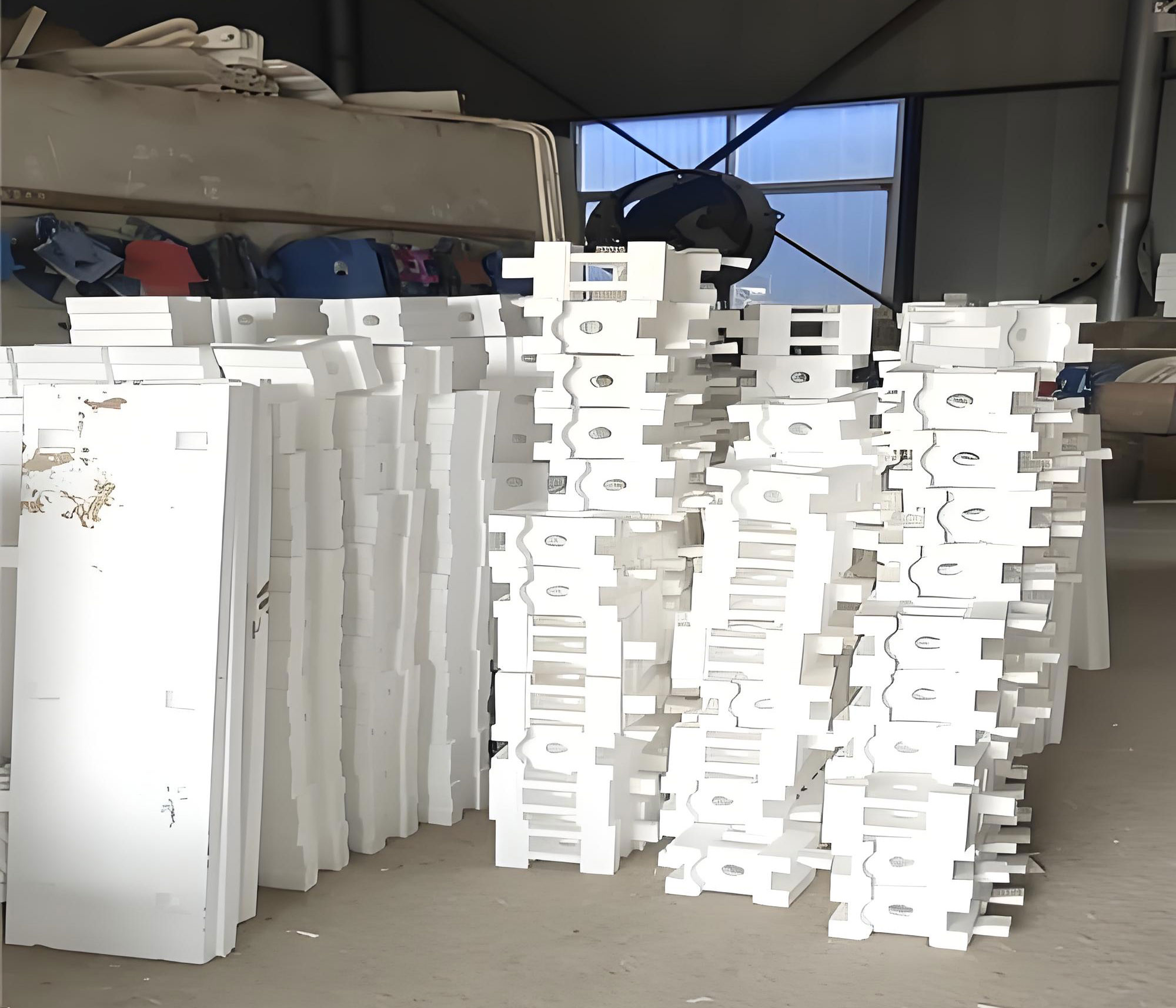
The properties of EPS lost foam plates make them ideal for various applications in lost foam casting and EPC. EPS is an ultra-lightweight polymer with notable characteristics, such as compressibility, thermal stability, and durability. Under compression, EPS exhibits elastic behavior within certain limits, with minimal permanent creep, but it transitions to plastic deformation under higher stresses. The compressive strength increases with density, as described by the empirical formula:
$$ \sigma_c = a \rho^b $$
where $\sigma_c$ is the compressive strength, $\rho$ is the density, and $a$ and $b$ are material-specific constants. Thermally, EPS begins to soften and shrink around 80°C, with significant contraction at 100°C, typically showing a molding shrinkage rate of 0.65% to 0.8%. This behavior is crucial in EPC, as it affects the pattern’s accuracy during metal pouring. Durability is generally high, but EPS is susceptible to UV radiation, high temperatures, and microbial attack, necessitating protective measures in storage and use. The following table summarizes the key properties of EPS lost foam plates, which are essential for designing effective lost foam casting processes:
| Property | Description | Relevance to Lost Foam Casting and EPC |
|---|---|---|
| Compression Deformation | Exhibits elastic behavior under low stress, with uniaxial compression under plastic conditions. Compressive strength increases with density. | Ensures pattern integrity during handling and casting in EPC, reducing defects. |
| Thermal Deformation | Softens and shrinks above 80°C, with rapid contraction at 100°C. Shrinkage rate is 0.65%-0.8%. | Critical for vaporization in lost foam casting, affecting mold cavity precision. |
| Durability | Resistant to aging but vulnerable to UV, heat, and microbes. | Influences storage and lifespan of patterns in EPC applications. |
In the results and discussion section, I analyze how process parameters impact product quality in lost foam casting. Pre-foaming is a pivotal stage where pentane content, steam pressure, and agitation rate directly influence foam density. From production data, I’ve observed that lower pentane levels correlate with higher foam densities, with an optimal pentane content of around 5.5% for EPS beads. Steam pressure typically ranges from 0.1 MPa to 0.2 MPa, and agitation speeds of 65–70 rpm are common. Interestingly, at constant agitation, shorter pre-foaming times result in higher densities, but beyond 6 minutes, the relationship can reverse due to over-expansion and bead degradation. This highlights the non-linear dynamics in EPC manufacturing, where time-dependent variables must be balanced. The aging process also plays a crucial role; prolonged aging improves bead fusion up to a point, but excessive duration leads to pentane loss and poor fusion in the final plate. The optimal aging time varies with bead density, as denser beads require longer periods. The interplay between aging time and fusion quality can be represented by a quadratic relationship:
$$ F(t_a) = -c t_a^2 + d t_a + e $$
where $F(t_a)$ is the fusion quality, $t_a$ is the aging time, and $c$, $d$, and $e$ are constants derived from experimental data. This equation emphasizes the need for tailored aging protocols in lost foam casting to maximize EPC efficiency.
To further illustrate the effects of pre-foaming parameters, I’ve compiled data from multiple production runs into the following table, showing how pentane content and pre-foaming time affect density in EPS lost foam plates. This data reinforces the importance of precise control in EPC processes:
| Pentane Content (%) | Pre-foaming Time (min) | Steam Pressure (MPa) | Agitation Speed (rpm) | Foam Density (kg/m³) |
|---|---|---|---|---|
| 4.7 | 2 | 0.05 | 40 | 24 |
| 5.5 | 4 | 0.05 | 40 | 20 |
| 6.6 | 6 | 0.05 | 40 | 16 |
| 5.5 | 8 | 0.05 | 40 | 14 |
| 5.5 | 10 | 0.05 | 40 | 12 |
Common practical issues in lost foam casting production often stem from improper parameter control. For instance, during pre-foaming, high environmental humidity can cause bead clumping, which I address by insulating steam pipes and using separators. Similarly, rapid agitator speeds or low temperatures may produce dead spots in the foam, remedied by adjusting feed rates and temperatures. In aging, low silo temperatures or insufficient time lead to poor pentane retention, affecting fusion; this is mitigated by optimizing silo design and maintaining strict humidity standards. During plate forming, adherence to the “low pressure, high flow” principle is essential—excessive pressure or temperature can cause surface burning or poor fusion, while insufficient flow results in incomplete bead melting. Leaks in the mold cavity exacerbate these issues, underscoring the need for robust sealing. Additionally, inadequate cooling times can cause deformation, necessitating balanced vacuum or water cooling methods. These challenges highlight the iterative nature of EPC optimization, where continuous monitoring and adjustment are key to successful lost foam casting.
In conclusion, the production of lost foam plates for EPC requires a holistic approach, from raw material selection to final forming. Bead size must align with casting specifications, considering factors like transport and storage to avoid fines that complicate processing. Pre-foaming should target a 40–50x expansion ratio, with bead diameter roughly one-third of the target size to ensure uniform wall thickness alignment. Based on my experience, a pentane content of 5.5% yields optimal pre-foaming results, and the inverse density-time relationship must be managed to prevent defects. Aging demands customized time and environmental controls to achieve consistent bead quality. Overall, advancing the manufacturing工艺 of lost foam plates through parameter refinement not only enhances product quality but also supports the broader adoption of lost foam casting and EPC in industries seeking precision and efficiency. This comprehensive analysis, grounded in practical insights, aims to guide practitioners in overcoming production hurdles and achieving excellence in lost foam casting applications.
To further elaborate on the thermal dynamics in lost foam casting, the heat transfer during the vaporization of EPS patterns in EPC can be modeled using Fourier’s law of heat conduction. For a simplified one-dimensional case, the temperature distribution $T(x,t)$ in the foam plate during metal pouring can be described by:
$$ \frac{\partial T}{\partial t} = \alpha \frac{\partial^2 T}{\partial x^2} $$
where $\alpha$ is the thermal diffusivity of EPS, which is relatively low due to its insulating properties. This equation helps predict the rate of pattern disappearance and ensures complete vaporization without residues, a critical aspect of EPC. Additionally, the energy required for vaporization per unit volume of EPS can be estimated as:
$$ Q = \rho \left( c_p \Delta T + L_v \right) $$
where $Q$ is the energy, $\rho$ is density, $c_p$ is specific heat capacity, $\Delta T$ is the temperature rise, and $L_v$ is the latent heat of vaporization. Such calculations aid in optimizing furnace temperatures and pouring rates in lost foam casting, minimizing defects like incomplete fills or gas entrapment.
Another key consideration in EPC is the environmental impact of lost foam plates. EPS is recyclable, but its disposal must be managed to reduce ecological footprints. In lost foam casting, efforts to use biodegradable alternatives or recycle waste foam contribute to sustainable manufacturing. For example, incorporating recycled EPS beads into new patterns can lower costs and environmental impact, though it may require adjustments in pre-foaming parameters to maintain density and strength. The following table compares the environmental aspects of different materials used in lost foam casting, emphasizing the role of EPC in promoting greener practices:
| Material | Recyclability | Biodegradability | Impact on Lost Foam Casting and EPC |
|---|---|---|---|
| EPS | High | Low | Widely used but requires proper waste management in EPC processes. |
| STMMA | Moderate | Moderate | Offers better thermal stability for complex EPC applications. |
| EPMMA | Low | High | Emerging as an eco-friendly option in lost foam casting. |
In summary, the integration of theoretical models, empirical data, and practical solutions forms the backbone of advanced lost foam casting and EPC technologies. By continuously refining parameters and addressing environmental concerns, manufacturers can achieve higher efficiency and quality in producing lost foam plates. This article, through detailed analysis and firsthand accounts, aims to serve as a valuable resource for those engaged in the evolving field of lost foam casting, driving innovation and sustainability in EPC practices worldwide.