
In modern casting production, lost foam casting (LFC), also known as expendable pattern casting (EPC), has gained significant attention due to its ability to produce complex geometries with high dimensional accuracy and minimal post-processing requirements. As a researcher in advanced manufacturing, I have explored the application of lost foam casting for producing steel components, focusing on process design and solidification simulation to optimize quality and reduce defects. This article delves into a comprehensive analysis of the lost foam casting process for a steel tank component, emphasizing the integration of computer-aided engineering (CAE) tools for predictive modeling. The EPC method utilizes foam patterns that vaporize during metal pouring, eliminating the need for traditional cores and enabling cost-effective solutions for small-batch production. Through this work, I aim to demonstrate how lost foam casting can be tailored for thick-walled steel castings, leveraging simulations to mitigate issues like shrinkage and porosity.
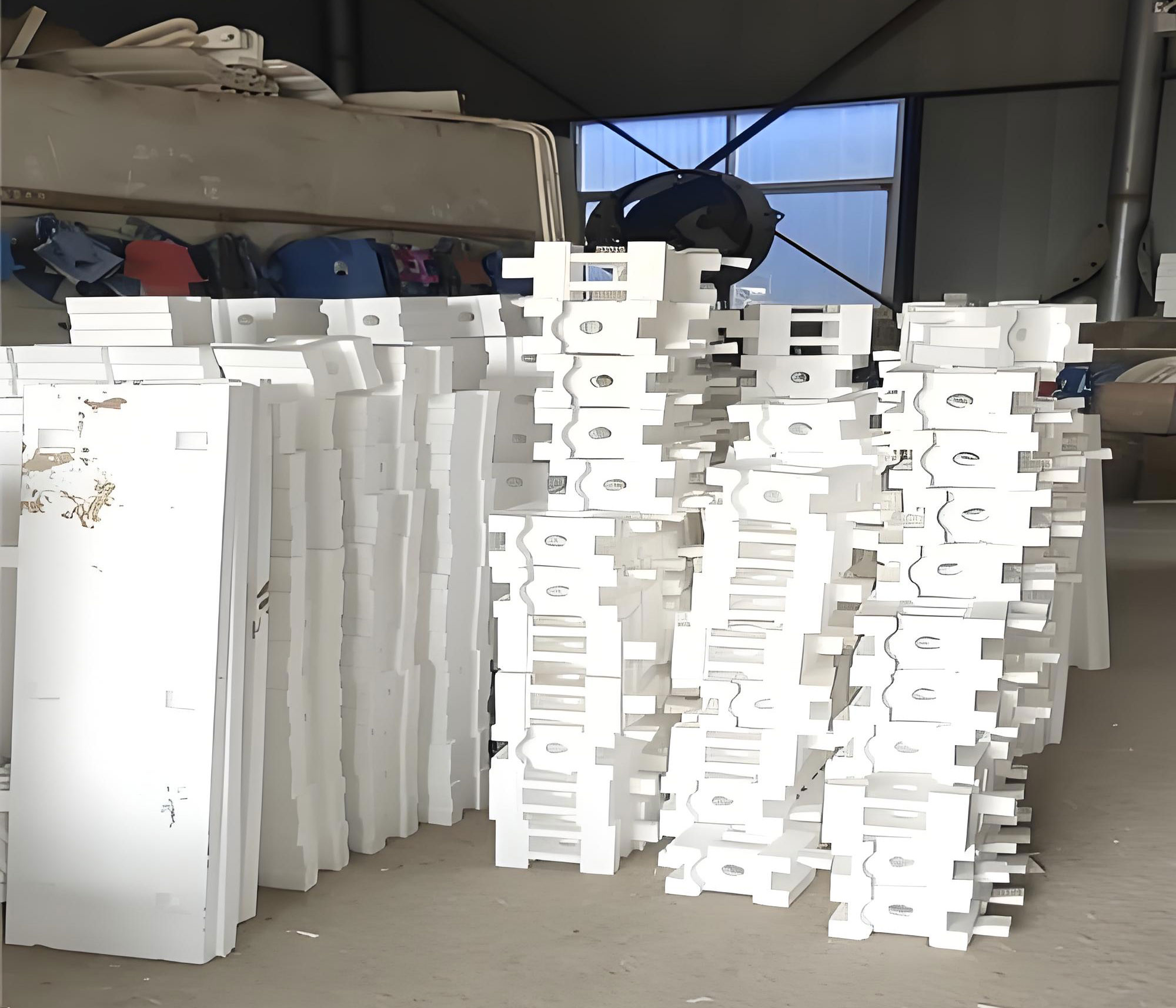
The foundation of any successful lost foam casting process lies in understanding the material properties and geometric constraints of the component. For this study, I considered a steel tank component with varying wall thicknesses, ranging from 16 mm to 40 mm, and an average thickness of 25 mm. The material selected was ZG30SiMn cast steel, which offers good mechanical properties but is prone to solidification defects if not handled properly. In lost foam casting, the pattern material plays a critical role; I chose expandable copolymer resin (STMMA) for its excellent vaporization characteristics and compatibility with steel pouring temperatures. The coating applied to the foam pattern consisted of a blend of 70% bauxite and 30% zircon flour, brushed to a thickness of approximately 4 mm, which ensures adequate refractory protection and gas permeability during the EPC process.
To model the component, I employed 3D CAD software, creating a detailed geometric representation that accounts for all structural features. This model served as the basis for subsequent simulations and process design. The key advantage of lost foam casting here is the elimination of complex core assemblies, which simplifies mold preparation and reduces production time. However, the EPC method requires careful control of process parameters to prevent defects such as misruns or gas entrapment. Below, I outline the critical parameters used in this lost foam casting setup:
| Parameter | Value | Description |
|---|---|---|
| Pattern Material | STMMA | Expandable copolymer resin for vaporization |
| Coating Thickness | 4 mm | Refractory coating of bauxite and zircon flour |
| Pouring Temperature | 1570–1600°C | Optimal range for ZG30SiMn steel |
| Pouring Time | 470–500 s | Duration to fill the mold cavity |
| Gating System Type | Closed | Designed to control metal flow and reduce turbulence |
The gating system in lost foam casting is crucial for ensuring smooth metal flow and minimizing defects. I designed a closed gating system using the choke section method, which involves calculating the cross-sectional areas based on the component’s volume and pouring characteristics. The sprue diameter was set to 56 mm with a height of 407 mm, while the runner cross-sectional area was 18.73 cm² over a length of 1500 mm. The ingate cross-sectional area was 7.34 cm² with a length of 60 mm. These dimensions were derived from empirical formulas specific to EPC processes, such as the relationship between flow rate and sectional areas. For instance, the flow rate \( Q \) can be expressed as:
$$ Q = A \cdot v $$
where \( A \) is the cross-sectional area and \( v \) is the velocity of the molten metal. In lost foam casting, the velocity must be controlled to avoid excessive pattern degradation. Additionally, the gating ratio for the system was maintained at 1:2.5:1.5 (sprue:runner:ingate) to ensure a pressurized flow that reduces air entrainment. This approach aligns with best practices in EPC for steel castings, where turbulent flow can lead to defects like slag inclusions.
Solidification simulation is an integral part of optimizing the lost foam casting process. I used CAE software to model the filling and solidification stages, predicting potential defect zones such as shrinkage porosity and hot tears. The initial simulation, conducted without risers or chills, revealed that defects were concentrated near the gating system due to uneven cooling. This is common in EPC processes where the foam pattern’s decomposition affects heat transfer. The solidification time \( t_s \) for a section can be estimated using Chvorinov’s rule:
$$ t_s = k \cdot \left( \frac{V}{A} \right)^2 $$
where \( V \) is the volume, \( A \) is the surface area, and \( k \) is a constant dependent on the mold material. For the lost foam casting setup, \( k \) was calibrated based on the coating properties and sand type. The simulation results indicated that areas with higher volume-to-surface area ratios solidified slower, leading to shrinkage defects. To address this, I incorporated three standard open risers with dimensions of 75 mm height, 100 mm length, and 50 mm width, placed strategically along the component. The riser design followed the modulus method, ensuring that the riser solidifies after the casting to provide adequate feeding.
After adding risers, the simulation showed improved defect distribution, but some shrinkage persisted in regions adjacent to the risers. This highlighted the need for additional cooling measures in the lost foam casting process. I introduced external chills to enhance heat extraction in critical areas. The chill dimensions were determined based on the wall thickness; for a thickness \( t = 25 \) mm, the chill thickness \( B \) was set to 20 mm using the formula \( B = 0.8t \). Two types of chills were used: Chill 1 with dimensions 62 mm width and 87 mm length, placed at the ends, and Chill 2 with 180 mm width and 190 mm length, positioned behind the central riser. The effectiveness of chills in EPC can be quantified by the heat transfer coefficient, which influences the solidification rate. The modified simulation demonstrated that most defects were confined to the risers and gating system, with the casting itself exhibiting minimal porosity. This optimization underscores the importance of integrating simulations in lost foam casting to achieve high-quality outputs.
Further analysis involved evaluating the thermal gradients during solidification. In lost foam casting, the foam pattern’s decomposition generates gases that can interfere with heat flow, making thermal management critical. I modeled the temperature distribution using the heat conduction equation:
$$ \frac{\partial T}{\partial t} = \alpha \nabla^2 T $$
where \( T \) is temperature, \( t \) is time, and \( \alpha \) is the thermal diffusivity. For ZG30SiMn steel, \( \alpha \) is approximately \( 1.2 \times 10^{-5} \) m²/s. The simulation results showed that the addition of chills reduced the temperature gradient in thick sections, promoting directional solidification. This is vital in EPC to avoid isolated liquid pools that lead to shrinkage. The table below summarizes the key simulation findings and the impact of risers and chills on defect reduction in the lost foam casting process:
| Simulation Stage | Defect Severity | Key Observations |
|---|---|---|
| Initial (No Risers/Chills) | High | Shrinkage concentrated near gating system; uneven cooling |
| With Risers | Moderate | Defects reduced but present near riser bases; improved feeding |
| With Risers and Chills | Low | Most defects in risers; casting surface largely defect-free |
The economic and practical benefits of lost foam casting for this steel component are substantial. By using EPC, I eliminated the need for complex core boxes and reduced pattern-making costs, which is especially advantageous for small-batch production. The process also minimized machining allowances, as the as-cast surface quality was high. However, challenges such as pattern distortion and gas evolution required careful handling. For instance, the foam pattern must be stored in controlled environments to prevent dimensional changes, and the pouring rate in lost foam casting must be optimized to balance mold filling and pattern degradation. Based on my simulations, a pouring rate of 0.5–0.6 kg/s was ideal for this component, ensuring complete pattern vaporization without excessive turbulence.
In conclusion, the lost foam casting process, supported by CAE simulations, offers a robust solution for producing high-integrity steel castings. Through iterative design and analysis, I successfully optimized the gating system, riser placement, and chill usage to mitigate solidification defects. The EPC method not only reduces production time and cost but also enhances dimensional accuracy, making it suitable for applications requiring complex geometries. Future work could explore advanced materials for foam patterns or real-time monitoring techniques to further improve the reliability of lost foam casting. This study highlights the synergy between traditional foundry practices and modern simulation tools, paving the way for wider adoption of EPC in the manufacturing industry.
To summarize the key equations and parameters used in this lost foam casting analysis, I have compiled them below for reference. These formulas are essential for designing similar EPC processes and can be adapted based on specific component requirements:
- Flow rate: \( Q = A \cdot v \)
- Solidification time: \( t_s = k \cdot \left( \frac{V}{A} \right)^2 \)
- Heat conduction: \( \frac{\partial T}{\partial t} = \alpha \nabla^2 T \)
- Chill thickness: \( B = 0.8t \) for wall thickness \( t \)
Overall, the integration of lost foam casting with computational simulations represents a significant advancement in casting technology, enabling precise control over material properties and defect minimization. As I continue to refine these techniques, the potential for EPC to revolutionize small-batch production of steel components becomes increasingly evident.