
In the field of metal casting, traditional methods often face significant challenges when producing large, complex components, particularly for single-piece or small-batch orders. These challenges include high costs, extended lead times, and intensive labor requirements. As an engineer involved in foundry operations, I have explored alternative approaches to overcome these limitations. One such approach is the lost foam casting process, which has gained prominence in recent decades for its ability to streamline production. This article delves into a detailed case study where we successfully employed the lost foam casting process to manufacture large ductile iron sand molds, specifically for engine applications, without the use of vacuum assistance. The lost foam casting process, characterized by its use of expandable polystyrene patterns, offers a viable solution for rapid prototyping and cost-effective manufacturing. Throughout this discussion, I will emphasize the intricacies of the lost foam casting process, supported by formulas and tables to summarize key parameters and outcomes. Our experience demonstrates that even under non-vacuum conditions, the lost foam casting process can yield high-quality castings, expanding its applicability in industrial settings.
The lost foam casting process involves creating a foam pattern that replicates the final casting, coating it with a refractory material, embedding it in unbonded sand, and then pouring molten metal. The heat from the metal vaporizes the foam, allowing the metal to fill the cavity precisely. This method eliminates the need for cores and complex molding systems, reducing production steps. In our project, we aimed to produce large sand molds for a nine-cylinder engine, with dimensions of 4985 mm × 2244 mm × 600/1220 mm and weights of 6 tons and 10 tons, made of QT500-7 ductile iron. Traditional approaches would require numerous wooden core boxes, extensive labor, and a lead time of up to three months, which was impractical for urgent production needs. By adapting the lost foam casting process, we achieved a turnaround of just 15 working days, showcasing the efficiency of this method. The lost foam casting process, when optimized, can significantly cut costs and time, making it ideal for bespoke industrial components.
To understand the technical foundations, let’s review the principles behind the lost foam casting process. The process relies on the thermal decomposition of the foam pattern, which must be controlled to ensure proper metal flow and minimize defects. Key variables include foam density, coating permeability, sand compaction, and pouring temperature. In our implementation, we used a ground pit method without vacuum, which deviates from conventional lost foam casting process setups that often require vacuum assistance to remove gases and improve dimensional accuracy. However, through careful planning, we mitigated potential issues such as gas entrapment and pattern distortion. The lost foam casting process, in this context, is represented by a series of thermodynamic and fluid dynamics equations. For instance, the rate of foam degradation can be modeled using Arrhenius kinetics: $$ k = A e^{-\frac{E_a}{RT}} $$ where \( k \) is the rate constant, \( A \) is the pre-exponential factor, \( E_a \) is the activation energy, \( R \) is the gas constant, and \( T \) is the temperature. This formula helps predict the vaporization behavior during the lost foam casting process.
Our project began with the arrival of the expandable polystyrene patterns. In the lost foam casting process, pattern quality is critical; any imperfections can transfer to the final casting. We applied multiple coats of alcohol-based zirconia paint—a non-specialized coating for lost foam casting process, used cautiously without ignition—to enhance surface durability and prevent sand erosion. The coating thickness was controlled to balance permeability and strength, a key aspect of the lost foam casting process. For the molding setup, we utilized a pit with three existing walls as side barriers, while the fourth side was formed using a large, previously cast mold to conserve resources. The pit base was prepared with a 300 mm layer of furan resin self-hardening sand, leveled to create a stable foundation. This adaptation highlights the flexibility of the lost foam casting process in resource-constrained environments.
The lost foam casting process requires precise sand compaction to support the pattern and withstand metallostatic pressure. We allocated 400–500 mm of sand around the pattern’s exterior and 300–400 mm internally, with sand density optimized through manual tamping. To reduce sand consumption, we placed empty boxes inside the pattern cavity, sealed at the top, and incorporated venting ropes to facilitate gas escape—a crucial step in the lost foam casting process without vacuum. The pattern was oriented with the ribbed face upward to minimize deformation, and nails secured it to the sand base. During sand filling, we emphasized simultaneous filling from both sides and initial corner compaction to ensure pattern stability. This procedural rigor is essential in the lost foam casting process to avoid shifts that could lead to casting defects.
Thermal management is a cornerstone of the lost foam casting process. At rib connections and sidewall junctions, we installed exothermic insulation risers with an internal diameter of 80 mm and heights of 80 mm (for the upper mold) and 160 mm (for the lower mold). These risers aid in feeding and reducing shrinkage porosity, common concerns in the lost foam casting process. The gating system was designed with a single corner ingate to promote smooth metal entry. Additionally, vent holes were incorporated at lifting points to allow gas expulsion. Unlike typical lost foam casting process practices, we avoided burning off the foam pattern prior to pouring to prevent coating detachment—a decision that required careful control of pouring parameters. The lost foam casting process, in this configuration, relied on the metal’s heat to gradually decompose the foam, generating substantial smoke, which we managed through adequate ventilation.
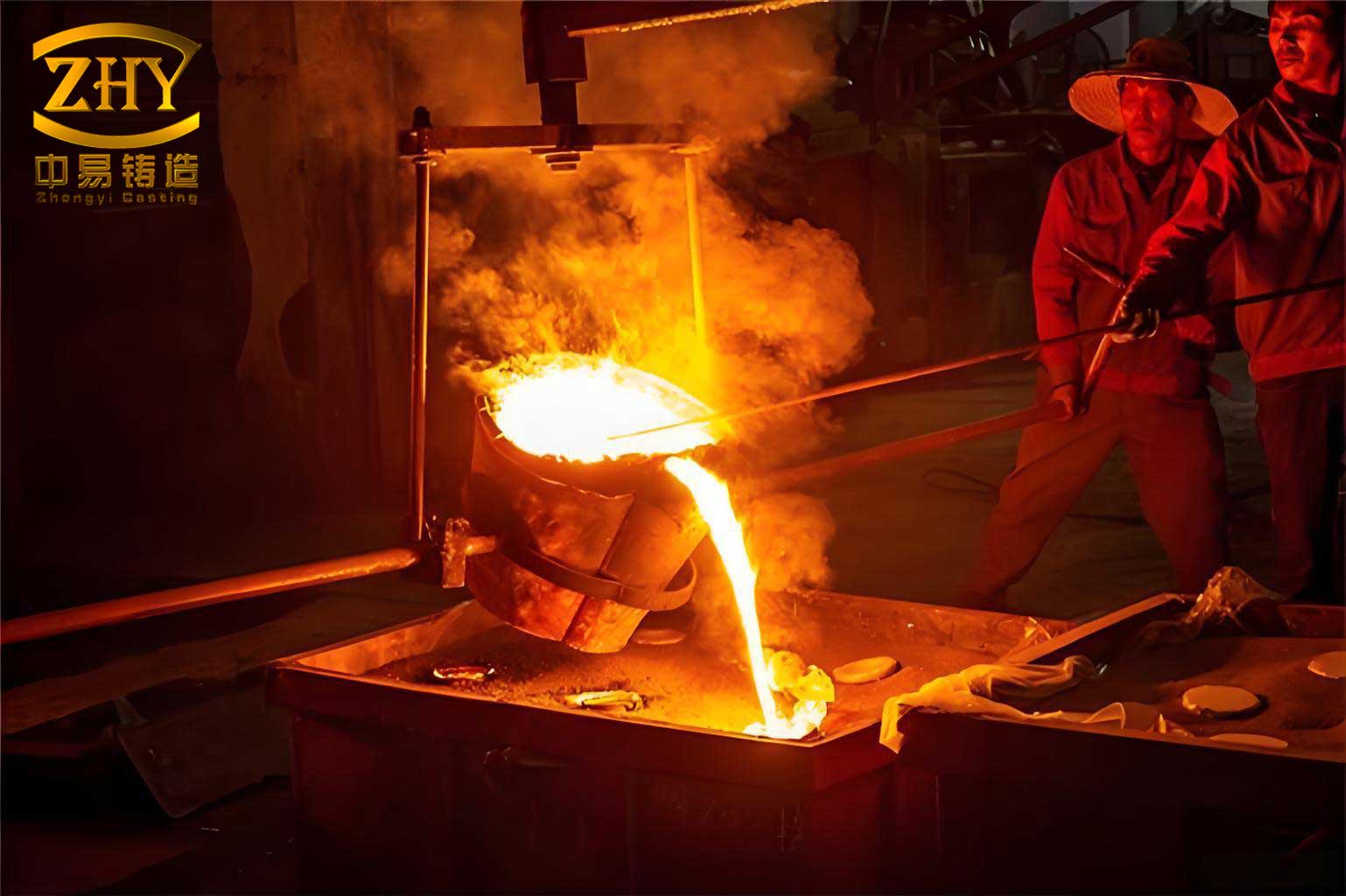
For melting, we used scrap iron such as gates and flashings to cut costs, adjusting the composition to QT500-7 specifications using thermal analysis. The pouring temperature was maintained at 1400–1430°C, with a fast, high-flow rate to ensure complete cavity filling before foam residue could interfere. The relationship between pouring temperature and solidification time in the lost foam casting process can be expressed as: $$ t_s = \frac{\rho L V}{h A (T_{pour} – T_m)} $$ where \( t_s \) is solidification time, \( \rho \) is metal density, \( L \) is latent heat, \( V \) is volume, \( h \) is heat transfer coefficient, \( A \) is surface area, \( T_{pour} \) is pouring temperature, and \( T_m \) is mold temperature. This equation guided our heating protocols. After pouring, we allowed a 48-hour cooling period before shakeout to prevent stress cracking—a standard precaution in the lost foam casting process for heavy sections.
The results validated the efficacy of the lost foam casting process. Post-cleaning inspections confirmed that the sand molds met all dimensional and material requirements, with no major defects. This success underscores that the lost foam casting process can be adapted for large-scale applications even without vacuum support. To quantify our findings, I present the following tables summarizing key parameters and comparisons. Table 1 outlines the critical steps in our lost foam casting process adaptation, while Table 2 contrasts traditional and lost foam casting process metrics. These tables encapsulate the systematic approach required in the lost foam casting process.
| Parameter | Value | Role in Lost Foam Casting Process |
|---|---|---|
| Pattern Material | Expandable Polystyrene | Forms the sacrificial model in lost foam casting process |
| Coating Layers | 4–5 alcohol-based zirconia | Provides refractory barrier in lost foam casting process |
| Sand Type | Furan Resin Self-Hardening | Supports pattern and withstands pressure in lost foam casting process |
| External Sand Thickness | 400–500 mm | Ensures mold rigidity in lost foam casting process |
| Internal Sand Thickness | 300–400 mm | Minimizes material use in lost foam casting process |
| Riser Dimensions | Ø80 mm × 80/160 mm | Manages solidification in lost foam casting process |
| Pouring Temperature | 1400–1430°C | Optimizes fluidity in lost foam casting process |
| Cooling Time | 48 hours | Prevents stresses in lost foam casting process |
The lost foam casting process also involves complex fluid dynamics during metal flow. The velocity of metal entering the cavity can be approximated using Bernoulli’s principle: $$ v = \sqrt{2gh} $$ where \( v \) is velocity, \( g \) is gravity, and \( h \) is the head height. This formula helps design gating systems in the lost foam casting process to minimize turbulence. Additionally, the gas generation rate from foam decomposition impacts mold pressure, which we monitored indirectly through vent placement. In our lost foam casting process setup, the absence of vacuum meant that sand permeability and venting were paramount to avoid blows or porosity. The lost foam casting process, when executed without vacuum, requires meticulous attention to these factors.
| Aspect | Traditional Casting | Lost Foam Casting Process |
|---|---|---|
| Lead Time | ~3 months | 15 working days |
| Core Boxes Required | Multiple wooden units | None (pattern-based) |
| Labor Intensity | High (molding, coring, assembly) | Moderate (pattern preparation, sand filling) |
| Material Cost | Elevated due to core materials | Reduced through scrap metal usage |
| Vacuum Requirement | Not applicable | Typically used, but omitted here |
| Defect Risk | Higher from core shifts | Lower with integrated pattern |
| Scalability for Single Pieces | Poor | Excellent |
From a metallurgical perspective, the lost foam casting process influences microstructure development. For ductile iron QT500-7, the cooling rate affects graphite nodularity and matrix formation. The heat transfer equation during solidification in the lost foam casting process is: $$ \frac{\partial T}{\partial t} = \alpha \nabla^2 T $$ where \( \alpha \) is thermal diffusivity. By controlling sand properties and riser design, we achieved uniform cooling, enhancing mechanical properties. The lost foam casting process, therefore, is not merely a shaping technique but a comprehensive manufacturing strategy that integrates material science. Our use of thermal analysis for composition adjustment ensured compliance with QT500-7 standards, demonstrating the lost foam casting process’s compatibility with quality control protocols.
In reflecting on this project, several conclusions emerge about the lost foam casting process. First, the lost foam casting process is highly adaptable; even without vacuum, it can produce large, sound castings through careful planning of sand support and venting. Second, while we used a non-specialized coating, employing dedicated lost foam casting process coatings would reduce smoke and improve surface finish—a consideration for future iterations of the lost foam casting process. Third, the lost foam casting process serves as an effective tool for process debugging and prototyping, slashing time and costs associated with traditional trials. The lost foam casting process, in essence, democratizes access to complex casting production for small batches.
To further generalize our experience, I propose a set of best practices for the lost foam casting process in non-vacuum scenarios. These include: (1) ensuring robust pattern fixation to prevent buoyancy-driven shifts, (2) optimizing coating permeability to balance gas escape and metal penetration, and (3) employing high pouring rates to swiftly displace foam vapor. The lost foam casting process, when these practices are followed, can yield repeatable success. Moreover, the lost foam casting process aligns with sustainable manufacturing through its ability to utilize recycled metals, as seen in our scrap-based melting. The lost foam casting process, thus, offers both economic and environmental benefits.
In summary, the lost foam casting process proved instrumental in overcoming the challenges of producing large ductile iron sand molds. Our case study highlights that the lost foam casting process, even without vacuum assistance, is a viable and efficient method for single-piece or small-batch production. The lost foam casting process reduces lead times, cuts costs, and minimizes labor, making it a valuable addition to foundry capabilities. As industries seek agile manufacturing solutions, the lost foam casting process will continue to evolve, with potential advancements in foam materials, coatings, and automation. I encourage further exploration of the lost foam casting process for diverse applications, leveraging its flexibility to meet evolving industrial demands. The lost foam casting process, as demonstrated here, is more than a casting technique—it is a paradigm shift toward responsive and resource-efficient production.