
In my extensive experience as a foundry engineer, I have found that the lost foam casting process offers significant advantages for producing large, complex frame and box-shaped castings, such as sintering machine trolleys. This process, which involves using expandable polystyrene (EPS) patterns that vaporize during metal pouring, allows for precise dimensional control, reduced machining, and minimized casting defects. Over the years, I have successfully applied the lost foam casting process to manufacture trolleys for various sintering machine sizes, including 42 m², 75 m², and 90 m² models, leading to substantial economic benefits in industrial applications. This article delves into the detailed implementation of the lost foam casting process for a 90 m² sintering machine trolley, highlighting key aspects from pattern preparation to pouring, with an emphasis on practical insights and technical data.
The lost foam casting process begins with a thorough understanding of the casting requirements. The sintering machine trolley is essentially a frame structure, resembling a large rectangular frame with internal reinforcements, as illustrated in the following diagram. It is critical that the trolley remains free from distortion or twisting, as any deformation could compromise its functionality in high-temperature sintering operations. The casting dimensions are approximately 3,062 mm in length, 970 mm in width, and 420 mm in height, with a weight of around 1,640 kg. Wall thickness varies between 20 mm and 40 mm, presenting a challenge for uniform cooling and solidification. This structural uniformity, however, makes it an ideal candidate for the lost foam casting process, which excels in producing such geometries with minimal residual stress.
From a performance perspective, the sintering machine trolley operates under harsh conditions, including elevated temperatures and mechanical loading. It must not crack or deform during use, and precise fitting between adjacent trolleys is essential for seamless operation. To meet these demands, the material specifications are stringent. The required material is ductile iron QT500-7, with the following mechanical properties: tensile strength (Rm) ≥ 500 MPa, yield strength (Rp0.2) ≥ 320 MPa, elongation (A) ≥ 7%, hardness between 170 to 230 HB, and a nodularity grade of 1 to 4. The chemical composition must be tightly controlled, as summarized in Table 1. Additionally, casting defects like shrinkage porosity or cracks are unacceptable, as they could lead to premature failure. Achieving these targets through the lost foam casting process requires meticulous attention to every step, from pattern assembly to molten metal treatment.
| Element | Target Composition (wt.%) |
|---|---|
| Carbon (C) | 3.6% – 3.8% |
| Silicon (Si) – Ladle | 2.7% – 2.9% |
| Silicon (Si) – Furnace | 1.5% – 1.7% |
| Manganese (Mn) | 0.5% – 0.7% |
| Sulfur (S) | ≤ 0.03% |
| Phosphorus (P) | ≤ 0.07% |
The success of the lost foam casting process hinges on proper tooling and preparation. For the trolley, I designed a custom flask to accommodate the large pattern. The flask dimensions were calculated based on the casting outline, with side clearance (sand thickness) of 200 mm to 300 mm, bottom clearance of at least 200 mm, and top clearance of 350 mm to 450 mm to counter buoyancy forces. To ensure uniform vacuum distribution—a critical aspect of the lost foam casting process—I employed a five-sided suction flask. This involved installing six suction pipes, each with a diameter of 60 mm and length of 200 mm, distributed along the flask’s perimeter: two on each long side and one on each short side. Given the flask’s massive weight (nearly 10 tons when filled with sand), I also built an off-line three-dimensional vibration table for compaction. This equipment is essential in the lost foam casting process to achieve dense, stable sand packing without pattern distortion.
Pattern making is a cornerstone of the lost foam casting process. For the trolley, I started by designing the pattern in CAD, incorporating shrinkage allowances and machining margins. The pattern was then split into sections for easier manufacturing using CNC foam cutting machines. EPS material with a density of 15 kg/m³ to 17 kg/m³ was selected, and it was thoroughly dried to prevent moisture-related issues during casting. To ensure dimensional accuracy, I constructed a dedicated assembly platform with positioning blocks that defined the gaps for each foam segment. The cut foam pieces were glued together within these blocks, resulting in a precise model. To prevent deformation during handling—a common pitfall in the lost foam casting process—I reinforced the model with five wooden ribs (15 mm × 15 mm) along the width direction before removing it from the platform. This approach not only improved accuracy but also expedited assembly, which is crucial for efficient production in the lost foam casting process.
Coating application and drying are vital stages in the lost foam casting process to create a refractory barrier between the foam pattern and the sand. I used a water-based coating composed of Guilin No. 5 binder and fine alumina powder, mixed for at least 4 hours. The pattern was coated three to four times to achieve a thickness of 2.5 mm to 3.0 mm, which enhances strength and prevents sand penetration. To minimize distortion, I placed the pattern on a fixed support frame from the start. The first coat was applied evenly with a sprayer, and then the pattern was moved to a drying room where it remained stationary for subsequent brushing. Drying was carried out at 40°C to 50°C, with each coat dried for a minimum of 24 hours. After the final coat, I inspected the thickness and performed touch-ups if necessary. This meticulous coating process in the lost foam casting process ensures that the pattern can withstand the rigors of sand filling and metal pouring without collapse.
The gating system design is a critical component of the lost foam casting process, as it governs molten metal flow and solidification. For the trolley, I adopted a bottom-gating parallel system to feed the flat frame structure evenly. The total ingate area was calculated based on empirical formulas to ensure proper filling. The ingate cross-sectional area (Σ_ingate) can be derived from the pouring rate and casting weight. Using the relationship for ductile iron castings, I determined the ingate area as 3,600 mm², which was implemented as four ingates each measuring 15 mm × 50 mm. For a semi-closed gating system, typical in the lost foam casting process, the area ratios are set as Σ_ingate : Σ_runner : Σ_sprue = 1 : 1.2 : 1.3. This led to a single sprue with a diameter of 70 mm (circular cross-section) and a single runner with a 60 mm × 60 mm square cross-section. The gating components were pre-coated and assembled during flask filling. Since the trolley has uniform wall thickness and no major hot spots, I opted for a riserless design, leveraging the self-feeding characteristics of ductile iron due to graphite expansion during solidification. The gating layout is summarized in Table 2, which highlights key parameters in the lost foam casting process.
| Gating Component | Dimensions/Quantity | Cross-Sectional Area (mm²) |
|---|---|---|
| Ingates | 4 units, 15 mm × 50 mm each | 3,600 (total) |
| Runner | 1 unit, 60 mm × 60 mm | 3,600 |
| Sprue | 1 unit, diameter 70 mm | Approx. 3,848 |
The filling of the flask, or molding, is a delicate operation in the lost foam casting process. One day prior, I filled critical areas like the wheel axle holes and slide grooves with furan resin sand and cured them to prevent metal penetration—a common defect in the lost foam casting process. The pattern was positioned in the flask with the specified sand clearances, and a network of conformal pipes was placed atop the model to enhance vacuum distribution. The gating system was encased in sodium silicate sand for reinforcement; the sprue was surrounded by a steel pipe (200 mm diameter) filled with hardened sand, and a steel plate (100 mm × 100 mm × 15 mm) was placed under the runner’s well to prevent erosion. Vibration compaction was performed in three stages: after laying the base sand, after placing the pattern, and after complete sand filling. Each stage involved multiple short bursts (e.g., 5 to 7 cycles of 1-2 seconds) to achieve optimal density without pattern shift. Finally, two layers of 0.07 mm plastic film were draped over the flask, and sealing was checked to avoid vacuum leaks. A large pouring cup (320 mm diameter, 400 mm height) was installed and fortified with sodium silicate sand to prevent overflow during pouring.
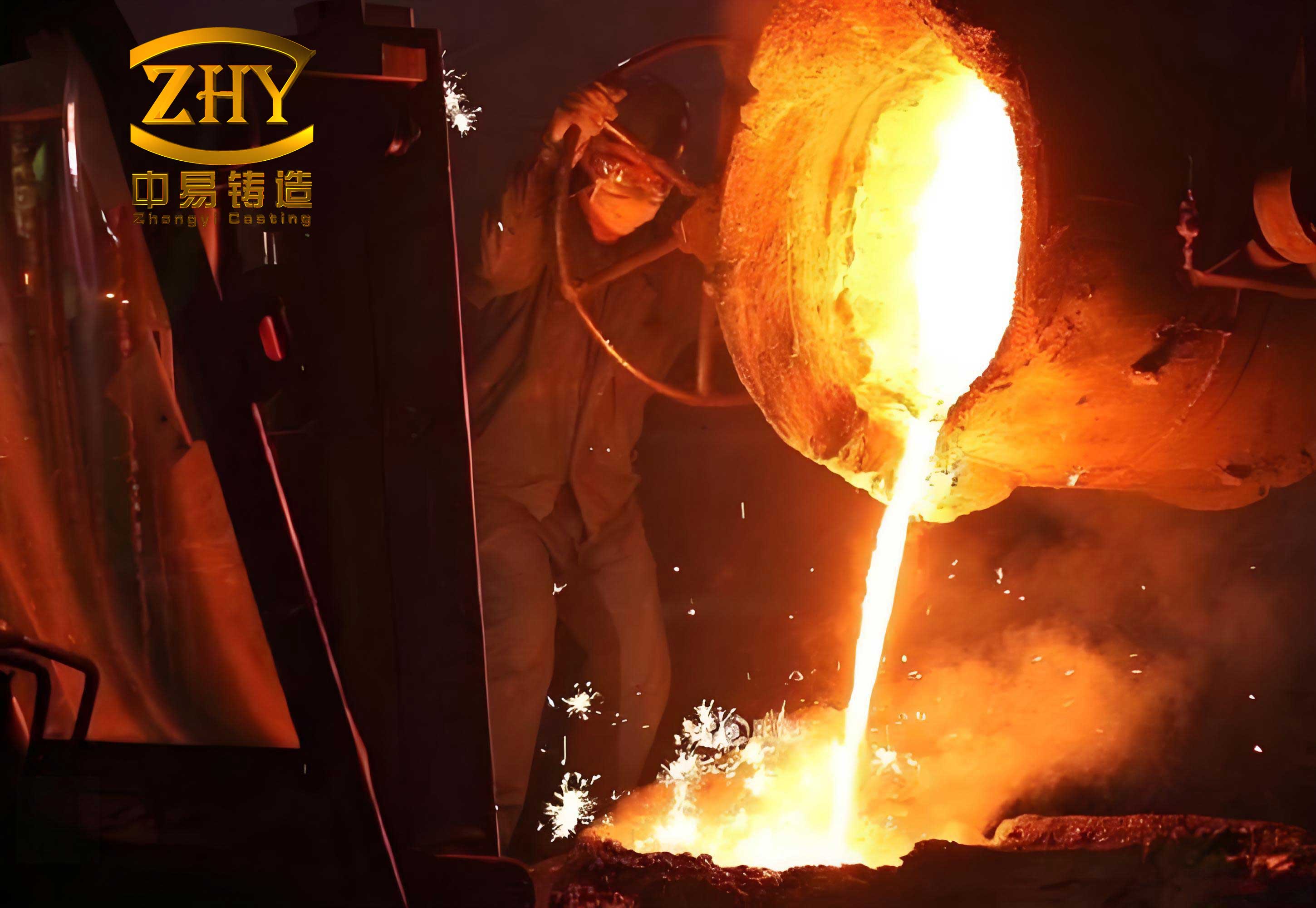
Melting and pouring are where the lost foam casting process culminates in metal formation. The charge consisted of 55% ductile iron returns and 45% steel scrap, with 2.5% carbon additive added in layers during melting to achieve the target carbon equivalent. The molten metal was treated using the sandwich method for nodularization, with 1.2% nodulizer (e.g., magnesium-ferrosilicon) placed at the bottom of the ladle and covered with iron chips. Inoculation was performed with 0.8% to 1.0% FeSi75 (10 mm to 25 mm granules) as a primary treatment, followed by a stream inoculation during pouring with 0.17% to 0.25% fine FeSi75 to enhance graphite nucleation. The tapping temperature was maintained at 1,510°C to 1,530°C to ensure a pouring temperature of 1,390°C to 1,410°C—a critical range in the lost foam casting process to balance fluidity and pattern degradation. Pouring was completed within 50 to 55 seconds under a vacuum of 0.05 MPa to 0.07 MPa, which was sustained for 22 minutes post-pouring to evacuate gases from pattern decomposition. Key process parameters are consolidated in Table 3, underscoring the precision required in the lost foam casting process.
| Parameter | Value or Range |
|---|---|
| Charge Composition (wt.%) | 55% returns, 45% scrap, 2.5% C-additive |
| Nodulizer Addition | 1.2% |
| Primary Inoculant | 0.8% – 1.0% FeSi75 |
| Stream Inoculant | 0.17% – 0.25% FeSi75 |
| Tapping Temperature | 1,510°C – 1,530°C |
| Pouring Temperature | 1,390°C – 1,410°C |
| Pouring Time | 50 s – 55 s |
| Vacuum Level | 0.05 MPa – 0.07 MPa |
| Vacuum Hold Time | 22 minutes |
During production runs, several challenges emerged, but through systematic analysis, I developed effective countermeasures. One issue was substandard mechanical properties, particularly in meeting the QT500-7 specifications. This was traced to inadequate inoculation practices in the lost foam casting process. To rectify this, I enhanced the inoculation strategy by combining primary ladle inoculation with precise stream inoculation. The stream inoculation rate was calibrated using the formula for inoculant addition: $$ m_{\text{inoc}} = \rho_{\text{Fe}} \cdot Q \cdot t \cdot w_{\text{Si}} $$ where \( m_{\text{inoc}} \) is the inoculant mass, \( \rho_{\text{Fe}} \) is the density of iron, \( Q \) is the pouring flow rate, \( t \) is the pouring time, and \( w_{\text{Si}} \) is the target silicon addition from inoculant. By ensuring consistent inoculant flow onto the metal stream, I achieved finer graphite nodules and improved ductility, which are hallmarks of a well-executed lost foam casting process.
Another problem was mold collapse, or “washout,” which occurred in early trials. This was attributed to insufficient coating thickness, inadequate pattern drying, or low vacuum levels in the lost foam casting process. I addressed this by strictly enforcing a coating thickness of at least 3 mm and extending the drying time to a minimum of five days at 40°C to 50°C. Additionally, I optimized vacuum distribution by adding more conformal pipes within the pattern cavity. The vacuum requirement can be expressed as $$ P_{\text{vac}} \geq \frac{\Delta P_{\text{gas}} + \Delta P_{\text{sand}}}{\eta} $$ where \( P_{\text{vac}} \) is the applied vacuum pressure, \( \Delta P_{\text{gas}} \) is the pressure from decomposed gases, \( \Delta P_{\text{sand}} \) is the sand pressure, and \( \eta \) is an efficiency factor. By maintaining a vacuum above 0.05 MPa, I prevented collapse and ensured pattern integrity throughout the lost foam casting process.
Distortion of the casting, especially in the beam sections, was also observed. This stemmed from pattern handling during coating and transportation in the lost foam casting process. To mitigate this, I designed dedicated support fixtures that held the pattern from the first coating stage through drying and flask loading. This minimized movement and stress, preserving geometrical accuracy. Furthermore, I calculated the thermal stresses during cooling using the formula $$ \sigma_{\text{thermal}} = E \cdot \alpha \cdot \Delta T $$ where \( E \) is Young’s modulus, \( \alpha \) is the thermal expansion coefficient, and \( \Delta T \) is the temperature gradient. By controlling cooling rates through sand properties, I reduced residual stresses that could cause warping. These interventions highlight the iterative refinement inherent in the lost foam casting process.
The lost foam casting process has proven highly effective for manufacturing large frame castings like sintering machine trolleys. Through careful control of pattern making, coating, gating, and metal treatment, I have produced over 200 trolleys with consistent quality. These castings have performed reliably in high-temperature sintering operations, demonstrating minimal wear or deformation. The economic benefits are substantial, owing to reduced machining allowances and higher yield compared to traditional green sand methods. In conclusion, the lost foam casting process offers a robust solution for complex geometries, provided that key parameters—such as coating integrity, vacuum management, and inoculation—are meticulously managed. The integration of empirical formulas and systematic troubleshooting, as discussed, underscores the technical depth required to master the lost foam casting process for industrial applications.
To further illustrate the principles, consider the relationship between gating design and filling time in the lost foam casting process. The filling time \( t_f \) can be estimated using the Bernoulli-based equation: $$ t_f = \frac{V_{\text{casting}}}{\mu \cdot A_{\text{sprue}} \cdot \sqrt{2 g H}} $$ where \( V_{\text{casting}} \) is the casting volume, \( \mu \) is the discharge coefficient, \( A_{\text{sprue}} \) is the sprue area, \( g \) is gravity, and \( H \) is the effective metallostatic head. For the trolley, with \( V_{\text{casting}} \approx 0.5 \, \text{m}^3 \), \( A_{\text{sprue}} = 3,848 \, \text{mm}^2 \), and \( H \approx 0.4 \, \text{m} \), the calculated \( t_f \) aligns with the observed 50-55 second range, validating the gating design in the lost foam casting process. Such analytical approaches, combined with practical adjustments, ensure the success of the lost foam casting process for demanding components. As foundry technology evolves, the lost foam casting process continues to offer opportunities for innovation, particularly in sustainability and automation, reinforcing its value in modern manufacturing.