
In the field of advanced manufacturing, the production of complex shell castings for industrial applications presents significant challenges, particularly when internal features such as cooling channels are required. As an engineer involved in this project, I have explored various casting methodologies to achieve efficient and cost-effective批量 production of water-cooled motor shell castings. The primary objective was to develop a reliable process that ensures high integrity, dimensional accuracy, and excellent thermal performance for these shell castings. This article details my first-hand experience in comparing traditional resin sand casting with a novel lost foam core composite casting approach, ultimately leading to the successful implementation of the latter for批量 manufacturing. Throughout this discussion, I will emphasize the importance of optimizing工艺 parameters for shell castings, utilizing tables and formulas to summarize key insights, and repeatedly highlighting the term “shell castings” to underscore its relevance in industrial contexts.
The water-cooled motor shell castings in question are designed with intricate internal循环水道 that facilitate efficient heat dissipation, making them critical components in high-performance motors. These shell castings, typically made from HT250 iron, feature a maximum diameter of 556 mm, a height of 274 mm, a minimum wall thickness of 7 mm, and a mass of approximately 98.5 kg. Their complex geometry includes external ribs, process sand holes, water inlet and outlet ports, and an internal接线盒, all demanding high mechanical strength and airtightness. In the initial development phase, we relied on无模砂型铸造 methods, which proved costly and low-yield, necessitating a shift toward scalable工艺 for批量 production. My team and I evaluated two primary casting schemes: a full core assembly resin sand casting and a lost foam core composite casting, with the latter emerging as the superior solution for these shell castings.
To systematically compare the two工艺, I have summarized their characteristics in the following table, which highlights the advantages of lost foam core composite casting for producing high-quality shell castings. This comparison is based on factors such as模具 complexity, core count, assembly ease, and overall cost-effectiveness.
| Aspect | Full Core Assembly Resin Sand Casting | Lost Foam Core Composite Casting |
|---|---|---|
| Number of Molds Required | 11 molds (including side cores, upper/lower cavity cores, and water channel core) | 3 molds (upper/lower foam patterns and water channel core) |
| Core Count | 9 cores (6 side cores, 1 upper cavity core, 1 lower cavity core, 1 water channel core) | 1 core (water channel core) combined with foam patterns |
| Assembly Complexity | High due to multiple parting lines and precise core positioning, leading to potential defects like uneven wall thickness | Low with simplified core placement and better alignment between foam patterns and core |
| Cost Implications | Higher模具 costs and increased labor for core assembly | Reduced模具 expenses and lower operational effort |
| Suitability for Batch Production | Limited by slow assembly and high defect rates | Excellent, enabling efficient批量 output of shell castings |
From this analysis, it is evident that the lost foam core composite casting工艺 offers substantial benefits for manufacturing shell castings, particularly in reducing模具 investment and simplifying production steps. In my experience, this approach not only cuts costs but also enhances the consistency and quality of the final shell castings, making it ideal for high-volume applications. To further illustrate the工艺 parameters, I will introduce formulas related to key casting variables. For instance, the浇注 temperature and vacuum pressure are critical for ensuring proper filling and minimizing defects in shell castings. The浇注 temperature, denoted as $T_p$, can be expressed as a function of the material’s melting point and superheat:
$$T_p = T_m + \Delta T_s$$
where $T_m$ is the melting temperature of HT250 iron (approximately 1150°C) and $\Delta T_s$ is the superheat, typically set at 340°C for this application, resulting in $T_p = 1490°C$. Similarly, the vacuum pressure during浇注, $P_v$, is maintained at -0.05 MPa to facilitate mold filling and reduce gas entrapment in shell castings. This can be modeled using the ideal gas law adapted for casting environments:
$$P_v = -\frac{RT}{V} \ln\left(\frac{P_a}{P_m}\right)$$
where $R$ is the gas constant, $T$ is the temperature, $V$ is the volume of the mold cavity, $P_a$ is atmospheric pressure, and $P_m$ is the mold pressure. Optimizing these parameters is essential for achieving defect-free shell castings.
The development of the lost foam core composite casting工艺 involved several meticulous steps, which I oversaw to ensure the批量 production of合格 shell castings. First, the foam patterns were fabricated using EPS beads with a density of 23–25 g/L, formed into upper and lower实型 patterns via specialized molds. These patterns were then subjected to a drying process at 45–55°C for 24 hours, followed by natural aging at room temperature for five days to stabilize their dimensions. This preparatory phase is crucial for maintaining the structural integrity of the foam patterns, which directly impacts the quality of the final shell castings. Next, the water channel core was produced using LB65 cold box core-making technology, coated with a refractory material to withstand high temperatures during浇注. The assembly process involved positioning the core within the upper foam pattern and securely bonding it, after which the lower foam pattern was attached using adhesive. This组合 approach ensures precise alignment and reduces the risk of core shift, a common issue in complex shell castings.
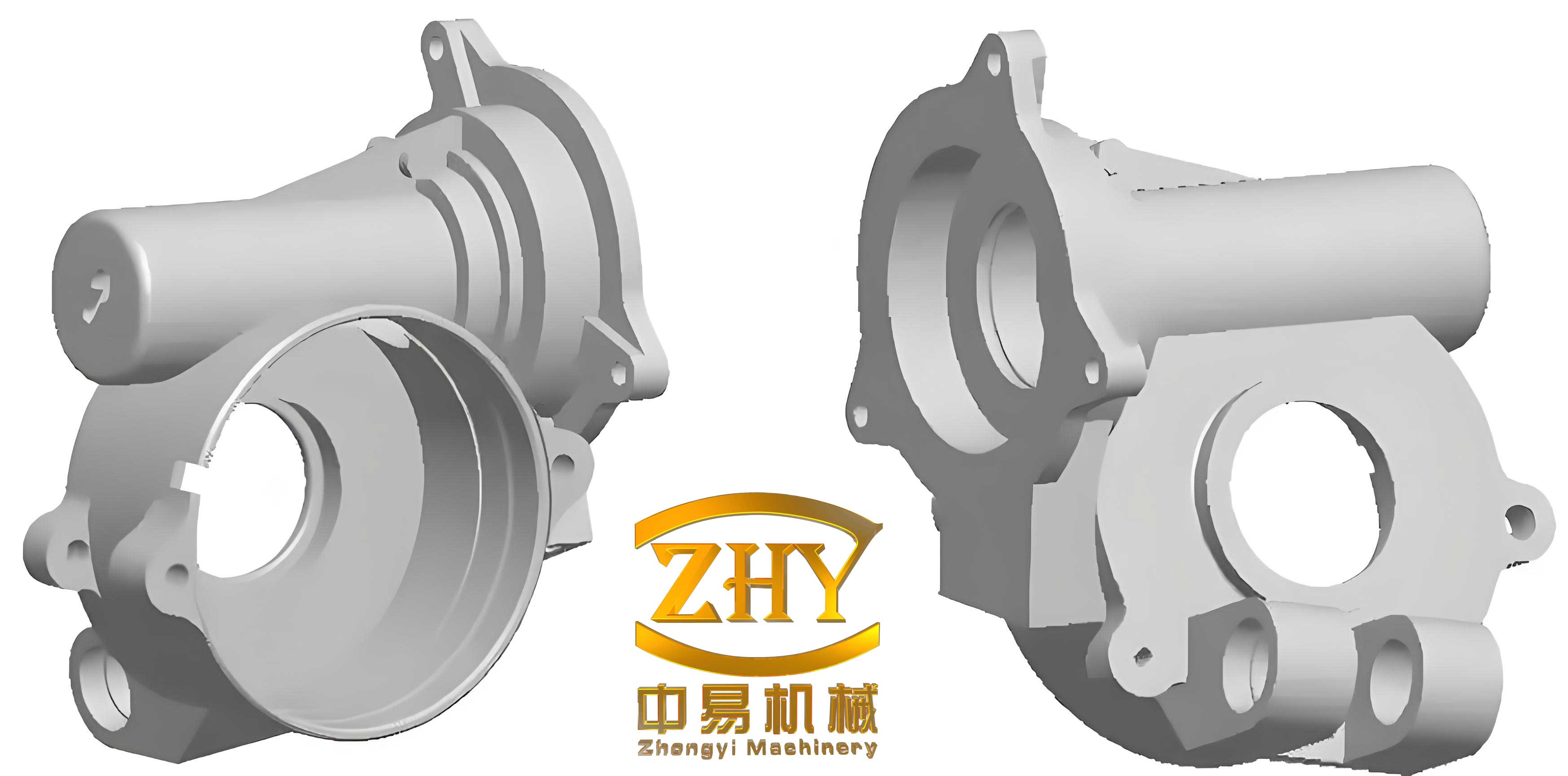
Following assembly, the entire pattern system, including浇注 systems and risers, was coated with a refractory涂料 through three successive dipping cycles. Each dip was followed by drying in a 50°C oven to achieve a coating thickness of about 1.5 mm, which is vital for preventing metal penetration and ensuring smooth surface finish on the shell castings. The coating process requires careful handling due to the low strength of EPS foam; in my practice, we reinforced the patterns with wooden strips and glue to prevent deformation. After coating, the patterns were placed in a rectangular砂箱 with a bottom sand layer of 300 mm, and molding sand was added using a rain-drop method. Vibration compaction at 50 Hz for 70 seconds ensured adequate sand density, which is critical for supporting the foam patterns during浇注 and preventing defects like swell or fins in the shell castings. The浇注 operation was conducted under controlled conditions: a浇注 temperature of 1490°C and a vacuum pressure of -0.05 MPa, as derived from the earlier formulas. Fast浇注 speeds were maintained to minimize thermal gradients and promote complete filling of the mold cavity for these shell castings.
During initial trials, we encountered several defects in the shell castings, such as冲砂,粘砂,烧结, and excess material on external contours. Through iterative adjustments, I identified that these issues could be mitigated by enhancing the core strength and optimizing the浇注 system. For instance, by incorporating core reinforcements (芯骨) in the water channel core and adopting a vertical浇注 system with gates positioned away from the core, we reduced direct metal impingement, thereby controlling冲砂 and粘砂. Additionally, improving the compaction of molding sand and increasing the实型 strength of the foam patterns addressed the problem of多余 material. These modifications underscore the importance of process refinement in achieving high-quality shell castings. To quantify the improvements, I have compiled a table summarizing the defect reduction strategies and their outcomes for the shell castings.
| Defect Type | Root Cause | Corrective Action | Impact on Shell Castings |
|---|---|---|---|
| 冲砂 (Erosion) | Direct metal flow冲击 water channel core | Relocate浇注 gates and use vertical浇注 | Minimized core damage and improved internal surface quality |
| 粘砂 (Penetration) | Inadequate coating thickness or sand compaction | Increase coating layers to 1.5 mm and enhance vibration time | Smoother casting surfaces and reduced cleaning effort |
| 烧结 (Burning) | High temperatures affecting core integrity | Employ LB65 cold box cores with refractory coatings | Preserved core shape and dimensional accuracy |
| 多肉 (Excess Material) | Insufficient foam pattern strength or sand support | Reinforce patterns and optimize sand compaction parameters | Sharper external contours and reduced machining needs |
The successful implementation of lost foam core composite casting has enabled the批量 production of合格 shell castings, as evidenced by the final machined components that meet all specifications for water-cooled motor applications. In my assessment, this工艺 not only reduces模具 costs by eliminating multiple cores and molds but also streamlines assembly operations, leading to higher productivity and consistency. The economic advantages can be further analyzed using a cost model公式. The total cost per shell casting, $C_{total}$, can be expressed as:
$$C_{total} = C_{material} + C_{labor} + C_{模具} + C_{energy}$$
where $C_{material}$ includes costs for foam, sand, and metal; $C_{labor}$ covers assembly and handling; $C_{模具}$ represents模具 amortization; and $C_{energy}$ accounts for drying and浇注 energy. For lost foam core composite casting, $C_{模具}$ is significantly lower due to fewer molds, and $C_{labor}$ is reduced thanks to simplified core placement. Assuming a production volume $N$ of shell castings, the cost savings $\Delta C$ compared to resin sand casting can be approximated as:
$$\Delta C = N \times (C_{resin} – C_{foam})$$
where $C_{resin}$ and $C_{foam}$ are the per-unit costs for resin sand and lost foam methods, respectively. In our case, this translated to approximately 30% cost reduction for批量 runs of shell castings, making the工艺 highly viable for industrial scale-up.
Beyond cost, the technical performance of the shell castings produced via lost foam core composite casting was rigorously evaluated. We conducted non-destructive testing, including pressure tests for the water channels and dimensional inspections, all of which confirmed the integrity and precision of the shell castings. The循环水道 exhibited no leaks, and the mechanical properties met HT250 standards, with tensile strengths exceeding 250 MPa. This reliability is paramount for motor applications where thermal management is critical. To further optimize the工艺, I explored the relationship between浇注 parameters and casting quality using statistical analysis. For example, the defect rate $D$ for shell castings can be modeled as a function of浇注 temperature $T_p$ and vacuum pressure $P_v$:
$$D = k_1 e^{-k_2 T_p} + k_3 |P_v|^{-1}$$
where $k_1$, $k_2$, and $k_3$ are empirical constants derived from production data. By minimizing $D$, we fine-tuned $T_p$ and $P_v$ to enhance the yield of acceptable shell castings. This analytical approach underscores the importance of data-driven process control in modern casting operations for shell castings.
In conclusion, the lost foam core composite casting工艺 represents a significant advancement in the manufacturing of water-cooled motor shell castings. From my firsthand experience, this method offers a compelling combination of reduced模具 complexity, lower production costs, and improved casting quality, making it ideal for批量 applications. The key to success lies in careful attention to pattern fabrication, core assembly, coating techniques, and浇注 parameters, all of which I have detailed in this article. As the demand for efficient thermal management in motors grows, such innovative casting approaches will continue to play a pivotal role in producing high-performance shell castings. Future work may involve exploring alternative materials for foam patterns or integrating digital simulations to further optimize the工艺 for shell castings. Ultimately, the lessons learned from this project highlight the value of hybrid casting techniques in overcoming the challenges associated with complex shell castings, paving the way for more sustainable and cost-effective manufacturing in the industry.
To encapsulate the entire process, I have developed a comprehensive formula that summarizes the overall efficiency $\eta$ of the lost foam core composite casting for shell castings, incorporating factors such as yield rate $Y$, cost savings $S$, and quality index $Q$:
$$\eta = \frac{Y \times S \times Q}{E}$$
where $E$ represents the environmental impact or energy consumption. In our implementation, $\eta$ showed a marked improvement over traditional methods, reinforcing the viability of this工艺 for shell castings. As I reflect on this journey, it is clear that continuous innovation and cross-disciplinary collaboration are essential for advancing casting technologies, particularly for intricate components like shell castings that drive modern industrial systems. Through persistent experimentation and optimization, we have not only achieved批量 production but also set a benchmark for future developments in the realm of shell castings.