
In my extensive research and practical applications within the field of precision casting, I have dedicated significant efforts to mastering the lost wax casting process for nodular iron components. This technique, often referred to as investment casting, presents unique challenges due to the specific solidification characteristics of nodular iron, which requires meticulous control over every stage from pattern making to final cooling. Through systematic experimentation and batch production, my team and I have developed a robust methodology that ensures high-dimensional accuracy, superior surface finish, and consistent mechanical properties in nodular iron castings. The journey began with a thorough investigation into the fundamental aspects of lost wax casting, focusing on pattern design, shell building, melting, and pouring parameters. This article delves into the detailed findings and optimized processes, emphasizing the critical role of precise parameter control in achieving successful outcomes. The integration of composite shell systems and tailored metallurgical practices has been pivotal, and I will elaborate on these aspects using formulas, tables, and empirical data to provide a comprehensive guide for practitioners in the lost wax casting industry.
The foundation of any successful lost wax casting operation lies in the accurate design of the pattern die, which must account for multiple shrinkage and expansion factors. In my work, I employed a low-temperature wax pattern material combined with a composite shell system, necessitating a precise calculation of the overall casting shrinkage. The total casting shrinkage (ε) is determined by the interplay of wax contraction, shell expansion, and metal shrinkage, including graphite expansion in nodular iron. I derived the following relationship through experimental validation:
$$ \epsilon = \epsilon_1 – \epsilon_2 + \epsilon_3 $$
where:
- $$ \epsilon_1 $$ represents the shrinkage rate of the low-temperature wax pattern, typically ranging from 0.6% to 0.8%.
- $$ \epsilon_2 $$ denotes the expansion rate of the composite shell after firing, also between 0.6% and 0.8%.
- $$ \epsilon_3 $$ is the shrinkage rate of the nodular iron, encompassing both liquid contraction and graphite expansion, generally between 0.7% and 0.9%.
Based on iterative trials and historical data from previous lost wax casting projects, I established an optimal casting shrinkage range of 0.7% to 0.9% for most components. However, through further experimentation, I confirmed that this value can be adjusted between 0.5% and 1.2% depending on the specific geometry and wall thickness of the part. This flexibility is crucial in lost wax casting to accommodate varying thermal dynamics. Additionally, the design must facilitate proper feeding during solidification. Nodular iron exhibits a mushy freezing pattern due to its wide crystallization temperature range, so I ensured that gating systems are sufficiently large to compensate for shrinkage. For instance, a bracket casting with a mass of 2.0 kg required a gate cross-sectional area of 375 mm² in lost wax casting, compared to only 100–200 mm² in sand casting, highlighting the need for enhanced feeding in precision processes.
The assembly and shell-building stages in lost wax casting demand rigorous attention to detail to prevent defects and ensure dimensional stability. In my approach, I utilized a composite shell system comprising five and a half layers to balance cost and quality. The first two layers employed a silica sol binder with zircon flour (270 and 200 mesh) as refractory material to achieve excellent surface finish. The subsequent three layers used a sodium silicate binder with mullite sand for reinforcement, followed by a final sodium silicate coating. This hybrid approach, common in advanced lost wax casting, leverages the strengths of both binders: silica sol provides fine detail, while sodium silicate offers economic efficiency and strength. The process parameters for shell building are summarized in Table 1, which I developed based on extensive testing.
| Layer | Binder System | Refractory Material | Drying/Hardening Condition | Time |
|---|---|---|---|---|
| 1–2 | Silica Sol | Zircon Flour (270 & 200 mesh) | Constant Temperature & Humidity | 6 hours per layer |
| 3–5 | Sodium Silicate | Mullite Sand | Aluminum Chloride Solution Hardening | 6 hours natural drying post-hardening |
| Final | Sodium Silicate Coating | N/A | Reinforcement | Applied after layer 5 |
After coating, the shells are dewaxed and fired. I found that thorough firing is essential to eliminate residual moisture and prevent gas defects during pouring. For assembly, I avoided separate feeders by integrating the gating system as a feeding channel. Smaller parts like rocker arms were directly welded to the sprue via gates, while larger castings included additional ties to prevent detachment during handling and to aid venting. The metal head height was maintained at a minimum of 60 mm to ensure adequate feeding pressure. These practices underscore the adaptability required in lost wax casting for nodular iron, where every step must be optimized to counteract the material’s inherent solidification behavior.
The core of my research centered on melting and pouring practices, as the metallurgy of nodular iron in lost wax casting is highly sensitive to composition and treatment. I focused on producing various grades of nodular iron, including QT400-18, QT420-15, QT450-10, QT500-10, QT550-6, and QT600-3, by controlling key elements. The chemical composition follows a “two-high, three-low” principle: high carbon and silicon to promote graphitization and ferrite formation, and low manganese, sulfur, and phosphorus to minimize harmful effects. Based on trials, I defined the compositional ranges shown in Table 2, which serve as a guideline for achieving desired microstructures and properties in lost wax casting.
| Element | Composition Range (wt%) | Role and Notes |
|---|---|---|
| C | 3.6–3.9 | Enhances graphitization; upper limit avoids graphite flotation. |
| Si | 1.8–2.8 | Promotes ferrite; exceeding 3% may cause embrittlement. |
| Mn | ≤0.7 | Kept low for ferritic grades; slightly higher for pearlitic. |
| P | ≤0.06 | Harmful; strictly controlled to prevent cold brittleness. |
| S | ≤0.03 | Detrimental to nodularization; minimized. |
| Mg | 0.03–0.05 | Nodularizing agent; residual critical for spheroidization. |
| RE | 0.02–0.04 | Rare earths aid nodularization and desulfurization. |
I derived an empirical formula to assess soundness: when $$ w(C) + 17w(Si) \geq 3.9\% $$, the castings tend to be free from shrinkage porosity and cavities. This relationship guided my composition adjustments in lost wax casting. Initially, high residual magnesium (0.08–0.10%) from excessive nodularizer addition (1.5–1.8%) caused severe gas porosity, with rejection rates up to 80%. By optimizing to residual Mg of 0.03–0.05% and RE of 0.02–0.04%, the issue was resolved, emphasizing the delicate balance in nodular iron treatment for lost wax casting.
Melting was conducted in 250 kg medium-frequency induction furnaces, with each heat taking 45–60 minutes. To manage charge balance, I adjusted the charge makeup to 45–50% pig iron (Q10), 45–50% returns, and 5% steel scrap, ensuring efficient use of materials in high-volume lost wax casting. Tap temperature was controlled at 1480–1520°C after modifying the treatment ladle to reduce heat loss—height-to-diameter ratio increased to 1.6 and refractory lining thickness reduced to 50 mm. This lowered temperature drop from 180–200°C to 80–100°C between tapping and pouring, critical for maintaining fluidity in lost wax casting. Pre-pour analysis used chilled samples for spectrometric testing to ensure accuracy, as slow cooling could distort carbon readings due to graphite precipitation.
For nodularization and inoculation, I tested various alloys and settled on FeSiMg8RE3 as the nodularizer, with composition detailed in Table 3. The treatment employed a sandwich method: 0.5% FeSi75 inoculant (4–8 mm) placed in a well-type ladle, followed by 1.0–1.2% nodularizer (10–15 mm) covered with a metal plate. Two-thirds of the iron was tapped initially to control violent reaction, then the remainder after stabilization. After skimming, the ladle was transferred for pouring with a second inoculation of 0.5% FeSi75 added during transfer. Covering the melt with charcoal or perlite helped slag formation and reduced magnesium loss. Pouring temperature was maintained at 1350–1380°C, with shells either hot or cold; hot-shell pouring favored higher ferrite content due to slower cooling. Cooling to below 600°C before decoring ensured complete transformation, and for ferritic grades, cooling to under 200°C prevented cracking.
| Element | Composition (wt%) |
|---|---|
| Mg | ~8.0 |
| RE | ~3.0 |
| Si | 40–45 |
| Ca | ~2.6 |
| MgO | ~0.75 |
| Fe | Balance |
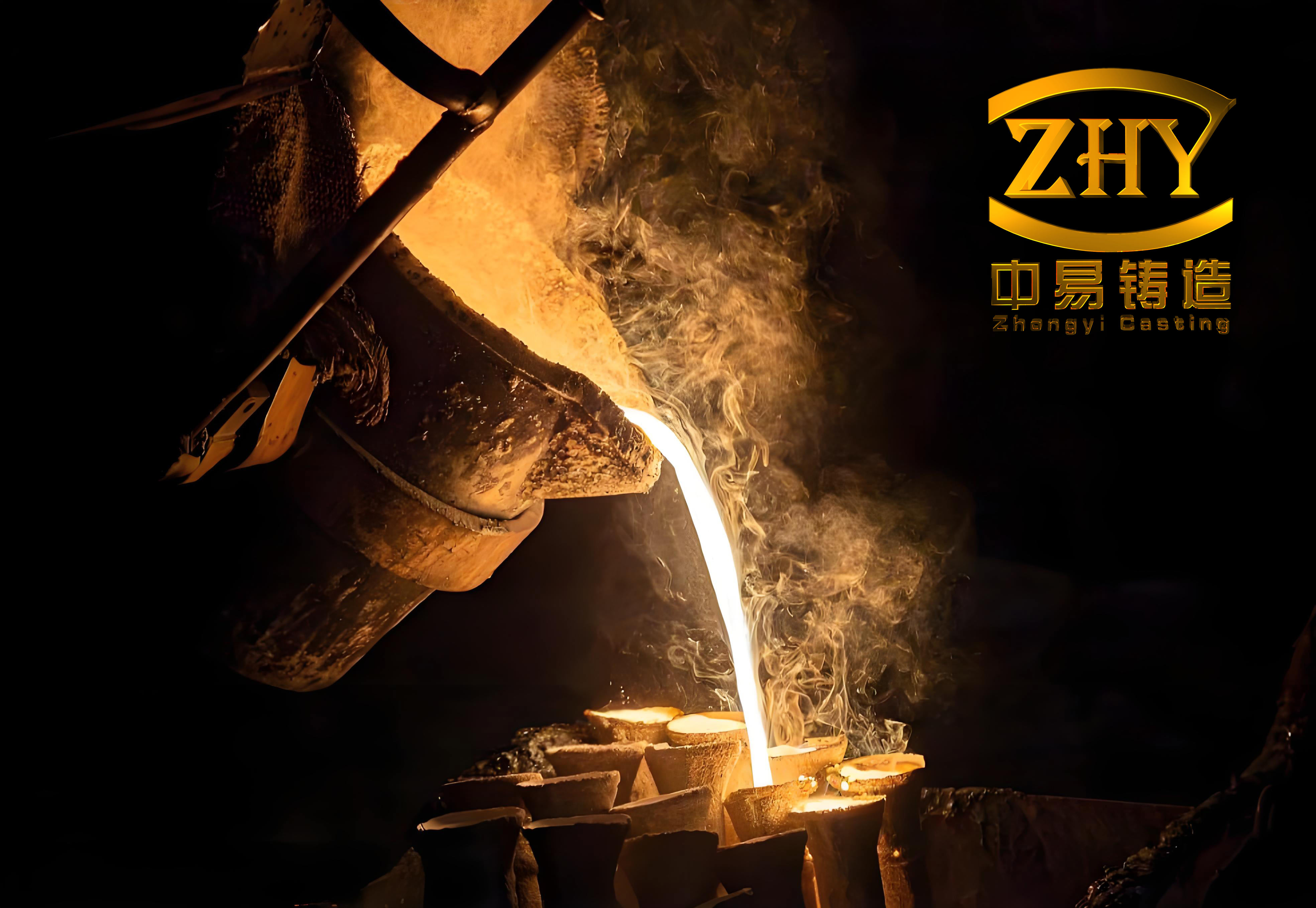
The results from batch production validated the efficacy of my lost wax casting approach for nodular iron. Microstructural analysis consistently achieved nodularization grade 2, nodule size grade 6, and pearlite content around 10% for grades like QT420-10, meeting the required mechanical properties. For instance, a bracket casting exhibited these characteristics, demonstrating the capability of lost wax casting to produce high-integrity nodular iron components. The dimensional accuracy reached CT6, with surface roughness of Ra 3.2–6.3 µm, surpassing conventional casting methods. To illustrate a typical outcome, here is an image from the process:
The success hinges on the integrated control of all parameters. I developed a mathematical model to predict shrinkage based on the formula above, and it aligns well with experimental data. Furthermore, the cooling rate after pouring significantly influences microstructure; I observed that slower cooling, achieved through hot shells or sand embedding, enhances ferrite formation, which is desirable for ductile grades in lost wax casting. This relationship can be expressed as:
$$ \text{Ferrite Content} (\%) = k \cdot \ln\left(\frac{1}{T_c}\right) + C $$
where $$ T_c $$ is the cooling rate in °C/min, and k and C are material constants derived from regression analysis of my data. For typical nodular iron in lost wax casting, k ranges from 15 to 20, and C from 5 to 10, depending on silicon content. This emphasizes the need for tailored cooling strategies in lost wax casting.
To provide a holistic view, I compiled key process parameters and their effects in Table 4, which summarizes the optimized conditions for lost wax casting of nodular iron based on my research. This table serves as a quick reference for implementing the technology.
| Process Stage | Parameter | Optimal Range | Impact on Casting Quality |
|---|---|---|---|
| Pattern Design | Casting Shrinkage | 0.5–1.2% | Ensures dimensional accuracy; adjustable per geometry. |
| Shell Building | Drying Time (Layers 1–2) | 6 hours per layer | Prevents cracks and ensures binder curing. |
| Shell Building | Hardening (Layers 3–5) | AlCl₃ solution + 6h drying | Enhances shell strength and permeability. |
| Melting | Tap Temperature | 1480–1520°C | Balances fluidity and gas absorption. |
| Composition | Carbon Equivalent (CE) | 4.3–4.5 (CE = C + Si/3) | Controls graphitization and soundness. |
| Nodularization | Residual Mg | 0.03–0.05% | Achieves spheroidization without defects. |
| Pouring | Temperature | 1350–1380°C | Minimizes shrinkage and porosity. |
| Cooling | Decoring Temperature | <600°C for all; <200°C for ferritic | Prevents stress and cracking. |
Through continuous refinement, my team and I have scaled up production to an annual capacity of 5000 tons, demonstrating the robustness of this lost wax casting methodology. The ability to consistently produce nodular iron castings with superior properties underscores the potential of lost wax casting for high-performance applications. Future work may explore advanced nodularizers or automated shell systems to further enhance efficiency, but the current framework provides a solid foundation. In conclusion, the research highlights that success in lost wax casting of nodular iron depends on a synergistic approach: precise pattern design, controlled shell construction, meticulous metallurgy, and tailored thermal management. By adhering to the principles and data outlined here, manufacturers can leverage lost wax casting to achieve exceptional quality in nodular iron components, pushing the boundaries of precision casting technology.