
In the field of wear-resistant materials, white cast iron has emerged as a pivotal solution due to its exceptional hardness and abrasion resistance. My research focuses on developing a cost-effective low chromium white cast iron specifically designed for grinding balls in industries such as power generation, mining, and cement production. This white cast iron variant addresses the limitations of traditional materials like high manganese steel and high chromium white cast iron by balancing performance, affordability, and simplified processing. Throughout this article, I will detail the material design, experimental procedures, mechanical properties, and real-world applications of this low chromium white cast iron, emphasizing its superiority over forged steel balls. The term ‘white cast iron’ will be frequently referenced to underscore its central role in this study.
The composition of low chromium white cast iron was meticulously designed to optimize hardness and toughness while minimizing production costs. Based on principles that reduce carbon content to enhance韧性 without compromising hardness, and incorporating chromium as the sole alloying element to lower expenses, the chemical composition was formulated as shown in Table 1. This approach ensures that the white cast iron maintains a robust microstructure while being economically viable for widespread adoption.
| Element | C | Cr | Si | Mn | P | S | Fe |
|---|---|---|---|---|---|---|---|
| Content | 2.0-3.0 | 1.5-2.5 | 0.5-1.0 | 0.5-1.0 | <0.1 | <0.05 | Balance |
The experimental methodology involved melting the white cast iron in a production-scale cupola furnace at approximately 1450°C, with a pouring temperature of 1350°C. The material was cast into grinding balls of diameters 60 mm and 100 mm, along with impact specimens and metallographic samples. Heat treatment processes included normalizing, quenching (oil cooling), tempering, and austempering, with parameters varied to study their effects. Quenching temperatures ranged from 850°C to 1050°C, tempering temperatures from 200°C to 600°C, and austempering involved heating at 950°C followed by isothermal holding at 250°C. Microstructural analysis was conducted using optical and scanning electron microscopy, while mechanical properties were assessed via Rockwell hardness tests and impact toughness measurements.
The as-cast microstructure of the low chromium white cast iron consisted of pearlite, eutectic ledeburite, and secondary carbides. The pearlite exhibited a coarse lamellar structure, as depicted in the following image link, which provides a visual reference for the typical white cast iron morphology. The eutectic network and needle-like secondary carbides were uniformly distributed, contributing to the initial hardness but limited toughness.
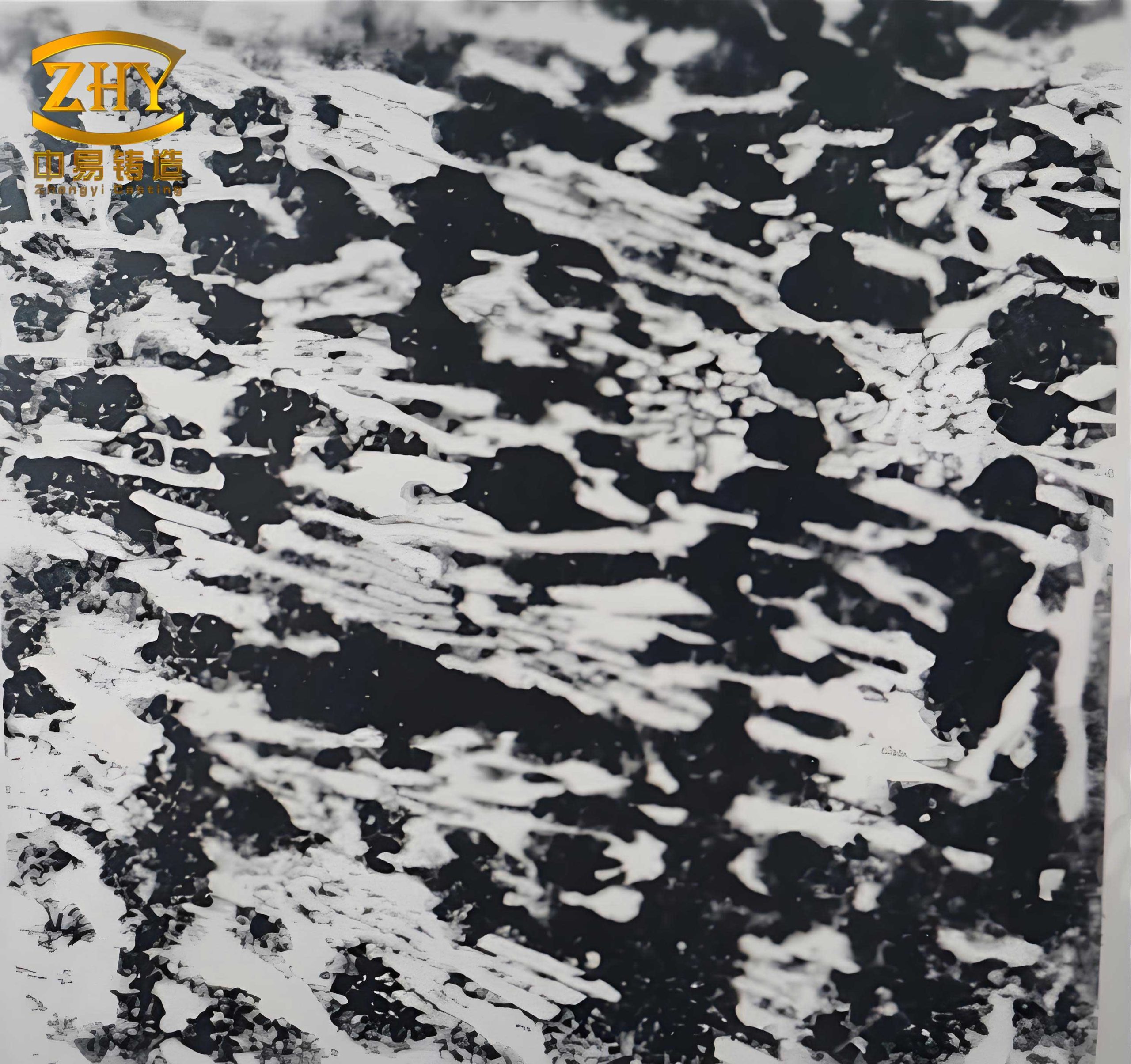
Upon heat treatment, significant microstructural transformations occurred. Quenching at lower temperatures (e.g., 850°C) resulted in partial austenitization, yielding a mixture of martensite, retained pearlite, and carbides. As the quenching temperature increased to 950°C, complete austenitization led to a martensitic matrix with eutectic ledeburite and secondary carbides, while temperatures above 1000°C caused carbide coarsening and grain growth, reducing hardness. Austempering produced a lower bainite matrix, enhancing both strength and ductility. These changes directly influenced the mechanical properties, as summarized in Table 2.
| Condition | Hardness (HRC) | Impact Toughness (J/cm²) | Notable Microstructure |
|---|---|---|---|
| As-cast | 45-50 | 3-4 | Pearlite + Ledeburite |
| Normalized (900°C) | 46-51 | 3-5 | Similar to as-cast |
| Quenched at 850°C | 52-56 | 6-8 | Martensite + Carbides |
| Quenched at 950°C | 58-62 | 4-6 | Full Martensite |
| Quenched at 1050°C | 55-59 | 3-5 | Coarse Martensite |
| Austempered (950°C + 250°C) | 56-60 | 8-10 | Lower Bainite |
The relationship between hardness and tempering temperature can be modeled using an empirical decay formula. For instance, after quenching at 950°C, the hardness decrease with tempering temperature (T in °C) follows approximately: $$H = H_0 \cdot e^{-k(T – T_0)}$$ where \(H_0\) is the initial hardness (e.g., 60 HRC), \(k\) is a material constant (约 0.002 for this white cast iron), and \(T_0\) is a reference temperature (200°C). Similarly, impact toughness shows a slight improvement with tempering, plateauing above 400°C, which can be expressed as: $$IT = IT_0 + \alpha \cdot \tanh(\beta (T – T_c))$$ where \(IT_0\) is the baseline toughness, \(\alpha\) and \(\beta\) are coefficients, and \(T_c\) is a critical temperature around 300°C. These formulas highlight the tunable properties of white cast iron through heat treatment.
Quench hardenability was evaluated on 100 mm diameter grinding balls. After quenching at 950°C and tempering at 250°C, the hardness distribution along the radial direction revealed a surface hardness of 58-60 HRC, with a hardened layer depth of about 15-20 mm, tapering gently to the core hardness of 45-50 HRC. This gradient can be described by: $$H(r) = H_s – (H_s – H_c) \cdot \left(1 – e^{-\gamma r}\right)$$ where \(H_s\) is surface hardness, \(H_c\) is core hardness, \(r\) is the distance from the surface, and \(\gamma\) is a decay constant. Drop weight tests on both 60 mm and 100 mm balls demonstrated that heat-treated white cast iron balls endured significantly more impacts than as-cast ones, with averages of 25-30 blows for heat-treated versus 10-15 for as-cast, underscoring the toughness enhancement.
Field applications of this low chromium white cast iron have yielded impressive results across various industries. In coal grinding at a thermal power plant, the white cast iron balls reduced wear loss by over 50% compared to forged steel balls, with a breakage rate below 1%. In mining operations, the material showed a 40-50% reduction in consumption per ton of ore processed. These outcomes are compiled in Table 3, illustrating the economic and operational benefits. The cost savings arise not only from lower material usage but also from reduced downtime and energy consumption, as the white cast iron’s durability minimizes replacement frequency.
| Application Site | Material | Wear Loss (kg/ton) | Breakage Rate (%) | Cost Saving per Ton (%) |
|---|---|---|---|---|
| Coal Grinding (Power Plant) | White Cast Iron | 0.05-0.08 | 0.5-1.0 | 55-60 |
| Forged Steel | 0.12-0.15 | 2-3 | Baseline | |
| Ore Processing (Mine) | White Cast Iron | 0.10-0.15 | 0.8-1.2 | 45-50 |
| Forged Steel | 0.20-0.25 | 3-5 | Baseline | |
| Cement Production (Factory) | White Cast Iron | 0.03-0.05 | 0.5-0.8 | 50-55 |
| Forged Steel | 0.08-0.10 | 2-4 | Baseline |
The superior performance of this white cast iron can be attributed to its optimized microstructure. The combination of hard carbides and a toughened matrix, achievable through tailored heat treatments, provides an excellent balance for abrasive and impact wear. In terms of production economics, the low chromium content keeps raw material costs low, while simple foundry and heat treatment processes reduce overhead. A profitability analysis indicates that for a factory producing 10,000 tons of these white cast iron grinding balls annually, the industrial profit can exceed $2 million, driven by high demand and competitive pricing.
To further quantify the benefits, consider the wear resistance model for white cast iron in grinding applications. The wear volume loss (W) per unit time can be estimated using: $$W = K \cdot \frac{P \cdot v}{H^{3/2}}$$ where \(K\) is a wear coefficient, \(P\) is applied pressure, \(v\) is sliding velocity, and \(H\) is hardness. For this low chromium white cast iron, the high hardness (58-62 HRC) and refined carbides reduce \(K\), leading to lower W compared to forged steel. Additionally, the fatigue life under cyclic loading can be approximated by: $$N_f = C \cdot (\Delta \sigma)^{-m}$$ where \(N_f\) is cycles to failure, \(\Delta \sigma\) is stress range, and \(C\) and \(m\) are material constants derived from testing. The white cast iron’s microstructure enhances \(C\), prolonging service life.
In conclusion, the low chromium white cast iron developed in this study represents a significant advancement in wear-resistant materials. Its cost-effectiveness, ease of production, and outstanding performance in grinding applications make it a viable alternative to traditional forged steel balls. The material’s properties can be finely adjusted via heat treatment, offering flexibility for different industrial needs. Future work may explore alloying variations or advanced processing techniques to further enhance this white cast iron’s capabilities. As industries strive for efficiency and sustainability, the adoption of such innovative white cast iron solutions will undoubtedly contribute to improved productivity and reduced environmental impact.