
In my extensive career providing specialized sand casting services, I have encountered numerous challenging projects, but the production of voltage equalizing rings for high-voltage transformers stands out due to its stringent quality demands. These rings, crucial for electrical insulation and field distribution, require flawless surface finishes after machining and polishing, with zero tolerance for porosity, inclusions, or shrinkage defects. Through this article, I will share the comprehensive approach we have developed in our sand casting services to manufacture such components reliably, focusing on an aluminum alloy equalizing ring. The process exemplifies how meticulous design and controlled execution in sand casting services can yield parts that meet the most exacting standards.
The foundation of any successful casting lies in material selection. For this equalizing ring, we opted for a eutectic aluminum-silicon alloy, typically around 12% silicon. This choice is strategic within sand casting services due to the alloy’s excellent fluidity, low shrinkage tendency, and good machinability. The near-eutectic composition minimizes the formation of primary silicon phases, reducing the risk of hard spots and improving polishability. The alloy’s solidification behavior can be described using the lever rule for phase fractions. For a binary Al-Si system, the fraction of eutectic at the eutectic temperature is given by:
$$ f_{\text{eutectic}} = \frac{C_0 – C_{\alpha}}{C_{\text{eutectic}} – C_{\alpha}} $$
where \( C_0 \) is the alloy composition, \( C_{\alpha} \) is the composition of the α-Al phase, and \( C_{\text{eutectic}} \) is the eutectic composition (~12.6% Si). This controlled microstructure is vital for defect-free surfaces, a non-negotiable requirement in high-end sand casting services.
The heart of the project lies in the casting process design. We employ a horizontal parting line sand mold, split at the component’s maximum diameter. The ring is oriented with its closed end (the dome) facing downward in the drag, while the open end and major flat surfaces are in the cope. A suspended sand core forms the internal cavity, which is critical for geometry and must allow efficient gas escape. The gating and feeding system is designed to ensure calm, progressive filling and directional solidification toward the risers. Key design parameters, derived from experience in sand casting services, are summarized below.
| Design Element | Specification | Function and Rationale |
|---|---|---|
| Parting Line | At maximum outer diameter (Ø~200 mm) | Simplifies molding, minimizes draft, and places critical surfaces optimally. |
| Cast Ring Dimensions | ~200 mm OD, ~150 mm height, ~10 mm wall thickness | Final part geometry; wall thickness is uniform to promote even cooling. |
| Pattern Allowances | Shrinkage: 1.0%; Machining: 2 mm (side & bottom) | Compensates for aluminum contraction and provides stock for finishing. |
| Process Pad (Riser Pad) | Added to spherical top section, max. thickness ~15 mm | Acts as a hot spot and slag trap to collect oxides and feed shrinkage. |
| Risers (3, equally spaced) | Diameter: Ø60 mm each | Provide feed metal to prevent shrinkage porosity and act as primary slag collectors. |
| Sprue (Vertical) | Diameter: Ø40 mm | Channels molten metal from pouring basin to the runner system. |
| Ingates (2 or more) | Cross-section: ~20 mm x 40 mm (800 mm² total area) | Control metal entry velocity and direction into the mold cavity. |
| Sand Core | Resin-bonded or CO₂ sodium silicate sand with venting rod | Creates internal geometry; suspension ensures alignment and gas venting. |
The feeding efficiency of risers in sand casting services is often evaluated using the modulus method. The modulus (M) is the volume-to-cooling-surface-area ratio:
$$ M = \frac{V}{A_c} $$
For a cylindrical riser to effectively feed a section of the casting, its modulus should be greater than that of the casting section. For our ring’s top section with a modulus \( M_c \), the riser modulus \( M_r \) is designed such that \( M_r > 1.2 \times M_c \). This ensures the riser solidifies last. The solidification time \( t \) relates to the modulus via Chvorinov’s rule:
$$ t = k \cdot M^n $$
where \( k \) is a mold constant specific to the sand used in sand casting services, and \( n \) is an exponent (typically ~2). This scientific approach is integral to modern sand casting services for predicting and controlling solidification.
Beyond design, the execution of sand casting services demands rigorous control over every operational step. The sand core is manufactured with high-strength binders to withstand metallostatic pressure and is reinforced with a central steel rod (hanging rod) for handling and to prevent floating. The rod also serves as an excellent vent path. We use a solid pattern for molding to achieve accurate dimensions. Mold alignment is secured with dowel pins, a simple but crucial step to prevent core shift and casting wall thickness variation.
The metallurgical preparation of the aluminum alloy is where quality is forged. The melt undergoes a two-stage treatment: degassing and modification. Degassing, typically using inert gas purging or solid fluxes, reduces dissolved hydrogen to prevent gas porosity. The equilibrium solubility of hydrogen in aluminum follows Sieverts’ law:
$$ S = k_H \sqrt{p_{H_2}} $$
where \( S \) is solubility, \( k_H \) is a temperature-dependent constant, and \( p_{H_2} \) is the partial pressure of hydrogen. By purging with argon, we reduce \( p_{H_2} \) at the bubble-melt interface, driving hydrogen diffusion into the bubbles. Modification of the eutectic silicon structure is achieved by adding strontium or sodium, which alters the growth morphology from coarse platelets to a fine fibrous form, significantly enhancing mechanical properties and polishability. The pouring temperature is tightly controlled between 680°C and 720°C. A lower temperature risks mistuns, while a higher temperature increases oxidation and turbulence. The filling time \( t_f \) can be estimated from the Bernoulli equation and continuity:
$$ t_f \approx \frac{V_{casting}}{A_{ingate} \cdot v_{ingate}} $$
where \( v_{ingate} \) is the linear velocity at the ingate, approximated by \( \sqrt{2gh} \), with \( g \) being gravity and \( h \) the effective sprue height. For our system, this yields a fill time of approximately 3-5 seconds, ensuring a smooth, non-turbulent fill—a hallmark of professional sand casting services.
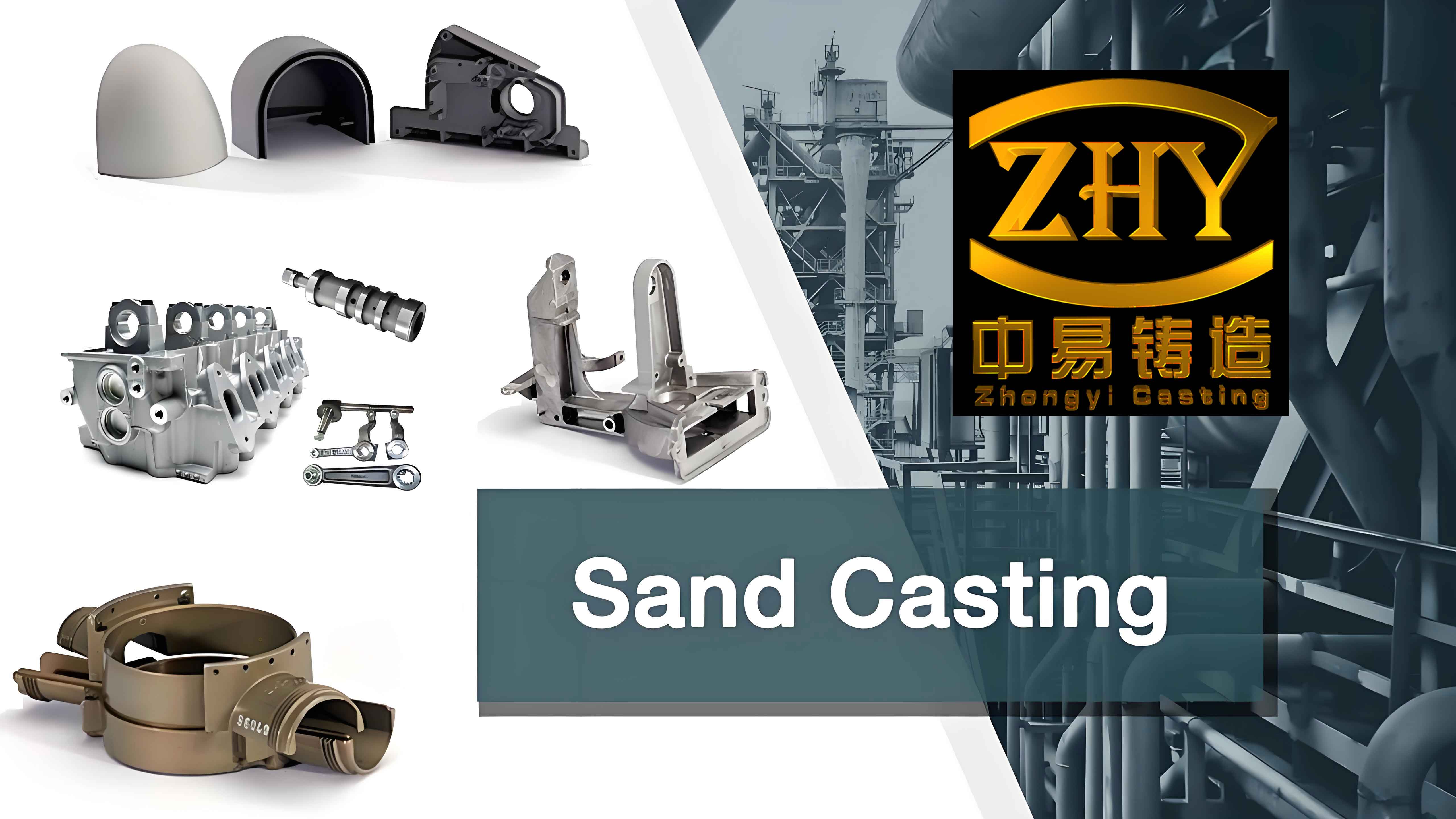
As illustrated, sand casting services are capable of producing complex, high-integrity parts. Post-pouring, we immediately top up the risers with molten metal to counteract liquid shrinkage and maintain a positive feeding pressure until the feeding paths solidify. The casting includes integral extensions—a chucking lug and a center mark—on non-critical areas to facilitate secure mounting during subsequent machining and polishing. These are later removed. After shakeout and cleaning, each ring undergoes visual inspection and non-destructive testing (like dye penetrant inspection) before proceeding to machining. The success of these steps validates the robustness of well-planned sand casting services.
Quality assurance in sand casting services extends to predictive modeling. We often use numerical simulation to analyze mold filling and solidification. The governing energy equation for solidification is:
$$ \rho c_p \frac{\partial T}{\partial t} = \nabla \cdot (k \nabla T) + \rho L \frac{\partial f_s}{\partial t} $$
where \( \rho \) is density, \( c_p \) is specific heat, \( T \) is temperature, \( k \) is thermal conductivity, \( L \) is latent heat, and \( f_s \) is the solid fraction. Solving this for our mold geometry helps visualize hot spots and optimize riser placement virtually, saving time and material. The table below compares key process parameters for different quality grades within sand casting services, highlighting the level of control required for critical components like our equalizing ring.
| Control Parameter | Standard Grade | Engineering Grade | Premium Grade (This Project) |
|---|---|---|---|
| Mold Sand | Green Sand (bentonite-bonded) | Chemically-bonded sand (e.g., furan) | High-resolution resin sand or silicate sand with precise additives |
| Metal Treatment | Basic degassing | Degassing + Grain refinement | Degassing + Modification + Compositional tight control (±0.5%) |
| Pouring Temp. Control | ±25°C | ±15°C | ±10°C (680-720°C range) |
| Riser Design | Rule-of-thumb sizing | Modulus method | Modulus method + Simulation-optimized placement and size |
| Post-Cast Inspection | Visual and dimensional | Dimensional + Pressure testing | Full NDT (Dye Penetrant/X-ray) on critical surfaces post-machining |
The economic and technical advantages of employing such dedicated sand casting services are clear. Compared to permanent mold or die casting, sand casting offers unparalleled flexibility for low-to-medium volume production of complex shapes without the high tooling costs. The ability to incorporate intricate cores and large risers makes it ideal for components where internal quality is as important as external appearance. For the equalizing ring, the sand casting process allows us to place the risers on non-functional areas (like the process pad) that are later machined off, ensuring the final functional surface is pristine. This flexibility is a cornerstone of value in sand casting services.
Furthermore, the metallurgical consistency achieved is critical. The fine, modified eutectic structure resulting from our treatment provides an excellent balance of strength and ductility, which is quantified by relationships like the Hall-Petch equation for strength dependence on grain size, and the effect of silicon morphology on fatigue life. While the primary function of the ring is electrical, its mechanical integrity during handling and operation is ensured by this quality. Every batch of alloy is tested for mechanical properties, with typical targets for this alloy being: Ultimate Tensile Strength > 200 MPa, Elongation > 3%. These are verified through standard test bars cast from the same pour, a common practice in advanced sand casting services to ensure batch-to-batch consistency.
In conclusion, producing a high-integrity voltage equalizing ring is a testament to the capabilities of modern sand casting services. It requires a synergistic integration of material science, precise engineering design, and meticulous process control. From selecting the optimal eutectic aluminum-silicon alloy to designing a gating system that minimizes turbulence and maximizes feeding, every step is deliberate. The use of suspended cores, controlled solidification through riser design, and stringent metallurgical treatments are all essential elements. As a practitioner, I have seen that the reliability of sand casting services for such critical applications hinges on treating the process as a holistic system, where design and execution are inseparable. The repeatability and quality achieved underscore why sand casting services remain indispensable for manufacturing complex, high-performance metal components across industries, from power transmission to precision machinery. The continuous improvement in simulation tools, material knowledge, and process monitoring promises to further elevate the standards and possibilities of sand casting services in the future.