
White cast iron, characterized by its hard, brittle cementite network, has long been recognized as a superior material for resisting abrasive wear. However, its inherent brittleness often limits its application under impact conditions. The development of alloyed white cast irons, particularly those containing chromium, marked a significant advancement, allowing for the manipulation of both carbide morphology and matrix structure. Among these, low-chromium white cast iron presents an economically attractive solution, offering a compelling balance of high hardness, adequate toughness, and production feasibility. This article delves into the microstructure, mechanical properties, and successful industrial application of low-chromium white cast iron, with a primary focus on its use as grinding media in the cement industry, drawing upon extensive research and practical implementation data.
The pursuit of more durable grinding media has been a constant in industries like cement production, where material comminution is a primary process. Traditional forged steel balls, while tough, suffer from relatively low hardness, leading to high wear rates—often in the range of several hundred grams per ton of cement produced. This not only increases direct material costs but also contributes to higher energy consumption and frequent operational stoppages for mill maintenance and ball replenishment. The introduction of alloyed white cast iron balls offered a path to dramatically reduce these losses. While high-alloy white cast irons (e.g., high-chromium or nickel-hard types) provide exceptional performance, their reliance on electric furnace melting and high alloy content elevates production costs, restricting widespread adoption. This context highlights the niche for low-chromium white cast iron, which aims to deliver performance comparable to premium alloys but through a more cost-effective and accessible manufacturing route.
Alloy Design Philosophy for Low-Chromium White Cast Iron
The fundamental goal in designing a low-chromium white cast iron composition is to achieve a hard, wear-resistant microstructure without incurring the prohibitive costs associated with high alloy additions. The chemistry is carefully balanced to promote the formation of hard carbides while allowing the metallic matrix to be strengthened through heat treatment. Through systematic optimization studies, a target compositional range has been established for applications such as grinding balls. The primary alloying elements and their roles are summarized below:
| Element | Weight Percent Range (%) | Primary Function |
|---|---|---|
| Carbon (C) | 2.4 – 3.0 | Forms hard iron carbides (M3C type); provides abrasion resistance. |
| Chromium (Cr) | 1.5 – 3.0 | Modifies carbide morphology; improves hardenability; enhances corrosion/oxidation resistance. |
| Silicon (Si) | 0.5 – 1.2 | Deoxidizer; influences graphite formation; affects hardenability. |
| Manganese (Mn) | 0.5 – 1.0 | Suppresses pearlite formation; increases hardenability; combines with sulfur. |
| Molybdenum (Mo) | 0 – 1.0 | Powerful hardenability agent; suppresses pearlite; promotes secondary carbide precipitation. |
| Copper (Cu) | 0 – 1.0 | Increases hardenability; improves corrosion resistance. |
| Sulfur (S) | < 0.05 | Impurity; kept low to avoid embrittlement. |
| Phosphorus (P) | < 0.10 | Impurity; kept low to avoid phosphide eutectic and embrittlement. |
This specific blend of elements ensures that the resulting white cast iron solidifies with a network of hard carbides embedded in a pearlitic or martensitic matrix, which can be subsequently optimized through heat treatment. The relatively low total alloy content, especially chromium, makes this white cast iron suitable for production in more common melting facilities like cupolas, significantly lowering the barrier to entry for foundries.
Microstructural Evolution in Low-Chromium White Cast Iron
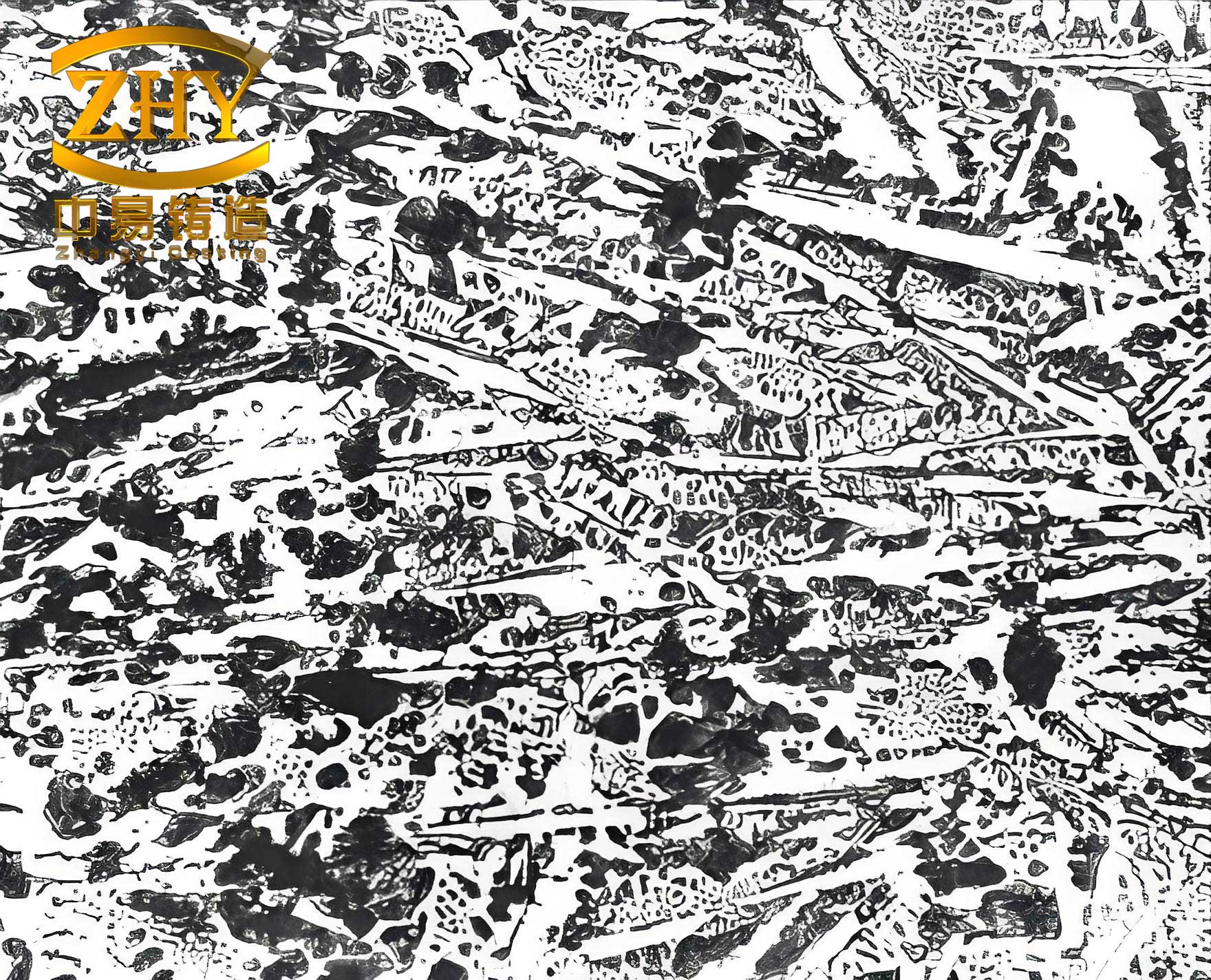
The as-cast microstructure of low-chromium white cast iron is critical to its final properties. Under typical metal mold casting conditions used for grinding balls, the rapid cooling suppresses graphite formation, resulting in a truly “white” fracture. The microstructure consists of a continuous or semi-continuous network of eutectic carbides (primarily of the M3C type, where M is predominantly Fe with some Cr in solution) within a matrix that is initially a mixture of pearlite and possibly some martensite, depending on the cooling rate and alloy content. The presence of chromium, even at these low levels, helps to slightly modify the carbide shape, making them less plate-like and more rod-like compared to plain white cast iron, which contributes to marginally better toughness.
However, the pearlitic matrix in the as-cast condition is suboptimal for maximum wear resistance and impact fatigue life. Pearlite, while stronger than ferrite, is relatively soft and ductile, providing a weak link for abrasive particles to gouge out material from between the hard carbides. Therefore, a crucial step in realizing the full potential of this white cast iron is heat treatment.
The standard heat treatment involves two stages:
- Austenitization: The castings are heated to a temperature of approximately 950°C – 980°C. At this temperature, carbon from the carbides dissolves into the austenite matrix, enriching it. The holding time is sufficient to ensure temperature uniformity and adequate carbon diffusion.
- Quenching and Tempering: The components are then rapidly cooled, typically by forced air (air-blast quenching) or oil. This rapid cooling transforms the high-carbon austenite into a hard, brittle martensitic matrix, often with a significant amount of retained austenite. To relieve quenching stresses and improve toughness, a tempering or stress-relieving treatment is performed, usually in the range of 200°C – 300°C. This tempering causes the precipitation of fine secondary carbides from the retained austenite and martensite, further increasing hardness and stabilizing the microstructure.
The final, heat-treated microstructure of low-chromium white cast iron is thus a synergistic combination of:
- Primary (Eutectic) Carbide Network: Hard, wear-resistant skeleton (HV ~ 1200-1600).
- Secondary Carbides: Fine precipitates within the matrix, contributing to precipitation hardening.
- Martensitic Matrix: A strong, hard (HV ~ 700-900) base that firmly supports the carbides.
- Small Amount of Retained Austenite: Provides a minor degree of damage tolerance.
This composite structure is the key to the material’s high wear resistance.
Mechanical and Wear Properties
The transformation from an as-cast to a heat-treated state brings about a dramatic improvement in the mechanical properties of low-chromium white cast iron, tailoring it for abrasive wear applications with moderate impact. The table below contrasts typical property ranges:
| Property | As-Cast Condition | Heat-Treated Condition (950°C Quench + 250°C Temper) |
|---|---|---|
| Macrohardness (HRC) | 45 – 55 | 58 – 65 |
| Transverse Rupture Strength (MPa) | 600 – 900 | 900 – 1300 |
| Impact Toughness (Charpy, J/cm²) | 3 – 6 | 5 – 9 |
| Abrasive Wear Resistance (Relative to As-Cast) | 1.0 (Baseline) | 1.8 – 2.5 |
The wear resistance of any material, including white cast iron, is not an intrinsic property but a system response. For grinding balls, a critical relationship exists between the ball hardness ($H_b$) and the hardness of the material being ground ($H_m$). Research has shown that the wear coefficient ($\mu$) can be expressed as a function of this hardness ratio:
$$\mu = f\left(\frac{H_b}{H_m}\right)$$
For abrasive wear dominated by micro-cutting and ploughing, the wear resistance increases sharply as $H_b/H_m$ increases from 1 to approximately 1.3-1.5. Beyond this range, further increases in ball hardness yield diminishing returns in wear rate reduction. More importantly, excessive hardness in a white cast iron is typically achieved at the expense of toughness, leading to an increased risk of brittle fracture, spalling, or catastrophic failure, which can completely negate the benefits of high hardness and actually increase the effective wear rate. For cement clinker, which has an average hardness of ~500-600 HV (approx. 50 HRC), the ideal grinding ball hardness, according to this model, is in the range of 60-65 HRC ($H_b/H_m \approx 1.2-1.3$). This is precisely the range achieved by heat-treated low-chromium white cast iron.
Manufacturing and Processing Considerations
A significant advantage of low-chromium white cast iron is its production flexibility. While it can be melted in electric induction furnaces for precise control, it is also amenable to cupola melting, which drastically reduces operational costs, especially for high-volume products like grinding balls. For batch production, medium-frequency induction furnaces are commonly used. A typical process flow is:
- Melting: Charge is melted to a tapping temperature of 1480-1520°C.
- Inoculation/Modification: Before pouring, a rare-earth-bearing ferrosilicon inoculant (e.g., 0.1-0.3% addition) is used. This modifies the carbide morphology, making it more isolated and rounded, thereby improving toughness without sacrificing hardness.
- Casting: Pouring is done into preheated metal molds (dies) at a temperature of 1380-1420°C. Metal mold casting provides a rapid and directional solidification, promoting a finer, more uniform carbide structure compared to sand casting. The pattern allowance (shrinkage) is typically around 2%.
- Heat Treatment: As described previously, the cast balls undergo austenitization, quenching, and tempering.
This straightforward process chain makes low-chromium white cast iron grinding balls accessible to a wide range of foundries.
Industrial Application and Performance in Cement Grinding
The ultimate validation of any engineering material comes from field performance. Low-chromium white cast iron balls have been extensively trialed and adopted in cement plant ball mills, particularly in small to medium-sized units. The performance is typically benchmarked against the traditional forged steel ball. Key performance indicators include:
- Ball Consumption (g/ton of cement): The mass of grinding media lost per ton of cement produced.
- Power Consumption (kWh/ton of cement): Indirectly affected by media efficiency and mill loading.
- Mill Output (ton/hour): Can be influenced by the effective grinding action of the media.
- Operating Costs: A combination of ball cost, power cost, and maintenance costs related to ball charging and mill liner wear.
The following table summarizes a comparative field test result from a cement plant operating a Ø2.2m x 6.5m ball mill (first compartment):
| Performance Metric | Forged Steel Balls | Low-Chromium White Cast Iron Balls | Improvement / Notes |
|---|---|---|---|
| Ball Consumption | 800 – 1000 g/ton | 100 – 200 g/ton | Reduction of 80-87% |
| Specific Power Draw | Baseline | ~5-8% lower | Due to reduced media mass for same fill level |
| Mill Output | Baseline | ~5-10% higher | Attributed to more effective grinding action |
| Service Life | 1X (Reference) | 6X – 8X longer | Primary economic driver |
| Cleaning Interval | Every 1-2 months | Extended to 6-8 months | Reduces downtime, increases availability |
The dramatic reduction in ball consumption, by a factor of 6 to 8, is the most compelling economic argument. Even when the initial purchase cost per kilogram of low-chromium white cast iron balls is higher than that of forged steel balls, the total cost per ton of cement ground is significantly lower. The extended service life reduces the frequency of mill stoppages for ball charging, increasing equipment availability and productivity. The slightly higher hardness and density of the white cast iron also contribute to a more efficient grinding action in the crucial first compartment of the cement mill, where size reduction of the hardest clinker particles occurs.
The successful application hinges on matching the material’s properties to the service conditions. The impact conditions in typical ball mill compartments, especially in smaller mills, are characterized by repeated, lower-energy impacts rather than single, catastrophic blows. The achieved impact toughness of 5-9 J/cm² in heat-treated low-chromium white cast iron is sufficient to withstand this type of repetitive stress without fracturing, while its high hardness provides the necessary abrasion resistance. The relationship defining the optimal hardness can be refined for the cement grinding system. Given a clinker hardness $H_m \approx 550$ HV, and aiming for the ideal ratio $1.2 < H_b/H_m < 1.5$, the target ball hardness range is:
$$H_b^{target} = (1.2 \text{ to } 1.5) \times H_m \approx 660 \text{ to } 825 \text{ HV}$$
Converting to the Rockwell C scale, 660-825 HV corresponds to approximately 58-64 HRC, which aligns perfectly with the capabilities of this alloy. Pushing the white cast iron hardness significantly beyond this upper limit, while technically possible with higher alloying or deeper chilling, would risk a steep drop in toughness and lead to brittle failure, invalidating the wear resistance benefit.
Conclusion
Low-chromium white cast iron represents a pinnacle of cost-effective material engineering for specific abrasive wear applications. Through judicious alloy design focusing on modest chromium additions and the strategic use of elements like molybdenum and copper, a microstructure is achieved that combines a hard carbide network with a strong, heat-treatable matrix. The subsequent thermal processing—austenitization, quenching, and tempering—transforms the as-cast structure into one with high hardness (58-65 HRC) and serviceable toughness. This property profile makes it exceptionally well-suited for components subject to low-to-moderate impact and high abrasion, with grinding balls for the cement industry being a prime example.
Field data consistently demonstrates that grinding balls made from heat-treated low-chromium white cast iron outperform traditional forged steel balls by a factor of 6 to 8 in terms of service life, while also contributing to reduced power consumption and increased mill productivity. Its principal advantage over higher-alloy white cast irons lies in its production economy; it can be manufactured using widely available cupola or induction melting technology followed by standard metal mold casting and heat treatment practices. Therefore, low-chromium white cast iron successfully bridges the gap between the high performance of specialty alloys and the economic and practical constraints of general industrial foundry production, securing its role as a material of choice for durable grinding media and other similar anti-abrasive components.