
In my extensive experience with industrial casting processes, the production of critical components like squeezing axles for spiral oil presses has always presented unique challenges. Traditionally, these parts were manufactured using metal mold casting to create a bimetallic composite of white cast iron and carbon steel. While this method yielded products that were cost-effective and performed well in service, it came with significant drawbacks for foundries, including high scrap rates and short mold lifespans, leading to elevated manufacturing costs. To address these issues, I have explored and implemented a shift to silicate-bonded sand casting, a technique that leverages the versatility and economic benefits of sand castings. This article delves into the comprehensive process adjustments, material modifications, and performance outcomes associated with producing twin metals composite squeezing axles via water glass sand molds. Throughout this discussion, I will emphasize how sand castings can be optimized for complex bimetallic applications, using detailed tables, formulas, and practical insights to illustrate the advancements.
The squeezing axle is a consumable key component in spiral oil presses, requiring high wear resistance and structural integrity. In the past, metal mold casting was favored for its rapid cooling, which promoted a hard, graphite-free microstructure in the white cast iron sections. However, the high scrap rate—often due to defects like cracking or poor bonding—and the frequent need for mold refurbishment made it costly. By transitioning to water glass sand casting, I aimed to retain the performance benefits while reducing production expenses and improving yield. Sand castings, particularly those using silicate-bonded sand, offer greater flexibility in mold design, better accommodates intricate geometries, and reduces thermal shock, which is crucial for bimetallic composites. In this context, I will detail every aspect of the process, from material formulation to final testing, highlighting how sand castings can be tailored for demanding applications.
Material Adjustments for White Cast Iron Squeezing Screw
When moving from metal mold to sand casting, the cooling rate decreases significantly, which can lead to undesirable microstructural changes in white cast iron. In metal mold casting, the rapid chill suppresses graphite formation, ensuring a hard, abrasion-resistant structure. However, in sand castings, the slower cooling may allow graphite to precipitate, reducing hardness and wear resistance. To counteract this, I adjusted the chemical composition of the white cast iron used for the squeezing screw. Originally, the composition included elements like chromium in the range of 0.4%–0.6%, but for sand castings, I increased the chromium content to 1.0%–1.2%. Chromium not only enhances hardenability but also improves corrosion and oxidation resistance, which is vital for the harsh operating conditions of oil presses.
Additionally, I introduced a composite modification treatment using rare earth (1# RE) and boron-iron (B-Fe) during molten metal processing. This treatment refines the microstructure, promoting finer carbides and reducing the likelihood of graphite formation. The mechanism involves nucleation enhancement and grain boundary strengthening, which collectively boost strength and hardness. Below is a table summarizing the chemical composition adjustments for the white cast iron in sand castings compared to the metal mold baseline:
| Element | Metal Mold Composition (%) | Sand Casting Composition (%) |
|---|---|---|
| Carbon (C) | 3.2–3.6 | 3.2–3.6 |
| Silicon (Si) | 0.8–1.2 | 0.8–1.2 |
| Manganese (Mn) | 0.5–0.8 | 0.5–0.8 |
| Chromium (Cr) | 0.4–0.6 | 1.0–1.2 |
| Phosphorus (P) | <0.2 | <0.2 |
| Sulfur (S) | <0.1 | <0.1 |
| Rare Earth (RE) | – | 0.1–0.2 |
| Boron (B) | – | 0.01–0.03 |
The increased chromium content, combined with RE-B modification, ensures that the white cast iron maintains a predominantly carbide-rich structure even under the slower cooling of sand castings. This adjustment is critical for achieving the desired hardness (targeting 50–55 HRC) and wear resistance. The thermodynamic basis for this can be expressed using the following formula for carbide stability in cast iron systems:
$$ C_{eq} = C + 0.33(Si + P) – 0.027Mn + 0.4Cr $$
where \( C_{eq} \) is the carbon equivalent, influencing graphite formation. By increasing Cr, the carbon equivalent shifts to promote carbide retention, which is essential for sand castings where cooling rates are lower. Moreover, the modification treatment alters the nucleation kinetics, described by:
$$ \frac{dN}{dt} = k \cdot \exp\left(-\frac{\Delta G^*}{RT}\right) $$
where \( \frac{dN}{dt} \) is the nucleation rate, \( k \) is a constant, \( \Delta G^* \) is the activation energy for nucleation, \( R \) is the gas constant, and \( T \) is temperature. The addition of RE and B reduces \( \Delta G^* \), leading to finer grains and improved properties.
Design and Preparation of Steel Axle Core
The twin metals composite squeezing axle consists of a prefabricated carbon steel axle core over which the white cast iron is cast to form the squeezing screw. In sand castings, achieving a strong metallurgical bond between the two metals is paramount to prevent delamination under operational stresses. Based on prior research into bimetallic casting, I treated the white cast iron layer as a thick-walled cylinder subjected to internal pressure—specifically, the clamping force exerted by the contracting cast iron on the steel core. Using the stress state equations for a thick-walled cylinder and the third strength theory (maximum shear stress theory), I derived the condition to avoid cracking at the interface.
The hoop stress \( \sigma_\theta \) and radial stress \( \sigma_r \) in a cylinder under internal pressure \( P \) are given by:
$$ \sigma_\theta = \frac{P \cdot d^2}{D^2 – d^2} \left(1 + \frac{D^2}{r^2}\right) $$
$$ \sigma_r = \frac{P \cdot d^2}{D^2 – d^2} \left(1 – \frac{D^2}{r^2}\right) $$
where \( D \) is the outer diameter, \( d \) is the inner diameter, and \( r \) is the radial distance. At the inner surface (\( r = d/2 \)), the maximum shear stress is:
$$ \tau_{max} = \frac{\sigma_\theta – \sigma_r}{2} = \frac{P \cdot D^2}{D^2 – d^2} $$
According to the third strength theory, failure occurs when \( \tau_{max} \geq [\sigma] / 2 \), where \( [\sigma] \) is the allowable stress of white cast iron. Setting \( \tau_{max} \leq [\sigma] / 2 \) and rearranging, we obtain the strength condition for no cracking:
$$ d \leq D \sqrt{1 – \frac{2P}{[\sigma]}} $$
In this application, for a 6YL-68 type oil press squeezing axle, the minimum outer diameter of the screw root is 46 mm. Taking \( P = 15 \, \text{MPa} \) as the clamping pressure and \( [\sigma] = 37 \, \text{MPa} \) for the modified white cast iron, the calculation yields:
$$ d \leq 46 \times \sqrt{1 – \frac{2 \times 15}{37}} \approx 46 \times \sqrt{1 – 0.8108} \approx 46 \times \sqrt{0.1892} \approx 46 \times 0.435 \approx 20.0 \, \text{mm} $$
Thus, the diameter of the steel core at the coated section should not exceed 20 mm. Considering factors like the overall screw outer diameter (68 mm), original iron composition, and core rigidity, I selected a 20 mm diameter. To enhance bonding strength, I incorporated two annular protrusions on the core, each 3 mm high and 20 mm wide, as shown in the design schematic. These protrusions increase the surface area and provide mechanical interlocking, which is especially beneficial in sand castings where thermal gradients might differ from metal molds. The steel core is fully machined from carbon steel (e.g., AISI 1045) to ensure dimensional accuracy and surface cleanliness, which are critical for effective bonding in bimetallic sand castings.
Casting Process with Silicate-Bonded Sand Molds
The casting process for the twin metals axle using water glass sand molds involves several meticulous steps to ensure quality and consistency. Each squeezing axle has a mass of approximately 7.8 kg and overall dimensions of Φ68 mm × 600 mm. For efficiency, I designed a horizontal parting mold with two cavities per flask to produce two axles simultaneously. This approach is common in sand castings for medium-batch production, balancing output and mold complexity. The mold design includes provisions for local sand supports (using chills or pads) to prevent sagging in the screw sections, and a gating system optimized for bimetallic casting.
The gating system is semi-closed, with cross-sectional area ratios set as \( F_{\text{sprue}} : F_{\text{runner}} : F_{\text{ingate}} = 1 : 1.2 : 0.8 \). The sprue is positioned at one end of the runner, near the thicker sections of the screw, to facilitate smooth filling. A bottle-shaped riser with a neck diameter of 20 mm is placed at the top of the thickest screw portion to aid in venting and slag collection. Below is a table outlining the key parameters for the sand casting process:
| Parameter | Specification |
|---|---|
| Mold Type | Silicate-bonded sand, horizontal parting |
| Flask Cavities | 2 per mold |
| Parting Line | Horizontal along axle axis |
| Gating System | Semi-closed, sprue at runner end |
| Riser Design | Bottle-shaped, Φ20 mm neck |
| Pouring Temperature | 1360°C |
| Mold Hardening Time | 2 hours natural after pattern removal |
| Cooling Method | Air cooling after shakeout |
The sand mixture formulation is crucial for achieving adequate strength and collapsibility in sand castings. I used the following recipe:
- Base sand: 100% silica sand (70/140 mesh, washed, moisture content < 1%)
- Binder: Sodium silicate (water glass) at 3.5%–4.5% by weight, modulus 2.2–2.5
- Catalyst: MDT organic ester at 0.35%–0.40% by weight
The mixing sequence involves blending the sand and ester for 1–1.5 minutes, then adding water glass and mixing for another 1–1.5 minutes before discharge. This ensures uniform distribution and proper hardening through ester hydrolysis, which forms a silica gel network. The hardening reaction can be summarized as:
$$ \text{Na}_2\text{O} \cdot n\text{SiO}_2 + \text{RCOOR}’ \rightarrow \text{Silica gel} + \text{Alcohol} $$
where R and R’ are organic groups. After molding, the pattern is removed after 15 minutes, and the mold is allowed to harden naturally for 2 hours. To improve venting in the fine-grained sand, I pierce multiple vent holes in the cope section. Before assembly, the steel core is prepared by cleaning off oil and rust, applying a specialized coating to prevent oxidation and improve bonding, and preheating to 250°C in a box furnace, then held at 150°C until mold assembly. It is essential to insert the core, close the mold, and pour in quick succession to maintain thermal conditions—cores should not be left overnight in sand castings to avoid moisture absorption or bonding issues.
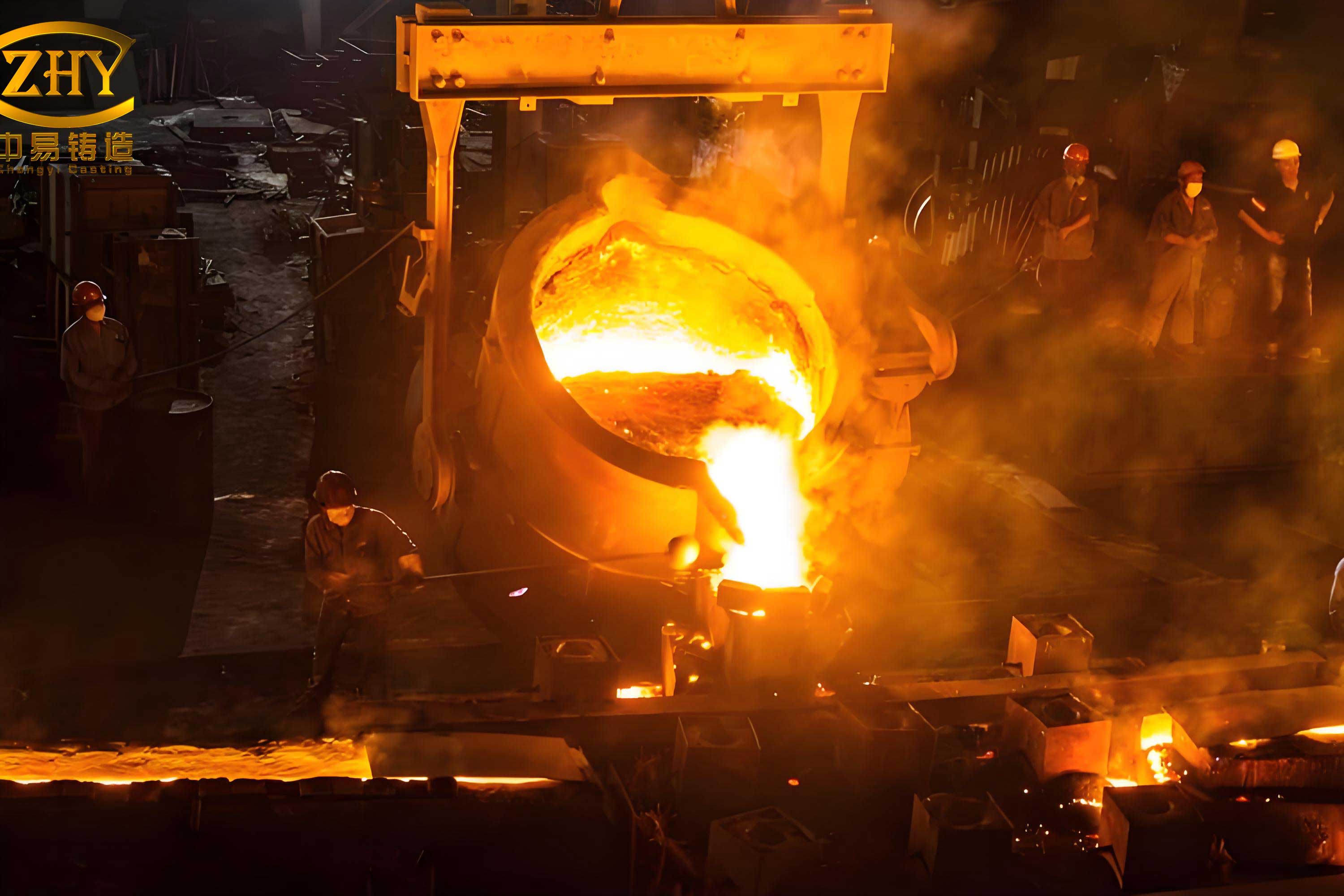
Pouring is conducted with the flask tilted at 40° near the sprue end to promote directional solidification and slag trapping. The molten iron is melted in a 500 kg induction furnace, superheated to 1400–1420°C, and treated with RE-B modifier in a ladle before pouring at 1360°C. After casting, the mold is opened within 2 minutes, and the casting is removed, desanded, and placed upright on a rack for air cooling. A stress-relief anneal at low temperature follows to minimize residual stresses, which is critical for bimetallic sand castings to prevent warping or cracking.
Performance Evaluation and Testing
To validate the effectiveness of the sand casting process and material adjustments, I conducted comprehensive performance tests on the produced squeezing axles. The screws were machined using a profile grinder, and hardness was measured directly on the finished screw tops. Wear resistance was assessed using an MLS-23 rubber wheel abrasion tester under two conditions: dry quartz sand (40/70 mesh) and wet quartz sand, with a load of 14.7 N. The wear loss \( \Delta W \) was recorded, and the abrasion resistance \( \epsilon \) was calculated relative to a metal mold casting baseline (\( \Delta W_0 \)), where \( \epsilon = \Delta W_i / \Delta W_0 \). Lower \( \epsilon \) values indicate better wear resistance. Service life was evaluated through field trials in oil presses processing raw soybeans.
The results are summarized in the table below, comparing metal mold and sand-cast axles:
| Property | Metal Mold Casting | Sand Casting (Water Glass) |
|---|---|---|
| Hardness (HRC) | 49.8–52.1 | 49.0–53.2 |
| Abrasion Resistance \( \epsilon_{\text{dry}} \) | 1.00 (reference) | 0.96 |
| Abrasion Resistance \( \epsilon_{\text{wet}} \) | 1.00 (reference) | 0.85 |
| Service Life (hours) | 3000–3100 | ≥3200 |
The data shows that sand castings achieve comparable or superior performance. The hardness range is slightly broader but includes higher maxima, attributed to the Cr addition and modification. In dry abrasion, sand castings perform similarly (ε=0.96), while in wet conditions, they excel (ε=0.85), likely due to improved microstructure and carbide distribution. The extended service life (≥3200 hours) underscores the practicality of sand castings for this application. Microstructural analysis reveals that the RE-B modification in sand castings refines carbides and reduces graphite nodules, enhancing toughness and wear resistance. The wear mechanism can be modeled using the Archard equation:
$$ V = K \cdot \frac{W \cdot L}{H} $$
where \( V \) is wear volume, \( K \) is a wear coefficient, \( W \) is load, \( L \) is sliding distance, and \( H \) is hardness. By increasing \( H \) through composition adjustments, wear volume decreases, explaining the improved performance in sand castings.
Cost Analysis and Economic Benefits
Transitioning to water glass sand casting involves both cost additions and savings. I performed a detailed cost breakdown to evaluate the economic viability. The increased expenses stem from materials (e.g., finer sand, binders, alloying elements), additional cleaning labor, and machining time due to the different surface finish of sand castings. However, these are offset by significant reductions in other areas, such as eliminating metal mold fabrication and maintenance, lowering scrap rates, and improving yield.
The table below quantifies the cost differences per axle unit:
| Cost Factor | Metal Mold Casting (Currency Units) | Sand Casting (Currency Units) |
|---|---|---|
| Mold Manufacturing/Maintenance | 15.0 | 0.0 |
| Material (Iron, Sand, Binders) | 10.0 | 12.5 (+2.5) |
| Labor (Molding, Cleaning, Machining) | 8.0 | 10.0 (+2.0) |
| Scrap Losses (Based on Yield) | 7.0 (33% scrap rate) | 2.0 (5% scrap rate) |
| Process Yield (Casting Recovery) | 67% | 78% |
| Total Cost per Axle | 40.0 | 36.0 |
The overall cost reduction is approximately 10%, making sand castings economically attractive. Moreover, the longer service life of sand-cast axles provides additional value to end-users, potentially increasing market demand. The yield improvement from 67% to 78% is particularly notable, as it reduces material waste and energy consumption per unit, aligning with sustainable manufacturing practices for sand castings.
Conclusions and Future Perspectives
Through this detailed exploration, I have demonstrated that silicate-bonded sand casting is a viable and advantageous method for producing twin metals composite squeezing axles. The process adjustments—including compositional tweaks with higher chromium and RE-B modification, precise core design based on mechanical principles, and optimized gating—ensure that sand castings meet or exceed the performance benchmarks set by metal mold counterparts. The key takeaways are: sand castings offer greater flexibility and lower upfront costs, while material enhancements compensate for slower cooling rates, resulting in improved wear resistance and longevity.
Looking ahead, further refinements in sand casting technology could enhance this application. For instance, incorporating advanced simulation software to model thermal stresses during solidification could minimize defects. Additionally, exploring alternative binder systems or sand types might improve surface finish and dimensional accuracy. The success of this project underscores the potential of sand castings in bimetallic components, paving the way for broader adoption in heavy-duty industrial machinery. By continuing to innovate in material science and process engineering, sand castings will remain a cornerstone of cost-effective, high-performance manufacturing.