
In the development of BOG compressors for gas boosting and transportation, a significant challenge arose due to the operational environment at cryogenic temperatures, specifically -162°C. Traditional compressor cylinders in our facility were designed for temperatures ranging from 0 to 300°C, utilizing materials such as gray iron and conventional spheroidal graphite cast iron. These materials proved inadequate for the stringent demands of low-temperature applications. Consequently, a comprehensive material selection process was initiated, focusing on thermal expansion coefficients as a critical factor. After extensive evaluation, we identified austenitic spheroidal graphite cast iron, specifically grade QTANi35Cr3, as the optimal material for manufacturing BOG compressor cylinders. This article delves into the intricate manufacturing process, from material preparation to casting validation, emphasizing the key technologies involved in producing high-integrity spheroidal graphite cast iron components for low-temperature service.
The selection of QTANi35Cr3 was driven by its exceptional properties, including high nickel content for austenite stability and low thermal expansion. Austenitic spheroidal graphite cast iron is renowned for its combination of ductility, corrosion resistance, and thermal stability, making it suitable for extreme environments. However, its manufacturing necessitates precise control over chemical composition, melting, spheroidization, and casting processes to achieve the desired microstructure and mechanical performance. The following sections outline our approach to mastering these aspects, with a focus on ensuring the consistent formation of spheroidal graphite within the austenitic matrix.
| Element | Standard Range (wt%) | Optimized Control Range (wt%) | Rationale for Optimization |
|---|---|---|---|
| Carbon (C) | ≤2.4 | 2.1–2.2 | Balances graphite formation and casting properties for medium-section castings. |
| Silicon (Si) | 1.5–3.0 | 1.6–1.8 | Minimized to reduce carbide formation while maintaining fluidity. |
| Manganese (Mn) | 1.5–2.5 | 1.5–1.7 | Kept at lower limit to avoid segregation and hardening phases. |
| Nickel (Ni) | 34.0–36.0 | 34.0–34.5 | Controlled at lower bound for cost-effectiveness while ensuring austenite stability. |
| Chromium (Cr) | 2.0–3.0 | 2.0–2.1 | Minimized to reduce shrinkage porosity tendencies. |
| Phosphorus (P) | ≤0.05 | <0.05 | Strictly limited to prevent grain boundary embrittlement. |
| Sulfur (S) | ≤0.03 | <0.03 | Low levels essential for effective spheroidization. |
The carbon equivalent (CE) is a crucial parameter in spheroidal graphite cast iron, influencing solidification behavior and shrinkage characteristics. For high-nickel alloys, the CE calculation incorporates nickel’s effect, as derived from empirical studies. The formula used is:
$$CE = w(C) + 0.3 \times w(Si) + 0.047 \times w(Ni) – (0.0055 \times w(Ni) \times w(Si))$$
where \(w(X)\) denotes the weight percentage of element X. To facilitate feeding and minimize shrinkage defects, we targeted a CE range of 4.1% to 4.4%. This adjustment accounts for the high nickel content, which alters the eutectic point compared to conventional spheroidal graphite cast iron. The optimization of CE ensures a balance between graphitization potential and volumetric stability during solidification.
Melting of QTANi35Cr3 was conducted using a coreless medium-frequency induction furnace. Charge materials consisted of low-sulfur pig iron, rust-free scrap steel, electrolytic nickel, high-carbon ferrochromium, ferrosilicon, high-carbon ferromanganese, and returns. Special attention was paid to trace elements; for instance, lead (Pb) content above 0.003% can lead to vermicular graphite formation, severely degrading mechanical properties. Aluminum (Al) must be avoided to prevent pinhole porosity. The melting sequence was critical: nickel, having high gas solubility, was added late in the melt under a protective cover to minimize hydrogen and nitrogen pickup. Alloying elements like chromium were introduced after spectroscopic analysis of the base iron for precise composition adjustment. The superheat temperature was maintained at approximately 1,530°C to compensate for the higher liquidus temperature of austenitic spheroidal graphite cast iron, ensuring adequate fluidity for pouring.
Spheroidization treatment is paramount in producing high-quality spheroidal graphite cast iron. The graphite morphology directly impacts ductility and low-temperature toughness. We evaluated two nickel-magnesium spheroidizing alloys: Ni70Mg30 and Ni85Mg15. The former resulted in suboptimal spheroidization, with a graphite nodule count of only 82% and reduced elongation, while the latter achieved 94% spheroidization, meeting the standard requirement of over 90% Type I and II graphite. The reaction kinetics of Ni85Mg15 are more controlled, reducing magnesium fade and ensuring consistent nodularity. The process followed a sandwich method: spheroidizer (1 wt% of Fe) placed in the ladle well, covered with inoculant (1 wt% of Fe). Two-thirds of the iron was tapped at 1,530°C onto the opposite side, allowing reaction completion before adding the remainder. Slag was skimmed, and a wedge test confirmed spheroidization before pouring.
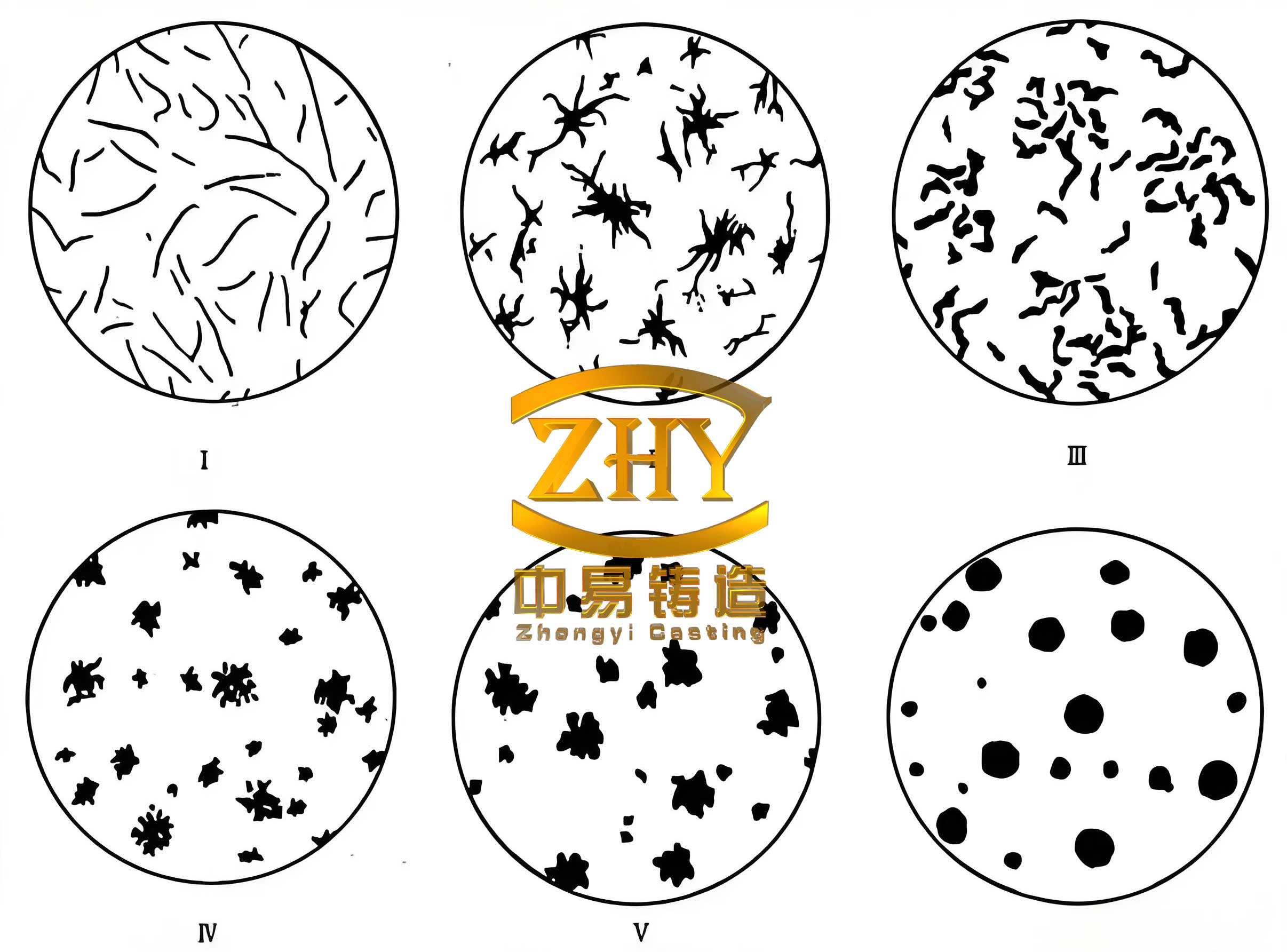
Inoculation was performed in two stages: ladle inoculation during spheroidization and instantaneous inoculation just before pouring. This dual approach enhances graphite nucleation, reduces chilling tendency, and delays spheroidization衰退. The inoculant, typically ferrosilicon-based, was added at 0.2–0.4 wt% during tapping to promote fine, uniformly distributed spheroidal graphite. The effectiveness of inoculation in austenitic spheroidal graphite cast iron is critical due to the alloy’s propensity for carbide formation; proper inoculation ensures a fully austenitic matrix with minimal hard phases.
Pouring parameters were optimized to address the high melting point and reduced fluidity of QTANi35Cr3. The pouring temperature was maintained between 1,520°C and 1,450°C, with rapid mold filling to prevent gas entrapment and oxide formation. The gating system was designed with minimal turbulence, incorporating filters to remove inclusions. The solidification characteristics of austenitic spheroidal graphite cast iron resemble those of steel, with significant shrinkage volumes; thus, feeding requirements are more demanding than for ordinary cast iron.
| Property | Value Range | Standard Requirement |
|---|---|---|
| Tensile Strength (MPa) | 370–450 | ≥370 |
| Yield Strength (MPa) | 220–240 | ≥220 |
| Elongation (%) | 7–10 | ≥7 |
| Hardness (HBW) | 150–180 | 150–200 |
Low-temperature performance was validated through testing at cryogenic conditions. The thermal expansion coefficient, a key factor for dimensional stability, was measured from 103 K to 303 K, showing minimal length change, which aligns with the low expansion behavior of austenitic spheroidal graphite cast iron. Tensile tests at 103 K demonstrated retained ductility and strength, crucial for compressor cylinder integrity under thermal cycling.
| Sample ID | Elongation (%) | Tensile Strength (MPa) | Elastic Modulus (GPa) |
|---|---|---|---|
| 1 | 7.2 | 372 | 145 |
| 2 | 7.3 | 373 | 149 |
| Sample ID | Length Change ΔL/L(303K) (%) |
|---|---|
| 1 | 0.0909 |
| 2 | 0.1150 |
The casting process for the compressor cylinder was meticulously designed, considering the shrinkage tendencies of high-nickel spheroidal graphite cast iron. The cylinder, with a design weight of 1,930 kg, required generous feeding due to its volumetric contraction, which approaches that of carbon steel. A top riser system was employed, accounting for approximately 30% of the casting weight (580 kg), resulting in a total poured weight of 2,500 kg. The geometry was optimized for uniform wall thickness to minimize thermal gradients and stress concentrations. ProCAST simulation software was utilized to validate the casting process, analyzing filling patterns, temperature fields, and defect prediction. The simulation confirmed adequate feeding and absence of major shrinkage porosity, as illustrated in the defect prediction maps. The filling analysis showed smooth metal flow without cold shuts or misruns, essential for achieving sound spheroidal graphite cast iron components.
One of the critical insights from this study is the importance of avoiding rare earth elements in spheroidizing treatments for austenitic spheroidal graphite cast iron. Cerium (Ce), commonly found in rare earth spheroidizers, can promote undesirable graphite forms and reduce ductility. Hence, nickel-magnesium alloys like Ni85Mg15 are preferred. Additionally, the high gas solubility of nickel necessitates strict process controls: dry charge materials, protective atmospheres during melting, and fast pouring to minimize hydrogen and oxygen pickup. The casting design must incorporate robust risering and chilling where necessary to direct solidification and prevent microporosity.
In summary, the successful manufacture of low-temperature austenitic spheroidal graphite cast iron compressor cylinders hinges on a holistic approach encompassing material science, metallurgy, and casting engineering. Key takeaways include: precise chemical composition control with emphasis on carbon equivalent; careful melting and alloy addition sequences to avoid trace contaminants; effective spheroidization using nickel-magnesium agents; dual inoculation for graphite refinement; and casting practices akin to steel foundry methods to accommodate shrinkage. The resulting spheroidal graphite cast iron exhibits excellent mechanical properties at cryogenic temperatures, validating the process optimizations. Future work could explore alternative inoculants or process simulations for larger castings, but the current methodology provides a reliable framework for producing high-performance spheroidal graphite cast iron components for extreme environments.
The development of this manufacturing process has broad implications for industries requiring durable materials under thermal stress, such as cryogenics, power generation, and chemical processing. Austenitic spheroidal graphite cast iron, with its unique combination of properties, offers a cost-effective alternative to high-alloy steels in many applications. By mastering the intricacies of its production, we can expand the horizons for spheroidal graphite cast iron in advanced engineering contexts.