
The application of lost foam casting for producing large steel castings has historically been limited. While concerns regarding carbon defects from the decomposing foam pattern are valid, a more immediate and catastrophic challenge has been the formidable impact force of molten metal from bottom-pouring ladles. This powerful stream can easily compromise the refractory coating on the foam pattern, leading to sand incursion into the cavity or, in severe cases, complete mold collapse. To mitigate this, the conventional approach has been to employ pre-formed ceramic tubes as the main runners. While effective, this method introduces significant material costs and complicates the molding process, making it cumbersome for shop-floor operations. My extensive experience has led to the development and successful implementation of an integrated, multi-stage buffer gating system fabricated from the foam pattern itself. This system elegantly solves the impact force dilemma, simplifies the entire casting process, reduces cost, and has proven its reliability in producing sound, heavy-section steel castings.
The core philosophy of this approach is to manage the kinetic energy of the metal stream through controlled deceleration and intelligent thermal distribution. A bottom-pouring ladle delivers metal with a high velocity head. In a traditional lost foam setup with a simple sprue, this energy is directly transferred to the first point of impact inside the mold, threatening the coating’s integrity. The multi-stage buffer system transforms this potentially destructive linear momentum into a more manageable, distributed flow.
The Hydraulic and Thermal Principles of Buffer Systems
The design is governed by fundamental fluid mechanics and heat transfer principles. The primary goal is to dissipate the dynamic pressure of the incoming stream before it contacts the main cavity. The dynamic pressure \( P_{dyn} \) of a fluid stream is given by:
$$ P_{dyn} = \frac{1}{2} \rho v^2 $$
where \( \rho \) is the density of molten steel (approximately 7000 kg/m³) and \( v \) is the flow velocity. A bottom pour ladle can sustain a relatively constant head pressure, leading to a high initial \( v \) at the sprue entrance. Our buffer system introduces multiple directional changes and expansion chambers. Each 90-degree bend induces a head loss due to turbulence and friction. The energy loss in a bend can be conceptually represented as a loss coefficient \( K_{bend} \), modifying the velocity head:
$$ \Delta P_{loss} = K_{bend} \cdot \frac{1}{2} \rho v_{in}^2 $$
By cascading these losses through several stages, the effective velocity \( v_{eff} \) reaching the casting in-gates is dramatically reduced. Furthermore, the system is designed to act as a thermal regulator. The sequential filling of the buffer chambers creates a temperature gradient, ensuring that the hottest metal is delivered to the top sections of the mold cavity last, promoting directional solidification from the bottom-up.
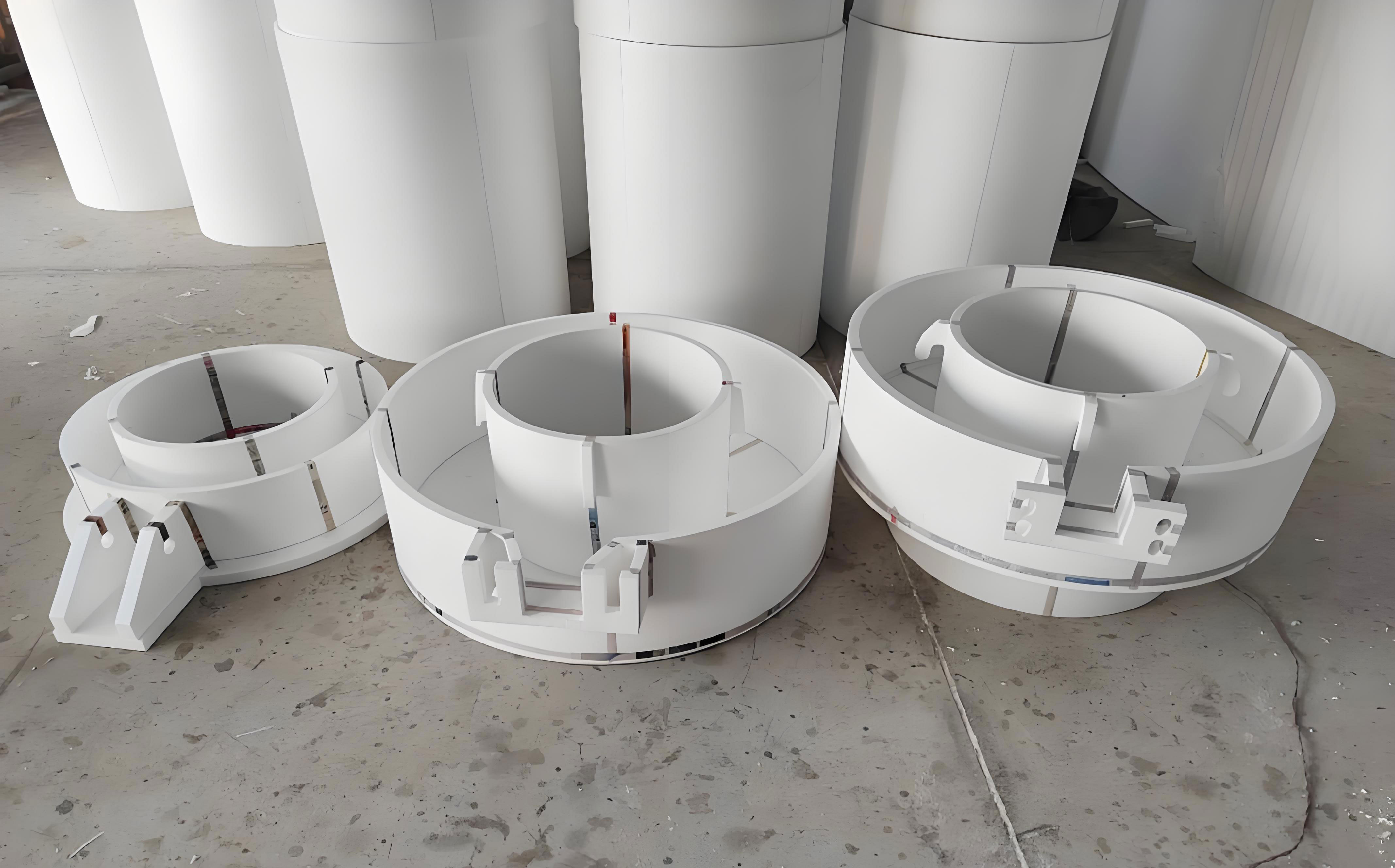
Case Analysis: Front Wall of a 125 Crusher
This methodology was applied to produce a substantial crusher front wall. The component, measuring 2344 mm x 750 mm x 1530 mm with a finished weight of 6322 kg in ZG35 steel, features a complex grid-like structure with varying wall thicknesses from 40mm to 150mm. The casting required full non-destructive testing with zero tolerance for carbon defects or shrinkage.
1. Pattern Assembly and Gating Design
The polystyrene foam pattern (density 18 g/L) was manually cut and assembled. A cardinal rule in lost foam casting for heavy sections is “orient vertically if possible.” The pattern was positioned on its side to minimize the horizontal projection area and facilitate sand filling. The integrated gating system was then attached. The design featured three distinct horizontal levels connected by vertical risers, creating a serpentine path.
The key design parameters for this specific casting are summarized below:
| System Component | Function | Key Design Feature |
|---|---|---|
| Sprue / First Stage Chamber | Initial impact absorption and flow distribution. | Large cross-sectional area to reduce initial velocity. |
| First Vertical Riser | Lifts metal to second stage; introduces first major directional change. | Height calculated to provide sufficient head for next stage. |
| Second Stage Runner | Secondary calming and thermal mass. | Acts as a holding basin before metal is tapped into the cavity. |
| Second Vertical Riser & Third Stage | Final velocity control and heat positioning. | Directs the now-calm metal to the upper, hotter zones of the casting. |
| Multiple In-gates (4 Nos.) | Controlled entry into the cavity. | Evenly distributed to balance flow and thermal input across the casting bottom. |
| Open Top Risers | Feeding, pressure equalization, and carbon evacuation. |
2. Coating and Molding Process
For a pattern of this size, dipping is impractical. The coating process was split into two logical steps. First, the downward-facing surfaces (which would be placed directly on the molding sand) were coated and reinforced. Blind holes in the pattern were backed with resin-bonded sand cores containing steel reinforcements. Only after this foundational layer was set was the entire pattern coated via spraying. This sequential approach prevented damage to the fragile foam during handling.
The coated pattern was carefully lowered into the flask using wide cloth slings to avoid coating cracks. Sand was then added and compacted in layers, ensuring no voids remained around the complex geometry. A critical preparatory step before pouring is the treatment of the top sand layer. To guard against potential splash-through from the initial ladle stream, this layer is lightly misted with water. Any escaping droplets of metal will rapidly solidify on the damp sand, sealing the breach and preventing a catastrophic loss of vacuum.
3. Pouring and Solidification
The pour was conducted using a bottom-pouring ladle at a temperature of 1630°C. Vacuum pressure was set at 0.08 MPa static but was expected to drop to around 0.04 MPa during the pour due to the massive volume of gas generated. The multi-stage buffer system performed flawlessly. The metal filled the system calmly, with no observable turbulence or sand breakthrough at the in-gates. The open-top risers allowed pyrolysis gases (including free carbon) to escape freely, a critical factor in preventing carbon defects in steel lost foam casting—a technique often termed the “carbon evacuation method.” The risers, placed on the thickest sections, remained full and piping hot until the end of the pour, confirming effective feeding.
The casting was left in the mold for over 12 hours to cool slowly. Upon shakeout, the coating had self-peeled excellently, and the casting surface was clean without any signs of burn-on or metal penetration. The entire gating system was intact, demonstrating the robustness of the foam-based design against erosion. The yield was remarkably high: from a casting weight of 6322 kg, the final part weighed 5650 kg, resulting in an impressive metal yield of 89.2%.
In-Depth Discussion: The Mechanism of Success
The success of this lost foam casting project hinges on several interlinked principles that go beyond simple geometry.
Sequential Flow and Thermal Staging
The design intentionally creates a temporal and thermal sequence. As pouring begins, metal fills the first buffer chamber and rises up the first riser. It does not immediately enter the casting because the first-level in-gates are located at the top of this riser. Only when the metal level reaches the height of the second-stage runner does flow begin into the cavity through the bottom in-gates. By this time, the metal has undergone two directional changes, shedding most of its destructive kinetic energy.
Mathematically, we can think of the system’s total pressure loss \( \sum \Delta P_{total} \) as the sum of losses from bends, friction, and area changes:
$$ \sum \Delta P_{total} = \left( \sum K_{bend} + f \frac{L}{D} + K_{contraction} + K_{expansion} \right) \cdot \frac{1}{2} \rho v_{sprue}^2 $$
This cumulative loss ensures \( P_{dyn@gate} \ll P_{dyn@sprue} \).
Thermally, the first metal to enter the cavity (through the bottom gates) begins to cool. Subsequently, hotter metal from the upper stages enters through higher gates, maintaining a positive temperature gradient from the casting bottom to the top risers. This is essential for sound feeding in lost foam casting, where chills are not used.
The Role of Open Risers in Steel Lost Foam Casting
Using open risers is a decisive advantage for steel in the lost foam process. They serve a triple purpose:
- Atmospheric Pressure Feeding: They are exposed to atmospheric pressure, significantly improving feeding efficiency over blind, foam-filled risers.
- Carbon Evacuation Pathway: They provide a direct, low-resistance escape route for the large volume of gaseous pyrolysis products, including carbon soot, effectively mitigating the risk of carbonaceous defects.
- Heat Sink: They act as a proven hot spot, ensuring the thermal center of the casting is in the riser, not within the casting wall.
Generalized Design Guidelines and Process Parameters
Based on this and similar applications, key parameters for designing a multi-stage buffer system for large steel lost foam casting can be outlined.
| Parameter | Recommended Range / Value | Rationale |
|---|---|---|
| Foam Density | 18-22 g/L (Fully aged/dry) | Minimizes liquid pyrolysis products, reduces gas volume. |
| Pouring Temperature | Liquidus + 70-100°C (e.g., ~1630°C for ZG35) | Compensates for heat loss in the buffer system and foam decomposition endotherm. |
| Static Vacuum Pressure | 0.07 – 0.09 MPa | Provides sufficient force to hold the mold shape against ferrostatic pressure. |
| Dynamic Vacuum (during pour) | > 0.03 MPa (Must be maintained) | Critical to evacuate gases rapidly and prevent back-pressure or cavity collapse. |
| Buffer Stages | Minimum 2, ideally 3 for >5T castings | Adequately decelerates the metal stream from a bottom-pour ladle. |
| Gating Ratio (Sprue:Runner:Gates) | 1 : 2.5 : 3 (Pressurized) or 1 : 3 : 4 (Unpressurized) | Ensures complete filling of the buffer system before cavitation, promoting non-turbulent transfer. |
| Cooling Time in Mold | > 12 hours for 5-10T sections | Prevents cracking due to residual stresses and allows complete transformation. |
Conclusion: Advantages and Future Potential
The adoption of an integrated, multi-stage foam buffer gating system represents a significant advancement for the lost foam casting of large steel components. It directly addresses the primary technical barrier—ladle stream impact—with an elegant, low-cost solution embedded within the pattern-making process itself. The advantages are manifold:
- Cost Reduction: Elimination of expensive ceramic tubes.
- Process Simplification: Streamlined molding operation, reducing labor and potential errors.
- Improved Reliability: Controlled, calm filling drastically reduces the risk of sand incursion and mold failure.
- Enhanced Quality: Promotes favorable thermal gradients and facilitates carbon evacuation, leading to sound, defect-free castings.
- High Yield: Efficient feeding via open risers coupled with a compact gating layout maximizes metal yield.
This case study demonstrates that with correct design principles centered on fluid energy management and thermal control, lost foam casting is not only viable but highly competitive for producing heavyweight, high-integrity steel castings. The technique transforms a perceived weakness of the process—the fragile mold medium—into a manageable variable through intelligent engineering of the flow path. It opens the door for wider industrial adoption of lost foam casting in sectors requiring large, complex steel components, paving the way for more economical and efficient manufacturing routes.