
In the realm of metal casting, achieving high dimensional accuracy and superior surface finish in complex components remains a paramount challenge. Through my extensive experience in foundry operations, I have come to rely on the transformative capabilities of resin sand casting. This process is not merely an alternative to traditional green sand methods; it represents a fundamental shift towards precision, repeatability, and control. The following account synthesizes key insights from the production of demanding aluminum alloys and intricate iron castings, demonstrating how meticulous control over every parameter—from melt chemistry to mold engineering—is crucial. This comprehensive guide will delve into the scientific and practical aspects, utilizing formulas and structured data to elucidate the path to casting excellence.
The foundation of any quality casting lies in the integrity of the molten metal. For high-performance aluminum-silicon alloys, such as those analogous to ZL102, the control of composition, temperature, and inclusion content is non-negotiable. The target composition must account for inevitable melt losses. This can be expressed by the fundamental relationship:
$$C_{melt} = \frac{C_{target}}{1 – L}$$
where \(C_{melt}\) is the charge composition, \(C_{target}\) is the desired final composition, and \(L\) is the fractional loss of the specific element during melting. Precise temperature control is equally critical; exceeding recommended ranges leads to excessive gas pickup and oxidation, while insufficient temperatures impede fluidity and feeding. The practice of melt refinement, often using hexachloroethane (C₂Cl₆), is a delicate operation. The reaction for degassing can be simplified as:
$$3C_2Cl_6 + 2Al \rightarrow 3C_2Cl_4 + 2AlCl_3 \uparrow$$
The rising AlCl₃ bubbles scavenge dissolved hydrogen and entrap oxides. The optimal addition range and processing time must be strictly adhered to, as summarized below:
| Process Parameter | Optimum Range | Consequence of Deviation |
|---|---|---|
| Refiner Addition (C₂Cl₆) | 0.3% – 0.5% of melt weight | Too low: Ineffective degassing. Too high: Increased alloy loss, severe fume generation. |
| Refinement Time | 10 – 15 minutes | Insufficient time: Incomplete reaction. Excessive time: Excessive temperature drop. |
| Holding Time Post-Modification | Sand Casting: ≤ 30 min; Permanent Mold: ≤ 60 min | Exceeding time leads to “fade” of modification effect, requiring re-treatment. |
Following refinement, modification of the eutectic silicon structure is essential to transform coarse, plate-like silicon into a fine, fibrous form. This is typically achieved with strontium (Sr) or sodium (Na) based modifiers. The efficacy of modification is often assessed qualitatively by fracture examination of a test coupon, but the underlying mechanism involves impurity-induced twinning in the silicon crystals.
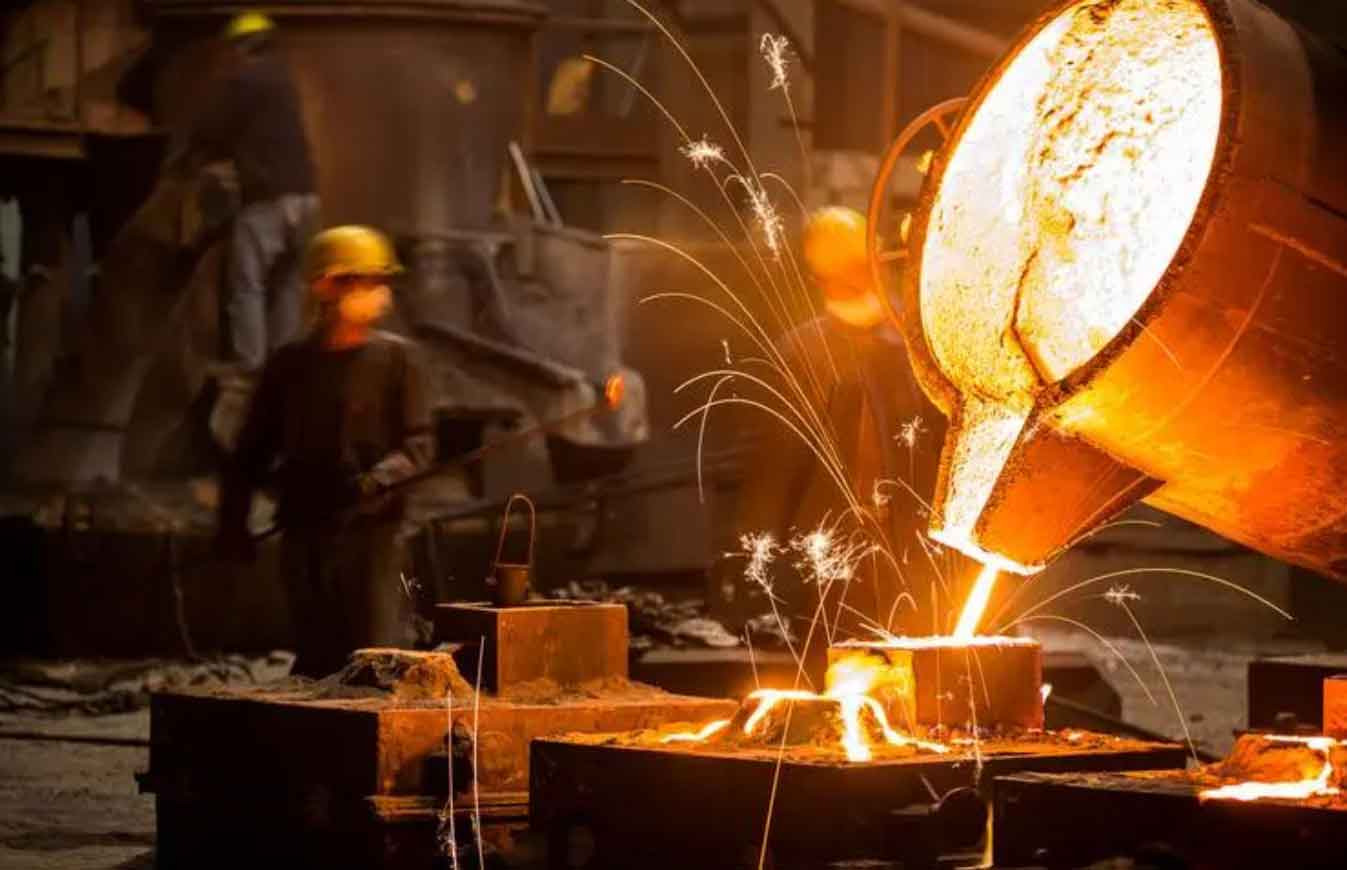
The principles of rigorous melt control find their ultimate test and expression in the production of geometrically complex castings. A quintessential example is the manufacture of “plum blossom hole” stove gratings for industrial blast furnace systems. These components are not simple plates; they are intricate networks of precisely arranged triangular and circular passages. The specifications are unforgiving: positional tolerances for hundreds of features within ±1 mm, surface finish requirements demanding clean, sand-free apertures, and material properties dictating a high-strength pearlitic gray iron. This is where the superiority of resin sand casting becomes indisputable.
The transition from conventional clay-bonded sand to resin sand casting for such parts is driven by fundamental advantages. The cured resin sand mold possesses high strength, allowing for near-perfect pattern reproduction and minimal mold wall movement. This directly translates to dimensional accuracy. The excellent flowability of the sand mix before curing enables it to fill complex core boxes, producing intricate cores with sharp definition. Furthermore, the thermal stability and collapsibility of resin sand after casting reduce the risk of hot tearing and facilitate cleaning. A comparative analysis highlights these points:
| Aspect | Traditional Green Sand Casting | Resin Sand Casting |
|---|---|---|
| Dimensional Accuracy | Lower; subject to mold deformation during handling and pouring. | High; rigid mold maintains shape, yielding castings with tolerances of ±0.5 mm or better. |
| Surface Finish | Relatively rough, prone to sand burning/penetration. | Excellent; fine, dense mold surface yields castings with low roughness (Ra 6.3-12.5 μm achievable). |
| Pattern/Core Complexity | Limited by need for draft and manual finishing. | Exceptional; allows for deep draws, undercuts, and complex, thin-walled cores. |
| Process Control | Highly dependent on molder skill (ramming, venting). | More repeatable; determined by mix ratios, curing time, and tooling precision. |
For the stove grating, the resin sand casting process was meticulously engineered. The pattern equipment was crafted from stable materials like wood or plastic to prevent warping. The core boxes for the myriad “plum blossom” and circular passages were precision-machined from plastic or metal to ensure core dimensional fidelity. A critical decision was the design of the core prints. Given the slenderness ratio (length/diameter) of the passage cores, stability was paramount. We adopted a dual-print system: a robust lower print for primary location and a matching upper print to prevent flotation and ensure vertical alignment. The interference or “crush” between core and mold was minimized to a precise clearance, often calculated as a function of core size:
$$Clearance = k \cdot \sqrt[3]{V_{core}}$$
where \(k\) is an empirical constant (typically 0.05-0.1 for resin sand) and \(V_{core}\) is the core volume. For our application, a uniform clearance of 0.5 mm was specified.
The feeding and gating system design in resin sand casting must account for the higher gas generation of the organic binder. A pressurized, bottom-gating system was employed to ensure a rapid, tranquil fill and maintain a metallostatic head to drive feeding. The cross-sectional area ratios were carefully balanced:
$$\Sigma A_{sprue} : \Sigma A_{runner} : \Sigma A_{gate} = 1.0 : 1.25 : 1.0$$
Ceramic inserts were used at the gate inlets to withstand the initial thermal shock and erosion, preventing sand wash-in and improving the quality of the metal entering the cavity.
The backbone of the process is the sand mixture itself. A typical formulation for a furan resin system is given below. Consistency in mixing is vital; deviations directly affect bench life, strip time, and final strength.
| Component | Specification | Function |
|---|---|---|
| Silica Sand | AFS 50-70, rounded grain, low fines content | Refractory base aggregate; round grains improve flowability and packing density. |
| Furan Resin | 0.9 – 1.2% of sand weight | Binder; provides cross-linking and strength upon acid catalysis. |
| Catalyst (Acid) | 30 – 50% of resin weight (concentration varies with temperature/humidity) | Initiates and controls the curing reaction rate. |
The selection of coating is a final, critical step for surface quality. A two-layer approach was used: a penetrating zircon-based alcohol coating applied by brushing to seal the surface, followed by a sprayed graphite-based coating to provide a superior parting layer against the molten iron. The coating thickness \(t_c\) is controlled to avoid flaking or causing dimensional shifts:
$$t_c \approx 0.05 \cdot d_{feature}$$
where \(d_{feature}\) is a characteristic dimension like minimum wall thickness, typically keeping total coating under 1.0 mm.
Returning to metallurgy, the iron for the gratings was a alloyed gray iron, targeting a pearlitic matrix with type A graphite. The composition was engineered for strength and thermal stability. The melt was treated with a late inoculant (FeSi) to promote graphite nucleation. The combined effect of alloying elements on the tensile strength can be approximated using regression formulas, such as:
$$TS (MPa) \approx 100 + 11.5 \cdot \%Si – 2.9 \cdot \%Si^2 + 28 \cdot \%Cu + 40 \cdot \%Mo + 45 \cdot \%Cr$$
(Note: Coefficients are illustrative; actual values depend on base composition and processing). Process control ensured the final properties met the specification: tensile strength > 300 MPa and hardness within 190-240 HB.
It is also insightful to consider complementary forming technologies for precision parts. For high-volume, near-net-shape components like automotive wheel hubs, a hybrid approach can be optimal. Here, a billet is first forged in the “warm” or “sub-hot” regime (e.g., 700-900°C). This temperature is a compromise: high enough to significantly lower flow stress compared to cold forging, enabling complex shapes to be formed with lower tonnage presses, yet low enough to minimize scale and decarburization, preserving surface quality and dimensional precision. The final geometry and critical tolerances are then achieved through a cold coining or calibration operation. The total true strain \(\epsilon_{total}\) in such a process is the sum of the forging and coining strains:
$$\epsilon_{total} = \epsilon_{forge} + \epsilon_{coin} = \ln\left(\frac{h_0}{h_f}\right)_{forge} + \ln\left(\frac{h_f}{h_c}\right)_{coin}$$
This hybrid method leverages the formability of warm working and the precision of cold working, often resulting in a more cost-effective and higher-quality solution than either process alone or full hot forging. While distinct from resin sand casting, this example underscores the same philosophical imperative: selecting and fine-tuning the process chain to meet exacting geometric and performance demands.
In conclusion, mastering high-precision casting is an exercise in systemic control. Resin sand casting emerges as a pivotal technology, providing the dimensional stability and reproducibility needed for intricate designs. Its success, however, is wholly dependent on a deep understanding of its characteristics: the precise formulation and handling of the sand-binder system; the design of robust, precise tooling with minimal core clearances; gating that manages both metal flow and gas evolution; and the application of specialized coatings. When this foundry discipline is coupled with equally rigorous metallurgical control—precise alloying, refinement, and treatment—the result is the consistent production of cast components that meet the most stringent standards of modern industry. The journey from molten metal to finished part is a chain of interdependent decisions, each link fortified by scientific principle and empirical validation.