
In my extensive experience within the foundry industry, the production of large-scale engineering components presents a unique set of challenges, particularly when dealing with materials like nodular cast iron. The V-process, or vacuum sealed molding process, has emerged as a revolutionary method for creating high-integrity castings. This article delves deep into the application of V-process technology for manufacturing a massive nodular cast iron loader backseat, sharing insights from a first-person perspective on overcoming significant technical hurdles related to mold wall movement, shrinkage, and dimensional stability. The repeated focus on nodular cast iron is intentional, as its unique graphite morphology and mechanical properties are central to this discussion.
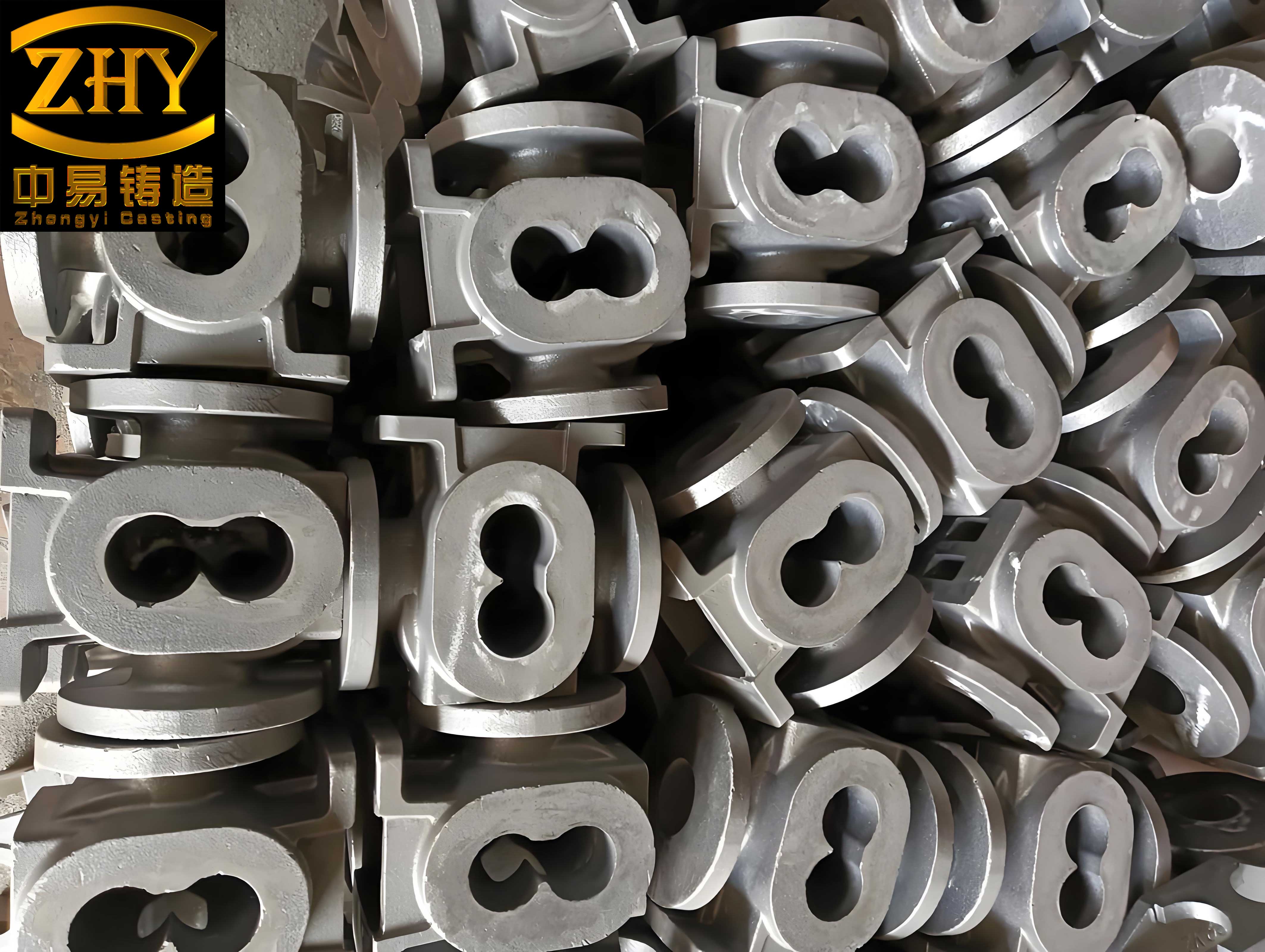
The fundamental appeal of nodular cast iron, especially grades like QT400-18, lies in its excellent combination of ductility, strength, and castability. However, when cast in thick sections exceeding 200 mm, the pronounced graphite expansion during solidification can lead to severe defects if not meticulously controlled. The V-process, which utilizes a vacuum to consolidate dry, unbonded sand against a plastic film, offers superior surface finish and dimensional accuracy. Yet, its lower and more variable mold stiffness compared to traditional green sand can exacerbate the challenges inherent in large nodular cast iron castings. My team’s journey in producing a 5,906 kg loader backseat was a testament to innovative engineering in this domain.
The component in question was a substantial U-shaped structure with an average wall thickness of 120 mm and critical functional requirements as a counterweight. The primary technical specifications demanded a fully ferritic matrix, a球化等级 of grade 3, and tensile properties exceeding 400 MPa in strength and 18% elongation. Achieving this in a nodular cast iron casting of this size via the V-process required a holistic re-engineering of everything from tooling design to metallurgical control.
| Parameter | Value / Range | Remarks |
|---|---|---|
| Final Casting Mass | 5,906 kg | Post-fettling weight |
| Overall Dimensions (LxWxH) | 3,195.6 mm x 1,352.55 mm x 993.78 mm | Critical for assembly |
| Material Grade | QT400-18 (ASTM A536) | Nodular cast iron with 18% min elongation |
| Target Base Metal Chemistry (C, Si, Mn, P, S) | 3.6-3.7%, 1.5-1.6%, 0.2-0.3%, <0.04%, <0.03% | Pre-treatment composition |
| Target Post-Treatment Chemistry (Si, Mg, RE) | ~2.8%, ~0.04%, ~0.03% | After spheroidization and inoculation |
| Required Hardness | 149 – 187 HB | Ensures machinability and wear resistance |
The initial technical analysis pinpointed three core challenges. First, the physical size exceeded standard V-process line capacities, necessitating custom tooling. Second, and most critically, the transient vacuum and inherent lower mold rigidity could lead to unpredictable型壁移动 (mold wall movement) during the graphite expansion phase of nodular cast iron solidification. This risked creating shrinkage porosity, cavities, and unacceptable weight deviation. The phenomenon can be conceptually modeled by considering the pressure balance. The internal pressure from graphite expansion ($P_{exp}$) must be countered by the mold’s resistance, which is a function of vacuum pressure ($P_{vac}$) and sand compaction.
$$ P_{exp} \approx \alpha_{gr} \cdot \Delta V_{gr} $$
$$ P_{mold} = f(P_{vac}, \rho_{sand}, t) $$
For a sound casting, we require: $P_{mold} \geq P_{exp}$ throughout solidification.
Where $\alpha_{gr}$ is a material constant related to graphite expansion in nodular cast iron, and $\Delta V_{gr}$ is the volumetric change due to graphite precipitation. The third challenge was thermal management—preventing distortion in the U-shaped geometry and ensuring adequate feeding to eliminate shrinkage in the heavy sections.
Our铸造工艺设计 was built on several pillars. The cornerstone was a custom-designed vacuum flask. To combat型壁移动, we engineered a flask with an exceptionally dense network of hollow reinforcing ribs. These ribs were internally connected to the side vacuum chambers and fitted with filtration screens, creating a distributed vacuum system that minimized pressure gradients and locally enhanced stiffness. The rib height was contoured to follow the pattern shape with a 150-200 mm sand cover, ensuring uniform compaction and vacuum effectiveness. This was a decisive step in stabilizing the mold for nodular cast iron solidification.
The gating and feeding system was designed for rapid, tranquil filling and effective feeding. We opted for a semi-choked system to reduce turbulence and slag entrainment. The gating ratio was carefully calculated based on hydraulic principles to ensure the sprue remained full, minimizing air aspiration. The general relationship for a pressurized system is:
$$ \Sigma A_{choke} : \Sigma A_{runner} : \Sigma A_{ingate} = 1 : 0.8 : 1.5 $$
Where $\Sigma A$ represents the total cross-sectional area for each segment. For such a large volume of nodular cast iron, the pouring time ($t_p$) is critical and was determined using the mass-energy balance:
$$ t_p = \frac{W}{\rho \cdot A_{choke} \cdot \sqrt{2gH}} $$
Here, $W$ is the casting weight (kg), $\rho$ is the density of nodular cast iron (~7100 kg/m³), $A_{choke}$ is the choke area (m²), $g$ is gravity (9.81 m/s²), and $H$ is the effective metallostatic head (m). We targeted a pour time of 270-300 seconds to balance temperature loss and mold filling stability.
Feeding the thick sections was addressed with two large, inverted bottle-shaped明冒口 placed at the heaviest thermal junctions. To compensate for the limited flask height which restricted冒口 height, we incorporated exothermic发热剂 to enhance their efficiency. The necessary冒口 volume for nodular cast iron, which experiences significant graphitic expansion, can be estimated using the modulus method but requires a safety factor. Additionally, nine φ60 mm通气冒口 were strategically placed to facilitate the escape of air and pyrolysis gases from the plastic film. The entire工艺布局 was validated through solidification simulation software prior to pattern manufacture.
| Process Stage | Parameter | Control Value / Method |
|---|---|---|
| Mold Making | Sand Compaction Time | ~150 seconds |
| Minimum Mold Hardness | > 90 (Brinell-type scale) | |
| Operating Vacuum Pressure | > 0.06 MPa (abs) | |
| Melting & Treatment | Base Iron Pouring Temperature | 1,480 – 1,490 °C |
| Spheroidizing Method | Sandwich Technique in 3-ton ladles | |
| Final Pouring Temperature | 1,320 – 1,340 °C | |
| Inoculation | 0.1% Incoude900 via stream inoculation | |
| Feeding Design | Main Riser Type & Size | Inverted Bottle, φ200 mm x 500 mm |
| Exothermic Addition | ~5 kg per main riser at 50% fill |
The pattern was a masterpiece of modern fabrication. Machined from high-density wood using 5-axis CNC technology, it was split for machining and then assembled into a monolithic structure to guarantee dimensional fidelity. Crucially, we incorporated strategic拉筋 (tie-bars) within the U-shaped cavity. These served a dual purpose: they acted as internal supports to resist warping during cooling, and they were cleverly designed to also function as sections of the horizontal runner, optimizing metal flow. This integration of distortion control into the gating geometry was key for this nodular cast iron part.
Metallurgical control for nodular cast iron at this scale was a logistics puzzle. With no standard ladle over 7 tons available for treatment, we devised a sequential process. Using a 12.5-ton induction furnace, we tapped base iron at the elevated temperature of 1,480-1,490°C to account for subsequent heat losses. The treatment was split into three batches in 3-ton ladles using the冲入法 (sandwich method). Each batch received a calculated charge of 3-8 grade spheroidizer (Mg-Fe-Si alloy) and 75SiFe孕育剂, covered with steel punch. The treated iron from each batch was then transferred into a pre-heated 8-ton ladle for final pouring. This sequential treatment and consolidation was vital to manage reaction kinetics and prevent premature衰退 (fade).
The final safeguard against衰退 was vigorous inoculation. Beyond the ladle inoculation, we employed an advanced stream inoculation using Incoude900, which contains potent nuclei for graphite formation. The effectiveness of inoculation in promoting a high nodule count in thick-section nodular cast iron is well-known, as described by the nucleation potential model. The nodule count $N$ can be related to undercooling $\Delta T$ and inoculant potency:
$$ N \propto I_0 \cdot \exp\left(-\frac{\beta}{\Delta T^2}\right) $$
Where $I_0$ is related to the potency and quantity of inoculant particles, and $\beta$ is a constant. Our dual-inoculation strategy maximized $I_0$, ensuring a fine, uniform graphite structure throughout the massive casting section of nodular cast iron.
During pouring, discipline was paramount. The large ladle was tipped to maintain a consistent pouring rate. When the metal level in the two main risers reached approximately half full, workers added the exothermic compounds. This timing ensured the compounds ignited properly, creating a sustained exothermic reaction that kept the riser metal molten longer, dramatically improving feeding efficiency in the final stages of solidification of the nodular cast iron.
The production results were highly satisfactory. The castings exhibited excellent surface finish, free from veining or rough texture common in some other processes. Dimensional inspections confirmed the geometry was within tolerance, with the U-shape showing no significant distortion thanks to the integrated tie-bars. Non-destructive testing via ultrasonic methods revealed no internal shrinkage cavities or major porosity. The mechanical properties, assessed from separately cast keel blocks, consistently surpassed requirements.
| Property | Specification Requirement | Average Achieved Result |
|---|---|---|
| Tensile Strength | ≥ 400 MPa | 490 MPa |
| Elongation | ≥ 18% | 19% |
| Hardness (HB) | 149 – 187 | 180 |
| Graphite Nodularity | Grade 3 (≥80%) | Grade 2-3 (85-90%) |
| Matrix Structure | Predominantly Ferrite | >95% Ferrite |
| Weight Consistency | Minimal Deviation | < ±1.5% from nominal |
The economic and operational benefits of using the V-process for such large nodular cast iron components became clear. Compared to traditional green sand molding, material yield improved by over 4% due to reduced machining allowances and the absence of bonding agents in the sand. The sand itself is nearly 100% recyclable, leading to a dramatic reduction in waste disposal costs and environmental footprint. Furthermore, the superior surface finish reduced cleaning and fettling labor by an estimated 30-40%.
In conclusion, the successful production of this massive loader backseat underscores that with meticulous design and process control, the V-process is fully capable of producing high-integrity, thick-section nodular cast iron castings. The keys to success were a multi-faceted approach: enhancing mold rigidity through custom flask design, implementing a rapid yet controlled filling and feeding strategy augmented by exothermic materials, integrating distortion control into the pattern geometry, and executing a precise, multi-stage metallurgical treatment to preserve the graphite morphology in nodular cast iron. This project reaffirms that the combination of advanced process engineering and a deep understanding of nodular cast iron solidification behavior can overcome the traditional limitations of any molding process, opening new avenues for manufacturing large, complex, and high-performance cast components. The lessons learned here, particularly in managing the expansion dynamics of nodular cast iron within a vacuum mold, are applicable to a wide range of heavy industrial castings.