
In my years on the foundry floor, I’ve come to understand a fundamental truth: ordinary melting and pouring practices can never produce a perfectly pure, contaminant-free metal stream. The molten metal we work with is more akin to a slurry, laden with fragmented oxide films. These films are ever-present, and their behavior during mold filling dictates the quality of the final casting. The central challenge we face is not eliminating these oxides—that is nearly impossible—but controlling their growth and preventing them from consolidating into detrimental networks that lead to pervasive casting defect issues.
The genesis of many defects lies in turbulence. When the molten metal enters the mold cavity with excessive velocity or agitation, it entrains air bubbles. These bubbles become entangled with the suspended oxide films. This mixture acts as a nucleus, continuously capturing more bubbles and fresh oxide slag generated from secondary oxidation within the stream. This process forms a tangled, web-like oxide structure of varying thickness. This network is the direct precursor to dross-related gas holes (slag entrapment). Furthermore, it severely weakens the metal’s cohesion, promoting other critical casting defect types such as shrinkage porosity, leaks under pressure, and hot tears.
The formation mechanism of these defect-promoting oxides can be summarized by a conceptual relationship. While not a strictly quantitative law, it illustrates the compounding effect of turbulent energy ($E_t$) on defect formation potential ($P_d$):
$$ P_d \propto E_t \cdot [O] \cdot t $$
Where $[O]$ represents the concentration of oxide fragments and $t$ is the time available for agglomeration. High turbulent energy ($E_t$) exponentially accelerates the agglomeration process. Therefore, our primary goal shifts from purity to control: we must design gating and venting systems that minimize turbulence, thereby suppressing the unfolding and growth of oxide films into macroscopic casting defect networks.
1. The Philosophy of a Superior Gating System: “Steady” and “Active”
A well-designed gating system is the first line of defense against turbulence-induced casting defect. Its design must adhere to two core principles: “Steady” and “Active”.
Steady: This principle targets the minimization of kinetic energy in the metal stream. The exit velocity from the ingates must be low to prevent splashing and the initiation of turbulent flow. Furthermore, the positioning of multiple ingates should be such that the incoming metal streams do not collide with or create violent disturbances against each other or the mold walls.
Active: This principle focuses on maintaining thermal and dynamic uniformity. It involves using multiple, well-distributed ingates to avoid the formation of cold spots, stagnant areas, or “dead zones” where metal flow ceases prematurely. In such stagnant areas, the metal surface quickly forms a thick, continuous oxide skin that traps gas and becomes a severe casting defect site.
Within the gating system itself, the highest flow velocities and most severe turbulence occur in the runner and at the ingate exit. To achieve “steadiness,” we must first reduce the metal velocity in these critical locations.
1.1. Runner Design: The First Brake
The primary purpose of the main runner is to act as a calming chamber, drastically reducing the velocity of metal coming from the downsprue. The recommended flow velocity in the runner for iron alloys should be kept below a critical threshold, typically in the range of 0.3 to 0.4 m/s. This necessitates a generously sized runner cross-sectional area. The required area can be derived from the continuity equation for incompressible flow:
$$ A_r = \frac{Q}{v_r} $$
where $A_r$ is the runner cross-sectional area, $Q$ is the volumetric flow rate (pouring rate), and $v_r$ is the target runner velocity (e.g., 0.35 m/s). A larger $A_r$ directly results in a lower $v_r$ for a given $Q$.
1.2. Ingate Velocity: The Critical Parameter
The ingate is the final gateway into the mold cavity. If its design is poor, the exit velocity ($v_i$) can be high enough to cause jetting and severe mold cavity turbulence. Traditionally, the focus was on the area ratios between the downsprue, runner, and ingates (e.g., the common gating ratios). However, experience with high-integrity castings like wind turbine components, gas engine blocks, and cylinder heads has underscored the paramount importance of controlling the absolute ingate exit velocity itself. This parameter is now recognized as a key design criterion for preventing casting defect formation.
The table below summarizes recommended maximum ingate velocities for different casting applications:
| Casting Material & Requirement | Recommended Max. Ingate Velocity ($v_i$) | Rationale |
|---|---|---|
| Ductile Iron (General) | < 1.0 m/s | Controls oxide entrainment for standard quality. |
| Ductile Iron (Pressure-tight, UT/MT inspected) | < 0.8 m/s | Further reduces turbulence to eliminate leakage paths and inclusion-based casting defect. |
| Gray Iron | < 1.5 m/s | Can tolerate slightly higher velocity due to morphology of graphite, but must still control agitation. |
Ingate area ($A_i$) is calculated based on this target velocity:
$$ A_i = \frac{Q}{v_i \cdot n} $$
where $n$ is the number of ingates. Using filters at the ingates is a highly effective practical method to reduce velocity and clean the metal. However, for very tall castings where gravity creates high initial momentum, a single filter may fail or break. A more robust solution is a stepped or two-stage gating system. The first stage (primary downsprue and runner) acts as a major flow buffer. The metal then enters a secondary, open gating system for final calming before passing through filters into the cavity. This approach has proven decisive in eliminating filter fragment defects and associated slag clusters.
1.3. Ingate Location: Making the Metal “Active”
While correct velocities are crucial, where you introduce the metal is equally vital for preventing specific casting defect types. Complex castings with deep pockets, cores, or abruptly enlarged sections are prone to stagnant metal surfaces. In these areas, the rising metal front slows nearly to a halt. The surface becomes “lazy,” forming a thick, continuous oxide film that blocks the escape of gases from the core or mold walls, leading to large slag and blowhole defects on upper surfaces or in deep cavities.
The solution is to make the metal in these areas “active.” This is achieved by strategically placing additional ingates or flow-offs that direct fresh, hot metal to wash over these stagnant surfaces. This continuous washing action mechanically disrupts the forming oxide film, preventing it from growing into a continuous sheet and facilitating gas venting. For example, introducing a filtered ingate into the core print area of a deep bore in a machine tool column can completely eliminate subsurface blowholes in that region by keeping the metal surface dynamic and hot.
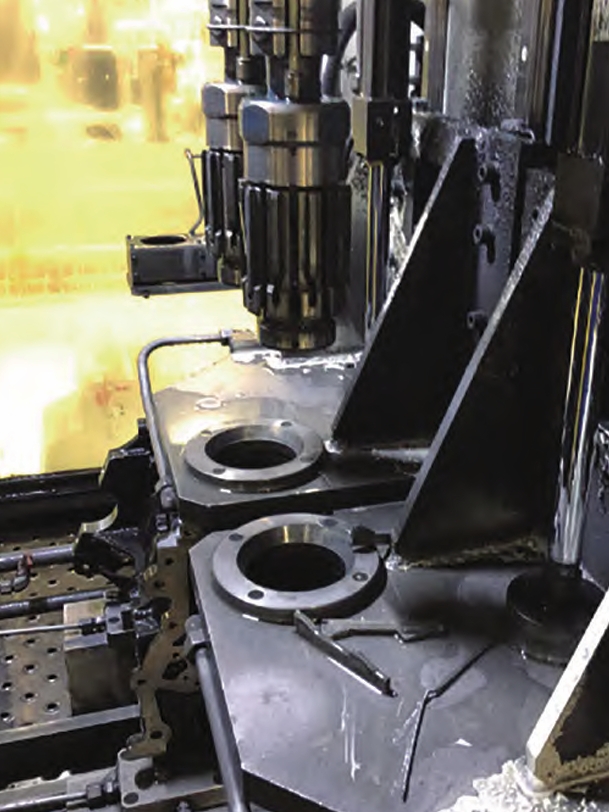
A complex component like an engine cylinder block embodies all these challenges. It features deep water jackets (prone to stagnation), critical sealing surfaces (must be free of casting defect like porosity), and thin-walled sections. Applying the “active” principle here means designing a gating system that ensures no cavity area is left without a controlled flow of fresh metal to displace the cooling front and break up oxide skins.
The correlation between turbulent areas and specific casting defect is strong. Examination of leak paths in pressure-tested castings or the roots of hot tears almost always reveals clusters of oxide inclusions. These defects are predominantly located in regions of severe mold-filling turbulence, not in quiet, non-splashing areas.
2. The Imperative of Efficient Mold and Core Venting
Even with a perfect gating system, a casting defect catastrophe can occur if the displaced air and core gases cannot escape freely. An effective venting system is the complementary half of the peaceful filling equation, preventing back-pressure-induced turbulence.
Cores, surrounded by hot metal, experience rapid heating and gas generation. The internal gas pressure ($P_g$) builds according to ideal gas laws approximated by:
$$ P_g \propto \frac{n_g R T}{V_c} $$
where $n_g$ is the moles of gas generated, $R$ is the gas constant, $T$ is the rapidly rising temperature, and $V_c$ is the core volume. If this pressure cannot vent quickly to the atmosphere, it reaches a critical point. When molten metal eventually finds a tiny path into the core vent (e.g., through a poorly sealed core print), the high-pressure gas escapes violently, ejecting a jet of metal. This creates intense local turbulence, entrains sand, and results in a severe combined casting defect of blowholes, slag, and sand inclusions.
Therefore, vent design is non-negotiable:
- Adequate Vent Area & Path: Complex, high-mass cores require large, dedicated vent channels, often created using perforated wax or plastic tubes placed in the core during molding.
- Unobstructed Outlet: Every vent must have a verified open path to the outside atmosphere. After mold assembly, vents near the mold’s top (e.g., by risers) must be protected from loose sand falling in, typically by creating a small clay dam around the vent opening.
- Minimizing Mold Joint Gaps: Perhaps the most overlooked source of venting failure is excessive flash or parting line gaps. A large gap at the mold joint means the seal between the core’s top vent and the corresponding relief in the cope is poor. Molders may pack this large gap with soft sealing rope. When the metal fills the cavity, buoyancy forces lift the core slightly, crushing and displacing the soft sealant. This creates a leak path, allowing metal to infiltrate the vent channel and collide with high-pressure gas, causing a violent eruption. Reducing mold deformation and ensuring tight parting lines can drastically reduce this type of casting defect.
3. A Unified View on Defect Formation and Control
The mechanisms linking turbulent filling to major casting defect types can be synthesized as follows:
| Casting Defect | Primary Formation Link to Turbulence/Oxides | Key Mitigation Strategy |
|---|---|---|
| Slag (Dross) Entrapment & Gas Holes | Direct entrainment and agglomeration of oxide films and air bubbles. | Low ingate velocity ($v_i$ < spec); use of filters; steady flow. |
| Shrinkage Porosity | Oxide networks block interdendritic feeding paths and reduce effective thermal conductivity, creating isolated hot spots. | Promoting directional solidification via “active” temperature control from flow; reducing oxide content. |
| Leaks under Pressure | Interconnected oxide/bubble networks create continuous permeability paths through the wall. | Very low turbulence ($v_i$ < 0.8 m/s for critical parts); bottom or stepped gating. |
| Hot Tears | Oxide films concentrate at grain boundaries, severely weakening cohesion during the vulnerable solidification temperature range. | Eliminating stress concentrators from turbulent fill; ensuring uniform cooling. |
| Sand Inclusions & Burn-on | High-velocity jets or gas eruptions erode the mold wall, entraining sand grains. | Low velocity; excellent core/mold strength; flawless core venting to prevent gas eruption. |
In conclusion, the battle against casting defect is fundamentally a battle against uncontrolled turbulent energy during mold filling. We cannot prevent the initial formation of oxide films in the melt, but through disciplined engineering, we can control their destiny. By designing gating systems that prioritize low, steady velocities and active, uniform cavity fill, and by coupling this with absolutely reliable mold and core venting, we dramatically suppress the conditions that allow oxide films to grow, intertwine, and manifest as costly defects. The goal is clear: tranquil flow and a dynamically active metal surface are the hallmarks of a process capable of producing high-integrity castings consistently. Implementing these principles—treating ingate velocity as a key design parameter, strategically positioning gates to eliminate stagnation, and ensuring vents are truly open—transforms the art of founding into a more predictable and reliable science, where the occurrence of a casting defect becomes the rare exception, not the recurring problem.