
The high-nickel-chromium indefinite chilled spheroidal graphite cast iron centrifugal composite roll represents a pinnacle of performance in the steel rolling industry. Its core design philosophy hinges on a composite casting process that strategically bonds materials of disparate properties, marrying the high wear resistance required at the roll body (working layer) with the high toughness needed at the roll core. This synergy significantly extends service life and enhances rolling efficiency. However, producing the spheroidal graphite cast iron working layer presents a persistent metallurgical challenge: substantial carbon loss during extended high-temperature processing in medium-frequency induction furnaces.
During the prolonged stages of melting, holding, and superheating (often exceeding 90 minutes), carbon oxidation losses can reach 12% to 18%. This frequently drives the final carbon content below the specified lower process limit, typically 3.2%. The traditional remedy—adding pig iron to recarburize—carries a severe cost penalty, increasing raw material expenses by 28% to 35%. The evolution towards synthetic spheroidal graphite cast iron technology, which maximizes the use of cost-effective charge materials, has further complicated carbon control. A modern charge makeup often comprises: scrap steel (35%-50%), roll returns (30%-40%), minimal pig iron (0-10%), and minor alloying additions.
While introducing a large proportion of scrap steel (≥40%) reduces costs and can elevate tensile strength beyond 500 MPa—a 15% improvement over traditional methods—it severely depresses the carbon equivalent (CE), often below 3.6. Consequently, implementing a precise and efficient carbon-adding (carburizing) process is not merely beneficial but essential to reliably adjust the carbon content into the target range of 3.2% to 4.1%. This article delves into the practical application, underlying principles, and critical parameters of the carbon-adding process in the production of these advanced spheroidal graphite cast iron rolls.
1. Fundamentals of Molten Iron Carburization
Carburization of molten iron is the controlled process of introducing carbon into the melt to achieve a predetermined target concentration. At its heart, this process involves the dissolution and diffusion of carbon atoms from a solid carburizing agent into the liquid iron matrix. It is governed by mass transfer, interfacial reactions, and diffusion dynamics, driven fundamentally by the concentration gradient between the actual carbon content in the melt and its saturation solubility at the given temperature.
1.1 Forms and Dissolution Mechanism of Carbon in Molten Iron
Within high-temperature molten iron, carbon exists primarily in two states: as dissolved carbon, occupying interstitial sites within the iron lattice to form a solid solution, and as free carbon, often manifesting as submicroscopic crystalline graphite particles suspended in the melt. When a carburizer is introduced, carbon atoms begin to interact with the iron. From a microscopic perspective, dissolution is a diffusion-controlled process where carbon atoms migrate from the surface of the carburizer into the bulk iron under the influence of a concentration gradient.
This diffusion is classically described by Fick’s First Law:
$$J = -D \frac{dc}{dx}$$
where $J$ is the diffusion flux (mol·m⁻²·s⁻¹), $D$ is the diffusion coefficient (m²·s⁻¹), and $\frac{dc}{dx}$ is the concentration gradient (mol·m⁻⁴). The diffusion coefficient $D$ for carbon in liquid iron is influenced by temperature and melt composition. Elevated temperature increases atomic activity and $D$, thereby accelerating dissolution. Conversely, elements like silicon can hinder carbon diffusion and reduce its solubility.
1.2 Chemical Reactions During Carburization
The carburization process is accompanied by several chemical reactions, primarily involving oxidation. In a high-temperature, oxygen-containing environment, carbon from the carburizer can react preferentially with oxygen, leading to process losses:
$$C_{(s)} + O_{2(g)} \rightarrow CO_{2(g)}$$
$$2C_{(s)} + O_{2(g)} \rightarrow 2CO_{(g)}$$
$$C_{(s)} + CO_{2(g)} \rightarrow 2CO_{(g)}$$
These side reactions reduce carburizing efficiency. Other elements in the melt, such as manganese, also participate by reacting with oxygen (e.g., forming MnO), which can indirectly influence carbon loss by altering the oxygen potential at the interface. Therefore, controlling the oxygen content and carefully balancing other elements are crucial for maximizing carbon yield.
2. Key Aspects and Technical Parameters of the Carburizing Process
The efficacy of carburization in spheroidal graphite cast iron production depends on a triad of factors: the characteristics of the carburizer, the state of the molten iron, and the operational methodology. The process is kinetically controlled by interfacial reactions and mass transfer diffusion.
| Factor | Optimal Condition/Requirement | Primary Impact on Process |
|---|---|---|
| Carburizer Quality | High Fixed Carbon (>98%), Low S (<0.05%), Low N, Graphitized | Determines dissolution speed, yield, and graphite nucleation potential. |
| Molten Iron State | High Temperature (1450-1550°C), Low Sulfur, Adequate Stirring | Governs carbon solubility, diffusion rate, and homogenization. |
| Operation | Correct Timing, Effective Covering, Sufficient Holding | Controls oxidation loss and ensures uniform carbon distribution. |
2.1 Selection of the Carburizing Agent
The choice of carburizer is paramount. For high-quality spheroidal graphite cast iron, graphitized petroleum coke or specially treated graphite is preferred. Its layered crystalline structure facilitates rapid dissolution and, importantly, provides excellent substrates for graphite nucleation during the subsequent spheroidization and inoculation stages, thereby improving graphite nodule count and morphology. Key specifications include fixed carbon content >98%, sulfur content <0.05%, and low nitrogen. Particle size is also critical; for medium-frequency furnaces, a size range of 1-5 mm is typically optimal to balance dissolution rate with minimization of oxidation and carry-over loss.
2.2 Timing and Method of Addition
The timing of carburizer addition significantly impacts absorption efficiency. Early addition (e.g., with cold charge) leads to prolonged exposure and increased oxidation loss. Late addition, when the bath temperature is already high but the carbon content is set, can result in insufficient dissolution time. The recommended practice is to add the majority of the carburizer when 70-80% of the charge has melted. At this point, a substantial liquid pool exists at a high temperature (~1350-1400°C), promoting rapid dissolution aided by the furnace’s inductive stirring.
The method of addition is equally important. For furnace addition, the carburizer should be evenly spread on the molten surface to leverage the stirring action. For ladle addition, placing the carburizer at the bottom and pouring the molten iron directly onto it creates intense mixing, improving absorption.
2.3 Influence of Initial Melt Composition
The starting carbon content of the melt is a primary driver for carburizing kinetics. A low initial carbon level creates a large concentration gradient, resulting in a high dissolution rate (>1.8%/min) and high overall absorption efficiency (>85%). As the initial carbon approaches the saturation limit, the driving force diminishes, slowing dissolution and increasing relative oxidation loss. Other elements exert measurable effects:
- Silicon: Exhibits a strong carbon-repelling (graphitizing) effect. An increase of ~0.1% Si can decrease carburizer absorption efficiency by 3-4%.
- Manganese: Promotes carbon absorption. An increase of ~0.1% Mn can improve absorption efficiency by 2-3%.
- Sulfur: Has a milder negative impact. An increase of ~0.01% S may reduce absorption efficiency by 1-2%.
The relationship can be conceptualized by an empirical absorption efficiency factor ($\eta$):
$$\eta \approx \eta_0 – k_{Si}[Si] + k_{Mn}[Mn] – k_{S}[S]$$
where $\eta_0$ is the base efficiency at optimal conditions, and $k$ are element-specific coefficients.
2.4 Temperature Control During Melting
Temperature is a critical lever. Higher temperatures increase both the solubility and the diffusion coefficient of carbon in iron, enhancing carburizing rate and efficiency. The optimal range for high-nickel-chromium spheroidal graphite cast iron is typically 1450-1550°C. Excessive temperature, however, promotes oxidation of iron and alloying elements, increases energy consumption, and may degrade refractory life. Precise monitoring and control via furnace power adjustment are essential.
2.5 Stirring and Mixing of the Molten Bath
Effective stirring is indispensable for breaking down carburizer agglomerates, renewing the reaction interface, and ensuring homogeneous distribution of carbon. While medium-frequency furnaces provide inherent electromagnetic stirring, it is often supplemented. The dissolution kinetics can be described by a simplified model where the rate of carbon increase is proportional to the stirring intensity and the surface area of the carburizer:
$$\frac{d[C]}{dt} = k \cdot A \cdot ([C]_{sat} – [C]_{actual})$$
where $k$ is a rate constant dependent on temperature and stirring, $A$ is the effective surface area of the carburizer, and $[C]_{sat} – [C]_{actual}$ is the driving force. Prolonged stirring after complete dissolution should be avoided to prevent carbon loss through oxidation.
3. Melting Process Flow for Spheroidal Graphite Cast Iron with Carburization
The following outlines a standardized melting practice for a 2-ton medium-frequency furnace to produce the high-nickel-chromium spheroidal graphite cast iron working layer.
| Typical Charge Makeup (with Carburization) | |
|---|---|
| Material | Percentage (w/%) |
| Scrap Steel | 30 – 40 |
| Roll Returns | 60 – 70 |
| Pig Iron | 0 – 10 |
| Graphitized Carburizer | 2.5 – 2.8 |
| Alloys (Fe-Ni, Fe-Cr, etc.) | As required |
Target Finished Composition:
| C | Si | Mn | Cr | Ni | Mo | S | P |
|---|---|---|---|---|---|---|---|
| 3.43 | 1.3 | 0.85 | 1.80 | 4.33 | 0.35 | 0.015 | 0.06 |
3.1 Melting and Carburizing Stage
- Initial Melt: Charge 20% of the total returns and 35% of the scrap steel. Melt completely and raise temperature to 1350-1400°C.
- First Carburizer Addition: Add the first portion of graphitized carburizer. Use mechanical stirring if needed, then cover with steel chips to submerge it and minimize oxidation.
- Secondary Charging: After the covering chips melt, add the remaining scrap steel. Heat again to 1350-1400°C and add the second portion of carburizer.
- Final Charging: Add the remaining roll returns. After all charge is molten, hold at ~1400°C for 5-10 minutes to homogenize the carbon via thermal diffusion.
- Final Adjustment: Raise to the final tapping temperature (e.g., 1500°C), slag off completely, and perform a quick composition analysis. If carbon is low, add a small corrective amount of carburizer. If carbon equivalent is too high, dilute with clean scrap steel.
3.2 Spheroidization and Inoculation Treatment
This is the core step defining the spheroidal graphite cast iron microstructure. A three-stage composite inoculation process is employed:
- Primary (Cover) Inoculation: A preheated ladle (650-750°C) is used. In the reaction well, 1.4-1.5% spheroidizing agent (e.g., Fe-Si-Mg) is added, covered with 0.2-0.3% 75FeSi inoculant (15-20mm), compacted, and insulated with pearlite. A special reaction chamber cover plate is used to slow the initial violent reaction and reduce Mg oxidation loss.
- Stream Inoculation: As the furnace is tapped (at ~1/3 full), a controlled stream of fine 75FeSi inoculant (0.4-0.6%, 3-5mm) is added continuously into the metal stream.
- Late (Instant) Inoculation: After slag removal and just before pouring, 0.1-0.15% of very fine 75FeSi inoculant (0.2-1mm) is sprinkled onto the melt surface and stirred in to maximize nucleation potential and combat fading.
3.3 Centrifugal Casting of the Working Layer
The treated iron is poured into a rotating mold at the specified centrifugal casting parameters. Immediately after pouring, an ‘O’-type glass-protective slag is applied to the inner surface. Solidification is monitored via infrared pyrometry. The machine is decelerated and stopped once the inner surface temperature falls 10°C below the calculated crystallization temperature, resulting in the indefinite chilled spheroidal graphite cast iron working layer.
4. Analysis of As-Cast Microstructural Characteristics
The centrifugal casting process subjects the high-alloy spheroidal graphite cast iron melt to direct chilling by the mold wall, creating an extreme axial temperature gradient (>150°C/mm). This leads to a strongly oriented solidification structure with carbides (M7C3 type) and graphite exhibiting a <001> preferred orientation governed by the von Mises stress field.
4.1 Graphite Morphology and Distribution
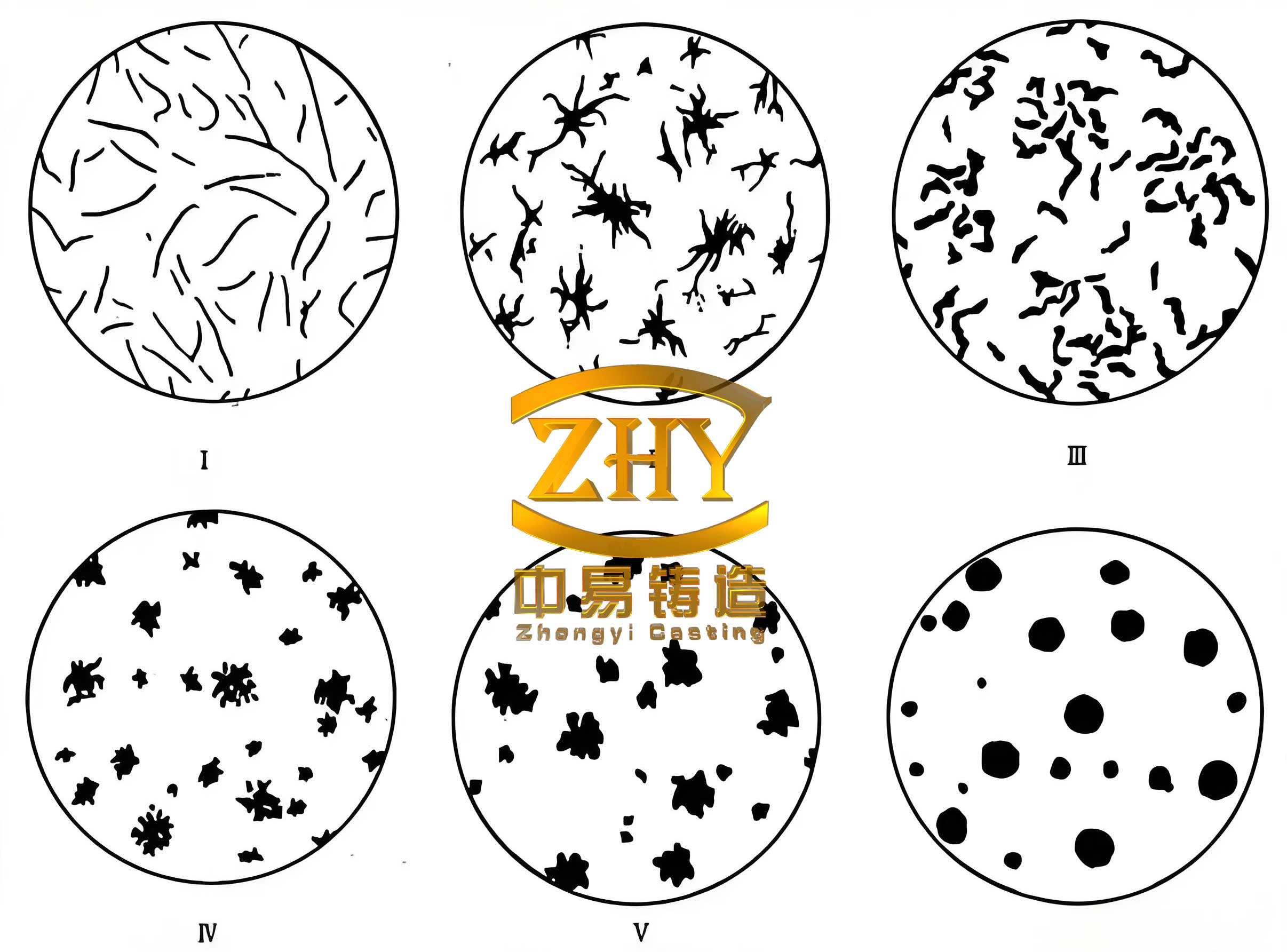
Quantitative metallography of the as-cast working layer reveals a nodularity ≥95% (Grade 1) and a graphite size ≤0.015 mm (Grade 8). The designed composition (1.3%Si, 4.33%Ni) combined with intensive 75FeSi inoculation creates a high density of heterogeneous nucleation sites (e.g., TiN-MgO-Al2O3 complexes), accounting for approximately (82 ± 5)% of all graphite nuclei.
The application of the carbon-adding process fundamentally optimizes the graphite phase. Prior to its use, insufficient carbon led to scarce, irregular graphite (small flakes, compacted vermicular, or isolated nodules). With a properly executed carburizing process, carbon availability and uniformity are ensured, promoting the abundant formation and uniform growth of graphite nuclei. The result is a significant increase in nodule count, with graphite appearing predominantly as well-formed spheres. The roundness improves, degenerate forms are minimized, and the size distribution becomes tighter. Graphite distribution becomes more uniform and dispersed throughout the matrix, though a gradient persists from the chill surface (finer, fewer nodules) to the interior (more, larger nodules). Compared to non-carburized melts, the nodule count (area fraction) increases by 10-20%, and nodularity consistently reaches ≥90%.
4.2 Matrix Structure Analysis
The matrix of the high-nickel-chromium indefinite chilled spheroidal graphite cast iron is a complex mixture of bainite, some martensite, retained austenite, and carbides. The microstructure exhibits a pronounced dendritic morphology, confirmed by the presence of 1.8% Cr, 0.85% Mn, and 0.35% Mo. These alloying elements intensify solute buildup at the solidification front, inducing substantial constitutional supercooling (ΔT > 18 K), which promotes dendritic growth as described by the Kurz-Fisher model. The primary dendrites nucleate at the mold wall and grow preferentially in the <100> direction. As growth proceeds, carbon and other solutes are rejected, lowering the local liquidus temperature while the release of latent heat creates a thermal barrier. This eventually triggers a transition from dendritic to columnar growth, a phenomenon consistent with the Hunt model for columnar-to-equiaxed transition (CET).
The carbon-adding process profoundly influences the final matrix. Without it, the base matrix is predominantly bainitic but can be intermixed with patches of pearlite due to carbon micro-segregation. The lower carbon content also reduces austenite stability, leading to easier formation of martensite, especially in heavily chilled zones, and lower levels of retained austenite. With optimal carburization, the abundant carbon enhances austenite stability during cooling. This results in a more homogeneous, predominantly bainitic matrix with significantly reduced martensite (confined to extreme chill areas) and an appropriate amount of toughening retained austenite. Non-target phases like pearlite are virtually eliminated, yielding a superior, more consistent matrix structure.
5. Conclusions
The practical implementation of the carbon-adding process in the production of high-nickel-chromium indefinite chilled spheroidal graphite cast iron rolls demonstrates its indispensable value:
- Its core principle lies in the precise, stable, and efficient adjustment of molten iron carbon content through the rational addition of high-quality carburizer during the mid-to-late stages of melting, coupled with sufficient stirring and holding time.
- The efficiency and speed of carburization are most critically governed by molten iron temperature, carburizer characteristics (especially graphitization degree and particle size), and stirring intensity.
- The adoption of this process leads to a marked optimization of the as-cast microstructure: high graphite nodularity with round, fine, and uniformly distributed nodules; refined and dispersed carbide morphology; and improved matrix homogeneity.
- The scientific application of the carbon-adding process stands as a key technological guarantee for the stable production of high-performance, long-service-life high-nickel-chromium indefinite chilled spheroidal graphite cast iron rolls, holding significant engineering application value and broad prospects for promotion.