
The pursuit of enhanced wear resistance in engineering materials has consistently directed attention towards white cast iron, an alloy renowned for its high volume fraction of hard carbides. However, the intrinsic brittleness of conventional white cast iron, primarily stemming from the continuous, three-dimensional network of M3C-type carbides within its microstructure, has historically limited its application under impact or high-stress abrasion conditions. The central challenge, therefore, lies not in improving its hardness, but in transforming this brittle carbide network into a more isolated, compact morphology to unlock superior toughness without compromising wear performance. My research focuses on elucidating the physical metallurgy behind achieving this transformation through advanced modification techniques, specifically the synergistic application of rare earth (RE), aluminum, and nitrogen.
The foundational problem in unmodified low-alloy white cast iron is the interconnected nature of the eutectic carbide phase. During solidification, the carbide, typically cementite (Fe3C), grows as the leading phase in the metastable eutectic reaction, forming sharp, elongated plates that interlock into a continuous skeleton. This structure provides excellent abrasion resistance but acts as a ready path for crack propagation, leading to low fracture toughness. The primary goal of modification is to disrupt this network, promoting a fragmented, blocky, or even spheroidal carbide morphology.
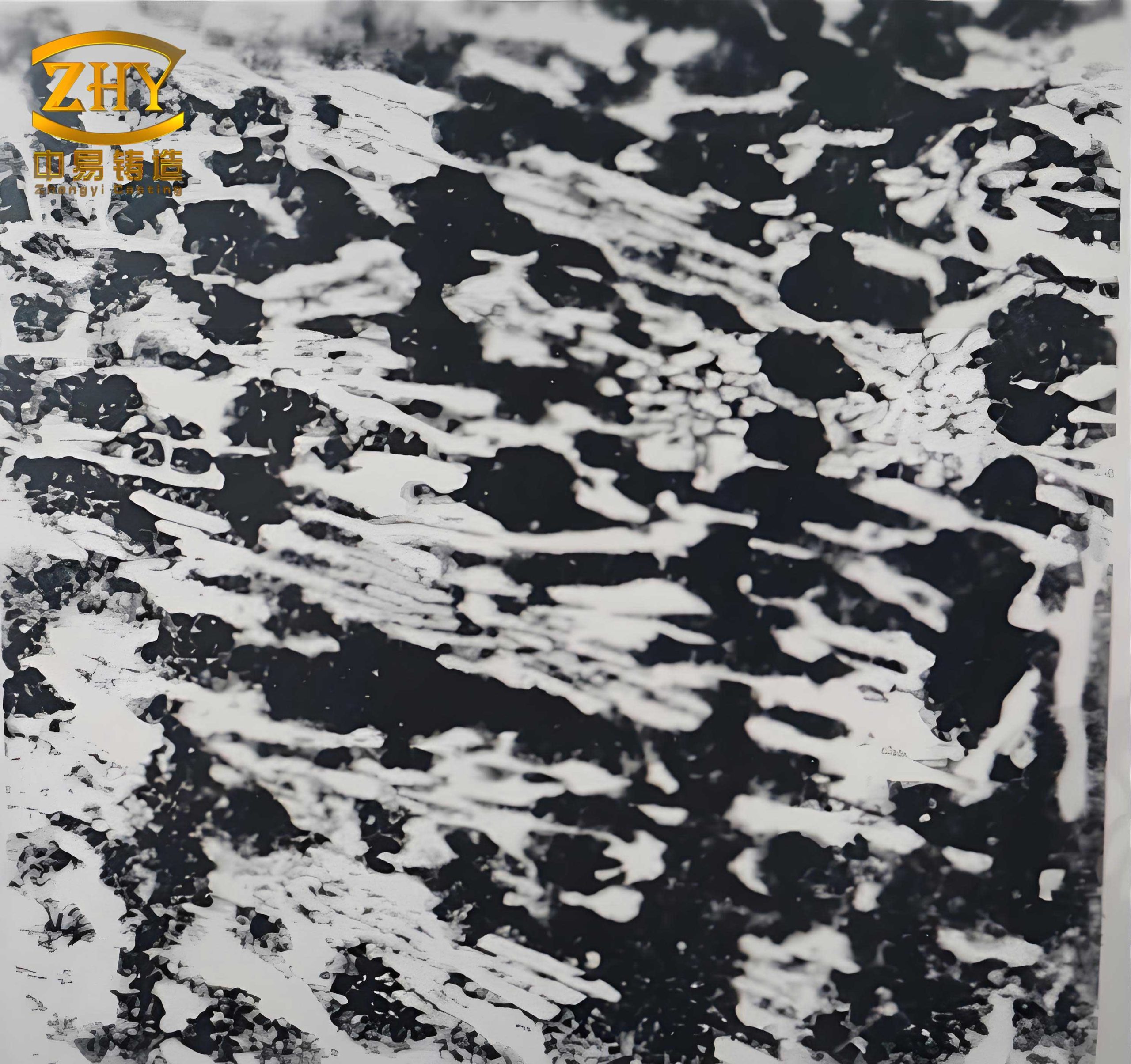
Initial breakthroughs involved the use of rare earth elements as modifiers for white cast iron. When added to the melt, rare earths like cerium (Ce) or lanthanum (La) induce a remarkable change: the carbide network becomes discontinuous, breaking into isolated blocks or short rods. The mechanism is multifaceted. First, rare earths are powerful deoxidizers and desulfurizers. Their addition leads to the formation of various non-metallic inclusions. The sequence of formation can be understood thermodynamically. The standard free energy of formation for key compounds is decisive. The reaction product that forms first depends on the activity of oxygen and sulfur in the melt.
The following table summarizes the standard free energy of formation ($\Delta G^\circ$) for relevant compounds, which dictates their stability and formation sequence in molten white cast iron.
| Compound | Approx. $\Delta G^\circ$ (J/mol) at 1500°C | Crystal Structure & Lattice Parameter (Å) |
|---|---|---|
| Ce2O3 | -1,650,000 | Hexagonal, a=3.89, c=6.06 |
| Ce2O2S | -1,250,000 | Trigonal/Hexagonal |
| CeS | -500,000 | FCC (NaCl-type), a=5.78 |
| Al2O3 | -1,200,000 | Trigonal (Corundum) |
| AlN | -300,000 | Hexagonal (Wurtzite), a=3.11, c=4.98 |
From the thermodynamic data, rare earth oxides and oxysulfides form first, effectively scavenging the melt. The remaining rare earth in solution profoundly influences solidification. It increases the liquidus temperature for primary austenite formation, indicating a smaller critical nucleus size due to reduced interfacial energy. Simultaneously, it depresses the metastable eutectic temperature (austenite-cementite). This widening of the solidification interval for primary austenite allows for more extensive dendritic growth. The rejected rare earth at the solid-liquid interface creates constitutional undercooling, promoting higher-order branching of the austenite dendrites. This dense, complex dendritic network physically obstructs the long-range growth and interconnection of the subsequent eutectic carbides.
Furthermore, rare earth elements adsorb onto the growing carbide crystals. Cementite has a layered orthorhombic structure with strong covalent bonds along specific directions (e.g., [010]), leading to its anisotropic, plate-like growth habit. Surface-active elements like Ce adsorb preferentially at the advancing edges or steps on the carbide crystal faces. According to adsorption theory, when the residence time of the adsorbate atom is longer than the time for a growth step to pass, the adsorbate acts as a barrier. This strong adsorption of rare earth inhibits the preferential lateral extension of the carbide plates, forcing growth to occur more isotropically in thickness as well, resulting in a blocky morphology. The impact toughness of rare earth-modified white cast iron can thereby be doubled.
While effective, rare earth modification alone often yields a blocky, yet not fully spheroidal, carbide structure. To further enhance toughness and push the carbides towards a more compact form, the synergistic use of aluminum was investigated. Aluminum is a potent deoxidizer and is more cost-effective than rare earths. Its role in modifying white cast iron is complementary. My experiments measured the deoxidation capability of Al versus Ce in a standard low-alloy white cast iron melt. The results are summarized below:
| Melt Condition | Temperature (°C) | Measured Oxygen Activity (ppm) |
|---|---|---|
| Base White Cast Iron | 1450 | 45 |
| Base White Cast Iron | 1400 | 32 |
| + 0.1% Ce | 1400 | 28 |
| + 0.3% Ce | 1400 | 25 |
| + 0.2% Al | 1400 | 26 |
| + 0.2% Al then +0.1% Ce | 1400 | 25 |
Aluminum significantly reduces oxygen content. More importantly, aluminum increases the surface tension of the molten white cast iron. The increase in melt-vapor surface tension suggests a corresponding increase in the solid-liquid interfacial energy, which can influence the wetting behavior and coalescence tendency of newly formed solid phases. When aluminum is added alone, it promotes carbide fragmentation. However, when combined with rare earth, the effect is more pronounced. The key lies in the formation of a specific compound: CeAlO3. This compound, with a perovskite crystal structure (pseudocubic, a ≈ 3.8 Å), can serve as an effective heterogeneous nucleation site for primary austenite (γ-Fe, FCC, a=3.65 Å). The lattice misfit ($\delta$) can be estimated using the classic formula for cubic-cubic systems:
$$ \delta = \frac{a_{substrate} – a_{crystal}}{a_{crystal}} $$
For CeAlO3 and austenite: $$ \delta = \frac{3.8 – 3.65}{3.65} \approx 0.041 \text{ or } 4.1\% $$
A misfit below 6% is considered favorable for effective nucleation. Thus, the Ce-Al-O complexes act as potent inoculants, dramatically increasing the number of primary austenite grains. This refined austenite matrix further confines the growing eutectic carbides, pushing their morphology from blocks towards isolated, chunky aggregates. The combined deoxidation and surface tension effects also promote the coalescence or “rounding” of carbide particles.
The final, most significant advancement in the metallurgy of tough white cast iron comes from the introduction of nitrogen into the RE-Al modification system. The rationale is to create a high density of effective nucleation sites. While CeAlO3 forms, its quantity might be limited by the transient reaction conditions. Introducing nitrogen, typically via additions like manganese nitride (MnN), allows for the formation of aluminum nitride (AlN). AlN has a hexagonal wurtzite structure (a=3.11 Å, c=4.98 Å) and a very high melting point. It is an excellent nucleant for austenite. The lattice matching can be assessed using a more generalized misfit equation for different crystal systems, considering planar matching. Both theoretical and practical evidence confirm AlN’s potency.
When RE, Al, and N are added together to white cast iron, a multifaceted synergistic mechanism unfolds:
1. Inoculation: A multitude of CeAlO3 and AlN particles form, providing copious nucleation sites for primary austenite. This results in an extremely fine, equiaxed austenite grain structure.
2. Melt Purification & Interfacial Modification: RE and Al thoroughly deoxidize and desulfurize the melt. The remaining RE in solution lowers the austenite-liquid interfacial energy, facilitating nucleation. The increased overall melt surface tension (due to Al and RE) reduces the wettability of the carbides, encouraging them to spheroidize to minimize surface area.
3. Crystal Growth Poisoning: Nitrogen, being a surface-active element, segregates to and adsorbs on the growing surfaces of the eutectic carbides. This adsorption is particularly effective in a purified melt (low O, S). It impedes the rapid, directional growth of carbide facets, leading to tip blunting and a more isotropic, globular growth morphology. This effect is only fully realized in the combined presence of RE and Al, which ensure the melt purity necessary for N adsorption.
4. Carbide Isolation: The dense “forest” of fine primary austenite grains physically separates the locations where eutectic carbides can initiate and grow. The carbides are forced to form in the confined inter-dendritic or inter-granular spaces, adopting a discrete, near-spheroidal shape rather than a connected network.
The transition in carbide morphology with different modification schemes can be summarized by the following sequence, where “→” represents the change induced by treatment:
Unmodified White Cast Iron: Continuous Carbide Network → RE-modified: Discontinuous Blocky Carbides → RE-Al modified: Chunky Aggregates + Blocks → RE-Al-N modified: Isolated Spheroidal/Globular Carbides.
The mechanical property improvement is dramatic. While RE modification can double the impact toughness, the RE-Al-N complex modification can increase it by a factor of three to four or more, often achieving values like $a_k \geq 10 \, J/cm^2$ in the as-cast state, which was previously only attainable through lengthy and costly heat treatments for carbide spheroidization. This makes the complex-modified white cast iron a viable, high-performance material for severe impact-abrasion applications.
In conclusion, the journey from a brittle, networked structure to a tough, globular-carbide white cast iron is governed by a sophisticated interplay of thermodynamics, kinetics, and interfacial phenomena. Rare earth elements lay the groundwork through purification and adsorption-mediated carbide shape control. Aluminum amplifies this by enhancing purification, increasing melt surface tension, and participating in the formation of potent nucleants like CeAlO3. Finally, nitrogen introduces a powerful nucleation agent (AlN) and acts as a growth modifier for the carbides themselves. The RE-Al-N complex modification is not merely an additive effect but a truly synergistic process. It manipulates the entire solidification sequence of white cast iron—from the nucleation of the primary phase to the growth habit of the eutectic hard phase—resulting in a microstructure that masterfully balances the traditionally opposing properties of high wear resistance and good toughness. This understanding opens avenues for designing next-generation abrasion-resistant white cast iron alloys through precise control of melt chemistry and solidification.