
The widespread application of nodular cast iron in water distribution and sewage systems is a testament to its favorable combination of mechanical strength, castability, and cost-effectiveness. However, its long-term service integrity is persistently challenged by corrosion. A significant, yet often underestimated, contributor to material degradation in aqueous environments is Microbiologically Influenced Corrosion (MIC). In systems carrying treated wastewater or reclaimed water—an increasingly critical resource—the residual organic nutrients create a fertile ground for microbial proliferation. Among the common bacteria in such environments, Escherichia coli (E. coli) is frequently prevalent. While its sanitary implications are well-known, its role in catalyzing the corrosion of metallic infrastructure, particularly nodular cast iron, is a complex interfacial process that warrants detailed investigation. This article delves into the electrochemical and morphological changes induced by E. coli on a common grade of nodular cast iron, QT500-7, elucidating the mechanisms through which a biological presence transforms a material’s durability.
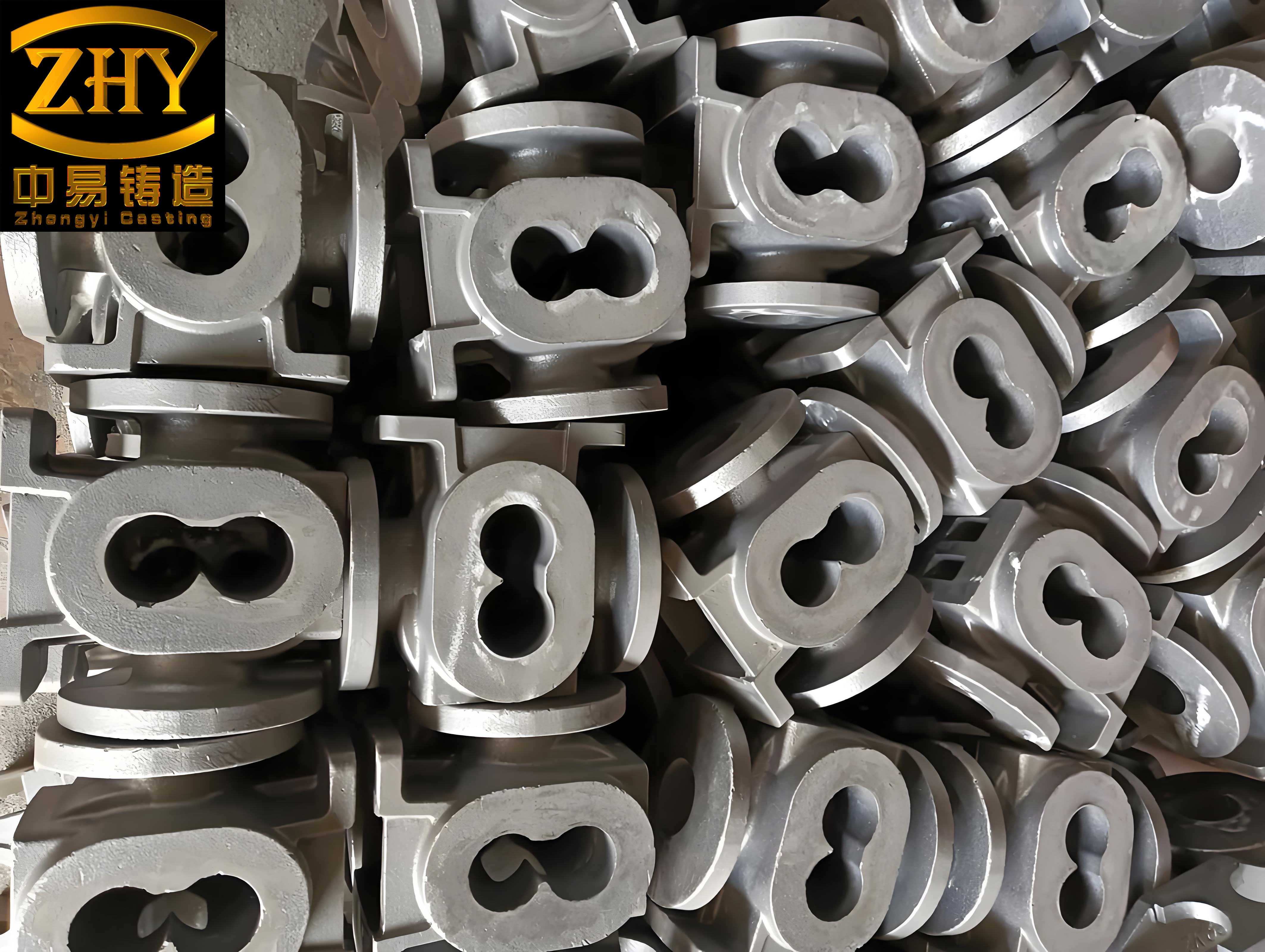
The inherent susceptibility of nodular cast iron to corrosion stems from its microstructure, which consists of a ferritic-pearlitic matrix with embedded spheroidal graphite nodules. This structure establishes numerous micro-galvanic cells where the graphite nodules (cathodic) and the surrounding iron matrix (anodic) are in direct electrical contact. The corrosion potential, $E_{corr}$, and current, $i_{corr}$, for such a system can be conceptually described by the mixed-potential theory, where the net current is zero at the corrosion potential:
$$\sum i_a(E_{corr}) = |\sum i_c(E_{corr})|$$
In a sterile, aerobic neutral medium, the primary cathodic reaction is oxygen reduction:
$$O_2 + 2H_2O + 4e^- \rightarrow 4OH^-$$
And the anodic reaction is iron oxidation:
$$Fe \rightarrow Fe^{2+} + 2e^-$$
The resulting ferrous ions subsequently undergo hydrolysis and precipitation, forming layers of iron hydroxides and oxyhydroxides (e.g., $Fe(OH)_2$, $FeOOH$, $Fe_3O_4$) on the surface of the nodular cast iron. The kinetics of this process are initially influenced by the rate of oxygen diffusion but later by the protectiveness of this corrosion product layer.
The introduction of microorganisms like E. coli profoundly disrupts this electrochemical equilibrium. Bacteria do not “eat” metal but accelerate corrosion through their metabolic activities and the physical/chemical environment created by their biofilm. A biofilm is a structured consortium of bacterial cells enclosed in a self-produced polymeric matrix (EPS – Extracellular Polymeric Substances) that adheres to a surface. The formation of a biofilm on nodular cast iron leads to:
- Creation of Differential Aeration Cells: The biofilm is heterogeneous and porous, leading to uneven diffusion of oxygen. Areas under thick biofilm become oxygen-depleted (anodic sites), while areas with thinner biofilm or at the biofilm/bulk solution interface remain oxygen-rich (cathodic sites). This establishes a powerful concentration cell, driving localized corrosion.
- Modification of the Local Chemistry: Bacterial metabolism consumes oxygen and organic nutrients, and releases metabolic by-products (acids, enzymes, peroxides). This can locally alter the pH, redox potential, and ionic concentration at the metal-biofilm interface, making it more aggressive.
- Under-Deposit Corrosion: The biofilm and associated corrosion products physically shield the underlying metal, creating a occluded zone where hydrolysis reactions can cause acidification and aggressive ion concentration.
- EPS-Metal Interactions: The EPS, rich in functional groups like carboxylates and phosphates, can chelate metal ions (e.g., $Fe^{2+}/Fe^{3+}$), destabilizing the passive film or corrosion product layer on the nodular cast iron and facilitating continuous metal dissolution.
To quantitatively assess the impact of E. coli on QT500-7 nodular cast iron, a combination of immersion tests and electrochemical measurements is essential. The corrosion rate $V_{corr}$ from weight loss is calculated as:
$$V_{corr} = \frac{\Delta W}{A \cdot t}$$
where $\Delta W$ is the mass loss, $A$ is the exposed surface area, and $t$ is the immersion time. This provides a global, time-averaged measure of material degradation. Electrochemical techniques, on the other hand, offer real-time, in-situ insights into the corrosion kinetics and mechanisms. Open Circuit Potential (OCP) monitoring tracks the thermodynamic tendency of the nodular cast iron to corrode. Potentiodynamic polarization curves allow for the determination of key parameters like corrosion current density ($i_{corr}$), which is related to the corrosion rate by Faraday’s law, and Tafel slopes ($\beta_a$, $\beta_c$). Electrochemical Impedance Spectroscopy (EIS) is particularly powerful for studying biofilm-influenced systems, as it can deconvolute the contributions from the solution resistance ($R_s$), the biofilm layer ($R_{bf}$, $Q_{bf}$), the corrosion product layer, and the charge transfer resistance ($R_{ct}$) at the metal-solution interface. A simplified electrical equivalent circuit (EEC) for a nodular cast iron sample with a biofilm often uses constant phase elements (CPE, represented as $Q$) instead of ideal capacitors to account for surface inhomogeneity caused by biofilm and corrosion product coverage.
The results from long-term immersion tests in a nutrient-rich medium, with and without E. coli, reveal a stark contrast. The corrosion rates for nodular cast iron are consistently higher in the biotic system. More importantly, the ratio of the corrosion rate in the biotic system ($V_E$) to that in the sterile system ($V_0$) increases over time, indicating that the microbial effect is not static but accelerates as the biofilm establishes and matures.
| Immersion Time (days) | $V_0$ (g m$^{-2}$ h$^{-1}$) | $V_E$ (g m$^{-2}$ h$^{-1}$) | Ratio $V_E / V_0$ |
|---|---|---|---|
| 5 | 0.0102 | 0.0105 | 1.03 |
| 10 | 0.0135 | 0.0218 | 1.32 |
| 15 | 0.0181 | 0.0335 | 1.85 |
| 20 | 0.0162 | 0.0682 | 4.21 |
Electrochemical monitoring provides a dynamic view of this process. The OCP of the nodular cast iron in the sterile system might initially shift to more noble potentials due to the formation of a protective oxide/hydroxide film, but then fluctuates or drifts negatively as the film breaks down locally. In the E. coli system, the OCP typically shows a more pronounced and sustained negative shift, reflecting the increased thermodynamic driving force for corrosion induced by the biofilm’s activity and the establishment of anodic sites beneath it. After a defined period of biofilm growth (e.g., 8 days), polarization curve analysis quantitatively confirms the accelerated kinetics. The corrosion current density $i_{corr}$ is significantly higher for the biotic sample. Using the Stern-Geary equation, $R_p$ (polarization resistance) is inversely related to $i_{corr}$:
$$i_{corr} = \frac{B}{R_p}, \quad \text{where } B = \frac{\beta_a \beta_c}{2.303 (\beta_a + \beta_c)}$$
A lower $R_p$ or higher $i_{corr}$ directly translates to a higher corrosion rate for the nodular cast iron.
| System | $i_{corr}$ (A cm$^{-2}$) | $E_{corr}$ (V vs. SCE) | $\beta_a$ (V dec$^{-1}$) | $\beta_c$ (V dec$^{-1}$) |
|---|---|---|---|---|
| Sterile | $2.50 \times 10^{-6}$ | -0.85 | 0.154 | 0.087 |
| With E. coli | $1.41 \times 10^{-5}$ | -0.93 | 0.355 | 0.121 |
EIS data offers further mechanistic insight. The Nyquist plots for sterile nodular cast iron often show increasing semicircle diameters over time, suggesting a growing resistance from the thickening corrosion product layer ($R_{ct}$ increases). In contrast, the EIS response for the biotic system is more complex. An additional time constant in the mid-frequency range often appears, attributable to the porous biofilm layer ($R_{bf}$, $Q_{bf}$). While $R_{bf}$ may initially increase as the biofilm forms, the charge transfer resistance $R_{ct}$, which is the most direct electrochemical indicator of the corrosion rate at the metal interface, is typically one order of magnitude lower in the presence of E. coli compared to the sterile condition. This drastic decrease in $R_{ct}$ signifies that the biofilm actively promotes the charge transfer reaction of iron dissolution, negating any protective effect the biofilm’s physical presence might suggest.
| Time (days) | $R_s$ ($\Omega$ cm$^2$) | $Q_{bf}$ ($\mu$F cm$^{-2}$ s$^{n-1}$) | $R_{bf}$ ($\Omega$ cm$^2$) | $Q_{dl}$ ($\mu$F cm$^{-2}$ s$^{n-1}$) | $R_{ct}$ ($\Omega$ cm$^2$) |
|---|---|---|---|---|---|
| 2 | 12.17 | 3.08 $\times 10^3$ | 5411 | 1.20 $\times 10^5$ | 6774 |
| 5 | 11.19 | 4.00 $\times 10^6$ | 20073 | 1.23 $\times 10^5$ | 1273 |
| 8 | 11.23 | 1.23 $\times 10^3$ | 14184 | 1.36 $\times 10^5$ | 1513 |
*$Q$ values are presented as CPE magnitude. $R_{ct}$ for sterile system after 8 days was $\sim 1.85 \times 10^4$ $\Omega$ cm$^2$.
Post-experiment surface analysis confirms the electrochemical findings. Scanning Electron Microscopy (SEM) of the nodular cast iron surface after biofilm removal reveals a corrosion morphology dominated by localized pitting in the biotic case, as opposed to a more generalized, shallow attack in the sterile case. This pitting is a direct consequence of the heterogeneous biofilm coverage and the resulting differential aeration cells. The pits often initiate at the matrix near graphite nodules, where the micro-galvanic effect and local chemical changes synergize. Energy Dispersive X-ray Spectroscopy (EDS) on the surface crust shows a higher oxygen and iron content in the biotic sample’s corrosion products, indicating more extensive oxidation. However, X-ray Diffraction (XRD) analysis reveals that the final corrosion products—typically a mixture of ferrous hydroxide ($Fe(OH)_2$), lepidocrocite ($\gamma$-$FeOOH$), goethite ($\alpha$-$FeOOH$), and magnetite ($Fe_3O_4$)—are similar in phase composition for both systems. This is a critical point: E. coli does not necessarily create novel corrosion products but drastically accelerates the corrosion pathway leading to them. The bacterial activity increases the flux of $Fe^{2+}$ from the anode, accelerates its oxidation, and influences the precipitation kinetics and morphology of these phases, often resulting in less protective, more porous layers on the nodular cast iron.
In conclusion, the presence of E. coli in nutrient-containing aqueous environments poses a significant threat to the integrity of nodular cast iron infrastructure. Through the formation of a heterogeneous biofilm, the bacteria create localized electrochemical cells, alter the interfacial chemistry, and facilitate metal ion complexation. This shifts the corrosion potential of nodular cast iron to more active values and increases the corrosion current density by an order of magnitude, as confirmed by both weight loss and electrochemical techniques. The corrosion morphology transitions from uniform to localized pitting, which is particularly dangerous for structural integrity. While the end products of corrosion are chemically similar, the rate-determining steps are profoundly accelerated. Therefore, for systems using nodular cast iron in reclaimed water or similar microbially active environments, corrosion management strategies must explicitly account for microbial factors. This includes considering microbiocidal treatments, protective coatings resistant to biofilm adhesion, or the use of corrosion-resistant alloys in critical sections to mitigate the accelerated degradation caused by microorganisms like E. coli.