
In our investigation, we focused on the sand casting process for ZA53 magnesium alloy, a system within the Mg-Zn-Al ternary that offers potential for improved mechanical properties. Sand casting is a widely used method for producing magnesium alloy components due to its flexibility and cost-effectiveness, particularly for complex geometries. This study aims to elucidate the microstructure evolution and room-temperature mechanical behavior of ZA53 alloy under sand casting conditions, with an emphasis on the effects of solid solution heat treatment. The findings provide insights into optimizing processing parameters for enhanced performance.
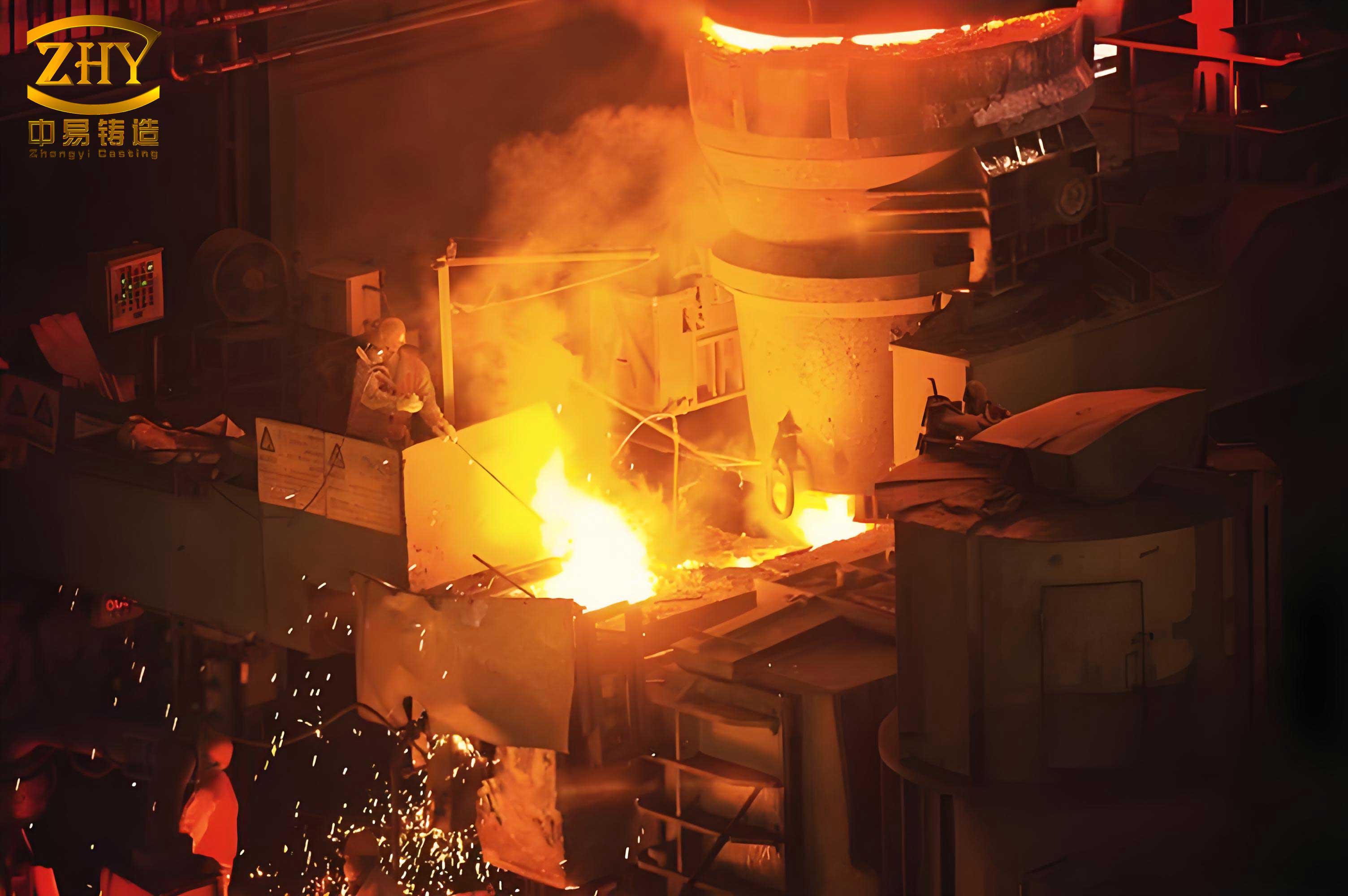
The significance of sand casting in magnesium alloy manufacturing cannot be overstated. It allows for the production of near-net-shape parts with reasonable dimensional accuracy. For ZA53 alloy, which contains approximately 5% Zn and 3% Al, the sand casting process influences phase distribution and defect formation, directly impacting mechanical properties. We designed our experiments to replicate industrial sand casting conditions, using silica sand molds to prepare tensile and metallographic specimens. The alloy was melted under a protective flux to prevent oxidation, and pouring was conducted at 745°C to ensure proper fluidity and minimize casting defects such as shrinkage porosity.
Our experimental methodology involved several key steps. The chemical composition of the ZA53 alloy was confirmed via inductively coupled plasma optical emission spectrometry (ICP-OES), with the target composition being Mg balanced with Zn (4.6–5.5 wt%), Al (2.6–3.5 wt%), Mn (0.15–0.25 wt%), and Fe (<0.016 wt%). The sand casting molds were prepared using standard green sand techniques to ensure consistent thermal properties. After casting, the specimens were subjected to solid solution heat treatments at varying temperatures (323°C, 335°C, 343°C, and 350°C) for a prolonged duration of 17 hours, followed by quenching in hot water at 70–80°C. We employed differential scanning calorimetry (DSC) to determine phase transformation temperatures, X-ray diffraction (XRD) for phase identification, and scanning electron microscopy (SEM) with energy-dispersive spectroscopy (EDS) for microstructural and compositional analysis. Mechanical testing was performed using a universal tensile testing machine, with three replicates for each condition to ensure statistical reliability.
The as-cast microstructure of ZA53 alloy produced via sand casting primarily consists of two phases: the δ-Mg matrix and the intermetallic τ phase, identified as Mg32(Al,Zn)49. The τ phase forms a semi-continuous network along the grain boundaries of the δ-Mg phase, with occasional particulate forms within the grains. This morphology is typical for sand cast Mg-Zn-Al alloys, where cooling rates influence phase distribution. The DSC analysis revealed a solidus temperature of approximately 356.8°C and a liquidus around 539.34°C, indicating a relatively wide freezing range that can affect casting soundness. The XRD patterns confirmed the presence of both phases, with peak intensities correlating to volume fractions. The EDS data provided quantitative composition analysis, as summarized in Table 1.
| Phase | Mg (at%) | Zn (at%) | Al (at%) |
|---|---|---|---|
| δ-Mg Matrix | 97.32 | 1.28 | 1.40 |
| τ Phase (Point a) | 33.56 | 42.64 | 23.80 |
| τ Phase (Point b) | 39.63 | 37.37 | 22.53 |
The mechanical properties of the as-cast ZA53 alloy from sand casting are summarized in Table 2, alongside comparable data for other sand cast magnesium alloys. The tensile strength and yield strength are moderate, but the elongation is relatively low, attributed to the brittle τ network acting as stress concentrators. The sand casting process inherently leads to coarse microstructures, which can limit ductility. To improve properties, we explored solid solution heat treatment, aiming to dissolve the τ phase into the matrix. The driving force for dissolution can be described by the diffusion-controlled kinetics equation:
$$ \frac{\partial C}{\partial t} = D \nabla^2 C $$
where \( C \) is the concentration of solute (Zn and Al), \( t \) is time, and \( D \) is the diffusion coefficient, which is temperature-dependent according to the Arrhenius equation:
$$ D = D_0 \exp\left(-\frac{Q}{RT}\right) $$
Here, \( D_0 \) is the pre-exponential factor, \( Q \) is the activation energy, \( R \) is the gas constant, and \( T \) is the absolute temperature. For ZA53 alloy, prolonged heating at temperatures near the solidus is necessary due to sluggish diffusion in magnesium alloys.
| Alloy | Condition | Tensile Strength, σb (MPa) | Yield Strength, σ0.2 (MPa) | Elongation, δ (%) |
|---|---|---|---|---|
| ZA53 (Our Study) | As-cast (Sand Casting) | 165 | 93 | 5.8 |
| AZ81A (ZM-5) | As-cast (Sand Casting) | 160 | 95 | 3.0 |
| ZK51A (ZM-1) | As-cast (Sand Casting) | 230 | 120 | 11.0 |
Upon solid solution treatment, significant microstructural changes occurred. At 335°C for 17 hours, approximately 80% of the τ phase dissolved, leading to a marked improvement in tensile strength and ductility. The complete dissolution was achieved at 343°C, transforming the microstructure into a single-phase solid solution. This transition enhances mechanical properties by eliminating brittle intermetallics and promoting solid solution strengthening. The strengthening contribution from solute atoms can be estimated using the Labusch-Nabarro model:
$$ \Delta \sigma_{ss} = G \epsilon^{3/2} c^{1/2} $$
where \( \Delta \sigma_{ss} \) is the increase in yield strength due to solid solution, \( G \) is the shear modulus, \( \epsilon \) is the misfit parameter, and \( c \) is the solute concentration. For ZA53, the combined effects of Zn and Al solutes contribute to this strengthening. The mechanical properties after different solid solution treatments are detailed in Table 3.
| Solution Temperature (°C) | Tensile Strength, σb (MPa) | Yield Strength, σ0.2 (MPa) | Elongation, δ (%) | Microstructural State |
|---|---|---|---|---|
| 323 | 169 | 93 | 5.3 | Partial dissolution of τ phase |
| 335 | 237 | 91 | 10.4 | ~80% dissolution of τ phase |
| 343 | 245 | 90 | 12.1 | Complete solid solution |
| 350 | 66 (overheated) | – | – | Overburning with coarse boundaries |
The optimization of sand casting parameters, combined with heat treatment, is crucial for achieving the best properties. The narrow temperature window for complete solid solution (between 335°C and 343°C) underscores the sensitivity of ZA53 alloy to overheating. Overburning at 350°C led to grain boundary coalescence and severe degradation of mechanical properties, as described by the overheating phenomenon where localized melting occurs. The fracture morphology evolved from a mixed mode (cleavage and quasi-cleavage) in the as-cast state to a fully ductile dimple pattern after T4 treatment (343°C/17h). This shift correlates with the removal of stress-concentrating τ networks and the increased homogeneity of the matrix.
To further analyze the mechanical behavior, we can consider the Hall-Petch relationship, which relates yield strength to grain size in polycrystalline materials:
$$ \sigma_y = \sigma_0 + k_y d^{-1/2} $$
where \( \sigma_y \) is the yield strength, \( \sigma_0 \) is the friction stress, \( k_y \) is the strengthening coefficient, and \( d \) is the average grain diameter. In sand cast ZA53, the as-cast grain size is relatively large due to slow cooling in sand molds, contributing to lower strength. Solid solution treatment does not significantly alter grain size but improves strength through solute mechanisms. Additionally, the work hardening behavior can be described by the Ludwik equation:
$$ \sigma = \sigma_0 + K \epsilon^n $$
where \( \sigma \) is the true stress, \( \epsilon \) is the true strain, \( K \) is the strength coefficient, and \( n \) is the work hardening exponent. For T4-treated ZA53, the higher \( n \) value indicates better uniform elongation, consistent with the observed ductility improvement.
Comparing ZA53 with other sand cast magnesium alloys, such as AZ81A and ZK51A, reveals its balanced properties. After T4 treatment, ZA53 exhibits tensile strength comparable to AZ81A-T4 and ZK51A-T1, but with superior elongation relative to ZK51A. This makes ZA53 a promising candidate for applications requiring a combination of strength and ductility in sand cast components. The role of sand casting in defining initial microstructure cannot be overlooked; it sets the stage for subsequent heat treatment efficacy. For instance, the distribution of τ phase in sand cast specimens is more heterogeneous compared to faster-cooled processes, necessitating longer solution times.
In conclusion, our study demonstrates that sand cast ZA53 magnesium alloy possesses a two-phase microstructure with a δ-Mg matrix and τ intermetallic network. Solid solution heat treatment at 343°C for 17 hours effectively dissolves the τ phase, transforming the alloy into a single-phase solid solution with enhanced mechanical properties: tensile strength of 245 MPa and elongation of 12.1%. The fracture mode shifts from mixed to ductile, underscoring the importance of microstructure control. These findings highlight the potential of ZA53 alloy in sand casting applications, provided that processing parameters are carefully optimized to avoid overheating. Future work could explore aging treatments to further strengthen the alloy or modify sand casting techniques to refine as-cast microstructure.
From a broader perspective, the integration of sand casting with tailored heat treatments offers a versatile approach for manufacturing magnesium alloy components. The economic and technical benefits of sand casting make it suitable for prototyping and low-volume production, where flexibility is key. For ZA53 alloy, the combination of solid solution strengthening and ductility improvement positions it well for automotive and aerospace applications where weight reduction is critical. Further investigations could involve computational modeling to predict phase transformations during sand casting and heat treatment, optimizing parameters digitally before physical trials.
To summarize the key relationships, we can express the overall strength of sand cast and heat-treated ZA53 as a combination of various contributions:
$$ \sigma_{\text{total}} = \sigma_{\text{ss}} + \sigma_{\text{gb}} + \sigma_{\text{dislocation}} + \sigma_{\text{precipitate}} $$
where \( \sigma_{\text{ss}} \) is solid solution strengthening, \( \sigma_{\text{gb}} \) is grain boundary strengthening (minor in this case), \( \sigma_{\text{dislocation}} \) is dislocation strengthening, and \( \sigma_{\text{precipitate}} \) is precipitation strengthening (negligible here as precipitates are dissolved). In the T4 condition, \( \sigma_{\text{ss}} \) dominates. Additionally, the effect of sand casting cooling rate on microstructure can be approximated using the solidification time equation:
$$ t_s = \frac{V}{A} \cdot \frac{\rho L}{h (T_m – T_0)} $$
where \( t_s \) is solidification time, \( V \) is volume, \( A \) is surface area, \( \rho \) is density, \( L \) is latent heat, \( h \) is heat transfer coefficient, \( T_m \) is melting temperature, and \( T_0 \) is mold temperature. For sand casting, \( h \) is relatively low, leading to longer \( t_s \) and coarser microstructures. This fundamental understanding aids in designing sand casting processes for ZA53 alloy to achieve desired properties.
In practice, the sand casting of ZA53 magnesium alloy requires attention to mold design, pouring temperature, and heat treatment schedules. Our results provide a foundation for industrial adoption, emphasizing that proper solid solution treatment can mitigate the limitations of as-cast microstructure. As research progresses, alloy modifications or composite reinforcements could further enhance performance, but the core advantage of sand casting—its adaptability—remains a key enabler for magnesium alloy utilization in diverse engineering fields.