
As an observer and participant in the manufacturing industry, I have witnessed a significant shift towards the adoption of mineral casting materials in machine tool applications. This innovative approach to machine tool casting represents a paradigm change from traditional methods, offering a blend of sustainability, performance, and economic efficiency. In this article, I will delve into the intricacies of mineral casting, its manufacturing processes, key characteristics, and the promising future it holds for various industrial sectors. The core of this discussion revolves around how mineral-based machine tool castings are revolutionizing the design and functionality of equipment, with a focus on enhancing precision, stability, and environmental compatibility.
Mineral casting, often referred to as synthetic granite or resin concrete, is a composite material that has gained traction as a superior alternative to conventional cast iron in machine tool castings. From my perspective, the rise of this material stems from its unique properties, which include exceptional damping capacity, thermal stability, and corrosion resistance. These attributes make it ideal for high-precision machine tool casting applications, where vibrations and thermal distortions can compromise accuracy. The manufacturing process of mineral machine tool castings involves a careful blend of epoxy resins, hardeners, and mineral aggregates like granite and quartz sand, all combined under ambient conditions to form a robust structure. This method not only reduces energy consumption but also shortens production cycles, making it a cost-effective solution for modern machine tool casting needs.
One of the most compelling aspects of mineral casting is its superior damping characteristics compared to traditional cast iron. In machine tool castings, vibrations from cutting forces or external sources can lead to inaccuracies in machining operations. Mineral-based machine tool castings exhibit a damping coefficient that is approximately ten times higher than that of cast iron, as illustrated by the relationship: $$ \zeta_{\text{mineral}} \approx 10 \times \zeta_{\text{cast iron}} $$ where $\zeta$ represents the damping ratio. This high damping capability minimizes the impact of vibrations, thereby enhancing the precision and surface finish of machined parts. In my experience, this has led to improved performance in high-speed machining applications, where stability is paramount.
Thermal stability is another critical factor in machine tool casting, as temperature fluctuations can cause dimensional changes that affect accuracy. Mineral machine tool castings possess a low thermal conductivity, typically ranging from 1 to 3 W/mK, whereas cast iron has a much higher value of 40 to 50 W/mK. This difference can be expressed as: $$ k_{\text{mineral}} \ll k_{\text{cast iron}} $$ where $k$ is the thermal conductivity. As a result, mineral castings are less sensitive to environmental heat, maintaining their dimensional integrity over a wide temperature range. This property is particularly beneficial in precision machine tool castings, where even minor thermal expansions can lead to significant errors.
The manufacturing process of mineral machine tool castings is a multi-step procedure that emphasizes efficiency and precision. Below, I outline the key stages involved, which highlight the advantages over traditional methods:
| Stage | Mineral Casting | Traditional Cast Iron |
|---|---|---|
| Raw Material Preparation | Involves mixing resins, aggregates, and additives at ambient temperature. | Requires melting iron at high temperatures (e.g., above 1200°C). |
| Mixing and Stirring | Uses mechanical mixers to ensure homogeneity; time-critical to avoid voids. | Involves ladle treatments and alloy additions in molten state. |
| Mold Making and Assembly | Custom molds with embedded components like pipes and inserts. | Sand molds or permanent molds, often without embedded features. |
| Casting | Pouring at room temperature with vibration to eliminate bubbles. | High-temperature pouring into molds, requiring cooling periods. |
| Curing and Solidification | Ambient curing over 10-15 days with low shrinkage. | Slow cooling and solidification, taking weeks to months. |
In the raw material preparation phase, the composition of mineral machine tool castings is critical. The mix typically includes sand, fillers, resin binders, hardeners, and retardants, with proportions optimized through extensive testing. For instance, the aggregate size and hardness influence the final strength, and the resin-to-aggregate ratio affects the viscosity and flow during casting. From my observations, the ideal mix can be represented by a formula that balances these components: $$ M_{\text{total}} = M_{\text{resin}} + M_{\text{aggregate}} + M_{\text{additives}} $$ where $M$ denotes mass, and the ratios are tailored to achieve desired properties like compressive strength and damping.
Mixing and stirring are vital to ensure uniform distribution of materials. Inadequate mixing can lead to weak spots in the machine tool casting, compromising its integrity. The process typically involves controlled stirring times to achieve full wetting of aggregates, which enhances the bond strength. This step is less energy-intensive compared to the high-temperature processes in traditional machine tool castings, aligning with eco-friendly practices.
Mold making and component integration are where mineral casting excels in design flexibility. I have seen how pre-installed elements such as coolant pipes, hydraulic lines, and steel inserts can be embedded directly into the mold, allowing for complex geometries in a single casting step. This reduces the need for secondary machining and assembly, lowering overall costs for machine tool castings. The ability to incorporate these features seamlessly is a hallmark of mineral-based machine tool castings, making them highly adaptable to various industrial requirements.
Casting and curing processes in mineral machine tool castings occur at room temperature, which minimizes energy consumption and residual stresses. The use of vibration during pouring helps compact the material and remove air bubbles, ensuring a dense and homogeneous structure. The curing time is relatively short, often between 10 to 15 days, compared to the prolonged cycles of traditional cast iron machine tool castings. This efficiency translates to faster delivery times and reduced inventory costs, as I have noted in several applications.
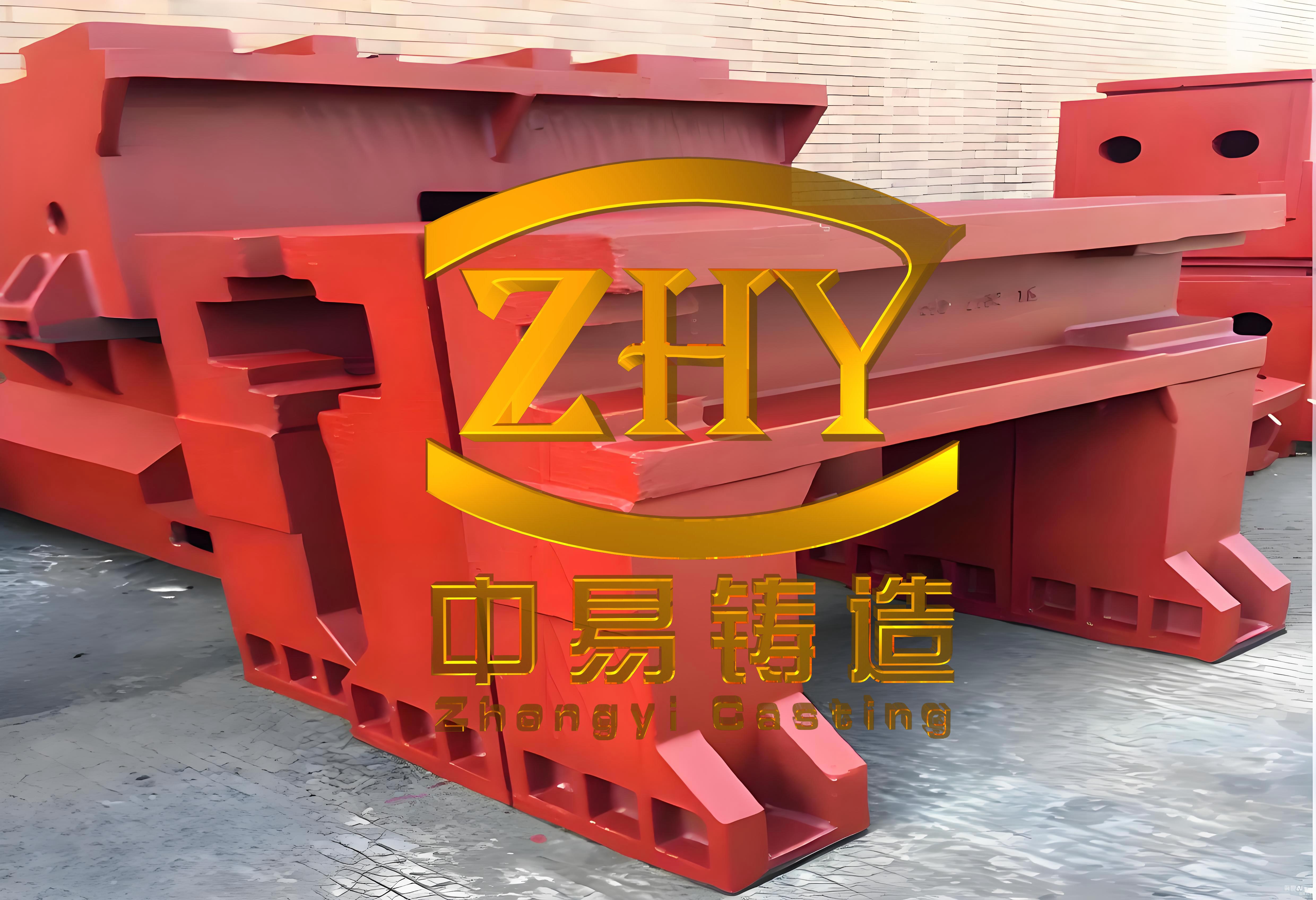
When evaluating the technical parameters of mineral machine tool castings, it is essential to compare them with traditional materials. The table below summarizes key properties, highlighting both strengths and limitations:
| Parameter | Mineral Casting | Cast Iron | Natural Granite |
|---|---|---|---|
| Density (g/cm³) | 2.30 – 2.45 | 6.6 – 7.4 | 3.0 – 4.5 |
| Compressive Strength (N/mm²) | 140 – 170 | 300 – 900 | 200 – 300 |
| Flexural Strength (N/mm²) | 25 – 45 | 100 – 300 | 20 – 30 |
| Elastic Modulus (N/mm²) | 30 – 50 | 80 – 120 | 50 – 100 |
| Thermal Conductivity (W/mK) | 1 – 3 | 40 – 50 | 2.5 – 3.5 |
| Coefficient of Thermal Expansion (10⁻⁶/K) | 10 – 20 | 10 – 15 | 5 – 7 |
| Poisson’s Ratio | 0.25 – 0.3 | 0.2 – 0.3 | 0.2 – 0.3 |
| Damping Coefficient | 0.01 – 0.02 | 0.001 – 0.002 | 0.002 – 0.003 |
From this comparison, it is evident that mineral machine tool castings have lower mechanical strengths than cast iron, but this is often compensated by designing thicker sections—typically 3 to 4 times the thickness of equivalent cast iron parts. The lower density of mineral castings results in lighter structures, which can reduce the overall weight of machine tools without sacrificing performance. Moreover, the high damping and low thermal conductivity contribute to better dynamic stability and accuracy in machine tool casting applications.
The applications of mineral machine tool castings span multiple industries, leveraging their unique properties to enhance equipment performance. In the machine tool industry, they are used in bases and frames for milling centers, lathes, and grinding machines, where precision and vibration damping are critical. For electronic and medical devices, mineral castings provide stable platforms for sensitive instrumentation, reducing errors caused by environmental factors. In aerospace and printing, their corrosion resistance and dimensional stability ensure long-term reliability. I have observed a growing adoption in these sectors, driven by the need for higher efficiency and sustainability.
To quantify the benefits, consider the cost implications of using mineral machine tool castings. The reduced machining requirements and shorter production cycles lower labor and energy costs. A simple economic model can illustrate this: $$ C_{\text{total}} = C_{\text{material}} + C_{\text{manufacturing}} + C_{\text{assembly}} $$ where $C_{\text{total}}$ is the total cost, and mineral castings often result in lower $C_{\text{manufacturing}}$ due to fewer post-processing steps. Additionally, the environmental advantages, such as minimal waste and lower emissions, align with global trends toward green manufacturing, making mineral machine tool castings a preferred choice for forward-thinking companies.
Looking ahead, the prospects for mineral machine tool castings are bright, with ongoing research focused on improving resin formulations and aggregate gradations. As industries prioritize environmental regulations and energy efficiency, the demand for these castings is expected to rise. Innovations in material science may lead to even higher strength and durability, expanding their use in heavy-duty machine tool casting applications. In my view, the integration of smart technologies, such as embedded sensors in castings, could further enhance monitoring and maintenance capabilities, paving the way for next-generation machine tools.
In conclusion, mineral casting represents a transformative approach to machine tool casting, offering a sustainable and high-performance alternative to traditional materials. Its advantages in damping, thermal stability, and design flexibility make it indispensable for modern manufacturing. As I reflect on the evolution of this technology, it is clear that mineral machine tool castings will continue to play a pivotal role in shaping the future of industrial equipment, driving progress toward more precise, efficient, and eco-friendly solutions.